Good Governance Day 2025 | UPSC Notes
Good Governance Day 2025 observed on 25 December: significance, governance reforms, Digital India, DBT for UPSC Prelims and Mains GS II, Ethics and Essay.
Dec, 2025
•6 min read
Why in the News?
Good Governance Day is observed annually in India on December 25 to commemorate the birth anniversary of Atal Bihari Vajpayee, a former Prime Minister of India. The day highlights the government’s commitment to transparent, accountable, and citizen-centric governance.
Why Cover this Topic for UPSC?
- Frequently asked in Prelims (Polity, Governance, Current Affairs)
- Direct relevance to GS Paper II – Governance, Constitution, Public Administration
- Important for GS Paper IV – Ethics in public administration
- Useful for Essay topics on democracy, governance, and leadership
Good Governance Day 2025
“The real strength of democracy lies in good governance that touches the lives of the poorest.”
Good Governance Day is observed to raise awareness about the importance of effective governance practices in promoting inclusive development, social justice, and sustainable growth. It reinforces the idea that governance should be people-oriented, ethical, and outcome-driven.
- Observed for the first time on 25 December 2014, coinciding with the birth anniversary of former Prime Minister Atal Bihari Vajpayee.
- Chosen to honour Atal Bihari Vajpayee’s vision of transparent, accountable, and inclusive governance.
- Aimed at promoting citizen-centric administration and improving the quality of public service delivery.
- Emphasises administrative reforms, innovation, and efficiency in governance processes.
- Reinforces commitment to constitutional principles such as the rule of law, accountability, and participation.
- Serves as a platform to review governance outcomes and best practices across ministries and states.
Significance of Good Governance Day
Good Governance Day serves as an important reminder that governance is the backbone of democracy and development.
- Strengthening Citizen–State Trust: By promoting transparency and accountability, Good Governance Day helps build public trust in institutions.
- Enhancing Administrative Efficiency: The day emphasises reforms aimed at improving efficiency, responsiveness, and outcome-oriented governance.
- Ensuring Inclusive and Equitable Growth: A core focus is on last-mile delivery, ensuring that welfare schemes reach marginalised and vulnerable sections without leakages.
- Promoting Rule of Law and Ethical Governance: The day highlights adherence to constitutional values, ethical conduct, and fairness, strengthening the rule of law in public administration.
- Strengthening Institutional Transparency: It encourages openness in decision-making through information sharing, digital platforms, and accountability mechanisms.
- Encouraging Performance-Based Governance: The observance promotes measurable outcomes, innovation, and best practices, shifting governance from process-oriented to results-driven models.
Also see: NITI Aayog: Composition, Functions, Objectives & Major Initiatives for UPSC Exam
What is Good Governance?
Good governance refers to the manner in which public institutions conduct public affairs, manage public resources, and guarantee the realisation of human rights while minimising corruption and ensuring accountability.
According to the World Bank, good governance is “the manner in which power is exercised in the management of a country’s economic and social resources for development”.
Key Principles of Good Governance
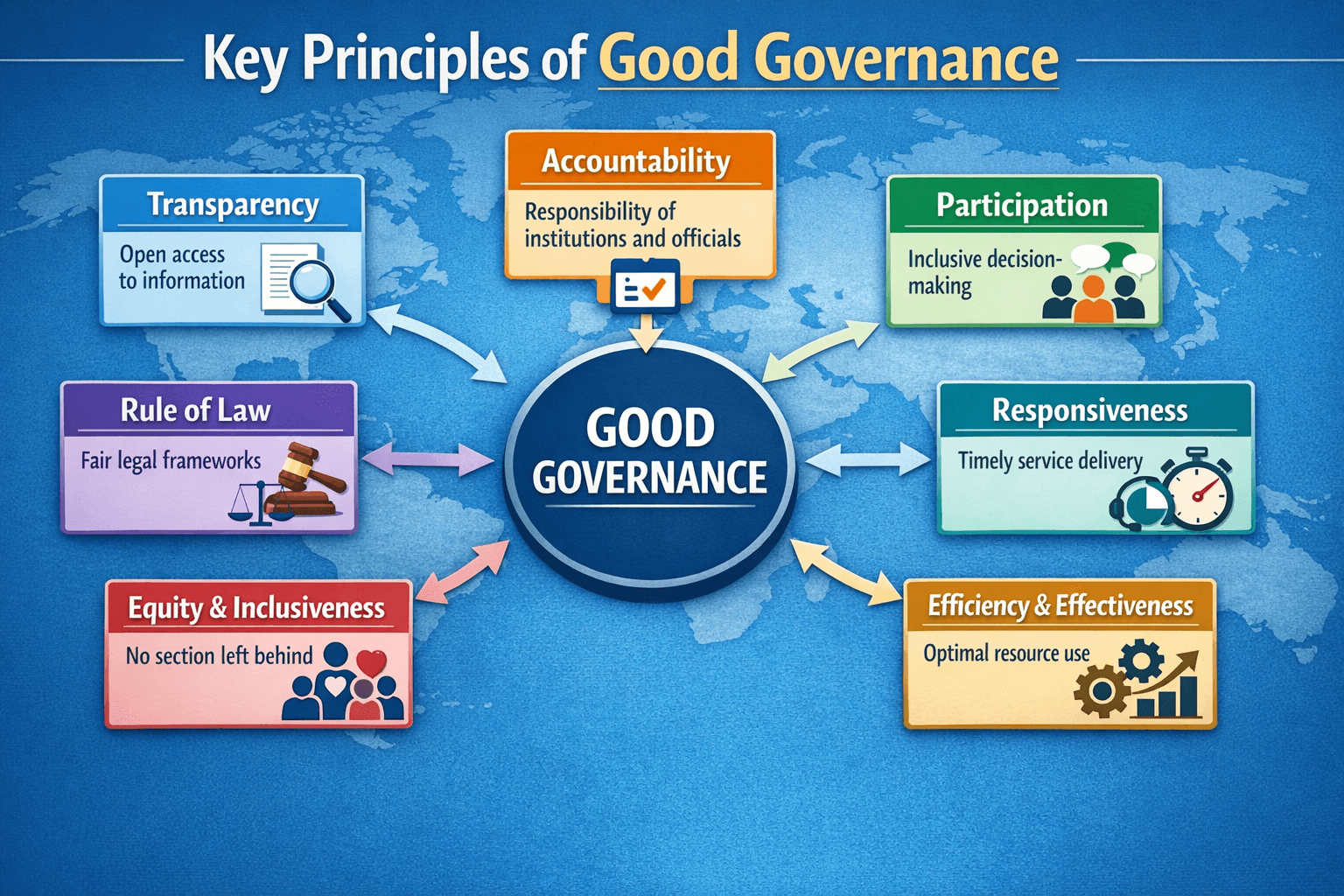
- Transparency – Open access to information
- Accountability – Responsibility of institutions and officials
- Participation – Inclusive decision-making
- Rule of Law – Fair legal frameworks
- Responsiveness – Timely service delivery
- Equity and Inclusiveness – No section left behind
- Efficiency and Effectiveness – Optimal resource use
In recent years, good governance has evolved with:
- Digital governance and e-services
- Direct Benefit Transfer (DBT)
- Minimum government, maximum governance
- Mission-mode governance
- Citizen-centric policy frameworks
Must read: Lokpal and Lokayukta: UPSC Polity Notes
UPSC Prelims PYQs on Good Governance
QUESTION 1
Consider the following
- Aarogya Setu
- CoWIN
- Digi Locker
- DIKSHA
Which of the above are built on top of open-source digital platforms?
Key Initiatives Reflecting Good Governance in India
Good Governance Day reflects India’s continuous efforts to institutionalise transparency, accountability, and citizen-centric administration through concrete governance reforms and national initiatives.
1. Digital India: Technology-Driven Governance
The Digital India Programme aims to transform India into a digitally empowered society and knowledge economy.
- Promotes e-governance and paperless administration
- Enables online access to public services such as DigiLocker, UMANG, and e-Office
- Enhances digital literacy and inclusion
- Reduces human interface, thereby minimising corruption and delays
2. Right to Information (RTI) Act, 2005: Accountable Governance.
The RTI Act empowers citizens to seek information from public authorities.
- Enhances administrative transparency
- Acts as a tool against corruption and arbitrariness
- Strengthens democratic accountability
- Encourages responsible decision-making by public officials
3. MyGov Platform: Participatory Governance
The MyGov portal enables citizens to directly engage with government policies and programmes.
- Allows feedback, suggestions, and discussions
- Facilitates crowdsourcing of ideas
- Enhances citizen participation in policymaking
- Strengthens trust between the government and citizens
4. Swachh Bharat Abhiyan: Social Transformation Governance
Launched to improve sanitation and cleanliness, Swachh Bharat Abhiyan is a major example of outcome-oriented governance.
- Focuses on behavioural change and public participation
- Improved sanitation infrastructure
- Strengthened urban and rural local governance
- Demonstrates convergence of policy, administration, and citizen action
- Links governance with health, dignity, and quality of life.
5. Direct Benefit Transfer (DBT): Welfare Governance
The DBT mechanism transfers welfare benefits directly into beneficiaries’ bank accounts.
- Reduces leakages and middlemenEnsures timely and targeted delivery
- Integrates Aadhaar, Jan Dhan, and mobile (JAM Trinity)
- Improves fiscal efficiency and trust in welfare schemes
6. PRAGATI 2.0: Responsive Governance
PRAGATI (Pro-Active Governance and Timely Implementation) 2.0 is an ICT-based platform for project monitoring.
- Enables real-time tracking of infrastructure projects
- Addresses inter-ministerial and Centre–State coordination issues
- Ensures time-bound decision-making
- Enhances accountability at the highest executive level
Additional Governance Reforms
- Good Governance Week (Prashasan Parv) (December 19 to 24, 2025) to focus on grievance redressal and service delivery
- Mission-mode programmes for focused outcomes
- Performance-based assessment of government departments
- Strengthening grievance redressal mechanisms like CPGRAMS
- Promotion of minimum government, maximum governance
Also read: DPSP UPSC Complete Notes: Articles, Classification, Features & Criticism
Case Study on Good Governance
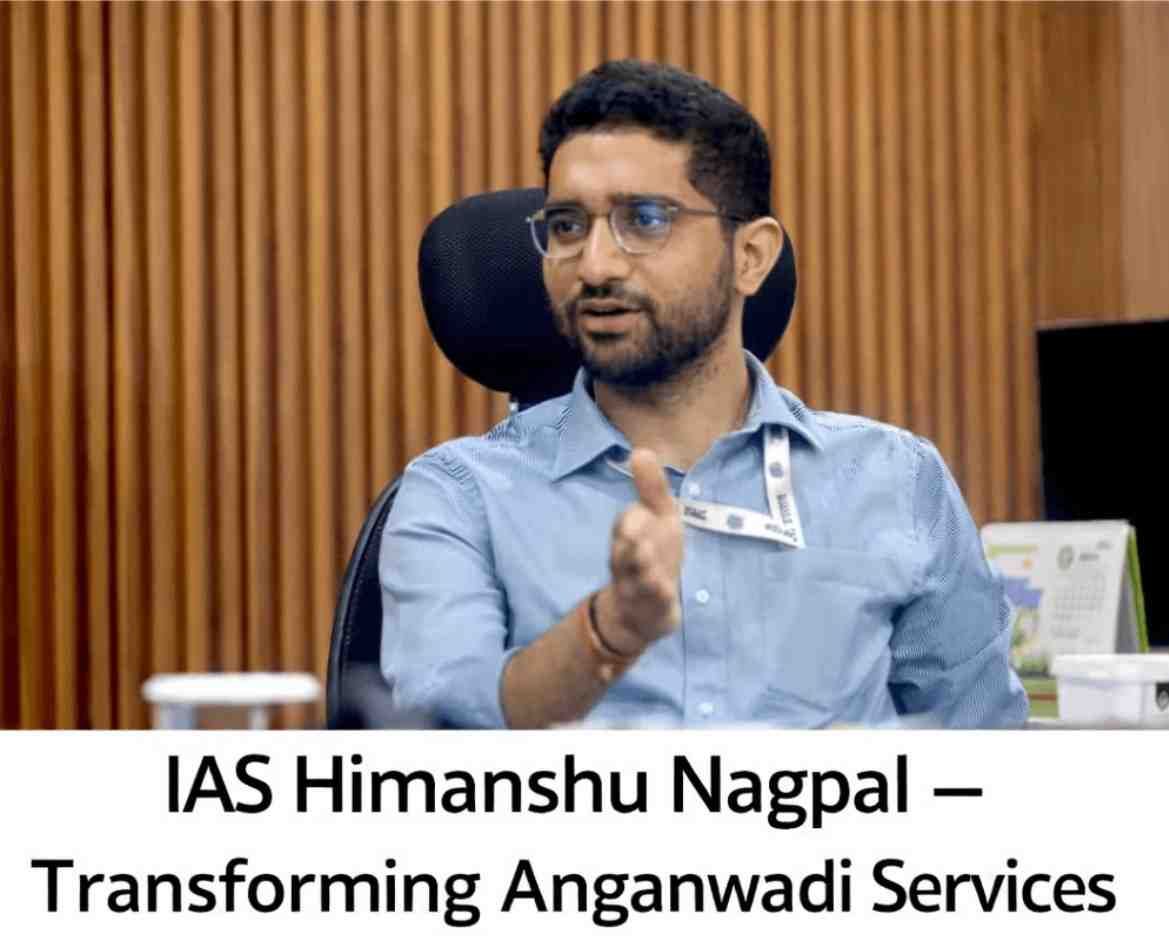
Name: Himanshu Nagpal
Service: Indian Administrative Service (IAS)
Role: District administration, Varanasi, Uttar Pradesh
He led a major public service reform under the Mission Parivartan initiative to improve early childhood development and welfare services across the district.
Context & Challenge
Anganwadi centres in Varanasi function under the Integrated Child Development Services (ICDS), were struggling with poor infrastructure, low attendance, and persistent malnutrition among young children. It is a challenge common in many districts of India.
Initiative & Governance Action
Under Nagpal Sir’s leadership:
- Rejuvenation of Anganwadi Centres: 2,382 existing centres were refurbished and improved, and 692 new centres were constructed across the district.
- Boosting Participation: Attendance of children in the centres skyrocketed from around 35% to over 80%.
- Nutrition Outcomes: The rate of malnourishment sharply declined from 7.7% to 0.12%, benefiting over 3.5 lakh children.
Key Governance Lessons
- Citizen-Centric Service Delivery: Nagpal focused on improving last-mile implementation, ensuring services reach the beneficiaries.
- Collaborative Approach: The initiative involved Anganwadi workers, communities, NGOs, and government departments, showcasing the value of participative governance.
- Data-Driven Monitoring: Regular tracking of attendance and health indicators ensured accountability and continuous improvement.
- Structural Improvement: Addressing both infrastructure gaps and behavioural issues helped convert Anganwadi centres from underused facilities into vibrant community hubs.
This example illustrates how effective governance leads to measurable social development outcomes. You can use this case study in:
- GS Paper II – Governance outcomes
- GS Paper I – Social sector development
- GS Paper IV – Ethics in public service
- Essay topics on governance and service delivery
Must read this recent development in news: MGNREGA Vs VB-G RAM G [UPSC 2025]
UPSC Mains Practice Question on Good Governance Ethics (GS Paper IV)
You are a District Magistrate facing pressure to bypass procedures for speedy project completion. How would you balance efficiency, ethics, and accountability to uphold good governance? (250 words)
Evaluate for Free!Final Words
As citizens of India, Good Governance Day 2025 reminds us that democracy thrives not only through elections but through everyday accountability and ethical governance. A transparent and responsive government is the foundation of a strong, inclusive, and progressive India.
Start your UPSC Preparation with SuperKalam
SuperKalam is your Personal AI Mentor that teaches, instantly evaluates handwritten answers & builds daily discipline. Cover 100 of % Prelims & Mains syllabus to add magic in your preparation.
Click the banner below:
Crack UPSC with your Personal AI Mentor
An AI-powered ecosystem to learn, practice, and evaluate with discipline
Download Now