Global Gender Gap Index 2026: India's Rank, WEF Data and the PLFS Paradox
India ranks 131st in the WEF Global Gender Gap Report 2026: near-parity in education and health, but economic participation and political empowerment lag.
Sep, 2026
•9 min read
Overview
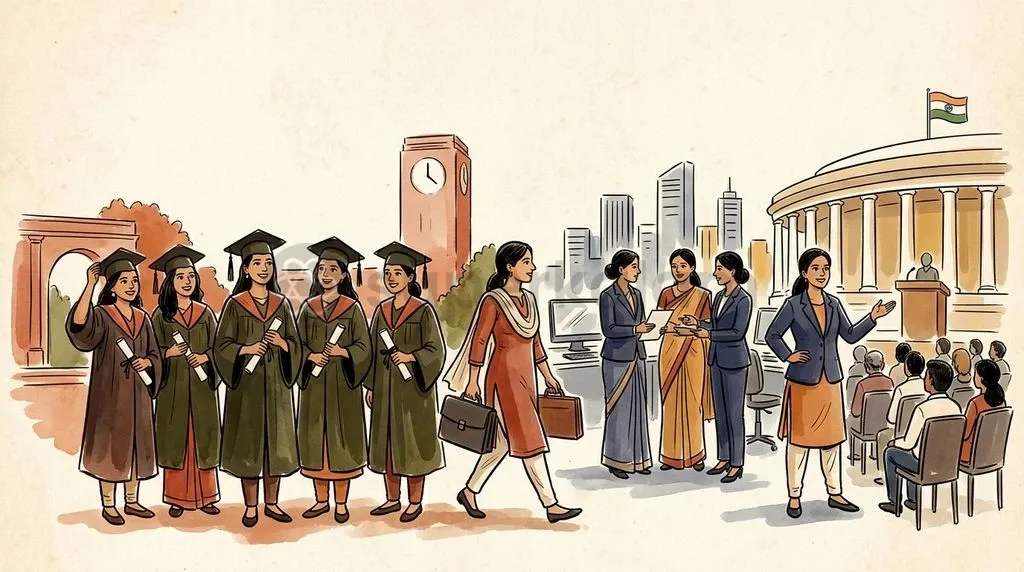
India ranks 131st out of 145 countries in the World Economic Forum's Global Gender Gap Report 2026, registering an overall parity score of 64.5%. This ranking highlights a persistent structural paradox. Near-universal educational parity sits right alongside deeply suppressed female economic engagement.
While educational attainment reached 96.6% parity, economic participation remains critically low at 41.2%. As of March 2026, this gap is further complicated by differences between international modelled estimates and domestic survey data from the Periodic Labour Force Survey. The low ranking is not just a statistical artefact. It reflects deep care-economy deficits and delayed political representation mechanisms.
Why the Global Gender Gap Report Matters
The World Economic Forum publishes the Global Gender Gap Report annually to track cross-national progress toward gender parity. Rather than measuring absolute wealth, the index benchmarks relative gaps between men and women across countries.
- Educational Attainment: Measures literacy and enrolment ratios across education tiers (India: 96.6%).
- Economic Participation and Opportunity: Evaluates workforce participation, wages, and leadership roles (India: 41.2%).
- Health and Survival: Assesses sex ratio at birth and healthy life expectancy.
- Political Empowerment: Tracks female representation in legislative and executive governance.
In the Indian Constitution, gender equality is anchored in Article 15(3), which enables affirmative action for women, and Article 39(d), which mandates equal pay for equal work. Examining international indices alongside domestic data shows whether these constitutional safeguards deliver actual economic security on the ground.
How WEF Measures Gender Parity: The Four Key Pillars
The Global Gender Gap Index assesses national gender disparities across four core sub-indices on a scale from 0 (complete imparity) to 1 (complete parity). The framework focuses entirely on female-to-male ratios rather than absolute living standards.
| Sub-Index | Key Indicators Measured | Scale Range | India's Performance Context |
|---|---|---|---|
| Educational Attainment | Literacy rates, enrolment across primary, secondary, and tertiary education | 0.0 to 1.0 | Scores 96.6% parity, achieving near-universal enrolment balance across higher education levels. |
| Economic Participation & Opportunity | Labour force participation, wage equality for similar work, estimated earned income, senior leadership roles | 0.0 to 1.0 | Scores 41.2% parity, remaining one of the lowest scoring sub-indices globally. |
| Health and Survival | Sex ratio at birth, healthy life expectancy | 0.0 to 1.0 | Suppressed primarily by long-standing historical deficits in the sex ratio at birth. |
| Political Empowerment | Female representation in parliament, ministerial positions, years with a female head of state | 0.0 to 1.0 | Reflects past historic female premiership but constrained by contemporary legislative representation. |
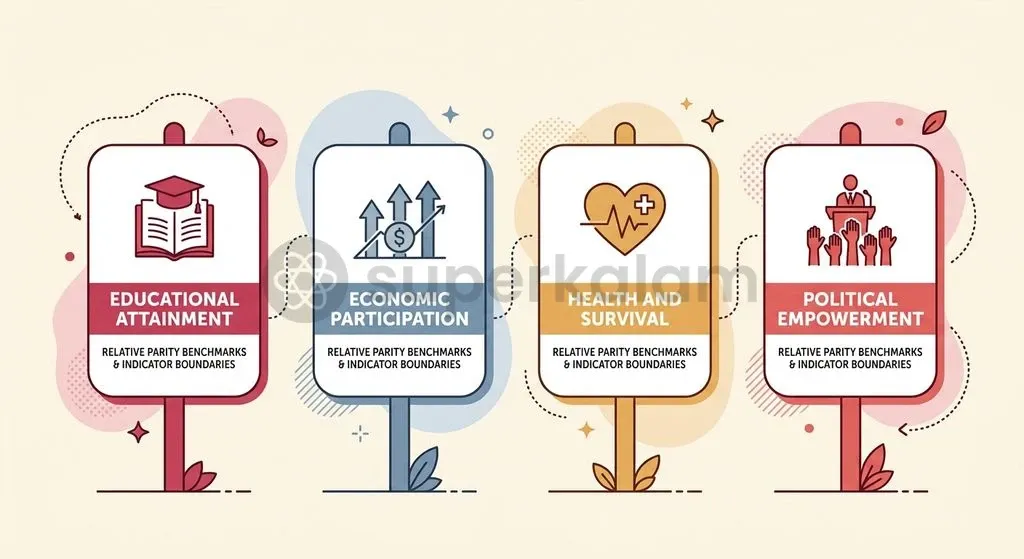
By tracking changes across these four distinct pillars, the framework isolates structural bottlenecks in policy implementation from broader macroeconomic growth trends.
Discuss with Superkalam
What are the four core sub-indices measured by the World Economic Forum to calculate the Global Gender Gap Index?
Ask NowIndia's Performance: Educational Parity vs Economic Reality
Recent Economic Surveys documented that India faces a pronounced feminisation U-curve. Expanding educational access has not yet generated commensurate formal employment.
- Subsistence Phase (Left of U-curve): High female participation driven by distress agricultural and unpaid family labour.
- Transition Trough (India's Current Stage): Rising household incomes lead families to withdraw women from manual labour to signal social mobility, while care burdens persist.
- Advanced Growth (Right of U-curve): High educational attainment and structural service-sector expansion draw women back into formal, well-paid employment.
India achieved near-universal parity in secondary and tertiary educational enrolment in the 2026 WEF index, recording an Educational Attainment score of 96.6%. Girls now match or outpace boys in gross enrolment across colleges and universities. This shift reflects the cumulative impact of targeted state incentives.
Economic participation presents a stark contrast with a parity score of 41.2%, leaving India among the lowest-ranked nations on this metric. Educated women often exit the workforce after marriage or encounter a shortage of formal white-collar jobs. This structural bottleneck keeps the economy trapped in the trough of the U-curve.
Discuss with Superkalam
How does the difference between Usual Status (365 days) and Current Weekly Status (7 days) explain the gap between domestic PLFS data and international labour models?
Ask NowThe Data Disconnect: Reconciling WEF Rankings with PLFS Data
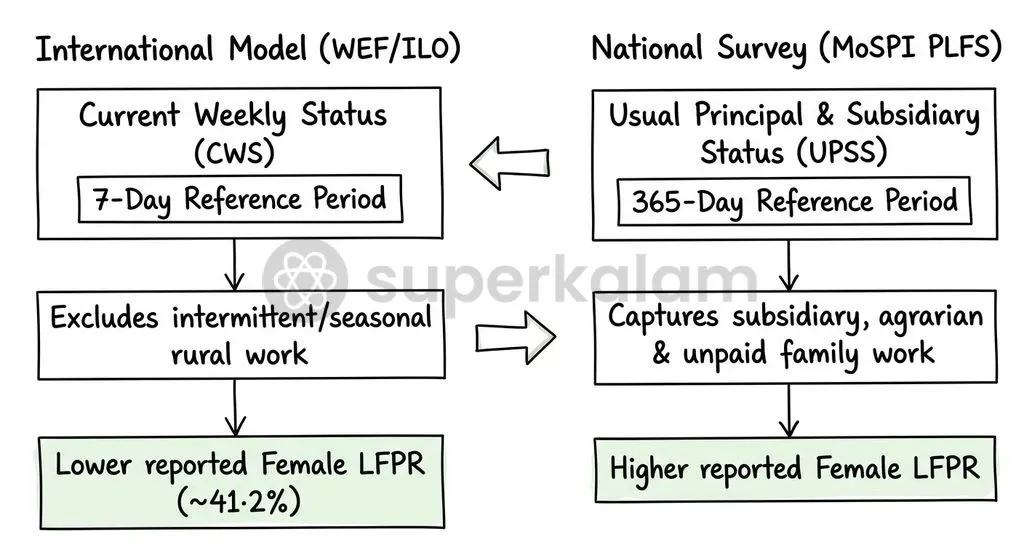
India's domestic data presents a different picture of female workforce engagement. The Periodic Labour Force Survey 2023-24 reported that female labour force participation reached 41.7% under Usual Status definitions.
| Dimension | Domestic Metric: PLFS (MoSPI) | Global Metric: WEF / ILO |
|---|---|---|
| Measurement Framework | Usual Principal and Subsidiary Status (ps+ss) | Current Weekly Status (CWS) |
| Reference Window | 365 days (captures work done for 30+ days) | 7 days (short recall window) |
| Economic Activities Captured | Seasonal agriculture, rural household enterprises, unpaid family work | Continuous, formal waged and salaried employment |
| Headline Result | 41.7% FLFPR (2023-24) | 41.2% parity score (2026 Report) |
The divergence between these two measures stems from specific methodological choices:
- Reference Period Differences: The PLFS uses the Usual Status (ps+ss) approach over 365 days, whereas ILO modelled estimates apply a 7-day recall window.
- Capture of Rural and Seasonal Labour: The Usual Status framework captures seasonal farm work and unpaid family labour, which constitute the bulk of female economic output in India.
- Urban-Centric Bias of Global Models: International models tend to treat intermittent home-based economic contributions as non-work.
While PLFS confirms rising economic activity, much of it remains concentrated in rural, informal agriculture. Greater participation has not yet translated into high-wage formal employment.
Discuss with Superkalam
If an industrial unit grows to employ 60 workers, what statutory care facility is required under the Maternity Benefit (Amendment) Act, 2017, and what challenges hinder its compliance?
Ask NowMethodological Critiques of the WEF Gender Gap Framework
The World Economic Forum truncates all indicator ratios at 1.0, penalising female deficits without crediting female-favourable imbalances. This design measures progress toward parity rather than women's empowerment beyond male levels.
This capping mechanism creates clear analytical distortions:
- Asymmetrical Penalty Structure: A country where female tertiary enrolment exceeds male enrolment receives a maximum score of 1.0. This surplus cannot offset severe deficits in wage parity or political representation.
- Reliance on Standardised Proxies: The WEF relies on third-party international models rather than primary national data releases, causing lags in reflecting policy shifts.
- Insensitivity to Local Economic Structures: The index prioritises formal corporate boards and salaried positions, ignoring community-level leadership in Self-Help Groups (SHGs) and Panchayati Raj institutions.
Understanding these methodological boundaries allows analysts to evaluate the index objectively without dismissing the genuine structural gaps it highlights.
What Drives India's Low Female Labour Force Participation?
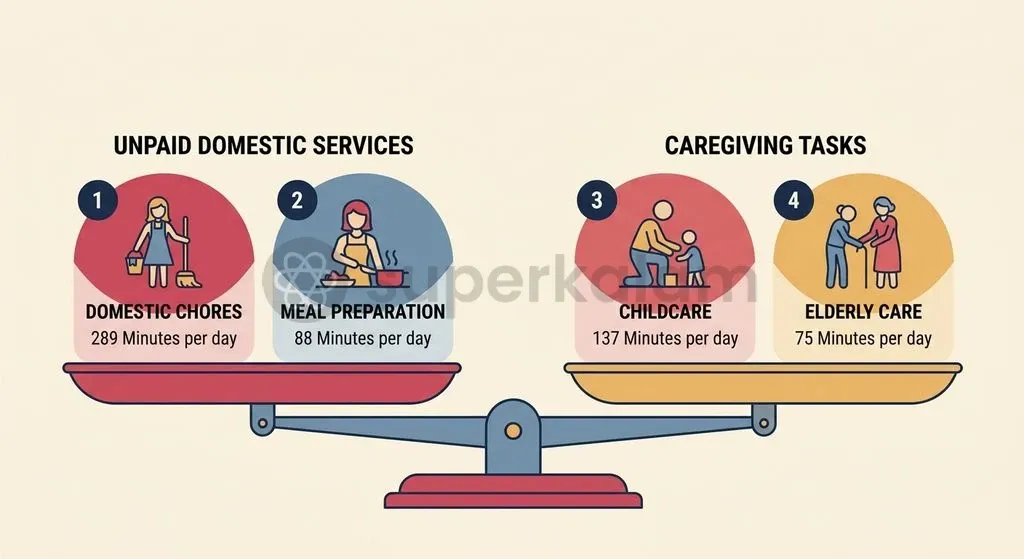
The Time Use Survey 2024 revealed that Indian women carry an overwhelming burden of unpaid domestic and caregiving duties. This time poverty limits their ability to enter and sustain formal paid employment.
| Activity Type (Time Use Survey 2024) | Women's Daily Time | Men's Daily Time |
|---|---|---|
| Unpaid Domestic Services | 289 minutes/day | 88 minutes/day |
| Unpaid Caregiving (Children/Elderly) | 137 minutes/day | 75 minutes/day |
According to the Time Use Survey 2024, women spend 289 minutes per day on unpaid domestic services, over three times the 88 minutes spent by men.
Four primary factors suppress female workforce engagement:
- Care-Economy Deficits: Working mothers face a severe shortage of affordable crèche facilities. While the Maternity Benefit (Amendment) Act, 2017 mandates crèches in establishments with 50+ workers, informal compliance remains low.
- Public Safety and Transit Friction: Inadequate and poorly lit transport options restrict women's job searches to hyper-local areas, curtailing geographic mobility.
- Informalisation and Wage Penalties: Women remain heavily concentrated in informal jobs without social security, statutory wage protections, or paid leave.
- Social Norms and Income Elasticity: As family incomes rise, households often withdraw women from manual labour to signal higher social status.
Discuss with Superkalam
Analyse the socio-economic factors that cause female workforce participation to decline in the trough phase of the feminisation U-curve despite gains in literacy.
Ask NowGovernment Interventions and Institutional Reforms
Parliament enacted the Constitution (106th Amendment) Act, 2023, known as the Nari Shakti Vandan Adhiniyam, to reserve 33% of seats for women in the Lok Sabha and State Legislative Assemblies.
- Legislative Enactment: The Act was passed in 2023, mandating a 33% seat quota for women.
- Statutory Implementation Condition: The reservation takes effect only after a delimitation exercise following the first post-enactment census.
- Current Composition: Women hold 13.6% of seats (74 of 543) in the 18th Lok Sabha, down from 14.4% (78 seats) in the 17th Lok Sabha.
- International Index Lag: India's Political Empowerment score will reflect an implementation lag until delimitation operationalises the quota.
Beyond legislative representation, policy and fiscal interventions include:
- Gender Budgeting Expansion: Allocations reached ₹3.10 lakh crore in Union Budget 2024-25, accounting for 6.5% of total budgetary expenditure.
- Enterprise Capitalisation: The Pradhan Mantri MUDRA Yojana (PMMY) has disbursed over 68% of its total loans to women entrepreneurs.
- Statutory Protections for Non-Standard Labour: The Code on Social Security, 2020 recognises gig and platform workers, establishing a legal framework for social security and maternity coverage.
Discuss with Superkalam
Evaluate whether capping gender indicators at 1.0 in global parity indices offers an accurate assessment of developing nations' structural policy progress.
Ask NowWay Forward: Beyond Metrics to Substantive Economic Agency
NITI Aayog policy frameworks emphasise that closing gender gaps requires expanding care infrastructure, securing non-standard employment, and enforcing rigorous gender budgeting across administrative levels.
Key policy priorities include:
- Formalising the Care Economy: Establish state-supported public crèche networks through public-private partnerships to distribute caregiving burdens.
- Enforcing Workplace Social Security: Expedite rules under the Code on Social Security, 2020 to guarantee paid maternity leave and crèche support for gig and informal workers.
- Strengthening Gender Budget Auditing: Implement mandatory, third-party outcome audits for both Part A and Part B gender budget schemes.
- Urban Infrastructure and Safe Mobility: Invest in well-lit transit routes, concessionary travel passes, and safe working women's hostels in commercial hubs.
- Accelerating Enterprise Value-Addition: Transition women-led Self-Help Groups into formal producer enterprises linked to public procurement and export channels.
Key Takeaways
- India ranked 131st out of 145 countries with an overall score of 64.5% (0.645) in the WEF Global Gender Gap Index 2026.
- India achieved near-universal gender parity in Educational Attainment (96.6%), but registered a severe deficit in Economic Participation and Opportunity (41.2%).
- Domestic data from the Periodic Labour Force Survey 2023-24 places the female labour force participation rate at 41.7% under the Usual Status (ps+ss) framework, diverging from the WEF's narrower weekly status models.
- The Time Use Survey 2024 highlights deep domestic imbalances, with women spending 289 minutes per day on unpaid household work compared to 88 minutes spent by men.
- The Constitution (106th Amendment) Act, 2023 mandates a 33% legislative reservation for women, but its linkage to a post-census delimitation exercise defers its immediate impact on female parliamentary representation, which sits at 13.6% in the 18th Lok Sabha.
Mains Question
'Near-universal educational parity sits right alongside deeply suppressed female economic engagement.' In light of the Global Gender Gap Report 2026 and PLFS data, critically examine the structural and methodological dimensions of India's gender paradox. (15 Marks)
Evaluate NowMains Question
Highlighting the provisions of the Nari Shakti Vandan Adhiniyam and Gender Budgeting initiatives, evaluate the efficacy of institutional mechanisms in overcoming gender disparities in India. (10 Marks)
Evaluate NowPractice MCQs
QUESTION 1
Consider the following statements regarding the methodological framework of the World Economic Forum's Global Gender Gap Index:
- The index measures absolute living standards and national income levels rather than female-to-male ratios.
- All indicator ratios are truncated at 1.0, penalising female deficits without crediting female-favourable imbalances.
- It tracks disparities across four core sub-indices: Educational Attainment, Economic Participation and Opportunity, Health and Survival, and Political Empowerment.
Which of the statements given above are correct?
QUESTION 2
With reference to female workforce measurement in India, consider the following statements:
- The Periodic Labour Force Survey (PLFS) uses the Usual Principal and Subsidiary Status (ps+ss) framework with a 365-day reference window.
- International modelled estimates by the ILO/WEF primarily adopt a Current Weekly Status approach with a 7-day recall window.
- PLFS 2023-24 reported India's female labour force participation rate at 41.7% under Usual Status definitions.
Which of the statements given above is/are correct?
QUESTION 3
Consider the following statements regarding statutory and constitutional provisions for women in India:
- Article 15(3) enables affirmative action for women, while Article 39(d) mandates equal pay for equal work.
- The Constitution (106th Amendment) Act, 2023 mandates a 33% reservation for women in Lok Sabha with immediate effect from the 18th Lok Sabha.
- The Maternity Benefit (Amendment) Act, 2017 mandates crèche facilities in establishments employing 50 or more workers.
Which of the statements given above is/are correct?
QUESTION 4
In the context of female labour force dynamics discussed in recent Economic Surveys, which of the following best describes India's position in the 'feminisation U-curve'?
QUESTION 5
Consider the following statements regarding the Time Use Survey 2024 and recent fiscal allocations:
- The Time Use Survey 2024 recorded that Indian women spend 289 minutes per day on unpaid domestic services compared to 88 minutes by men.
- Gender Budgeting allocations in Union Budget 2024-25 stood at ₹3.10 lakh crore, representing 6.5% of total budgetary expenditure.
Which of the statements given above is/are correct?