Gandhi’s 1922 Sedition Trial: Section 124A IPC, Broomfield, and Free Speech
When Gandhi pleaded guilty to sedition in 1922, he forced colonial law to confront its moral illegitimacy—a dilemma central to modern Indian free speech debates.
Oct, 2026
•10 min read
Context
Mahatma Gandhi’s 1922 sedition trial before the Ahmedabad Sessions Court transformed a colonial penal instrument into an indictment of imperial rule. By pleading guilty under Section 124A of the Indian Penal Code, Gandhi highlighted the breach between colonial legality and ethical duty. The proceedings demonstrated that colonial penal law could punish political dissent, yet could never command personal loyalty.
According to records preserved by the Bombay High Court, the trial established a defining precedent for non-violent resistance across the globe. For modern constitutional jurisprudence, this confrontation remains a foundational study in state authority, statutory coercion, and freedom of expression.
Why Gandhi's 1922 Trial Matters Today
The sedition trial of Mahatma Gandhi provides the historical benchmark for scrutinising free-speech jurisprudence in India. As of March 2025, debates surrounding the criminalisation of anti-state expression remain vital as Indian courts balance state security against civil liberties.
Gandhi’s courtroom stance severed statutory legality from moral legitimacy. Under British colonial rule, the legal framework demanded obedience irrespective of government conduct. By asserting that affection cannot be manufactured, Gandhi established that a citizen’s allegiance to a political regime must be earned through just governance rather than compelled through penal sanctions.
For civil services aspirants, this case bridges several key syllabus dimensions:
- Modern Indian History: The structural crisis of the Non-Cooperation Movement and colonial judicial policy.
- Constitutional Governance: The evolution of Section 124A of the Indian Penal Code, judicial interpretation, and democratic dissent.
- Ethics and Integrity: The moral dilemma of civil disobedience, professional legal responsibility, and adherence to individual conscience.
Discuss with Superkalam
Which three articles published in Young India formed the basis of the colonial state's sedition charges against Gandhi in 1922?
Ask NowThe Backdrop: Non-Cooperation, Chauri Chaura, and Young India
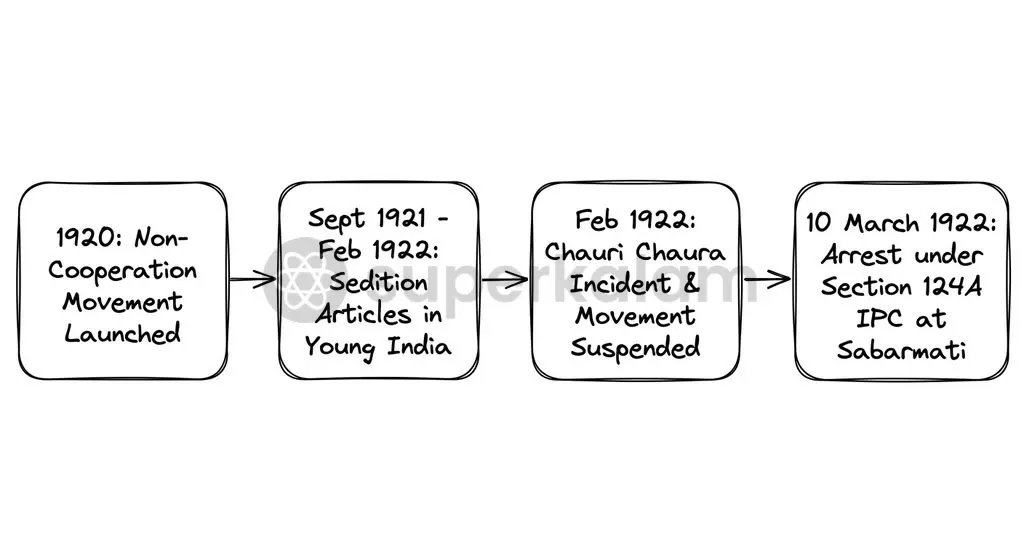
The political setting before Gandhi's arrest turned on the abrupt suspension of the nationwide Non-Cooperation Movement. The anti-colonial campaign had mobilised millions across British India through coordinated boycotts of foreign cloth, courts, and educational institutions.
However, violent clashes at Chauri Chaura prompted Gandhi to halt the agitation abruptly. Holding that a non-violent struggle could not tolerate bloodshed, he convinced the Congress Working Committee to suspend mass civil disobedience.
Colonial authorities viewed this retreat as strategic vulnerability. Convinced that Gandhi’s mass influence had waned, the British administration executed his arrest on 10 March 1922 at Sabarmati Ashram.
The colonial government based its prosecution on Gandhi’s writings in his weekly journal, Young India. Three specific essays formed the foundation of the state's sedition charge:
- 'Tampering with Loyalty' (published on 29 September 1921): Argued that Indian soldiers and civil servants were under no moral obligation to serve an unjust imperial administration.
- 'The Puzzle and Its Solution' (published on 15 December 1921): Challenged Lord Reading’s viceregal authority and affirmed the national resolve to pursue self-rule.
- 'Shaking the Manes' (published on 23 February 1922): Warned the British Empire that threats of state force would not extinguish Indian aspirations for freedom.
The Legal Charge: How Section 124A IPC Was Used Against Gandhi
Colonial authorities prosecuted Mahatma Gandhi and his publisher Shankarlal Banker under Section 124A of the Indian Penal Code. Section 124A criminalised attempts to excite disaffection against the Government established by law in British India.
The provision possessed a long legislative history designed to preserve imperial hegemony:
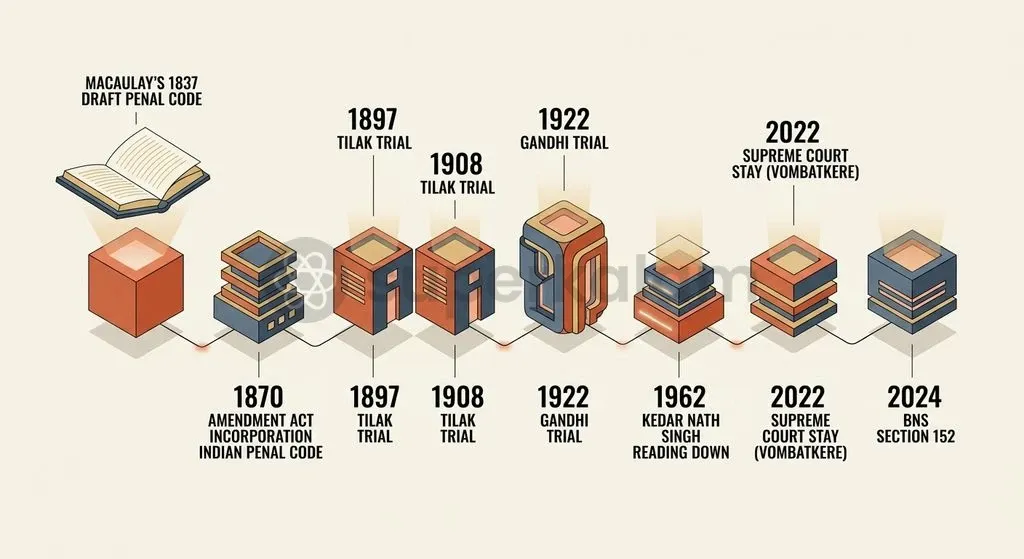
- Original Drafting: Thomas Babington Macaulay initially drafted the sedition clause as Clause 113 of the 1837 Draft Penal Code.
- Omission in 1860: The colonial government inadvertently left the clause out when enacting the Indian Penal Code in 1860.
- Statutory Insertion: The provision entered the Indian Penal Code through the Indian Penal Code (Amendment) Act, 1870 (Act XXVII of 1870), piloted by Sir James Fitzjames Stephen.
In nineteenth-century practice, colonial magistrates interpreted the statute broadly. The law did not require proof of actual violence or incitement to riot.
Expressing dissatisfaction with imperial authority was sufficient to secure a conviction. Gandhi recognised this design, terming Section 124A the prince among political sections engineered to crush political autonomy.
Discuss with Superkalam
How did Justice Arthur Strachey's 1897 definition of 'disaffection' lower the threshold for criminalising speech under Section 124A IPC?
Ask NowInside the Courtroom: The Great Trial of March 18, 1922
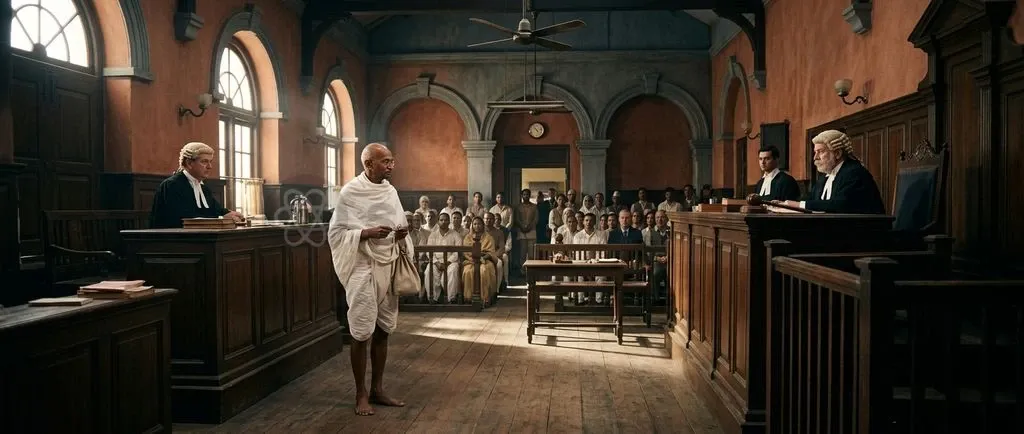
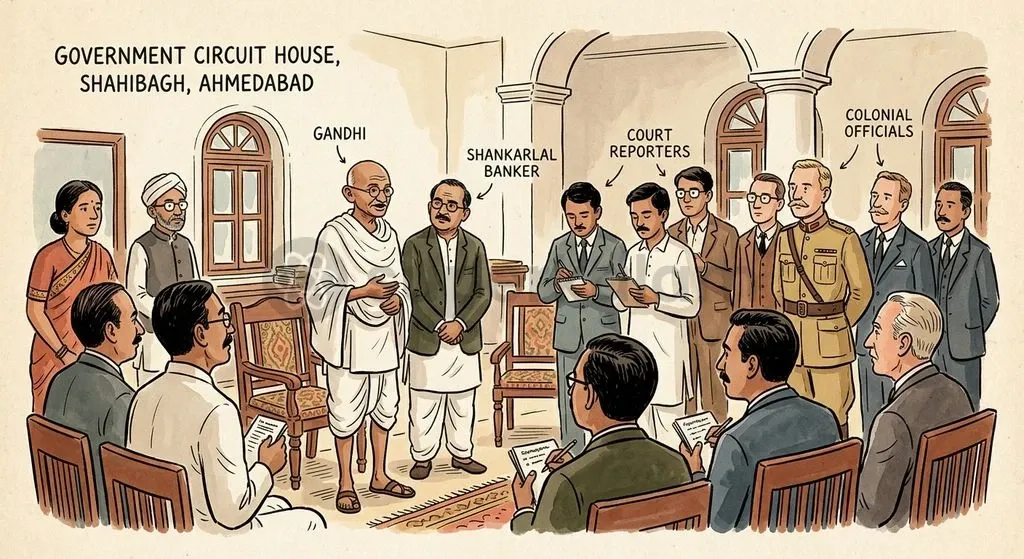
District and Sessions Judge C. N. Broomfield presided over the trial on 18 March 1922 at the Government Circuit House in Shahibagh, Ahmedabad. The colonial administration treated the courtroom as a security zone, fearing popular unrest.
The trial moved with remarkable speed. When the court read out the charges under Section 124A of the Indian Penal Code, both Mahatma Gandhi and Shankarlal Banker pleaded guilty on all counts.
The courtroom proceedings turned on two sharply opposing legal strategies:
- The Crown's Accusation: Advocate-General Sir Thomas Strangman argued that despite Gandhi’s non-violent preachings, his published writings stirred public disloyalty. Strangman contended that Gandhi’s articles caused violent outbreaks in Bombay and Chauri Chaura, urging the bench to deliver an exemplary sentence.
- Gandhi's Capitulation on Facts: Rather than disputing the factual claims, Gandhi endorsed the prosecution's narrative. He admitted that he preached disaffection and accepted moral responsibility for mass unrest.
By offering no legal defence, Gandhi shifted the trial from a statutory dispute into an examination of imperial legitimacy.
Gandhi's Historic Statement: 'Affection Cannot Be Manufactured by Law'
Gandhi delivered an unsparing oral statement to explain his decision to plead guilty. He traced his personal evolution from an ardent supporter of the British Empire during the Boer War to an uncompromising non-cooperator.
Punjab atrocities, the Jallianwala Bagh massacre, and the economic exploitation of Indian villagers had convinced him that imperial rule was destructive. Gandhi then framed the philosophical core of non-violent dissent:
"Affection cannot be manufactured or regulated by law. If one has no affection for a person or system, one should be free to give the fullest expression to his disaffection, so long as he does not contemplate, promote, or incite to violence."
Gandhi asserted that non-cooperation with evil was as much an ethical obligation as cooperation with good. He presented the presiding judge with a sharp moral dilemma:
- Judicial Resignation: If the judge believed the colonial system was inherently unjust, he was morally bound to resign from the bench.
- Maximum Penalty: If the judge believed the imperial administration was beneficial, he had to inflict the severest possible sentence.
This stance inverted classical legal conventions. Gandhi accepted physical punishment while denying the moral authority of the statute used against him.
Discuss with Superkalam
If Gandhi's principle that 'affection cannot be manufactured by law' is applied to modern free speech jurisprudence, where should the legal boundary between lawful political dissent and state security be drawn?
Ask NowThe Verdict: Judge C.N. Broomfield's Dilemma and the Six-Year Sentence
Judge C. N. Broomfield faced the complex task of sentencing a defendant whose moral stature he openly acknowledged. In delivering his judgment, Broomfield admitted that in the eyes of millions of his countrymen, Gandhi was a great leader of high ideals and noble character.
Broomfield observed that his judicial duty was strictly confined to applying the statutory law of the land. He noted that even men of noble character had to face penal consequences when violating criminal statutes:
- The Sentence: Broomfield sentenced Gandhi to six years of simple imprisonment.
- Sentencing Structure: The court imposed two years of simple imprisonment for each of the three Young India articles, ordering the terms to run consecutively.
- Executive Leniency: Broomfield remarked that if the government later reduced the sentence due to altered political conditions, no one would be more pleased than the judge himself.
Gandhi accepted the sentence with gratitude, noting that the penalty was as light as any colonial judge could deliver. He was transferred to Yerwada Central Jail to serve his term.
Gandhi served nearly two years before the government ordered his unconditional release on 5 February 1924 on medical grounds following an emergency appendectomy.
Bal Gangadhar Tilak and Gandhi: How British Sedition Precedent Evolved
Judge Broomfield explicitly modelled Gandhi’s six-year sentence on the judicial precedent established in the 1908 trial of Bal Gangadhar Tilak under Section 124A. The British Raj repeatedly deployed sedition law to silence prominent nationalist leaders.
Tilak had faced two separate trials under Section 124A of the Indian Penal Code:
- The 1897 Trial: In Queen-Empress v. Bal Gangadhar Tilak, Justice Arthur Strachey of the Bombay High Court expansively defined "disaffection" as simply the absence of affection. This ruling equated the mere lack of emotional loyalty toward the Crown with criminal sedition.
- The 1908 Trial: Justice Dinshaw Davar tried Tilak for his Kesari editorials regarding the Muzaffarpur bombing. Davar sentenced Tilak to six years' transportation to Mandalay.
The table below contrasts the application of Section 124A across these two historical trials:
| Feature / Dimension | Bal Gangadhar Tilak's Trial (1908) | Mahatma Gandhi's Trial (1922) |
|---|---|---|
| Presiding Judge | Justice Dinshaw Davar (Bombay High Court) | Judge C. N. Broomfield (Ahmedabad Sessions) |
| Publications Charged | Editorials in the Marathi weekly Kesari | Three articles in the English weekly Young India |
| Legal Plea | Pleaded not guilty; offered an aggressive legal defence | Pleaded guilty; offered no defence on legal facts |
| Sentencing Benchmark | Six years' transportation to Mandalay | Six years' simple imprisonment, modelled directly on Tilak |
| Judicial Attitude | Hostile; denounced Tilak’s political writings | Courteous; praised Gandhi’s personal character |
| Philosophical Focus | Political rights and constitutional press freedom | Moral duty to resist systemic injustice non-violently |
Discuss with Superkalam
Analyse the ethical dilemma faced by Judge C.N. Broomfield between executing statutory obligations and acknowledging the moral integrity of the accused.
Ask NowConstitutional and Ethical Takeaways for Modern India
Gandhi’s 1922 trial offers direct insights for modern debates on constitutional free expression and state authority. The tension between criminalising disloyalty and protecting political speech has evolved significantly through independent India's jurisprudence.
In Kedar Nath Singh v. State of Bihar (1962), a five-judge Constitution Bench of the Supreme Court upheld the constitutional validity of Section 124A of the Indian Penal Code. To protect the fundamental right to free speech under Article 19(1)(a), the court read down Section 124A. The bench ruled that comments showing disapprobation toward the government do not constitute sedition unless accompanied by incitement to violence or public disorder.
However, colonial-era sedition provisions faced continued scrutiny due to allegations of misuse against political dissenters:
- Judicial Abeyance (2022): On 11 May 2022, the Supreme Court of India ordered in S.G. Vombatkere v. Union of India that Section 124A of the Indian Penal Code be kept in abeyance. The court directed all central and state governments to refrain from registering fresh cases under the provision.
- Law Commission Position (2023): In April 2023, the 22nd Law Commission of India released its 279th Report, titled Usage of the Law of Sedition. The Commission recommended retaining the offence of sedition with procedural safeguards, while proposing an increase in the minimum punishment to seven years.
- Bharatiya Nyaya Sanhita (2023): On 1 July 2024, the Bharatiya Nyaya Sanhita, 2023, replaced the Indian Penal Code. The new criminal code omitted the term "sedition" and introduced Section 152, which penalises acts endangering the sovereignty, unity, and integrity of India.
- Statutory Safeguards: Section 152 of the Bharatiya Nyaya Sanhita contains an explicit Explanation. It clarifies that comments expressing disapproval of administrative actions without exciting secession, rebellion, or subversive violence do not constitute an offence.
From an ethical perspective, Gandhi’s trial provides a foundational text on civil disobedience. By accepting criminal consequences, Gandhi demonstrated that satyagraha does not evade the rule of law. Instead, it accepts state-imposed punishment to reveal the moral inadequacy of unjust statutes.
Discuss with Superkalam
Evaluate whether Gandhi's tactic of pleading guilty without mounting a legal defence was more effective at delegitimising colonial rule than a conventional courtroom contest would have been.
Ask NowKey Takeaways
- The Historic Date: Mahatma Gandhi was tried on 18 March 1922 before Judge C. N. Broomfield at the Government Circuit House in Ahmedabad under Section 124A of the Indian Penal Code.
- The Charged Articles: The sedition charges were based on three Young India articles: 'Tampering with Loyalty', 'The Puzzle and Its Solution', and 'Shaking the Manes'.
- The Ethical Plea: Gandhi pleaded guilty, describing Section 124A as the prince among political sections designed to suppress citizen liberty, and declared that affection cannot be manufactured by law.
- The Sentence: Judge Broomfield sentenced Gandhi to six years of simple imprisonment, modelled on Bal Gangadhar Tilak’s 1908 sedition sentence, before Gandhi's early release on health grounds in 1924.
- Modern Legal Evolution: The Supreme Court placed Section 124A in abeyance in May 2022 (S.G. Vombatkere), leading to the Bharatiya Nyaya Sanhita, 2023, which omitted the term sedition and enacted Section 152 to protect national integrity.
Mains Question
"Affection cannot be manufactured or regulated by law. If one has no affection for a person or system, one should be free to give the fullest expression to his disaffection, so long as he does not contemplate, promote, or incite to violence." In the context of Mahatma Gandhi's 1922 trial, elucidate how non-violent dissent exposed the divergence between statutory legality and moral legitimacy. (10 Marks)
Evaluate NowMains Question
Section 124A of the Indian Penal Code was characterised by Mahatma Gandhi as 'the prince among political sections' designed to suppress political autonomy. Critically analyse the evolution and colonial application of sedition law with reference to the trials of Bal Gangadhar Tilak and Mahatma Gandhi. (15 Marks)
Evaluate NowPractice MCQs
QUESTION 1
With reference to the legislative evolution of Section 124A of the Indian Penal Code, consider the following statements:
- It was originally drafted by Thomas Babington Macaulay as Clause 113 of the 1837 Draft Penal Code.
- It was omitted when the Indian Penal Code was initially enacted in 1860.
- It was inserted into the Indian Penal Code via an amendment act in 1870 piloted by Sir James Fitzjames Stephen. Which of the statements given above are correct?
QUESTION 2
Regarding the prosecution of Mahatma Gandhi under Section 124A IPC in 1922, consider the following statements:
- The charges were based on three articles authored by Gandhi in his weekly journal Young India.
- In the essay 'Tampering with Loyalty', Gandhi maintained that Indian soldiers and civil servants had no moral obligation to serve an unjust imperial administration.
- Gandhi and his publisher Shankarlal Banker pleaded not guilty, choosing to mount a rigorous legal defence against the Crown's charges. Which of the statements given above is/are correct?
QUESTION 3
Consider the following statements regarding the 1922 trial of Mahatma Gandhi before District and Sessions Judge C. N. Broomfield:
- Judge Broomfield sentenced Gandhi to six years of simple imprisonment, structured as three consecutive two-year terms.
- The sentence was explicitly patterned on the judicial precedent established in the 1908 trial of Bal Gangadhar Tilak.
- Gandhi completed the entirety of the six-year prison sentence in Yerwada Central Jail. Which of the statements given above is/are correct?
QUESTION 4
In Queen-Empress v. Bal Gangadhar Tilak (1897), how did Justice Arthur Strachey interpret the term 'disaffection' under Section 124A of the Indian Penal Code?
QUESTION 5
With reference to the political developments surrounding Mahatma Gandhi's arrest in March 1922, consider the following statements:
- Gandhi was arrested at Sabarmati Ashram following his decision to halt the Non-Cooperation Movement after violent clashes at Chauri Chaura.
- The prosecution was led by Advocate-General Sir Thomas Strangman, who argued that Gandhi's writings incited unrest in Bombay and Chauri Chaura. Which of the statements given above is/are correct?