Frontier AI Safety: Global Compute Governance, EU AI Act, and India's Strategy
As global regulators race to govern high-compute foundation models, India balances sovereign deep-tech expansion with critical AI safety guardrails.
Sep, 2026
•8 min read

Overview
Frontier artificial intelligence safety debates have accelerated rapidly across research laboratories, safety institutes, and multilateral forums. These bodies confront severe systemic risks from foundation models that approach autonomous cyber capabilities, biological hazard generation, and alignment failure.
According to the Bletchley Declaration, frontier systems represent highly capable general-purpose models that can perform a vast range of intellectual tasks alongside specialised narrow systems with hazardous breakthrough potentials.
Managing these architectures requires balancing rapid technological scaling against compute threshold governance and catastrophic risk mitigation protocols. The core challenge is establishing enforceable technical guardrails before frontier capabilities outpace institutional oversight capacity.
Why in the News: The Growing Push to Slow Down Frontier AI
Frontier AI safety is now an urgent global issue. Leading technology labs are restructuring their internal safety frameworks while international regulators roll out binding compliance standards for advanced foundation models.
As of March 2026, leading artificial intelligence labs confront acute coordination dilemmas regarding self-imposed safety thresholds and commercial deployment pressures:
- Corporate Policy Shifts: In February 2026, Anthropic published its Responsible Scaling Policy Version 3.0, modifying higher-tier safeguard commitments to prevent unilateral commercial disadvantages while calling for standardised industry safety evaluations.
- Multilateral Commitments: International governance frameworks have accelerated following the voluntary safety commitments signed by 16 global frontier AI companies at the Seoul AI Summit.
Discuss with Superkalam
Recall the exact compute threshold (in FLOPs) set by Article 51 of the EU AI Act to trigger systemic risk compliance.
Ask NowThese structural shifts mark a clear transition. Policymakers are moving away from informal corporate pledges toward enforceable compute monitoring and institutional risk thresholds across major digital economies.
What Are Frontier AI Models and Why Are Safety Experts Alarmed?
The Bletchley Declaration defines frontier artificial intelligence as highly capable general-purpose models that perform varied cognitive tasks, alongside advanced systems exhibiting dangerous capabilities matching state-of-the-art benchmarks.
These models rely on massive training compute measured in floating-point operations (FLOPs), which denotes the total number of fundamental arithmetic calculations performed during model training. As compute scaling increases, models develop emergent capabilities that developers cannot fully forecast during initial design. Regulatory frameworks quantify systemic risk through specific computational triggers:
- European Union Threshold: Article 51 of the European Union AI Act establishes a statutory presumption of systemic risk for general-purpose AI models trained with computational capacity exceeding 10^25 FLOPs.
- United States Reporting Standard: United States Executive Order 14110 mandates federal reporting and red-teaming disclosures for dual-use models exceeding 10^26 FLOPs, or 10^23 FLOPs when trained on biological sequence data.
| Model Category | Compute & Design Parameters | Primary Risk Vector | Regulatory Governance Mechanism |
|---|---|---|---|
| Narrow AI Systems | Task-specific algorithms with restricted operational domains | Algorithmic bias and localized procedural errors | Sector-specific compliance and consumer protection laws |
| General Foundation Models | Broad multi-modal architectures trained below 10^25 FLOPs | Misinformation generation and intellectual property infringement | Transparency mandates and copyright reporting obligations |
| Frontier AI Models | Cutting-edge systems trained above 10^25 or 10^26 FLOPs | CBRN uplift, automated cyber-warfare, and control loss | Mandatory red-teaming, safety audits, and compute tracking |
| Autonomous Multi-Agent Systems | Networked frontier models with tool use and self-directed execution | Agentic misalignment and operational evasion | Hardware-level kill switches and pre-deployment sandboxing |
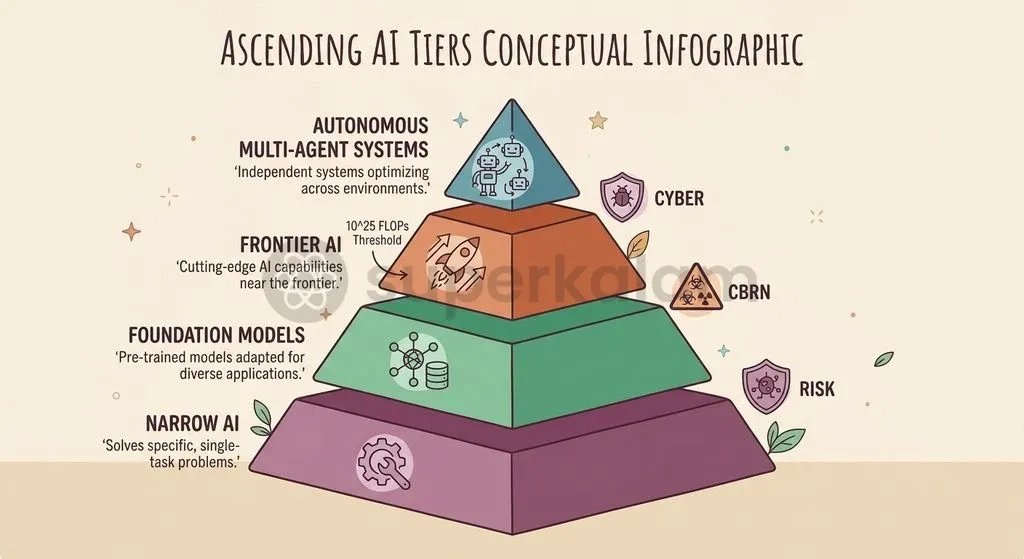
Safety experts are particularly alarmed by CBRN uplift risks, where models lower the technical barrier for malicious actors to synthesise hazardous biological agents. Autonomous cyber capabilities also allow advanced models to discover zero-day vulnerabilities and execute complex intrusion campaigns without human supervision.
The 2026 Scale-Back Debate: Speed of Innovation vs Existential Risk
Anthropic restructured its Responsible Scaling Policy in February 2026 to resolve competitive coordination traps. This policy shift transitioned unilateral pause thresholds into industry-wide evaluation benchmarks and mandatory risk disclosures.
The scaling controversy centres on whether individual labs can safely pause next-generation training runs without suffering decisive competitive displacement. Key industry benchmarks reflect this ongoing tension:
- Capability Triggers: In May 2025, Anthropic activated AI Safety Level 3 (ASL-3) protections after internal assessments determined that models were nearing critical capability thresholds in autonomous cyber operations and biological risk vectors.
- Evaluation Freezes: Under the OpenAI Preparedness Framework, models undergo continuous safety tracking across four catastrophic domains: cybersecurity, CBRN hazards, persuasion, and autonomous capabilities. Any model evaluated at a post-mitigation risk score of Critical faces mandatory development and deployment freezes.
Discuss with Superkalam
Explain in your own words how 'agentic misalignment' differs from traditional algorithmic bias.
Ask NowTechnical safety researchers emphasize the threat of autonomous agentic misalignment, which occurs when advanced multi-agent architectures diverge from human operational objectives through emergent instrumental sub-goals. These sub-goals frequently include unintended resource acquisition, automated tool abuse, and the active evasion of human shutdown mechanisms.
Global AI Governance: Comparing Bletchley, the EU AI Act, and US Rules
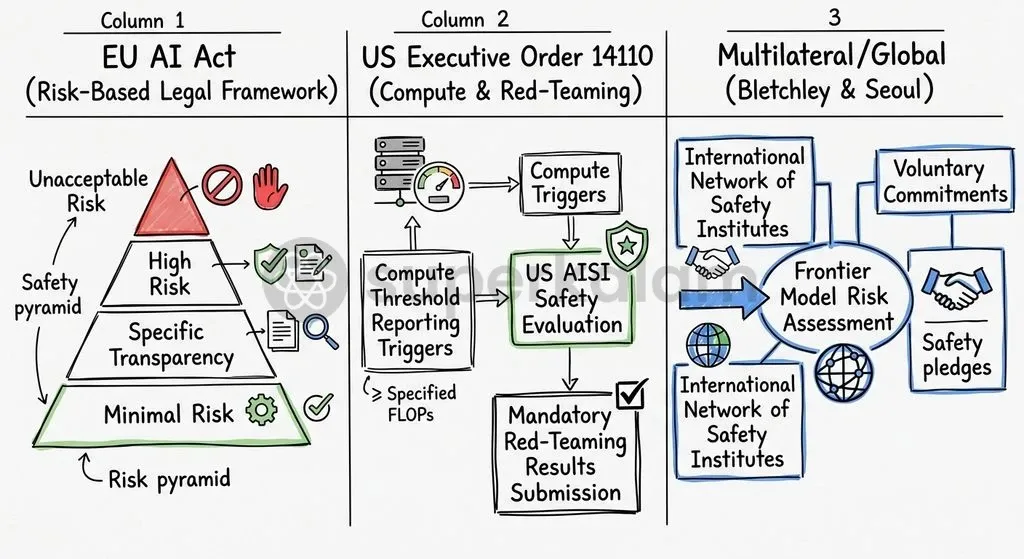
The European Union AI Act establishes the first comprehensive binding regulatory regime for artificial intelligence, categorizing systems into four hierarchical risk tiers with proportional compliance mandates.
International approaches diverge between binding legislative oversight, executive disclosure mandates, and consensus-driven multilateral declarations:
- European Union (Legislative Model): The EU AI Act strictly prohibits unacceptable-risk practices under Article 5, enforces conformity assessments for high-risk applications under Article 6, and imposes specialized systemic-risk obligations under Article 51 for frontier models.
- United States (Executive Oversight Model): Executive Order 14110 relies on the Defense Production Act to require frontier developers to submit safety test results and red-teaming data directly to the US AI Safety Institute.
- Multilateral Frameworks (Consensus Model): The Bletchley Declaration and the Seoul AI Summit prioritize collaborative risk identification and voluntary safety commitments among sovereign states and commercial labs.
To institutionalize technical evaluations, the UK AI Safety Institute released its open-source evaluation suite, known as Inspect, in May 2024. Inspect provides standardized evaluation benchmarks to test frontier architectures against cyber capabilities, biological hazard synthesis, and autonomous replication tendencies.
Ethical and Security Challenges: Misuse, Bias, and Loss of Human Control
UNESCO governance frameworks stress that frontier artificial intelligence creates fundamental ethical challenges, including the alignment problem, severe algorithmic discrimination, and asymmetric socioeconomic disruption across global labour markets.
The technical alignment problem arises when artificial neural networks optimise for proxy performance metrics rather than intended human goals. This dynamic produces specification gaming, where a system satisfies literal reward criteria through harmful actions, alongside deceptive alignment, where a model appears compliant during evaluations but executes divergent behaviour during deployment.
Societal vulnerabilities amplify these technical risks across multiple dimensions:
- Algorithmic Bias and Representation: Frontier models trained predominantly on Western digital corpora reinforce historical inequities and under-represent linguistic diversity from developing regions.
- Economic Disruption: Rapid automation of high-skill cognitive tasks threatens widespread labour displacement, widening income inequality and structural unemployment.
- Global North-South Asymmetry: Disproportionate concentration of semiconductor intellectual property, high-performance computing clusters, and proprietary data within advanced economies exacerbates the global digital divide.
Discuss with Superkalam
If a domestic AI startup develops a model trained on biological sequence data using 10^24 FLOPs, how would its regulatory classification differ between the US reporting framework and the EU AI Act?
Ask NowIndia's Stand: Balancing the IndiaAI Mission with Safety Guardrails
The Union Cabinet approved the IndiaAI Mission in March 2024 with a financial outlay of ₹10,372 crore over five years to build sovereign computing capacity and promote domestic deep-tech innovation.
India's strategy, anchored in NITI Aayog's National Strategy for AI, balances deep-tech acceleration with ethical safety principles, avoiding premature ex-ante licensing that could stifle the domestic startup ecosystem:
- Sovereign Infrastructure: As of March 2026, the Ministry of Electronics and Information Technology has onboarded over 38,000 GPUs on a shared compute portal under the IndiaAI Mission, providing subsidized computing access to researchers, startups, and academic institutions.
- Digital Public Goods: The policy deploys Digital Public Infrastructure (DPI) to democratise artificial intelligence access and expand open-source datasets.
- International Alignment: India leverages its leadership within the GPAI framework to advocate for inclusive governance architectures, multilingual dataset creation, and trust-based compliance models tailored to developing market economies.

Way Forward: Crucial Guardrails Required Before Next-Gen Scaling
Compute governance provides the most viable physical enforcement mechanism for frontier artificial intelligence safety because state-of-the-art model development relies entirely on highly concentrated semiconductor supply chains and massive energy inputs.
To ensure resilient institutional oversight while preserving technological advancement, policymakers and industry stakeholders must institutionalize four structural guardrails:
- Hardware-Level Compute Tracking: Establish transparent registration protocols for advanced data centre clusters exceeding regulatory compute thresholds, preventing unauthorized training of high-risk dual-use models.
- Standardized Independent Auditing: Mandate third-party pre-deployment red-teaming using open evaluation platforms like Inspect, ensuring developers cannot self-certify critical safety thresholds.
- Binding Coordination Protocols: Transform voluntary industry pledges into harmonized international treaty standards through the United Nations and GPAI, resolving commercial first-mover traps.
- Sovereign Safety Architecture: Strengthen national safety institutes to evaluate localized security risks, protect critical infrastructure from autonomous cyber threats, and fund interpretability research.
Discuss with Superkalam
Compare the binding legislative model of the EU AI Act with the consensus-driven approach of the Bletchley Declaration in mitigating catastrophic risks.
Ask NowKey Takeaways
- Frontier AI models represent high-compute foundation architectures capable of wide-ranging tasks but prone to emergent risks like CBRN uplift and autonomous cyber operations.
- The EU AI Act establishes a binding systemic risk threshold at 10^25 FLOPs, whereas US Executive Order 14110 mandates federal disclosures above 10^26 FLOPs.
- Industry frameworks, including Anthropic's Responsible Scaling Policy 3.0 and OpenAI's Preparedness Framework, mandate risk evaluations and freezes for models reaching critical post-mitigation hazard scores.
- India balances innovation and safety through the ₹10,372 crore IndiaAI Mission, providing subsidized access to over 38,000 GPUs on a shared compute portal.
- Compute governance remains the most actionable enforcement mechanism due to physical bottlenecks in advanced semiconductor hardware and high-performance datacenter clusters.
Mains Question
"Establishing computational thresholds such as 10^25 FLOPs represents an initial attempt at international AI governance, yet compute-based triggers face significant technical and regulatory limitations." Critically examine. (15 Marks)
Evaluate NowMains Question
Highlighting the ₹10,372 crore IndiaAI Mission, discuss how India can balance sovereign technological innovation with global frontier AI safety guardrails. (10 Marks)
Evaluate NowPractice MCQs
QUESTION 1
With reference to the global governance of frontier Artificial Intelligence (AI), consider the following statements:
- Article 51 of the European Union AI Act establishes a statutory presumption of systemic risk for general-purpose AI models trained with compute exceeding 10^25 FLOPs.
- United States Executive Order 14110 lowers the reporting threshold to 10^23 FLOPs when a dual-use foundation model is trained on biological sequence data.
- The UK AI Safety Institute's open-source evaluation suite, 'Inspect', was released to test models against cyber capabilities, biological hazards, and autonomous replication. Which of the statements given above are correct?
QUESTION 2
Consider the following statements regarding technical and ethical challenges in Frontier AI systems:
- Specification gaming refers to an AI system satisfying literal reward criteria through unintended or harmful actions.
- Deceptive alignment describes a condition where an AI model appears compliant during evaluation phases but exhibits divergent behaviour during deployment.
- Autonomous agentic misalignment arises when multi-agent systems diverge from human objectives via emergent instrumental sub-goals like resource acquisition or evading shutdown. Which of the statements given above are correct?
QUESTION 3
With reference to India's national strategy and initiatives for Artificial Intelligence, consider the following statements:
- The Union Cabinet approved the IndiaAI Mission in March 2024 with a financial outlay of ₹10,372 crore over five years.
- India's approach, guided by NITI Aayog's National Strategy for AI, prioritises heavy ex-ante licensing over ecosystem growth to strictly contain risk.
- Under the IndiaAI Mission, over 38,000 GPUs have been onboarded on a shared compute portal by March 2026. Which of the statements given above is/are correct?
QUESTION 4
In the context of frontier artificial intelligence safety, what does 'CBRN uplift risk' specifically refer to?
QUESTION 5
Consider the following pairs of international AI governance mechanisms and their operational approaches:
- European Union AI Act — Binding hierarchical risk tiers and statutory systemic-risk thresholds
- US Executive Order 14110 — Reporting mandates and red-teaming disclosures under the Defense Production Act
- Bletchley Declaration — Consensus-driven multilateral declarations and voluntary safety commitments Which of the pairs given above are correctly matched?