Foreign Exchange Risk Reserve: Mechanics of Rupee Defence
As central banks balance imported inflation against export competitiveness, macroprudential currency curbs shift the true cost of hedging onto market players.
Oct, 2026
•11 min read

Overview
The Reserve Bank of India introduced a mandatory twenty per cent cash reserve on qualifying foreign currency derivative contracts. The measure deters speculative rupee shorting. It also cushions central bank foreign currency assets against abrupt exchange rate volatility during periods of external pressure.
This macroprudential mechanism compels Authorised Dealers to park unremunerated funds directly with the monetary authority whenever corporate entities contract large-scale forward hedges against the domestic currency. Tightening the carrying cost of hedging tempers self-fulfilling depreciation spirals without depleting headline foreign exchange reserves.
As of October 2026, the intervention highlights a persistent macroeconomic reality: shielding the domestic economy from imported inflation requires active balance-sheet defence, shifting capital costs onto market participants.
Why the Foreign Exchange Risk Reserve is in the Spotlight
The Reserve Bank of India placed foreign currency derivatives under intensified regulatory scrutiny as part of calibrated administrative measures to curb excessive rupee volatility. As of October 2026, foreign exchange markets experienced heightened dollar demand. This prompted the central bank to activate targeted macroprudential curbs on forward contracts alongside targeted liquidity interventions.
Central banks face compounded pressures when global currency shifts trigger rapid capital outflows and widen current account pressures. According to the Economic Survey 2025-26, shielding the domestic economy from imported inflation—particularly for critical commodities such as crude oil, edible oils, and fertilisers—is essential to preserve macroeconomic stability.
To relieve concentrated spot market pressure, the Reserve Bank of India established a special foreign exchange window to meet the entire daily dollar requirements of major public sector oil marketing companies:
- Indian Oil Corporation Limited
- Bharat Petroleum Corporation Limited
- Hindustan Petroleum Corporation Limited
Simultaneously, the central bank tightened foreign exchange derivative guidelines to curtail speculative positioning against the domestic currency.
What is the Foreign Exchange Risk Reserve and How Does It Work?
The Foreign Exchange Risk Reserve is a mandatory cash deposit ratio that commercial banks must park with the central bank against eligible currency derivative contracts. Under regulatory instructions issued through RBI A.P. (DIR Series) Circular No. 26, the central bank mandated that Authorised Dealers maintain a Foreign Exchange Risk Reserve (FERR) equal to 20 per cent of the rupee equivalent of the notional amount of qualifying foreign exchange derivative contracts involving the Indian Rupee.
The macroprudential mandate applies strictly to specific transactions meeting defined exposure thresholds:
- Eligible Contracts: The requirement covers rupee-linked derivative contracts with a notional value exceeding USD 2 million equivalent undertaken to hedge current account transactions where the user purchases foreign currency against the rupee.
- Maintenance Form: Authorised Dealers must deposit and maintain the entire 20 per cent reserve in cash in India with the Reserve Bank of India on a daily basis until contract termination.
- Compliance Reporting: Authorised Dealers are required to report compliance and daily reserve balances through the Centralised Information Management System (CIMS) of the central bank.
Alongside the cash reserve requirement, the Reserve Bank of India issued companion directives under RBI A.P. (DIR Series) Circular No. 25 to close avenues for speculative round-tripping. Authorised Dealers are prohibited from permitting users to rebook any cancelled foreign exchange derivative contracts involving the rupee, whether deliverable or non-deliverable. Furthermore, the regulatory threshold for undertaking currency derivative transactions without establishing documentary evidence of an underlying contracted exposure was sharply reduced from USD 100 million to USD 5 million equivalent across all Authorised Dealers and recognised stock exchanges.

Authorised Dealers must also obtain and retain an undertaking from corporate users verifying that the underlying exposure has not been hedged with any other bank. Banks must keep this documentation on record for at least two years.
Per reporting by The Indian Express (as reported in October 2026), this administrative design draws operational parallels from the foreign exchange risk reserve ratio utilised by the People's Bank of China to curb currency forward speculation.
Discuss with Superkalam
What is the exact percentage of the cash reserve requirement that Authorised Dealers must maintain under the FERR guidelines?
Ask NowHow the Reserve Protects the Central Bank Balance Sheet
The Currency and Gold Revaluation Account protects the Reserve Bank of India balance sheet by absorbing mark-to-market fluctuations in foreign currency assets and gold without impacting annual profitability. Central bank balance sheets operate under unique accounting mechanics compared to commercial entities, as external reserves are translated into domestic currency at prevailing market rates.
According to the RBI Annual Report, unrealised gains and losses arising from the daily translation of foreign currency assets and liabilities are credited or debited directly to the Currency and Gold Revaluation Account (CGRA) without passing through the profit and loss statement. This accounting treatment prevents exchange rate volatility from artificially inflating or depressing the central bank's operational surplus.
Balance sheet movements generate dynamic revaluation effects across currency cycles:
- Rupee Depreciation Effects: When the domestic currency weakens against the US dollar, the rupee value of foreign assets increases, expanding the credit balance of the CGRA.
- Rupee Appreciation Risks: A sharp appreciation of the rupee lowers the valuation of foreign reserves in local currency terms, representing a balance sheet contraction risk that depletes accumulated revaluation balances.
- Ancillary Valuation Buffers: The central bank maintains the Investment Revaluation Account-Foreign Securities (IRA-FS) and the Foreign Exchange Forward Contracts Valuation Account (FCVA) to absorb fluctuations in overseas sovereign bond yields and outstanding forward books.
Institutional safeguards governing these accounting buffers were formalised under the Bimal Jalan Committee on Economic Capital Framework. The committee established that revaluation balances are governed by one-way fungibility, meaning they can absorb market risk but cannot be drawn down to offset operational, credit, or monetary stability risks.
Furthermore, the Bimal Jalan Committee ruled that revaluation reserves cannot be distributed as dividends to the Union Government, restricting annual transfers strictly to realised net income. Realised risk is cushioned separately by the Contingent Risk Buffer (CRB), comprising the Contingency Fund and Asset Development Fund, which the committee recommended maintaining within a band of 5.5 per cent to 6.5 per cent of the central bank's balance sheet.
Discuss with Superkalam
How does mandating an unremunerated cash reserve on currency derivatives translate into higher hedging costs for corporate entities?
Ask NowHow the RBI Steps In to Protect the Rupee: Spot, Forwards, and Swaps
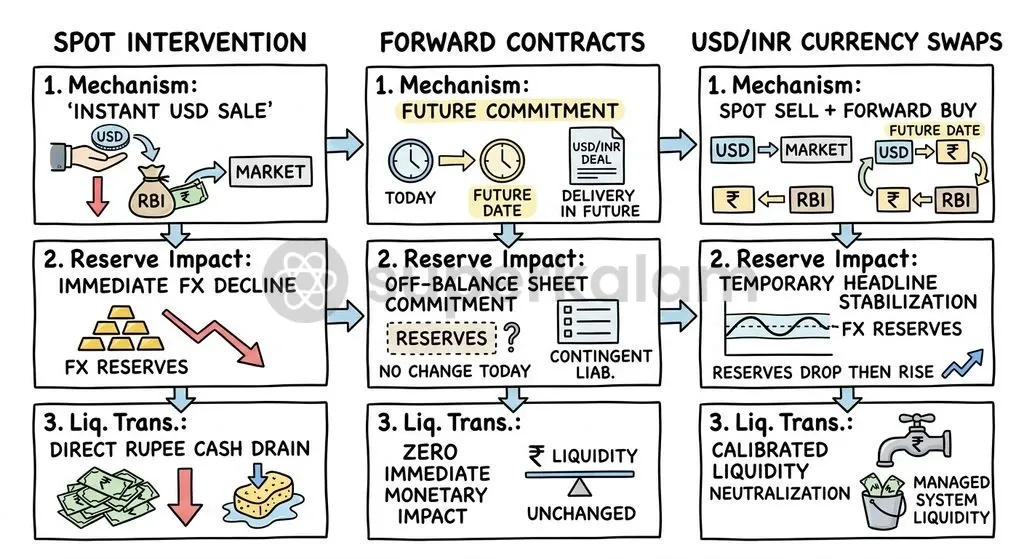
The Reserve Bank of India deploys a tripartite intervention framework comprising spot dollar sales, forward contracts, and currency swaps to manage foreign exchange volatility while managing domestic liquidity. The central bank operates under a stated policy of avoiding target exchange rate levels. It intervenes solely to contain disorderly movements and anchor macroeconomic expectations.
Direct intervention in the spot foreign exchange market offers immediate price support by expanding the supply of foreign currency. However, as noted in the RBI Bulletin, selling dollars in the spot market causes an immediate decline in gross foreign currency assets.
| Intervention Tool | Operational Mechanism | Liquidity & Reserve Impact |
|---|---|---|
| Spot Market Operations | Direct spot dollar sales | Delivers immediate dollar liquidity; drains domestic reserves |
| Forward Contracts | Contractual future currency exchanges | Alters future cash flows; defers spot reserve depletion |
| Forex Swaps (Sell/Buy) | Simultaneous spot sale and forward buyback | Delivers immediate dollars; neutralises longer-term liquidity |
Spot dollar sales carry immediate monetary consequences:
- Domestic Liquidity Contraction: When the central bank sells foreign currency against rupees, it absorbs domestic cash, contracting the reserve money base (M0).
- Monetary Sterilisation: To prevent unwanted monetary tightening, the central bank conducts monetary sterilisation via Open Market Operations (OMOs) or liquidity adjustment facility repo injections.
- Off-Balance Sheet Operations: Forward contracts defer settlement. A forex sell/buy swap includes an immediate dollar sale and a forward buyback, so it does not avoid the initial spot reserve drawdown.
Providing a dedicated dollar window for public sector oil marketing companies is an off-market intervention. Supplying crude import payments directly bypasses public order matching on currency exchanges, removing heavy commercial dollar bids from the daily market.
Discuss with Superkalam
Contrast the domestic liquidity impact of direct spot market dollar interventions with off-balance sheet forward contract interventions.
Ask NowThe True Price of Hedging: Corporate Risks and Central Bank Costs
Forward premia in Indian financial markets reflect covered interest parity determined by the spread between domestic rupee interest rates and overseas dollar interest rates. According to the RBI Working Paper Series, forward exchange rates typically trade at a premium to the spot rate, reflecting higher domestic interest rates relative to global benchmarks.
When Authorised Dealers are required to park a 20 per cent unremunerated cash reserve with the central bank, their capital efficiency diminishes. Per reporting by The Times of India (as reported in October 2026), banks face an increased carrying cost of funds on derivative books, which prompts them to widen bid-ask spreads for commercial clients.
Regulatory intervention reshapes market incentives across the corporate sector:
- Deterring Front-Loaded Speculation: Per analysis by The Economic Times (as reported in October 2026), raising the effective cost of forward contracts deters importers from aggressively booking advance dollar coverage, thereby compressing forward premia that would otherwise encourage spot dollar hoarding.
- Elevated Hedging Expenses: Genuine commercial importers face higher transaction costs to secure exchange rate certainty, occasionally leaving balance sheets exposed to unhedged currency risk.
- Export Hedging Distortions: Distortions in forward premia alter the net realisations of exporters, influencing forward cash-flow planning across external trade corridors.
Comparing Approaches: Direct Rupee Defense versus Free Market Floating
Exchange rate regimes balance the policy trade-offs between macroeconomic stability achieved through central bank intervention and price discovery under a freely floating currency regime. Central banks across emerging markets navigate this spectrum based on external vulnerability profiles, foreign exchange reserve buffers, and capital account openness.
| Analytical Dimension | Direct Rupee Defence (Managed Float) | Free Market Floating |
|---|---|---|
| Primary Policy Objective | Dampening extreme price volatility and anchoring expectations | Market-clearing price discovery without official price targets |
| Forex Reserves Impact | Drawdown of foreign currency assets during sustained depreciation | Reserves remain intact as the exchange rate absorbs balance of payments shocks |
| Domestic Liquidity Effect | Requires sterilisation operations to counter monetary base contraction | Domestic banking liquidity remains insulated from external adjustments |
| Inflation Implications | Contains imported inflation by moderating landed import costs | Currency depreciation passes directly into domestic consumer prices |
| Corporate Incentive Structure | May encourage unhedged foreign exposures if markets perceive an explicit central bank floor | Incentivises market participants to hedge currency risks systematically |
The Reserve Bank of India maintains a managed floating regime rather than a pegged currency. Market interventions aim to curb disruptive speculative swings while permitting gradual realignment with underlying macroeconomic fundamentals.

Trade-Offs and Risks of Prolonged Forex Market Intervention
Persistent foreign exchange market intervention presents structural trade-offs between shielding domestic consumers from imported inflation and sustaining the international competitiveness of Indian exports. While aggressive dollar sales alleviate short-term imported price pressures, prolonged interventions generate distinct economic frictions.
According to the RBI Bulletin on nominal and real effective exchange rates, actively defending the nominal rupee value during episodes of broad dollar strengthening causes the Real Effective Exchange Rate (REER) to appreciate relative to trading partners. This trade-weighted appreciation renders Indian manufactured goods more expensive overseas, placing export sectors at a pricing disadvantage.
Sterilisation operations also generate domestic policy trade-offs:
- Sovereign Quasi-Fiscal Costs: When the central bank conducts open market bond purchases to replace rupee liquidity absorbed by spot dollar sales, it replaces high-yielding foreign sovereign securities with domestic assets, altering central bank income streams.
- Reserve Exhaustion Concerns: Continual reliance on foreign currency assets to meet external deficits reduces aggregate import cover, elevating perceived sovereign risk during global liquidity squeezes.
- Derivative Distortion Risks: Heavy use of forward and swap positions shifts settlement liabilities into future periods, requiring careful roll-over management to avert sudden balance sheet constraints.
Discuss with Superkalam
Evaluate whether macroprudential measures like the FERR are more effective than direct spot market sales during periods of intense capital outflow.
Ask NowWay Forward: Balancing Rupee Stability with Sustainable Capital Buffers
Sustainable external sector management requires the Reserve Bank of India to align macroprudential derivative curbs with disciplined balance sheet governance and deep domestic currency internationalisation. Administrative measures like the Foreign Exchange Risk Reserve are effective short-term stabilisers, but long-term resilience requires systemic structural depth.
First, regulatory reserve mandates should be calibrated dynamically against underlying market conditions. Imposing static cash reserve burdens on derivative books risks driving corporate hedging into offshore non-deliverable forward (NDF) centres, diminishing onshore price discovery.
Second, strict adherence to the capital guidelines formulated by the Bimal Jalan Committee remains paramount. Protecting the Contingent Risk Buffer within the current 4.5 to 7.5 per cent corridor ensures that the Reserve Bank of India retains sufficient realised risk capital to manage severe market shocks without eroding its institutional autonomy.
Finally, accelerating the internationalisation of the rupee through bilateral local-currency settlement mechanisms reduces structural dollar dependency. Expanding rupee invoicing across bilateral trade corridors cushions domestic importers from international exchange rate shocks, diminishing the need for central bank interventions in foreign exchange markets.
Key Takeaways
- Regulatory Mandate: Authorised Dealers must maintain a 20 per cent Foreign Exchange Risk Reserve in cash with the central bank for eligible rupee derivative contracts exceeding USD 2 million equivalent.
- Balance Sheet Insulation: Unrealised exchange rate gains and losses are absorbed directly by the Currency and Gold Revaluation Account without passing through the central bank's profit and loss accounts.
- Capital Governance: The Bimal Jalan Committee established that revaluation reserves cannot be transferred as dividends to the Union Government and originally recommended a Contingent Risk Buffer between 5.5 and 6.5 per cent of the central bank's balance sheet. The current revised range is 4.5 to 7.5 per cent.
- Liquidity Dynamics: Spot market dollar sales deplete foreign exchange reserves and contract domestic reserve money, necessitating sterilisation operations through open market purchases or repo facilities.
- External Trade Trade-Offs: Defending the nominal exchange rate dampens imported inflation but risks appreciating the Real Effective Exchange Rate, which can erode export competitiveness.
Mains Question
'Shielding the domestic economy from imported inflation requires active balance-sheet defence, shifting capital costs onto market participants.' In light of the Reserve Bank of India introducing the Foreign Exchange Risk Reserve (FERR), examine how macroprudential tools mitigate exchange rate volatility without depleting headline foreign currency reserves. (10 Marks)
Evaluate NowMains Question
The Bimal Jalan Committee on Economic Capital Framework formalised clear institutional safeguards regarding central bank balance sheet management. Elucidate the accounting mechanics of the Currency and Gold Revaluation Account (CGRA) and discuss the rationale behind the 'one-way fungibility' principle in safeguarding monetary stability. (15 Marks)
Evaluate NowPractice MCQs
QUESTION 1
With reference to the Foreign Exchange Risk Reserve (FERR) framework introduced by the Reserve Bank of India, consider the following statements:
- Authorised Dealers are required to maintain a 20 per cent unremunerated cash reserve against eligible rupee derivative contracts.
- The requirement applies to derivative contracts with a notional value exceeding USD 2 million equivalent undertaken to hedge current account transactions.
- The compliance and daily reserve balances are reported through the Centralised Information Management System (CIMS). Which of the statements given above are correct?
QUESTION 2
Regarding the accounting framework and balance sheet buffers of the Reserve Bank of India, consider the following statements:
- Unrealised gains and losses from daily translation of foreign currency assets and gold are routed directly through the central bank's profit and loss statement.
- The Bimal Jalan Committee established that revaluation balances possess one-way fungibility and cannot be distributed as dividends to the Union Government.
- The Contingent Risk Buffer was recommended by the Bimal Jalan Committee to be maintained within a band of 5.5 per cent to 6.5 per cent of the RBI balance sheet. Which of the statements given above is/are correct?
QUESTION 3
In the context of central banking operations, the Currency and Gold Revaluation Account (CGRA) maintained by the Reserve Bank of India serves which of the following primary functions?