Emergency Oil Releases: How Strategic Petroleum Reserves Work
Strategic petroleum reserves help manage oil supply disruptions. Read how emergency releases work, the IEA role and India's underground oil caverns.
Oct, 2026
•12 min read
Overview
Strategic Petroleum Reserves (SPRs) are state-funded emergency crude stockpiles managed by entities like Indian Strategic Petroleum Reserves Limited (ISPRL). They insulate national economies against physical supply disruptions, geopolitical embargoes, and external energy price shocks. As an import-dependent economy, India maintains an aggregate storage buffer of 74 days across strategic caverns and commercial oil marketing infrastructure.
India's transition toward a commercialised, public-private partnership model highlights a central policy tension. The state must balance sovereign emergency autonomy against commercial leasing obligations. Monetising cavern space through foreign partners like the Abu Dhabi National Oil Company (ADNOC) eases fiscal burdens. However, it requires clear legal safeguards to guarantee uncompromised emergency access during international supply crises.
Why Strategic Petroleum Reserves Are Back in Focus
Global energy volatility has pushed crude stockpiling back to the centre of national security agendas. Import-dependent nations face mounting shipping disruptions. Heightened maritime risks across key energy transit chokepoints—such as the Strait of Hormuz and the Red Sea—have exposed the vulnerability of maritime oil supply chains.
India imports over four-fifths of its crude requirements. Sustained regional conflict threatens domestic price stability and macroeconomic balances. Key strategic priorities driving this renewed focus include:
- Supply Shock Cushioning: Bridging physical deficits during unexpected shipping bottlenecks or geopolitical blockades.
- Macroeconomic Stabilisation: Dampening inflationary spikes and curbing panic buying across domestic fuel retail networks.
- Geopolitical Leverage: Deploying stockpiles as an active instrument of energy diplomacy and fiscal risk management.
As of March 2026, energy security debates focus on the operational readiness and physical drawdown timelines of emergency stockpiles. When global oil supply lines face acute bottlenecks, emergency reserves are the first line of sovereign defence. They bridge the immediate shortfall between physical disruption and alternative cargo procurement, preventing severe domestic fuel rationing.
What Is a Strategic Petroleum Reserve?
A Strategic Petroleum Reserve (SPR) is a government-controlled crude stockpile maintained to cushion domestic markets during physical supply deficits. Unlike operational crude inventories held by commercial refiners for routine processing, an SPR remains ring-fenced strictly for national emergencies, geopolitical embargoes, or catastrophic natural disasters.
The modern global SPR architecture emerged directly from the 1973 OPEC oil embargo. The resulting supply shock prompted major consumer nations to sign the 1974 Agreement on an International Energy Program (IEP), which established the International Energy Agency (IEA). Under the IEP framework, participating countries committed to maintaining collective emergency reserves to counter producer cartels.
Governments choose between holding raw unrefined crude or finished petroleum products based on strategic trade-offs:
| Dimension | Strategic Crude Oil Reserves | Refined Product Reserves (Diesel/Petrol) |
|---|---|---|
| Storage Medium | Underground unlined rock caverns, salt domes | Above-ground steel storage tanks |
| Product Degradation | Minimal; multi-year subterranean stability | Rapid; chemical degradation within months |
| Refining Flexibility | High; processed into varied fuel yields | Rigid; fixed to specific end-use fuels |
| Maintenance Cost | Low capital maintenance once constructed | High; requires continuous inventory turnover |
| Adoption | India, United States | European Union (partial mandate) |
Underground unlined rock caverns offer substantial security advantages over above-ground steel tanks. Built deep inside stable geological formations below the natural groundwater table, caverns rely on hydro-geological containment where surrounding water pressure prevents crude hydrocarbons from escaping.
This engineering design delivers clear operational benefits. It eliminates surface evaporation losses, drastically reduces operational maintenance, and provides robust physical protection against aerial bombardment or sabotage.
Discuss with Superkalam
Recall the total crude storage capacity established under Phase I of India's SPR programme and the specific locations of the three underground caverns.
Ask NowHow Do Emergency Oil Releases Actually Work?
Emergency oil releases operate through sovereign directives or multilateral declarations. These mechanisms inject crude into commercial refineries via direct sales, temporary loans, or relaxed stockholding rules. When a severe disruption occurs, the sovereign state or coordinating body assesses the physical deficit against baseline consumption to determine the necessary drawdown volume.
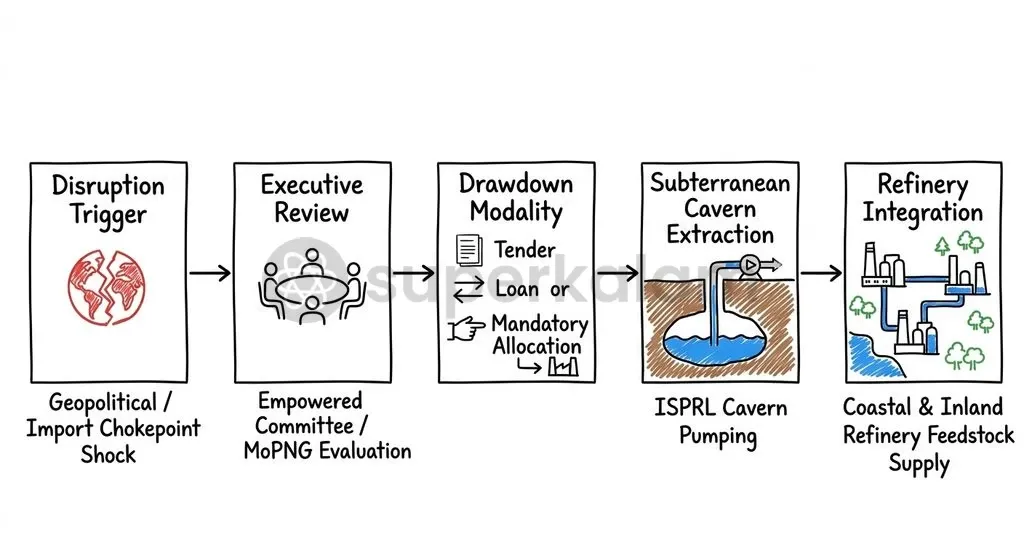
The operational sequence moves through five distinct release phases:
- Disruption Assessment: The sovereign state or coordinating body evaluates the physical supply deficit.
- Executive Authorisation: Sovereign leadership issues an official emergency drawdown directive.
- Modality Selection: Authorities select between competitive sales, crude loans, or regulatory stock releases.
- Subterranean Extraction: Cavern pumps extract crude and route it to marine or pipeline manifolds.
- Refinery Delivery: Crude reaches processing units within an estimated 13-day lead time.
The drawdown execution follows three primary operational modalities:
- Competitive Tender Sales: The administering authority auctions state crude directly to registered commercial refiners to replace disrupted seaborne cargoes.
- Crude Oil Exchanges (Loans): The state lends physical barrels to refiners facing immediate feedstock shortages, requiring them to return the crude later with an additional in-kind premium.
- Mandatory Stockholding Relaxation: Regulatory bodies temporarily lower the legal minimum inventory requirements imposed on commercial oil marketing companies, releasing commercial stocks directly into distribution.
Physical drawdown speed depends on subterranean pumping capacity and pipeline connectivity. According to the U.S. Department of Energy, physical delivery of crude from the United States SPR to commercial refineries requires approximately 13 days from the date of an executive drawdown order. Cavern crude must be pumped up to surface manifolds, quality-tested, metered, and transported through trunk pipelines or marine terminals to processing units.
Emergency releases are strictly short-term market bridges rather than permanent price suppressors. An SPR drawdown injects immediate physical liquidity into refining networks. This reassures markets and prevents hoarding while international supply routes reconfigure.
Discuss with Superkalam
Explain the principle of hydro-geological containment and how it makes unlined rock caverns technically superior to surface steel tanks for crude storage.
Ask NowIndia's Underground Oil Caverns: Locations and Capacity
Indian Strategic Petroleum Reserves Limited (ISPRL) manages three operational underground rock caverns holding 5.33 Million Metric Tonnes (MMT) of crude. Established as a Special Purpose Vehicle (SPV) and wholly owned subsidiary of the Oil Industry Development Board (OIDB) under the Ministry of Petroleum and Natural Gas (MoPNG), ISPRL oversees the engineering, maintenance, and strategic operations of these subterranean sites.
Under Phase I of the National SPR Programme, the Union Government commissioned three coastal storage facilities:
- Visakhapatnam (Andhra Pradesh): 1.33 MMT storage capacity, engineered into metamorphic rock formations on the eastern seaboard.
- Mangaluru (Karnataka): 1.50 MMT storage capacity, located along the western coast to feed domestic coastal refineries.
- Padur (Karnataka): 2.50 MMT storage capacity, representing the largest single operational cavern complex under Phase I.
Phase I strategic reserves provide roughly 9.5 days of national crude consumption coverage. In addition to ISPRL's dedicated capacity, commercial Oil Marketing Companies (OMCs) maintain technical and commercial storage for crude and refined products equivalent to 64.5 days.
Combining ISPRL's strategic crude with OMC commercial storage gives India an aggregate national storage buffer of 74 days.
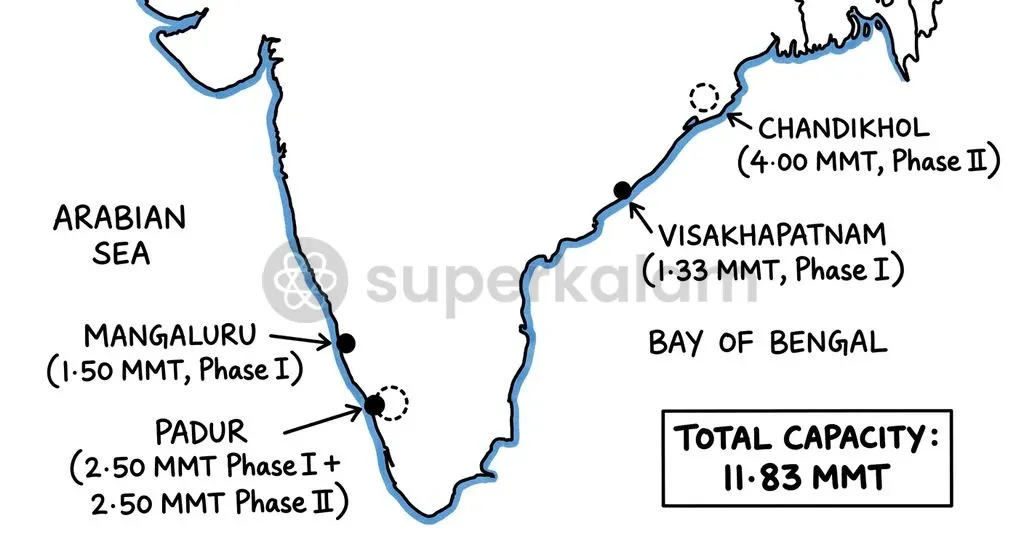
To expand this buffer, the Union Government approved Phase II of the SPR Programme. This phase adds 6.5 MMT of underground storage capacity across two strategic locations: Chandikhol in Odisha (4.0 MMT) and a commercial expansion at Padur in Karnataka (2.5 MMT). Phase II is being implemented under a Public-Private Partnership (PPP) model to attract private investment and reduce sovereign capital expenditure.
Global Coordination: How the International Energy Agency Triggers a Release
The International Energy Agency (IEA) coordinates collective emergency oil drawdowns through binding mandates established under the 1974 Agreement on an International Energy Program (IEP). Under the IEP Agreement, all IEA member countries are legally obligated to maintain emergency oil reserves equivalent to at least 90 days of the previous year's net oil imports.
The collective release framework operates under clear procedural rules:
- Governing Board Assessment: The IEA Governing Board determines whether an ongoing or anticipated supply disruption threatens global economic stability.
- Proportional Allocations: Once collective action is approved, member states contribute proportionally based on their share of total IEA oil consumption.
- Domestic Implementation: Member nations execute their allocations through domestic legal mechanisms, deploying government-owned crude or releasing mandatory industry reserves.
Non-member strategic partner countries, such as India, can coordinate voluntarily with IEA collective releases. This enhances global market stability without binding India to mandatory treaty compliance.
Discuss with Superkalam
If a major shipping crisis halts tanker movement across the Strait of Hormuz, assess how India's 74-day aggregate buffer and ISPRL's 13-day drawdown lead time would be operationalised.
Ask NowIndia vs Global SPR Models: Comparing Capacities and Financing
National strategic storage models diverge sharply across jurisdictions like India, the United States, and the European Union in their fuel composition and physical infrastructure. While the United States relies entirely on vast subterranean salt domes along the Gulf Coast, European nations mandate high shares of finished refined products to safeguard local distribution systems.
| Strategic Parameter | India (ISPRL / MoPNG) | United States (DOE SPR) | European Union (Council Directive 2009/119/EC) |
|---|---|---|---|
| Primary Storage Medium | Hard unlined rock caverns | Subterranean salt caverns | Above-ground tanks and salt caverns |
| Crude vs Refined Split | 100% crude oil | 100% crude oil | Mandatory minimum: one-third refined products |
| Financing Architecture | OIDB budgetary funding + Phase II PPP model | Federal sovereign appropriations | Industry-funded stockholding agencies |
| Mandatory Stock Target | National policy target (74 days total current) | 90 days of net imports (IEA mandate) | 90 days net imports or 61 days inland consumption |
| Commercial Leasing | Allowed (up to 30% storage space) | Prohibited; dedicated federal emergency asset | Permitted under regulated agency management |
European Union regulations under Council Directive 2009/119/EC require member states to hold at least one-third of their mandatory 90-day stocks in refined products, representing roughly 75% of inland consumption. This reflects Europe's strategy to protect transport sectors directly from regional refinery shutdowns. In contrast, India and the US prioritise raw crude storage to maximise domestic refining flexibility.
Discuss with Superkalam
Analyse the trade-offs between holding raw subterranean crude oil versus maintaining refined petroleum product reserves (such as petrol and diesel).
Ask NowCommercialisation and Private Sector Participation in India's Phase II
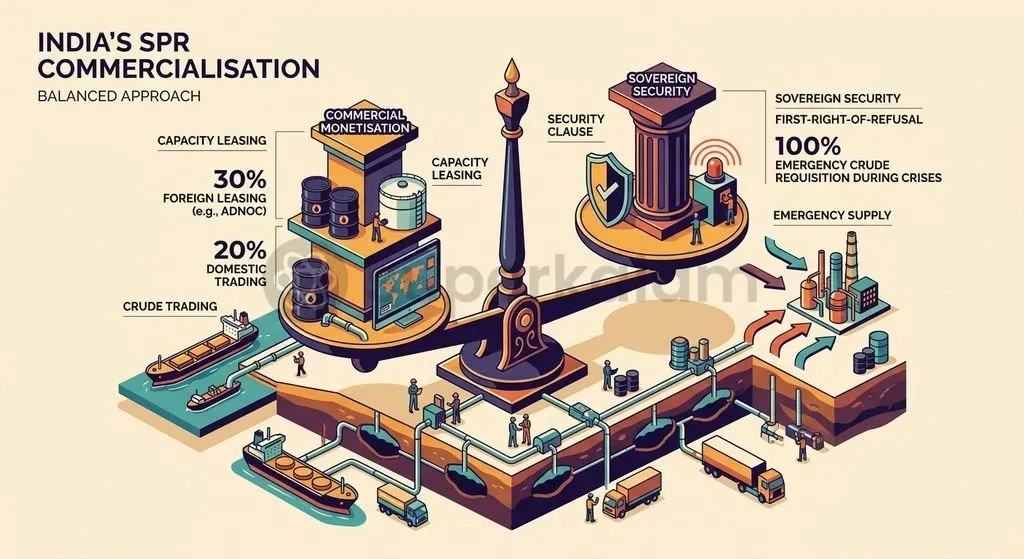
The Union Cabinet approved commercialisation reforms in July 2021 to allow private trading and foreign leasing across India's strategic petroleum infrastructure. This decision permitted ISPRL to lease up to 30% of its storage capacity to foreign national oil companies and private trading entities. It also enabled ISPRL to trade up to 20% of its inventory in the domestic market.
Under this commercial-cum-strategic framework, ISPRL entered landmark storage agreements with the Abu Dhabi National Oil Company (ADNOC) for the Mangaluru and Padur cavern complexes. ADNOC stores its crude at its own cost, retaining the right to sell barrels to Indian refiners or export cargoes during normal market conditions. In exchange, the Indian government secures physical crude stored within its sovereign territory without bearing upfront inventory procurement costs.
This commercialisation strategy creates a fundamental structural trade-off between fiscal relief and sovereign emergency autonomy:
- The Case for Commercialisation: Capital expenditure for underground caverns and crude procurement places heavy demands on the public exchequer. Commercial leasing generates non-tax revenue for ISPRL, offloads crude financing costs onto foreign entities, and integrates India into global oil trading routes.
- The Sovereign Risk: Allowing foreign entities to trade or re-export stored crude means that leased cavern volumes do not constitute unconditional sovereign property during ordinary operations.
To resolve this trade-off, bilateral agreements between ISPRL and foreign partners contain an explicit first-right-of-refusal clause. In the event of a government-declared national supply emergency, India retains the overriding sovereign right to requisition all crude stored within the caverns. Commercialisation is a pragmatic fiscal bridge, enabling India to expand its subterranean infrastructure through public-private partnerships while preserving ultimate emergency control.
Key Challenges: Geopolitical Vulnerability, Fiscal Costs, and Energy Transition
India faces three major strategic and structural hurdles in managing its emergency storage architecture:
- The 16-Day Storage Deficit: India's combined storage buffer of 74 days falls short of the 90-day import cover benchmark mandated by the IEA. Bridging this gap requires substantial capital investment to complete Phase II caverns at Chandikhol and Padur and procure crude fill.
- Stranded Asset Risks: Balancing long-term petroleum investments against the national green energy transition is increasingly difficult. Committing billions of rupees to stationary fossil fuel infrastructure risks creating stranded assets over a 30-year operational horizon.
- Critical Mineral Supply Vulnerabilities: Clean energy technologies demand new input materials. Resource security now requires protecting non-petroleum mineral supply chains alongside conventional fossil fuels.
To address these evolving risks, the Union Government launched the National Critical Mineral Mission (NCMM). Modelled on the Strategic Petroleum Reserve system, the NCMM incorporates a strategic stockpiling framework for critical transition materials—including lithium, cobalt, and rare earth elements. This evolutionary step broadens India's resource security architecture from crude stockpiles to critical green technology inputs.
Way Forward: Strengthening India's Energy Security Architecture
To build a resilient energy security framework, policy makers should pursue three coordinated interventions:
- Accelerate Phase II Execution: Fast-tracking the Chandikhol (4.0 MMT) and Padur (2.5 MMT) projects under the public-private partnership model will add 6.5 MMT of crude capacity, moving India closer to international storage standards.
- Institutionalise Statutory Drawdown Protocols: The Union Government should establish a dedicated statutory framework governing national emergency drawdowns. Clear inter-ministerial protocols between MoPNG, the Ministry of Finance, and the National Security Council Secretariat will streamline physical release triggers, auction systems, and refinery allocations during crises.
- Expand Regional and Mineral Stockpiles: India should broaden regional energy partnerships across the Global South by offering shared commercial cavern space to neighbouring South Asian countries. Integrating strategic crude reserves with critical mineral stockpiles under the National Critical Mineral Mission will ensure resilient supply chains across conventional and clean energy sectors.
Discuss with Superkalam
Weigh the fiscal advantages of commercialising underground caverns via foreign oil partnerships against the potential risks to sovereign autonomy during an acute geopolitical supply crisis.
Ask NowKey Takeaways
- Strategic Petroleum Reserves (SPRs) are dedicated state-managed crude stockpiles designed to protect the domestic economy from international supply disruptions, price shocks, and geopolitical embargoes.
- The global SPR framework originated from the 1973 OPEC oil shock, leading to the 1974 IEP Agreement and the IEA mandate requiring member states to maintain 90 days of net import cover.
- Indian Strategic Petroleum Reserves Limited (ISPRL), a subsidiary of OIDB under MoPNG, operates 5.33 MMT of underground rock caverns across Visakhapatnam, Mangaluru, and Padur under Phase I.
- India's total storage buffer stands at 74 days (9.5 days under ISPRL strategic caverns plus 64.5 days of commercial OMC storage), leaving a 16-day gap compared to the IEA 90-day standard.
- Phase II expansion will add 6.5 MMT of underground storage at Chandikhol and Padur under a Public-Private Partnership model.
- Commercialisation policies allow ISPRL to lease up to 30% of capacity to entities like ADNOC, balancing sovereign emergency access via first-right-of-refusal clauses with fiscal revenue generation.
Mains Question
"The transition toward a commercialised Public-Private Partnership model in Phase II of India's Strategic Petroleum Reserve programme highlights the delicate balance between fiscal prudence and uncompromised sovereign emergency autonomy." Critically examine. (15 Marks)
Evaluate NowMains Question
Underground unlined rock caverns form the cornerstone of India's national strategic crude oil architecture. Elucidate the engineering advantages and operational modalities of emergency drawdown mechanisms associated with these facilities. (10 Marks)
Evaluate NowPractice MCQs
QUESTION 1
With reference to India's Strategic Petroleum Reserves (SPR) Programme, consider the following statements: 1. Indian Strategic Petroleum Reserves Limited (ISPRL) operates as a wholly owned subsidiary of the Oil Industry Development Board under the Ministry of Petroleum and Natural Gas. 2. Under Phase I, the largest operational underground rock cavern facility in terms of capacity is located at Visakhapatnam. 3. The combined storage capacity created under Phase I provides approximately 9.5 days of national crude consumption coverage. Which of the statements given above are correct?
QUESTION 2
Consider the following statements regarding the technical and strategic dimensions of crude oil storage: 1. Underground unlined rock caverns rely on hydro-geological containment, where surrounding groundwater pressure prevents hydrocarbons from escaping. 2. Strategic crude stored in subterranean caverns suffers rapid chemical product degradation within months compared to refined petroleum fuels. 3. Underground cavern storage drastically reduces surface evaporation losses and offers physical protection against aerial bombardment. Which of the statements given above is/are correct?
QUESTION 3
With reference to the International Energy Agency (IEA) and emergency stockholding frameworks, consider the following statements: 1. The modern global SPR architecture originated following the 1973 OPEC oil embargo and the subsequent 1974 Agreement on an International Energy Program (IEP). 2. IEA member countries are legally obligated to maintain emergency reserves equivalent to at least 90 days of the previous year's net oil imports. 3. Under the IEP framework, non-member partner countries like India are legally mandated to participate in collective emergency releases. Which of the statements given above is/are correct?
QUESTION 4
Consider the following pairs regarding India's Strategic Petroleum Reserve locations and their designated phases: 1. Chandikhol (Odisha) — Phase II (4.0 MMT) 2. Mangaluru (Karnataka) — Phase I (1.50 MMT) 3. Padur (Karnataka) — Phase I and Phase II commercial expansion. Which of the pairs given above are correctly matched?
QUESTION 5
What constitutes India's total aggregate national petroleum storage buffer of 74 days as detailed in national energy security assessments?





