Elderly Care in India: Overcoming the Skilled Caregiver Crisis
With India's elderly population surging to 347 million by 2050, formalising skilled caregivers is critical for social justice and healthcare delivery.
Oct, 2026
•9 min read
Overview
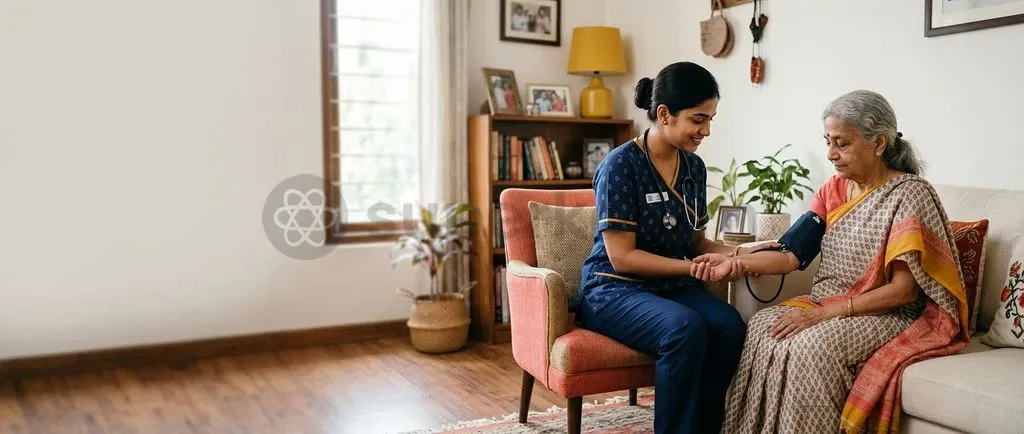
India faces an unprecedented demographic transition. Protecting millions of vulnerable older citizens demands moving from uncompensated family assistance to a professionalised eldercare workforce.
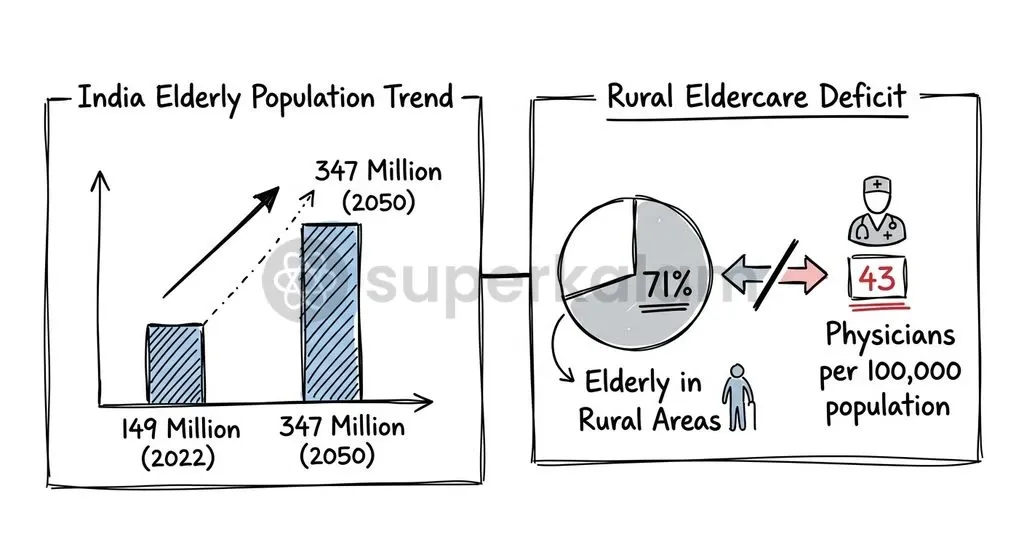
According to the NITI Aayog Report: Reimagining Care: Strategies for Empowering Caregivers in Viksit Bharat@2047, the country's elderly population will expand from 149 million in 2022 to 347 million by 2050. Despite this rapid expansion, fewer than 1.5 lakh certified professional caregivers exist nationwide. That leaves nearly 146 million informal, unpaid family members to absorb the clinical and financial burdens of eldercare alone.
Without statutory standards, public financing, and formal accreditation pathways, this workforce deficit threatens senior health security. It also depresses female labour participation and strains domestic family life across India.
Why in the News?
As of August 2026, the NITI Aayog released its landmark report recommending the statutory establishment of a National Caregiver Council to standardise and regulate geriatric care qualifications across the country.
The report highlights that an expanding care economy presents vast economic opportunities alongside urgent healthcare imperatives. This policy push tackles long-standing omissions in welfare legislation, which historically focused on basic family maintenance rather than enforceable standards for domiciliary healthcare.
Discuss with Superkalam
How many certified professional caregivers exist in India compared to the number of informal, unpaid family caregivers?
Ask NowThe Emerging Reality: India's Shift to Assisted Eldercare
India's demographic structure is altering rapidly. Projections from the NITI Aayog show that older persons will make up 20.8% of the total population by 2050, up from 10.5% in 2022.
Over this period, the absolute number of citizens aged 60 and above will more than double from 149 million to 347 million. Urbanisation and family nuclearisation compound this shift by steadily shrinking the pool of co-residing relatives available for daily care.
Key structural pressures defining this demographic transition include:
- Rural-Urban Health Disparities: Rural communities house approximately 71% of senior citizens, where institutional public healthcare remains sparse and access to clinics is limited.
- Skewed Physician Density: According to NITI Aayog findings, rural physician density stands at only 43 per 100,000 population, compared to 118 per 100,000 in urban centres.
- Absence of Home-Care Extension: Public interventions under the National Programme for Health Care of the Elderly (NPHCE) have established Regional Geriatric Centres and two National Centres for Ageing. These tertiary centres provide advanced clinical treatment. However, NPHCE facilities currently lack dedicated domiciliary caregiver extension units to support bedridden seniors at home.
Inside the Care Deficit: Why Family Care Cannot Replace Trained Support
Clinical evidence confirms that non-professional domestic care cannot handle complex geriatric multimorbidities. According to the Longitudinal Ageing Study in India (LASI) Wave 1 India Report, MoHFW & IIPS, roughly 75% of elderly persons have at least one chronic medical condition. Furthermore, 40% suffer from functional disabilities affecting activities of daily living such as bathing, dressing, and walking.
Cognitive decline places severe strain on untrained households. Data from the Longitudinal Ageing Study in India - Diagnostic Assessment of Dementia (LASI-DAD) reveals that approximately 8.8 million elderly Indians live with dementia. Managing neurodegenerative conditions requires specialised behavioural techniques and structured protocols that unassisted relatives simply cannot provide.
Urban households frequently substitute professional medical support with untrained domestic workers due to acute personnel shortages. Yet informal helpers lack clinical competencies in patient mobilisation, vital monitoring, and pressure-ulcer prevention.
| Parameter | Untrained Domestic Worker | Certified Geriatric Care Aide |
|---|---|---|
| Accreditation and Standards | Informal arrangement without qualification | Standardised certification under the National Skills Qualifications Framework |
| Clinical Competence | Basic domestic support; no clinical skills | Vital monitoring and mobilisation, basic emergency management |
| Dementia and Cognitive Care | Unprepared for psychiatric or cognitive needs | Trained in behavioural mitigation techniques and communication protocols |
| Patient Safety Protocols | Elevated risk of accidental falls and injuries | Trained in fall prevention and infection control protocols |
| Statutory Worker Protections | Unregistered, cash-based informal labour | Formal contract, transparent wages, accredited agency oversight |
Discuss with Superkalam
Why is relying on untrained domestic helpers inadequate for elderly patients experiencing cognitive decline or multimorbidities?
Ask NowThe Core Bottlenecks: Low Wages, Informal Contracts, and Fragmented Training
Structural fragmentation in India's care labour market discourages new entrants. Remuneration is low. Attendants endure long working hours, lack social security, and face non-existent career ladders. Consequently, prospective workers treat elderly care as precarious domestic work rather than an allied healthcare profession.
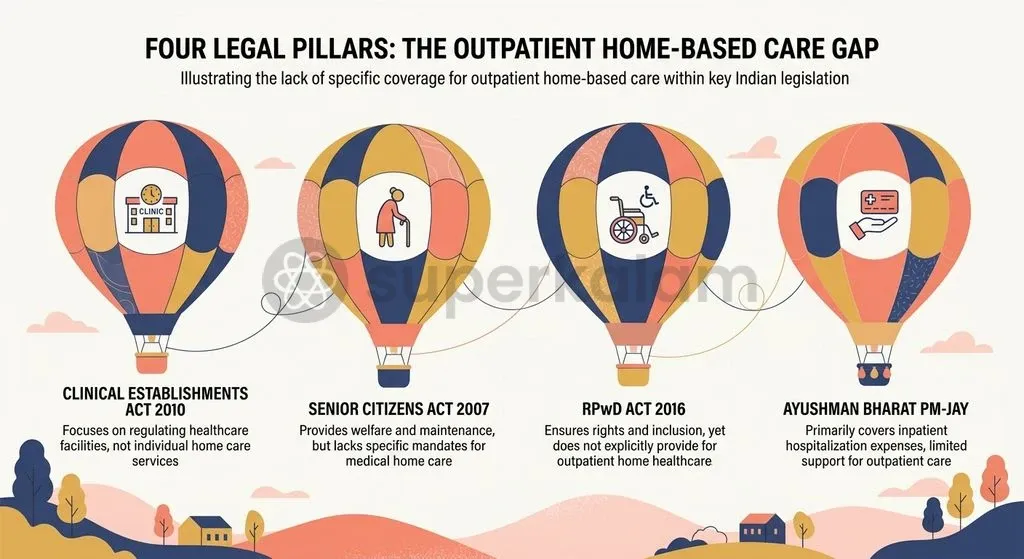
Regulatory blind spots leave both care aides and vulnerable households exposed. Four distinct statutory barriers drive this market failure:
- Absence of Domiciliary Regulations: The Clinical Establishments (Registration and Regulation) Act, 2010 applies strictly to brick-and-mortar facilities in adopting states. It excludes home-based clinical and caregiving agencies, allowing digital aggregators and private brokers to operate without quality benchmarks or labour safeguards.
- Narrow Legislative Mandates: The Maintenance and Welfare of Parents and Senior Citizens Act, 2007 provides tribunals for maintenance and property revocations. It contains no statutory provisions governing the quality, licensing, or operation of home care agencies.
- Incomplete Welfare Enactments: The Rights of Persons with Disabilities (RPwD) Act, 2016 recognises caregivers of individuals with benchmark disabilities requiring high support. However, the statute stops short of creating enforceable entitlements to state-funded care allowances or respite services.
- Exclusion from Public Health Insurance: Ayushman Bharat PM-JAY provides universal health coverage of Rs 5 lakh annually for citizens aged 70 and above. This entitlement covers inpatient hospitalisation, leaving outpatient long-term domiciliary care unfinanced.
Unlocking the Care Economy: Economic and Employment Potential
Formalising care delivery unlocks substantial economic value while converting uncounted domestic labour into productive employment. Economic modelling by the NITI Aayog shows that India's care services sector was valued at USD 29.62 billion in 2023. Driven by rising life expectancy and domestic spending power, this market is projected to expand at a compound annual growth rate of 13.76% to reach USD 72.31 billion by 2030.
Expanding this infrastructure delivers both domestic and international dividends across three dimensions:
- Female Workforce Participation: Indian women spend 299 minutes per day on unpaid care and domestic work, compared to only 97 minutes spent by men. This uncompensated burden keeps urban female workforce participation depressed between 20% and 25%. Accessible home care allows women to pursue formal careers.
- Domestic Job Creation: Transitioning care from informal kinship into regulated service delivery establishes a dignified, remunerative career pathway for thousands of young workers entering the health sector.
- Global Care Corridors: The World Health Organization estimates a worldwide deficit of nearly 11 million health and care workers by 2030, while OECD nations will require 13.5 million additional personnel by 2040. Rigorous domestic certifications position India as a reliable provider of care personnel globally.
Discuss with Superkalam
How does the exclusion of domiciliary care from public health insurance schemes like Ayushman Bharat PM-JAY impact rural households?
Ask NowInternational Benchmarks: Lessons from Japan's Long-Term Care Model
Japan implemented statutory universal eldercare through the Long-Term Care Insurance (LTCI) Act, enacted in 1997 and launched nationally in 2000. The LTCI system removes the burden of senior care from private family arrangements by providing publicly funded, institutionalised home care and day services. Financing draws equally from mandatory social insurance contributions paid by citizens aged 40 and above, supplemented by general taxation.
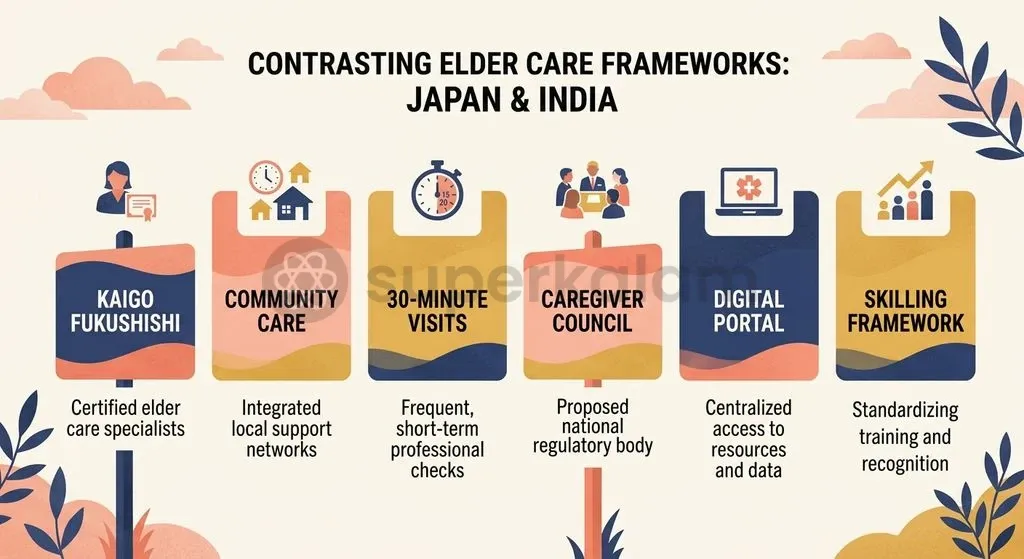
Professionalisation of the Japanese care sector operates through the certified care worker credential, known as Kaigo Fukushishi. Regulated under the Social Welfare Worker and Certified Care Worker Act, this framework establishes standardised multi-year curricula, rigorous national licensing examinations, and legally protected wage floors.
| Institutional Pillar | Operational Mechanism |
|---|---|
| Social Insurance | Mandatory LTCI pooling covers non-medical domiciliary support |
| Professional Certification | Statutory Kaigo Fukushishi credential ensures uniform care standards |
| Integrated Delivery | Community centres guarantee comprehensive care within a 30-minute radius |
| (Source: Ministry of Health, Labour and Welfare, Japan) |
Japan also implemented the Community-based Integrated Care System under the Medical Care Act and LTCI Law amendments. This framework integrates healthcare, home assistance, housing, and livelihood services within a 30-minute neighbourhood radius.
Similarly, Germany uses statutory long-term care insurance (Pflegeversicherung) to finance certified nursing and eldercare apprenticeships. Both systems illustrate how statutory social insurance underpins a professional care workforce.
Standardising the Profession: Institutional Roles of HSSC and NSQF
Vocational certification under the Healthcare Sector Skill Council (HSSC) faces structural obstacles in placing skilled geriatric workers across domestic healthcare markets. While the National Skill Development Corporation (NSDC) and the Pradhan Mantri Kaushal Vikas Yojana (PMKVY) have funded healthcare training, industry absorption remains uneven. Across healthcare and allied trades under PMKVY short-term initiatives, the overall placement rate reached only 41%, placing 23.18 lakh workers out of 56.14 lakh certified candidates.
Two structural bottlenecks explain this low absorption:
- Entry-Level Curricular Ceilings: Existing qualifications for Geriatric Care Aides focus on entry-level proficiencies at NSQF Levels 3 and 4. These courses lack advanced modules required to manage complex conditions such as Parkinson's, advanced Alzheimer's, stroke rehabilitation, and end-of-life palliative home care.
- Unregulated Private Aggregators: The Ministry of Social Justice and Empowerment launched the SHATAYU digital dashboard to monitor geriatric infrastructure, institutional capacity, and caregiver training across states. However, private home healthcare agencies operate largely outside these training frameworks, keeping market standards fragmented and unregulated.
Discuss with Superkalam
Should India adopt a mandatory social insurance mechanism for eldercare similar to Japan's Long-Term Care Insurance framework? Weigh the trade-offs.
Ask NowWay Forward: A National Strategy for Training and Worker Protections
Establishing a statutory National Caregiver Council under the Ministry of Skill Development and Entrepreneurship is essential to regulate, accredit, and standardise home-care professions. A dedicated council would define mandatory operating standards for private home-care agencies and establish an enforceable registry of certified practitioners.
Policy reforms should focus on four integrated priorities:
- Create Modular NSQF Certifications: The HSSC should develop tiered certifications advancing from basic eldercare at NSQF Level 3 to specialised geriatric and palliative credentials at Levels 5 and 6.
- Launch the National Digital Caregiving Portal: Operating a verified digital directory will allow families to hire certified attendants directly while curbing exploitative intermediary fees.
- Introduce Social Insurance Mechanisms: Expanding Ayushman Bharat PM-JAY or creating a dedicated long-term care insurance vertical will help finance outpatient domiciliary care for vulnerable elderly populations.
- Form Government-to-Government Mobility Pacts: Developing structured bilateral agreements with rapidly ageing economies such as Germany, Japan, and the UK will build formal overseas employment corridors supported by cultural and language training.
Key Takeaways
- India's elderly population will surge from 149 million in 2022 to 347 million by 2050, creating urgent demand for formal geriatric care services.
- Fewer than 1.5 lakh certified caregivers currently exist to assist an estimated 146 million informal, unpaid family caregivers across the country.
- Chronic disease affects roughly 75% of elderly Indians, while 8.8 million seniors live with dementia, requiring skilled clinical interventions rather than unassisted domestic support.
- Private home-healthcare platforms operate under a regulatory vacuum because the Clinical Establishments Act, 2010 excludes domiciliary providers.
- International models like Japan's Long-Term Care Insurance and certified Kaigo Fukushishi credentials demonstrate how public insurance and statutory licensing professionalise care work.
Mains Question
"Non-professional domestic care is structurally ill-equipped to manage complex geriatric multimorbidities and neurodegenerative conditions." In light of this statement, critically examine the institutional and regulatory gaps in India's domiciliary eldercare sector. (15 Marks)
Evaluate NowMains Question
Highlighting the recommendations of NITI Aayog's report 'Reimagining Care: Strategies for Empowering Caregivers in Viksit Bharat@2047', elucidate how formalising the care economy can unlock economic growth and address female labour force participation. (10 Marks)
Evaluate NowPractice MCQs
QUESTION 1
With reference to demographic trends and elderly care in India, consider the following statements:
- According to NITI Aayog projections, older persons will account for more than 20% of India's total population by 2050.
- Over 70% of senior citizens reside in rural areas, where physician density is less than half that of urban centres.
- The National Programme for Health Care of the Elderly (NPHCE) currently provides dedicated domiciliary caregiver extension units across all tertiary facilities. Which of the statements given above are correct?
QUESTION 2
Consider the following statements regarding the regulatory and statutory landscape of eldercare in India:
- The Clinical Establishments (Registration and Regulation) Act, 2010 regulates home-based caregiving aggregators and domiciliary care agencies.
- The Maintenance and Welfare of Parents and Senior Citizens Act, 2007 provides for maintenance tribunals but contains no statutory provisions governing the licensing of home care agencies.
- Ayushman Bharat PM-JAY covers universal inpatient hospitalisation up to Rs 5 lakh annually for citizens aged 70 and above, but excludes outpatient long-term domiciliary care. Which of the statements given above is/are correct?
QUESTION 3
Regarding the economic dimensions of the care economy as outlined in recent reports, consider the following statements:
- Indian women spend more than three times as many minutes per day on unpaid care and domestic work compared to men.
- According to NITI Aayog modelling, India's care services sector is projected to reach over USD 70 billion by 2030.
- The Rights of Persons with Disabilities (RPwD) Act, 2016 establishes enforceable, state-funded monetary entitlements for informal family caregivers. Which of the statements given above is/are correct?
QUESTION 4
With reference to international models of long-term care mentioned in the NITI Aayog findings, consider the following statements:
- Japan's Long-Term Care Insurance (LTCI) system finances eldercare using mandatory social insurance contributions starting at age 40, supplemented by general taxation.
- Under Japan's framework, certified care workers are credentialed under the designation 'Kaigo Fukushishi'. Which of the statements given above is/are correct?
QUESTION 5
According to the Longitudinal Ageing Study in India (LASI) data cited in the NITI Aayog report, what proportion of elderly persons in India have at least one chronic medical condition?