Draft Rules on Generative AI in Research: Curbing Academic Fraud in Higher Education
As automated tools threaten scientific credibility, India moves to separate permissible editorial AI use from fraudulent manuscript generation.
Aug, 2026
•7 min read

Overview
The University Grants Commission and academic regulatory bodies are introducing rigorous guidelines to govern Generative AI in higher education. These rules establish clear boundaries between permissible editorial assistance and fraudulent content generation. While artificial intelligence offers researchers rapid data synthesis and literature indexing, unchecked adoption facilitates synthetic data fabrication, automated paper mills, and citation hallucinations. Establishing institutional governance frameworks ensures scientific authenticity, enforces human accountability, and protects academic credibility across Indian research institutions.
Why Are GenAI Guidelines for Higher Education in the News?
The University Grants Commission is finalising comprehensive guidelines to regulate Generative Artificial Intelligence tools across Indian universities and research institutions. As of June 2026, academic bodies have intensified scrutiny on automated manuscript generation to address structural risks threatening scientific validity.
Research regulatory bodies are responding to an influx of machine-generated text in academic dissertations and scholarly journals. Emerging frameworks restrict artificial intelligence tools to language polishing and formatting, while strictly prohibiting uncredited AI drafting of core analysis, as outlined in the UGC Academic Integrity and Research Quality Framework.
Higher education regulatory monitoring indicates that unacknowledged machine-generated text in doctoral dissertations may face institutional sanctions. The reported enforcement matrix applies tiered penalties for misconduct:
- Minor Overlaps: Mandatory thesis revision within six months.
- Severe Violations: Debarment and cancellation of doctoral registration.
Discuss with Superkalam
What are the two integrity panels established under the UGC Regulations 2018 to investigate research misconduct?
Ask NowWhat the Draft Guidelines Propose for Indian Universities
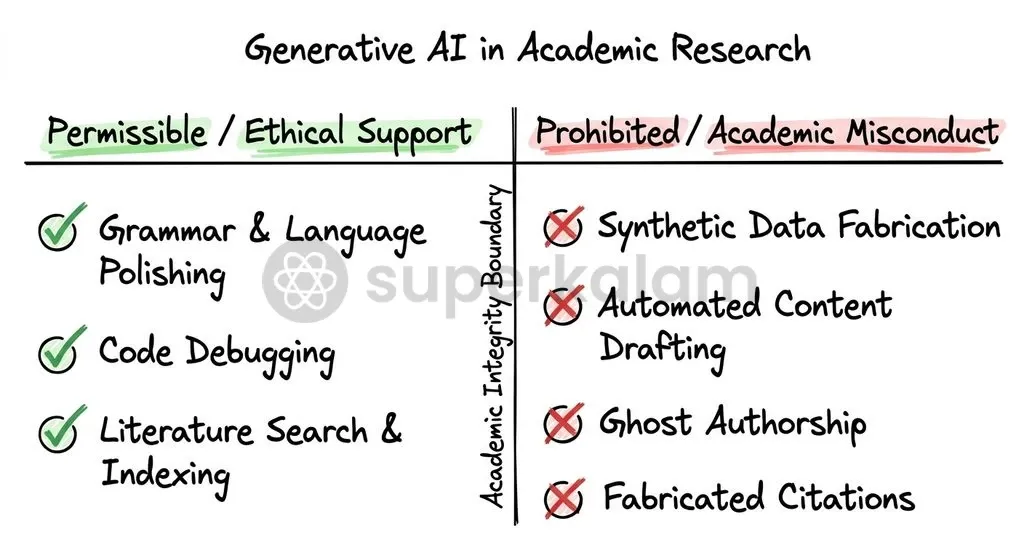
The University Grants Commission proposes a dual-tier approach separating acceptable digital research assistance from non-negotiable research misconduct. Permissible use allows scholars to employ machine models for grammar correction, language translation, code debugging, and formatting assistance.
- Permissible Assistance: Refining sentence syntax, copy-editing, restructuring author-generated prose, and optimising programming scripts for data computation.
- Prohibited Applications: Employing artificial intelligence to fabricate empirical results, generate synthetic data arrays, or draft literature reviews without independent human analysis.
- Mandatory Transparency: Researchers must include explicit disclosure statements in their methodologies, specifying the exact software version, prompt parameters, and functional scope utilised.
To investigate violations, higher education institutions rely on the statutory framework established under the University Grants Commission Regulations, 2018. These regulations empower a two-tier adjudicatory structure comprising the Departmental Academic Integrity Panel and the Institutional Academic Integrity Panel to assess infractions and recommend appropriate institutional penalties.
How Generative AI Threatens Academic Integrity and Data Authenticity
Generative AI architectures introduce profound vulnerabilities into scientific literature by generating fabricated citations, non-existent Digital Object Identifiers, and synthetic data. Large language models operate on probabilistic token prediction rather than factual comprehension. Consequently, they frequently invent authoritative-sounding references that distort the scholarly record.
Scientific integrity guidelines classify the creation of ungrounded synthetic datasets as severe scientific fraud. According to the Indian Council of Medical Research Policy on Research Integrity and Publication Ethics, generating synthetic experimental results without authentic empirical execution constitutes actionable data fabrication.
- Synthetic Data Generation: Machine-generated laboratory readings and patient cohorts that mimic genuine experimental datasets while lacking physical laboratory verification.
- Citation Hallucination: Algorithmic generation of fictional journal titles, author names, and volume numbers that misdirect scholarly verification.
- Confidentiality Breaches: Uploading unpublished manuscripts or grant proposals into commercial cloud models, violating reviewer confidentiality agreements and exposing intellectual property.
Discuss with Superkalam
Why do large language models generate citation hallucinations even when producing fluent academic prose?
Ask NowThe Rise of AI-Powered Predatory Publishing and Paper Mills
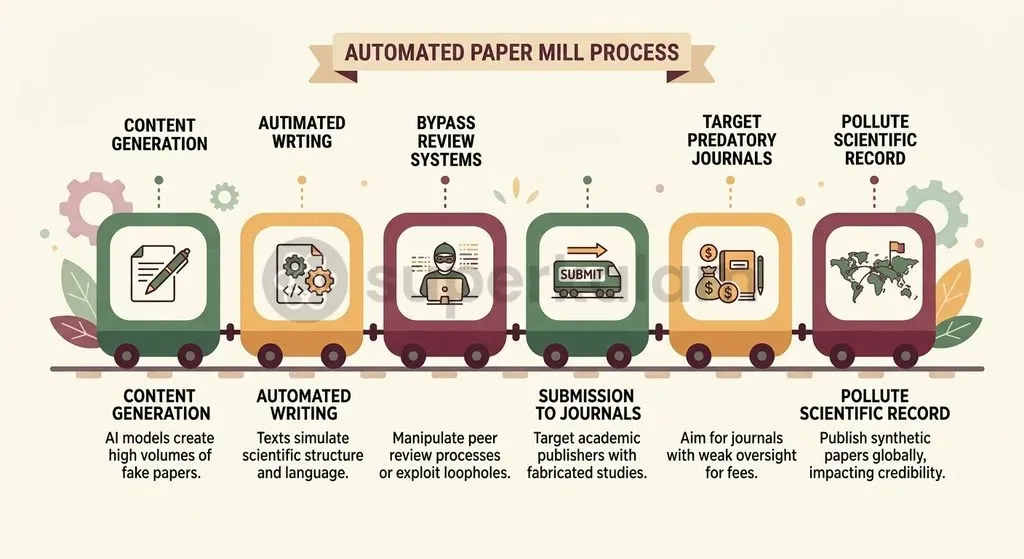
Commercial paper mills are deploying large language models to produce pseudo-scientific manuscripts at industrial scale, overwhelming standard editorial review mechanisms. A joint investigation by the Committee on Publication Ethics and STM confirmed that automated syndicates flood scholarly databases with synthetic manuscripts to monetise academic credentialism.
To combat this proliferation, Indian regulatory bodies enforce specific institutional mechanisms:
- Curated Journal Indexing: The University Grants Commission maintains the UGC-CARE reference list to steer scholars toward vetted publications and prevent the diversion of institutional funds toward deceptive open-access outlets.
- Repository Similarity Screening: Through the Ministry of Education's ShodhShuddhi programme, administered by the INFLIBNET Centre, universities deploy automated text-similarity tools across doctoral repositories.
However, current probabilistic detection software exhibits documented false-positive rates, frequently penalising non-native English scholars whose predictable writing syntax resembles machine outputs.
Comparing Global Standards: India, UNESCO, and the European Union
International governance bodies have established distinct regulatory approaches to balance research innovation with ethical accountability. While the European Union adopts a legally binding classification system, UNESCO provides broad normative recommendations for educational deployments.
| Parameter | Indian Regulatory Framework | UNESCO Recommendations (2023) | European Union AI Act (2024) |
|---|---|---|---|
| Legal Character | Statutory regulations and institutional advisory frameworks | Non-binding global ethical guidance | Legally binding regulation across member states |
| Scope of R&D Exemption | Targeted integrity rules for dissertations and publications | Broad principles across educational systems | Explicit exemption for purely scientific research and development |
| High-Risk Classification | Evaluated via departmental and institutional integrity panels | Emphasises age restrictions and data protection | Classifies educational evaluation and recruitment tools as high-risk systems |
| Capacity Building | Ministry-supported repository checks via ShodhShuddhi | Recommends national validation mechanisms | Mandates institutional measures to ensure baseline AI literacy |
Article 2(8) of the EU AI Act further clarifies that developmental testing prior to commercial deployment remains exempt from general compliance duties, maintaining flexibility for laboratory innovation.
Discuss with Superkalam
How should a university panel handle a case where text-detection software flags a non-native English researcher's dissertation as AI-generated?
Ask NowEthical Dilemmas in AI-Driven Research (GS Paper 4 Perspective)
Scientific ethics requires that moral and legal responsibility for intellectual claims rests exclusively with human practitioners. Authoritative publishing bodies, including the Committee on Publication Ethics and the International Committee of Medical Journal Editors, affirm that artificial intelligence cannot claim authorship because algorithms cannot accept legal accountability or manage conflict-of-interest declarations.
National biomedical guidelines reinforce this requirement for human-centred oversight. The Indian Council of Medical Research mandates that all medical and clinical AI deployments adhere to active human governance, ensuring algorithmic outputs do not bypass ethical review boards.
- Epistemic Responsibility: Ensuring that researchers personally verify the mathematical accuracy, logical deduction, and empirical truth of every asserted finding.
- Procedural Transparency: Providing verifiable disclosure records detailing the specific software version and algorithmic parameters applied in empirical analysis.
- Distributive Justice: Preventing proprietary commercial models from establishing technological monopolies that disadvantage researchers from resource-constrained public universities.

Discuss with Superkalam
Weigh the benefits of R&D exemptions in AI regulation against the risks of unchecked synthetic data fabrication in academic labs.
Ask NowWay Forward: Building Institutional Capacity and Responsible AI Norms
Indian higher education institutions must transition from relying exclusively on automated text-screening tools toward multi-layered verification systems. Because statistical detection models produce frequent false positives, institutions must combine digital screening with structural research oversight.
Policy dialogues convened by scientific bodies recommend augmenting text-matching tools with oral thesis defenses, open reproducible research repositories, and laboratory notebook inspections. These practical measures verify that researchers performed authentic laboratory work rather than generating synthetic findings.
- Establishing AI Ethics Committees: Integrating computational specialists into Institutional Academic Integrity Panels to evaluate technical fraud allegations.
- Adopting Open-Science Protocols: Requiring doctoral candidates to archive raw laboratory readings, computation scripts, and source code in university-managed repositories.
- Restructuring Doctoral Evaluations: Prioritising rigorous viva voce examinations that test a candidate's independent mastery over empirical methodologies and statistical reasoning.
- Strengthening AI Literacy: Implementing structured training programmes across universities to ensure faculty members effectively identify predatory publishing schemes.
Key Takeaways
- The University Grants Commission is instituting comprehensive frameworks that permit generative models for syntax and formatting assistance while strictly prohibiting uncredited content generation.
- International publishing bodies, including COPE and ICMJE, rule that artificial intelligence cannot receive authorship credits due to an inability to bear legal accountability.
- Fabricating synthetic experimental data without physical or empirical grounding constitutes severe scientific misconduct under national research integrity standards.
- The European Union AI Act provides dedicated exemptions for purely scientific research under Article 2(6), while classifying educational assessment tools as high-risk systems under Annex III.
- Sustainable governance requires combining digital detection tools with oral thesis defense protocols, raw data archiving, and institutional integrity panel reviews.
Mains Question
"Artificial intelligence cannot claim authorship because algorithms cannot accept legal accountability or manage conflict-of-interest declarations." In light of this statement, critically analyse the ethical and structural challenges posed by Generative AI to academic integrity, and evaluate the institutional mechanisms proposed by the UGC to regulate its use. (15 Marks)
Evaluate NowMains Question
Compare the regulatory approaches of India, UNESCO, and the European Union towards governing Artificial Intelligence in research and higher education. Elucidate how India can balance scientific innovation with research integrity. (10 Marks)
Evaluate NowPractice MCQs
QUESTION 1
Consider the following statements regarding the institutional mechanisms to address academic misconduct and predatory publishing in India:
- The UGC Plagiarism Regulations, 2018 establish a two-tier adjudicatory structure comprising the Departmental Academic Integrity Panel and the Institutional Academic Integrity Panel.
- The Ministry of Education's ShodhShuddhi programme is administered by the INFLIBNET Centre to deploy automated text-similarity tools across doctoral repositories.
- The UGC-CARE reference list is maintained to identify deceptive open-access outlets and mandate them as sole publication channels. Which of the statements given above is/are correct?
QUESTION 2
Consider the following statements regarding the ethical guidelines and legal status of Artificial Intelligence in research and publishing:
- According to the Committee on Publication Ethics (COPE) and ICMJE, artificial intelligence tools cannot be listed as authors on scholarly papers.
- The European Union AI Act (2024) provides an explicit exemption from compliance duties for purely scientific research and development.
- The Indian Council of Medical Research (ICMR) allows synthetic data generation in clinical studies without empirical laboratory execution if approved by institutional heads. Which of the statements given above is/are correct?
QUESTION 3
Under the Draft UGC guidelines on Generative AI, which of the following uses of AI tools are classified as 'Permissible Assistance' for academic researchers?
- Optimising programming scripts for data computation
- Refining sentence syntax and grammar correction
- Generating synthetic patient cohorts and experimental data arrays
- Drafting literature reviews without independent human analysis Select the correct answer using the code given below:
QUESTION 4
Under the European Union Artificial Intelligence Act (2024), AI systems used for educational evaluation and recruitment are classified under which of the following categories?
QUESTION 5
Consider the following statements regarding the risks of Generative AI in scientific integrity:
- Large language models frequently produce citation hallucinations because they operate on probabilistic token prediction rather than factual comprehension.
- Uploading unpublished manuscripts to commercial cloud AI models can breach reviewer confidentiality agreements.
- Current probabilistic text-detection software has documented false-positive rates that disproportionately affect non-native English writers. Which of the statements given above are correct?