Dak MITRA and Dak Sewa: India Post IT 2.0 and Rural Delivery
How India Post's cloud-native IT 2.0 rollout is transforming 1.9 lakh Gramin Dak Sevaks into last-mile financial inclusion hubs across rural India.
Sep, 2026
•9 min read
Overview
The Department of Posts has transformed India Post from a traditional postal carrier into a cloud-native financial logistics engine. This shift relies on indigenously developed Dak MITRA and Dak Sewa applications under the comprehensive IT 2.0 framework.
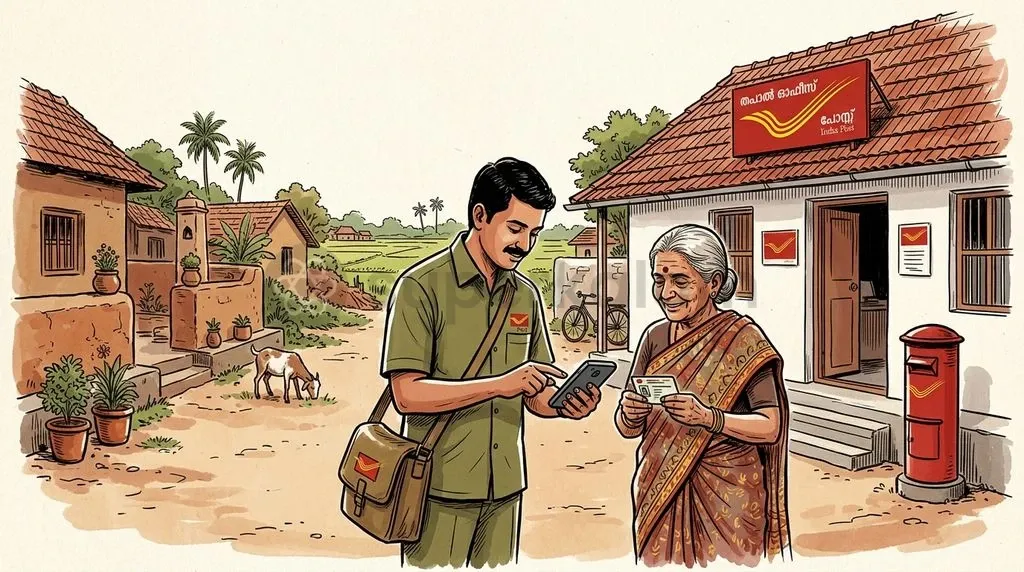
Deployed across more than 1.4 lakh Branch Post Offices, the unified Dak MITRA platform equips over 1.9 lakh Gramin Dak Sevaks with Android smartphones and biometric hardware. These frontline workers deliver paperless banking, Aadhaar-enabled payments, and real-time parcel bookings directly to citizens' doorsteps.
Complementing this, the citizen-facing Dak Sewa application democratises access to postal and micro-logistics tracking across 23 Indian languages. This modernisation bridges rural digital divides by turning every local post office into a full-spectrum inclusion hub.
Why in the News? Department of Posts Rolls Out IT 2.0 Initiatives
The Department of Posts rolled out upgraded versions of the indigenously developed Dak MITRA and Dak Sewa mobile applications on 24 August 2026. Alongside this software deployment, the Ministry of Communications inaugurated 14 renovated post office buildings across ten States to modernise physical and digital service delivery.
This digital overhaul marks the nationwide expansion of the Department of Posts IT Modernisation Project 2.0 (DoP IT 2.0). The reform anchors postal delivery to India's digital public infrastructure. Consequently, it directly facilitates decentralised citizen service delivery and social protection disbursement across remote geographies.
Discuss with Superkalam
What are the core technical specifications and developer origin of the Advanced Postal Technology (APT) platform under IT 2.0?
Ask NowUnderstanding DoP IT 2.0: The Blueprint for Modernizing Postal Infrastructure
The Department of Posts IT Modernisation Project 2.0 transitions postal operations from legacy monolithic software architectures to modular, cloud-native frameworks. Under IT 2.0, India Post replaced older SAP systems and DARPAN 1.0 architecture with the Advanced Postal Technology platform, an indigenous solution developed in-house by the Centre for Excellence in Postal Technology (CEPT), Mysore.
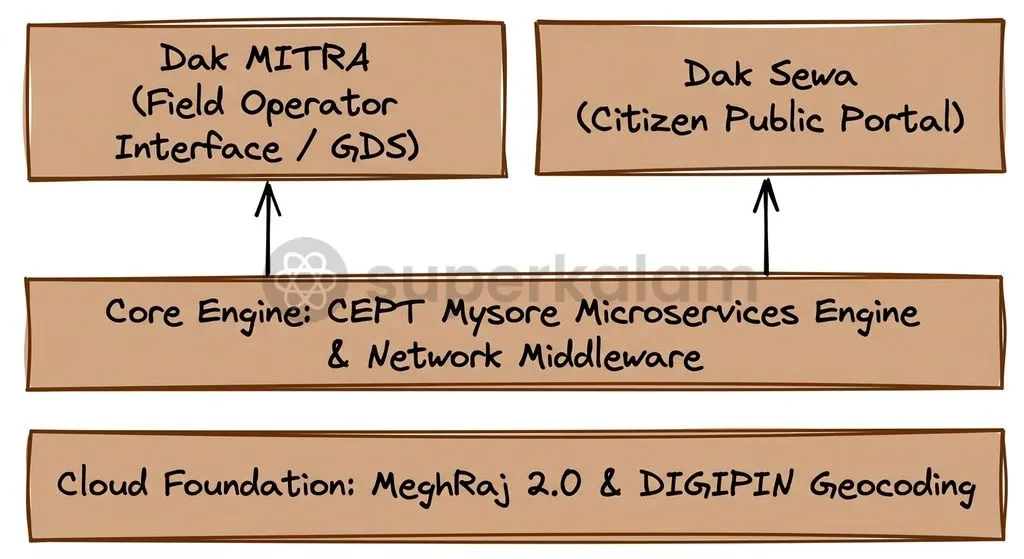
The modernized architecture rests on several core structural pillars:
- Cloud-Native Microservices: Hosted on the Government of India's MeghRaj 2.0 cloud infrastructure, the platform runs on a microservices and Open API architecture.
- Extensive Network Coverage: The setup connects approximately 1.70 lakh postal units over Bharat Sanchar Nigam Limited (BSNL) nationwide connectivity.
- Geospatial Addressing: To resolve spatial discrepancies in remote deliveries, the ecosystem introduced the DIGIPIN geospatial system. This 10-digit alphanumeric geo-coded identification grid eliminates address ambiguity.
- E-Commerce Integration: The framework underpins India Post's pivot toward high-volume parcel logistics, integrating seamlessly with platforms like the Open Network for Digital Commerce (ONDC) and Government e-Marketplace (GeM).
What Are Dak MITRA and Dak Sewa? Architecture, Functions, and Use Cases
Dak MITRA and Dak Sewa are the two primary operational interfaces of India Post's digital transformation. Dak MITRA serves the frontline postal workforce, whereas Dak Sewa functions as the unified customer-facing portal.
Dak MITRA (Mobile Interface for Transactions & Rural Assistance) is a unified Android-based operational application. Deployed across more than 1.4 lakh Branch Post Offices, it empowers Branch Postmasters and Gramin Dak Sevaks to perform:
- Paperless postal bookings for domestic and international letters, speed posts, and parcel logistics.
- Doorstep financial transactions, including deposits, withdrawals, and remittances through core banking integration.
- Postal Life Insurance operations, enabling digital premium collections, policy issuance, and real-time ledger updates.
- Biometric Aadhaar services, allowing Aadhaar-based e-KYC, mobile number updation, and new enrolments.
Dak Sewa is the public-facing mobile application providing round-the-clock access to postal services. Integrated with the BHASHINI language translation engine, the app supports 23 Indian languages. Dak Sewa allows citizens to calculate tariffs, request doorstep package pickups, locate the nearest post office, register service complaints, and track parcels using real-time GPS telemetry.
| Functional Dimension | Dak MITRA (Workforce Interface) | Dak Sewa (Citizen Interface) |
|---|---|---|
| Primary User Base | Gramin Dak Sevaks & Branch Postmasters | General public, MSMEs, and rural enterprises |
| Operating System | Android OS on departmental mobile devices | Multi-platform mobile app (iOS and Android) |
| Core Functions | Postal booking, AePS banking, and biometric updates | 24x7 parcel booking, tracking, and tariff calculation |
| Language Support | Standardised operational workflows | 23 Indian languages integrated via BHASHINI |
| Verification Mechanism | Biometric scanning, iris capture, and Face Auth | OTP-based electronic Proof of Delivery (e-PoD) |
Discuss with Superkalam
How does the shift from proprietary DARPAN terminals to standardized Android smartphones improve operational scalability for India Post?
Ask NowTransforming Rural Financial Logistics: From Traditional Post to Last-Mile Banking Hubs
India Post Payments Bank forms the operational backbone for rural financial inclusion by leveraging India Post's physical distribution network. Functioning through 650 branches and over 1.64 lakh postal access points, India Post Payments Bank utilises the Aadhaar Enabled Payment System to provide interoperable, bank-agnostic doorstep financial services.
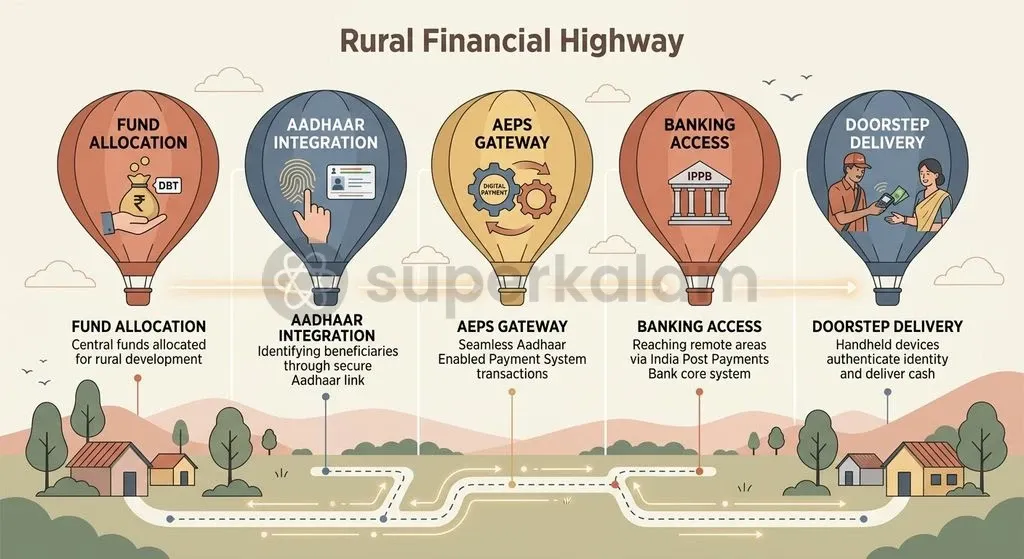
Over 1.9 lakh Gramin Dak Sevaks and postmen carry biometric scanning devices and smartphones, effectively turning postal delivery beats into mobile banking corridors. This setup enables Direct Benefit Transfer disbursements under major welfare schemes without requiring rural beneficiaries to travel to distant commercial bank branches.
Beyond cash transactions, the postal network delivers critical non-financial administrative services:
- Child Enrolment Lite Client (CELC) services for enrolling children aged under five into the Aadhaar ecosystem at home.
- Aadhaar demographic updations, facilitating real-time mobile number linkage to bank accounts.
- Digital Life Certificates (Jeevan Pramaan) generation, utilising biometric verification to eliminate physical appearance requirements for pensioners.
As of August 2026, the Post Office Savings Bank system manages 40 crore accounts with ₹24 lakh crore in deposits, alongside roughly 4 crore Sukanya Samriddhi Accounts holding ₹2.5 lakh crore in accumulated savings. The postal network actively bridges gender disparities, with women comprising 48% of total account holders across India Post Payments Bank.
Discuss with Superkalam
How can the integration of India Post with ONDC and GeM stimulate micro, small, and medium rural enterprises (MSMEs)?
Ask NowComparing DoP IT 1.0 vs. DoP IT 2.0: What Changes on the Ground?
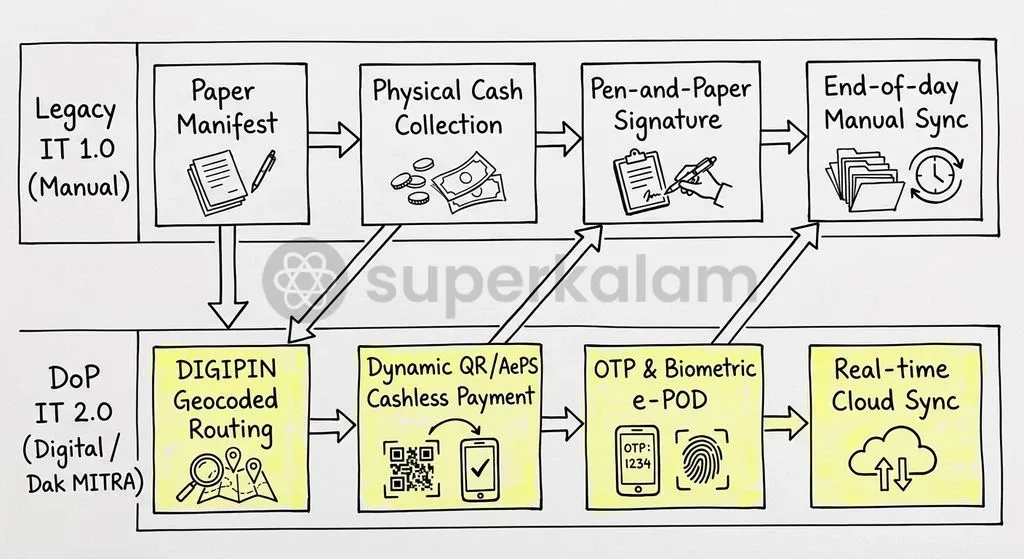
The transition from IT Modernisation Project 1.0 to IT 2.0 replaces closed, hardware-dependent field architecture with open, cloud-native systems. Under IT 1.0, rural branches relied on custom SIM-based DARPAN handheld terminals deployed from 2018 at a cost exceeding ₹1,300 crore.
| Parameter | IT Modernisation Project 1.0 (Legacy) | DoP IT 2.0 Architecture (Current) |
|---|---|---|
| Software Model | Monolithic, siloed enterprise applications (SAP, DARPAN 1.0) | Cloud-native microservices architecture (APT platform) |
| Hosting Environment | On-premise departmental servers | MeghRaj 2.0 Cloud infrastructure |
| Field Hardware | Proprietary DARPAN handheld terminals | Standardised Android smartphones with biometric peripherals |
| Delivery Validation | Physical paper signatures and manual manifests | Dynamic QR codes and OTP-based e-PoD |
| Logistics Integration | Point-to-point batch processing | Real-time tracking integrated with ONDC and GeM |
| Operational Agility | Fixed branch operating hours | 344 specialized delivery centres operating across extended shifts |
This structural upgrade has yielded tangible commercial gains. India Post registered postal revenue exceeding ₹4,000 crore in the first quarter of financial year 2026-27 (Q1 FY27), representing a 22 percent year-on-year growth over Q1 FY26. Operational efficiency has also been bolstered by 344 specialised delivery centres running on morning, evening, and holiday shifts.
Key Challenges in Implementation: Digital Connectivity, Hardware Reliability, and Field Training
Implementing a real-time digital architecture across remote geographies exposes major infrastructural and technical vulnerabilities. The foremost constraint involves cellular blind spots in remote areas.
- Connectivity and Cloud Latency: Intermittent cellular networks and regional uptime gaps across BharatNet fibre assets create transaction timeouts during live biometric e-KYC verification and cloud synchronisation on MeghRaj, according to parliamentary performance reviews.
- Biometric Authentication Failures: Fingerprint degradation among agricultural labourers and the elderly poses serious authentication roadblocks. To address this exclusion risk, the Department of Posts has integrated Aadhaar-based Face Authentication within GDS mobile devices.
- Hardware and Thermal Stress: Frontline smartphones face hardware degradation and battery exhaustion during long delivery routes in extreme weather conditions, requiring reliable field support networks.
- Workforce Digital Upskilling: Transitioning over 1.9 lakh Gramin Dak Sevaks from paper-based ledgers to multi-service digital terminals requires continuous, multi-lingual technical training.
GS4 Ethical and Governance Angle: Financial Inclusion as a Catalyst for Public Trust
Public administration principles emphasise that accessibility, equity, and procedural justice form the core of legitimate democratic governance. Gramin Dak Sevaks provide a vital human connection between the state apparatus and rural citizens, embodying compassionate and responsive public administration.
When welfare beneficiaries face structural hurdles in accessing their entitlements due to physical infirmity or geographical isolation, doorstep service delivery upholds distributive justice. Taking banking services directly to vulnerable citizens prevents exclusion errors in welfare delivery.
Moreover, institutionalising transparency through OTP-based electronic proof of delivery and dynamic QR payments curtails intermediary rent-seeking. This strengthens public trust in institutional mechanisms and reinforces the social contract between citizens and the state.
Way Forward: Leveraging Gramin Dak Sevaks for Full-Spectrum Citizen Services
Maximising the potential of India Post's digital infrastructure requires converging postal logistical capacity with grassroots governance initiatives. Gramin Dak Sevaks can function as decentralised enterprise facilitators by partnering with Self-Help Groups under the National Rural Livelihoods Mission (NRLM) to aggregate rural artisan products for national marketplaces via ONDC.
Physical infrastructure must modernise alongside software assets. The Department of Posts has partnered with the School of Planning and Architecture (SPA), New Delhi, to draft a national Design Manual to re-engineer post office layouts for standardised accessibility, modern counters, and transparent service zoning.
Investing in offline-capable transaction queuing, biometric face authentication, and continuous digital upskilling will ensure that India Post anchors the delivery of universal social security across rural India.
Discuss with Superkalam
Evaluate the effectiveness of utilizing postal distribution networks rather than expanding traditional commercial bank branches for achieving complete rural financial inclusion.
Ask NowKey Takeaways
- The Department of Posts transitioned to DoP IT 2.0, replacing legacy monolithic SAP systems with the cloud-native Advanced Postal Technology platform hosted on MeghRaj 2.0.
- Dak MITRA equips over 1.9 lakh Gramin Dak Sevaks with Android smartphones and biometric hardware to execute paperless postal booking, AePS banking, and Aadhaar e-KYC across 1.4 lakh branch post offices.
- The citizen-facing Dak Sewa application provides 24x7 tracking, tariff calculation, and pickup requests in 23 Indian languages through BHASHINI integration.
- India Post Payments Bank utilises over 1.64 lakh access points to deliver interoperable doorstep banking, life certificates, and Direct Benefit Transfers.
- Adoption of the 10-digit DIGIPIN system and dynamic QR-based e-PoD enhances last-mile parcel tracking and logistics revenue.
- Mitigating rural connectivity deficits, resolving biometric authentication errors through Face Auth, and modernising post office physical architecture remain essential for long-term operational resilience.
Mains Question
"The transition from legacy hardware-dependent systems to cloud-native microservices under India Post IT Modernisation 2.0 has redefined the role of Gramin Dak Sevaks from mere postal couriers to last-mile delivery agents of welfare and banking." Elucidate. (15 Marks)
Evaluate NowMains Question
"Despite the deployment of advanced mobile interfaces like Dak MITRA, last-mile digital public service delivery continues to encounter severe infrastructural and technological bottlenecks in remote rural geographies." Critically examine. (10 Marks)
Evaluate NowPractice MCQs
QUESTION 1
With reference to the Department of Posts IT Modernisation Project 2.0 (DoP IT 2.0), consider the following statements:
- The Advanced Postal Technology (APT) platform was developed indigenously by the Centre for Excellence in Postal Technology (CEPT), Mysore.
- The underlying software architecture is hosted on the MeghRaj 2.0 cloud infrastructure using microservices and Open APIs.
- The DIGIPIN geospatial system introduces a 12-digit numeric identification grid to resolve rural delivery discrepancies.
Which of the statements given above are correct?
QUESTION 2
Consider the following statements regarding the 'Dak MITRA' and 'Dak Sewa' applications:
- Dak MITRA is a frontline operational application running on Android mobile devices for Gramin Dak Sevaks and Branch Postmasters.
- Dak Sewa is an outward-facing citizen portal integrated with the BHASHINI translation engine supporting 23 Indian languages.
- Both applications rely exclusively on proprietary DARPAN handheld hardware terminals deployed during IT Modernisation Project 1.0.
Which of the statements given above is/are correct?
QUESTION 3
With reference to rural financial logistics through India Post Payments Bank (IPPB) and Post Office Savings Bank (POSB), consider the following statements:
- IPPB utilizes the Aadhaar Enabled Payment System (AePS) to deliver interoperable, bank-agnostic doorstep financial services.
- Women constitute nearly 48 percent of total account holders across India Post Payments Bank.
- Doorstep non-financial services delivered through the network include Child Enrolment Lite Client (CELC) and Digital Life Certificates (Jeevan Pramaan).
Which of the statements given above are correct?
QUESTION 4
Which of the following correctly describes the 'DIGIPIN' system introduced under India Post's modernised framework?
QUESTION 5
Consider the following operational shifts between India Post IT 1.0 and IT 2.0 architectures:
- IT 1.0 relied on monolithic enterprise applications (SAP and DARPAN 1.0), whereas IT 2.0 utilizes cloud-native microservices under the Advanced Postal Technology platform.
- Physical paper signatures and manual manifests under IT 1.0 have been superseded by dynamic QR codes and OTP-based electronic Proof of Delivery (e-PoD).
- Field hardware has transitioned from custom, proprietary DARPAN handheld terminals to standardised Android smartphones with biometric peripherals.
Which of the statements given above are correct?