Cyber Fraud in India: RBI Rules on Bank and Customer Liability
RBI rules distinguish bank negligence, third-party breaches and customer negligence. Read liability limits, reporting timelines and the 1930 helpline.
Oct, 2026
•10 min read

Overview
Under Reserve Bank of India regulations, bank customers enjoy absolute zero liability for unauthorised electronic transactions caused by institutional negligence or third-party breaches reported within three working days. This framework places the legal burden of proof and financial restitution squarely on commercial banks.
The framework operates alongside the Ministry of Home Affairs' Citizen Financial Cyber Fraud Reporting and Management System and the 1930 national helpline to intercept and freeze illicit transfers in real time. As digital payments expand across India, structural challenges like mule accounts and inter-state jurisdictional friction complicate fund recovery. Ensuring genuine protection requires bridging the gap between statutory liability and ground-level restitution.
Why Cyber Fraud and Bank Liability Are in the News
The Reserve Bank of India and the Supreme Court of India have tightened scrutiny over digital financial fraud, setting clear operational timelines for lenders:
- Judicial Mandate on Mule Accounts: In its August 4, 2026 order in In Re: Victims of Digital Arrest Related to Forged Documents, the Supreme Court directed the RBI to formulate a uniform standard operating procedure (SOP) for commercial banks to manage mule accounts and debit freezes.
- Proportionate Debit Holds: In response, the RBI released draft Know Your Customer (KYC) Amendment Directions in September 2026. These directions propose placing temporary debit holds solely on the disputed fraudulent amount of ₹1,000 or above, rather than freezing complete accounts.
This regulatory push addresses cases where police freezes locked entire accounts of innocent holders during fraud investigations.
Discuss with Superkalam
What is the maximum resolution window mandated by the RBI for banks to determine final liability in unauthorized transactions?
Ask NowUnderstanding the Modern Playbook of Digital Financial Frauds
The Indian Cyber Crime Coordination Centre identifies social engineering schemes, illicit mule networks, and compromised payment gateways as primary vectors for digital financial fraud across India. Fraud syndicates exploit digital payment rails to move stolen money across multiple banking layers within minutes.
To understand how illicit transfers evade simple tracing, one must look at the laundering infrastructure:
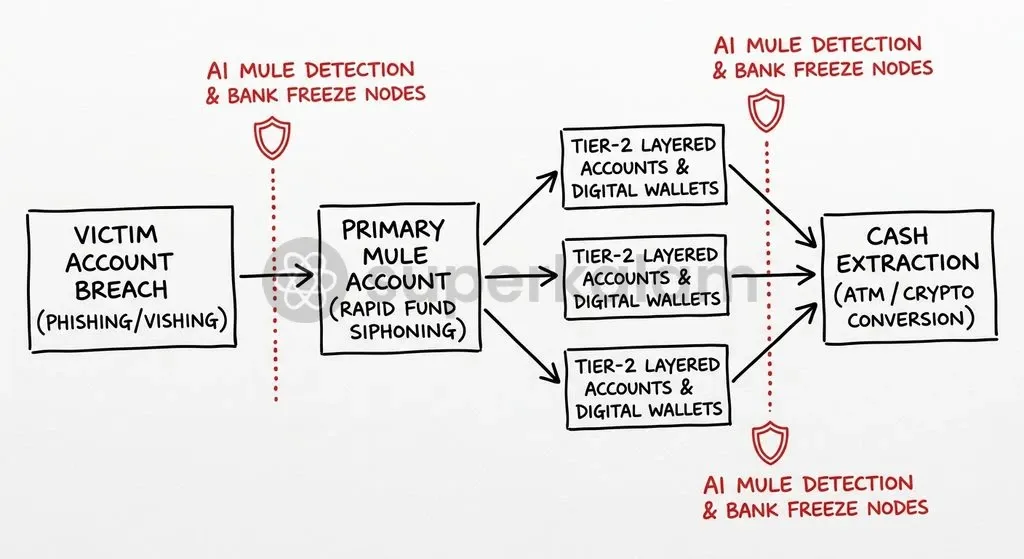
- Mule Accounts: A mule account is a bank account opened with forged credentials or rented from third parties to receive and launder illicit funds. These accounts absorb initial victim transfers and instantly split them into smaller tranches.
- Layering and Rapid Dispersal: Syndicates route illicit funds through a chain of digital wallets, payment aggregators, and unified payments interface (UPI) channels. This layering aims to obscure the audit trail before investigators can flag the source.
- Immediate ATM and POS Cash-outs: Fraudsters withdraw layered tranches as physical cash at remote automated teller machines (ATMs) or point-of-sale (POS) terminals within hours of the original breach.
To counter these organised syndicates, the RBI deployed an artificial intelligence system named MuleHunter.AI across 26 commercial banks to detect mule accounts used for illicit layering. Furthermore, the Indian Digital Payment Intelligence Corporation (IDPIC) was incorporated on October 16, 2025 as a Section 8 non-profit company. IDPIC provides real-time AI-driven fraud detection and threat intelligence across India's digital payment architecture.
The RBI Liability Framework: When Is a Customer Fully Protected?
The Reserve Bank of India circular dated July 6, 2017 establishes that an account holder bears zero liability when financial loss arises from institutional negligence or third-party system breaches. Under this regulatory architecture, the legal burden of proof rests entirely on the bank, not the consumer.
The regulatory structure enforces strict compliance across three core dimensions:
- Mandatory 24x7 Reporting Channels: Commercial banks must provide continuous 24x7 reporting mechanisms through SMS, email, interactive voice response (IVR) systems, toll-free lines, and web portals.
- Ten-Day Shadow Reversal: When a customer flags an unauthorised transaction, the bank must execute a shadow reversal—crediting the disputed sum to the customer's account within 10 working days, without waiting for insurance settlements.
- Ninety-Day Resolution Window: Banks must conclude complaint investigations and determine final liability within a maximum period of 90 days from complaint receipt.
If the bank fails to establish customer negligence or breach of duty within this 90-day window, the account credit becomes permanent.
Discuss with Superkalam
How does the operational mechanism of mule accounts facilitate the rapid layering and cash-out of stolen digital funds?
Ask NowZero Liability vs Limited Liability: The Critical 3-Day Rule
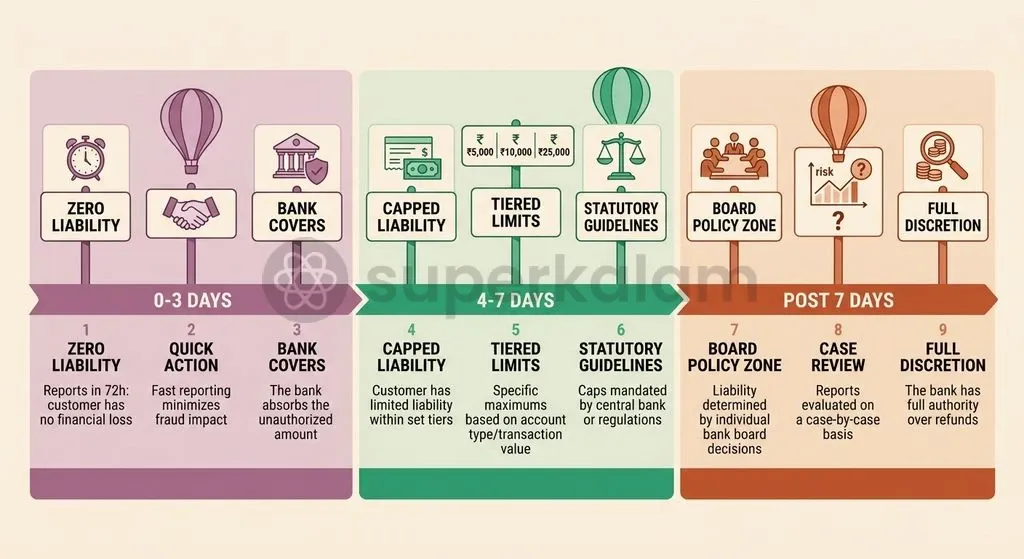
The Reserve Bank of India categorises customer liability for unauthorised electronic transactions into three distinct tiers based strictly on reporting timelines and negligence criteria. Timely notification is the single most critical factor determining whether an account holder receives complete restitution.
| Scenario / Cause of Fraud | Reporting Timeline | Customer Liability Cap | Mandatory Bank Action |
|---|---|---|---|
| Bank Contributory Negligence (system deficiency / internal fraud) | Any time (even if unreported by customer) | Zero Liability (₹0) | Full reimbursement; shadow credit within 10 working days |
| Third-Party Breach (system deficiency elsewhere; no customer fault) | Within 3 working days of transaction alert | Zero Liability (₹0) | Full shadow credit within 10 working days |
| Third-Party Breach: BSBD Accounts | Between 4 to 7 working days | Capped at ₹5,000 | Amount exceeding ₹5,000 credited to account |
| Third-Party Breach: Savings & Cards (limits up to ₹5 lakh) | Between 4 to 7 working days | Capped at ₹10,000 (or transaction value, whichever is lower) | Amount exceeding ₹10,000 credited to account |
| Third-Party Breach: Current / Overdraft / Cards (limits > ₹5 lakh) | Between 4 to 7 working days | Capped at ₹25,000 | Amount exceeding ₹25,000 credited to account |
| Third-Party Breach: Delayed Notification | Beyond 7 working days | Determined by individual Board-approved bank policy | Settlement governed by internal bank rules |
| Customer Negligence (e.g. sharing credentials / OTP) | Until reported to bank | 100% of loss until reported; Zero liability for losses occurring after reporting | Full customer liability up to reporting timestamp |
Where an account holder shares confidential credentials, such as one-time passwords (OTPs) or personal identification numbers (PINs), the customer bears the entire financial loss until the incident is formally logged with the bank. Any subsequent transactions occurring after the reporting timestamp are borne entirely by the bank.
How the 1930 Helpline and National Cybercrime Portal Intercept Stolen Money
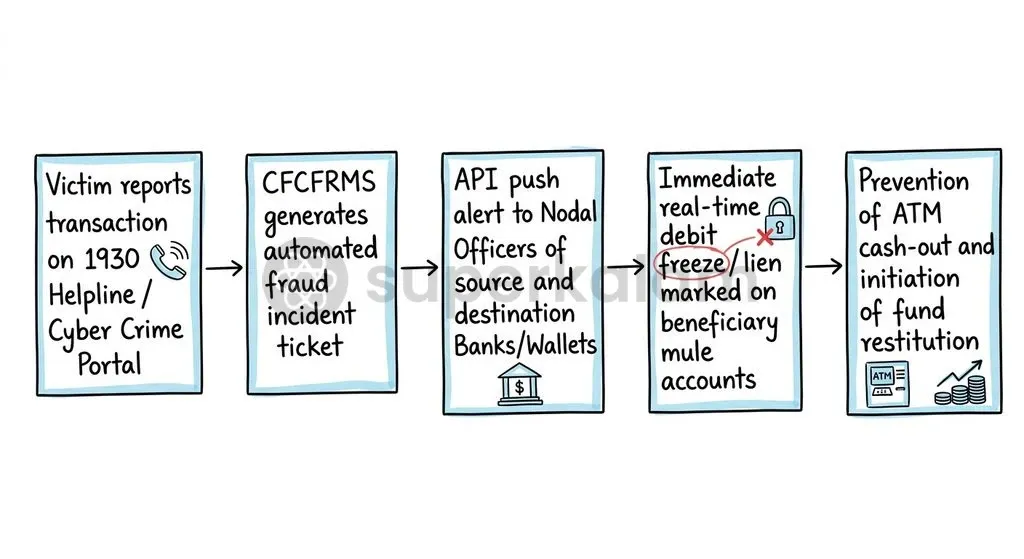
The Citizen Financial Cyber Fraud Reporting and Management System, managed by the Indian Cyber Crime Coordination Centre under the Ministry of Home Affairs, intercepts stolen funds through real-time communication. The platform integrates law enforcement agencies, commercial banks, payment aggregators, and digital wallets.
When a citizen dials the 1930 national helpline or logs an incident on the national cybercrime reporting portal, an automated ticket issues immediate lien alerts:
- Intimation and Ticketing: The victim provides transaction details, bank account numbers, and transaction reference IDs to the 1930 operator.
- Real-Time Lien Marking: The system tracks the flow of stolen money across downstream financial entities and automatically places debit freezes on receiving accounts.
- Prevention of Cash Outflow: Funds are locked inside the banking system before fraudsters can withdraw them at physical ATMs.
As of June 30, 2026, the CFCFRMS and the 1930 helpline had successfully saved more than ₹11,158 crore across over 32.80 lakh registered complaints. In April 2026, the Ministry of Home Affairs operationalised the Money Restoration Module (MRM) and Grievance Redressal Module (GRM) under CFCFRMS. These modules accelerate the formal return of frozen amounts to verified victims and provide a dispute mechanism for legitimate merchants subjected to erroneous account freezes.
Discuss with Superkalam
Suppose a customer falls prey to a credential-harvesting scam and reports it 12 hours later: how does RBI's liability rule allocate losses before and after that timestamp?
Ask NowLegal Redressal: Banking Ombudsman, Consumer Courts, and Judicial Precedents
The Consumer Protection Act, 2019 and the Information Technology Act, 2000 provide statutory mechanisms for account holders seeking compensation for deficient banking services and data breaches. Aggrieved consumers are not limited to internal bank grievance cells when seeking financial redress.
Banking operations fall squarely within the definition of 'service' under Section 2(42) of the Consumer Protection Act, 2019. Account holders can approach Consumer Disputes Redressal Commissions to claim compensation for deficiency in service under Section 2(11) when a bank refuses to reverse unauthorised debits. Furthermore, Section 43A of the Information Technology Act, 2000 establishes statutory civil liability for corporate bodies that fail to maintain reasonable security practices while handling sensitive personal data.
Judicial and consumer forums have repeatedly reinforced bank accountability through landmark rulings:
- Chairman, Punjab National Bank v. Leader Valves Ltd. (2020): The National Consumer Disputes Redressal Commission (NCDRC) held that commercial banks are primarily responsible for maintaining electronic account security. The commission ruled that banks remain liable for unauthorised fund transfers resulting from systemic lapses unless clear customer fault is proved.
- HDFC Bank Ltd. v. Jesna Jose (2020): The NCDRC reaffirmed that when an account holder reports an unauthorised transaction within three working days, the bank is strictly liable to compensate the full loss if customer negligence is not established.
Customers may also escalate unresolved grievances to the RBI Integrated Ombudsman Scheme if the bank rejects the claim or fails to respond within 30 days.
Why Pinning Liability on Banks Remains Difficult in Practice
The Seventh Schedule of the Indian Constitution places 'Police' and 'Public Order' under State List entries (Entry 1 and Entry 2 of List II), creating jurisdictional friction during multi-state cyber fraud investigations. Because financial cyber syndicates operate across state boundaries, local police officers frequently face procedural delays when requisitioning account data from banks headquartered in other states.
Practical challenges frequently undermine customer rights on the ground:
- Misattribution of Customer Negligence: Commercial banks routinely deny liability claims by asserting that OTP compromise implies voluntary customer negligence, bypassing the statutory burden of proof mandated by the RBI.
- Asymmetric Technical Capability: Individual consumers lack the digital forensics tools necessary to prove that a security breach originated within a bank's third-party application programming interface (API) or telecommunication network.
- Inter-State Coordination Bottlenecks: State police units exhibit wide variations in digital forensics infrastructure, resulting in delayed police reports (FIRs) that hinder judicial restitution.
These structural hurdles mean that despite central regulations, victims often endure protracted litigation before securing financial relief.
Ethical Responsibilities of Financial Institutions in Digital Inclusion
The Reserve Bank of India's customer service framework emphasises that commercial banks hold an ethical fiduciary duty towards digitally vulnerable and rural depositors. The rollout of digital public infrastructure has integrated millions of first-time digital banking users across rural India.
Financial institutions cannot push digital adoption while offloading cybersecurity risks onto individuals with low digital literacy. Promoting inclusive banking requires commercial banks to implement ethical product design:
- Accessible Vernacular Interfaces: Financial institutions must design multilingual fraud alerts and simplified dispute escalation workflows suitable for non-English speakers.
- Proactive Risk Monitoring: Banks have an institutional duty to deploy heuristic behavioural analysis to detect anomalous transactions on low-balance rural accounts before large sums are drained.
- Empathy in Dispute Redressal: Bank branch managers must assist victims of social engineering rather than summarily dismissing claims at the initial counter.
Discuss with Superkalam
Why has the transition from complete account freezes to proportionate debit holds become necessary from both a legal and consumer rights standpoint?
Ask NowWay Forward: Strengthening Digital Infrastructure and Consumer Safeguards
The Indian Digital Payment Intelligence Corporation and the Reserve Bank of India must coordinate systemic technological and regulatory safeguards to protect India's digital payments infrastructure. Mitigating financial fraud requires aligning institutional accountability with technological innovation.
Key institutional and policy priorities include:
- Universal Deployment of AI Detection: Expanding tools like MuleHunter.AI across regional rural banks and cooperative banks will close entry points for money-laundering syndicates.
- Standardising Targeted Debit Holds: Implementing the Supreme Court's mandated SOP and the RBI's draft KYC rules will ensure debit holds apply strictly to disputed fraud tranches rather than freezing entire customer accounts.
- Streamlining Victim Restitution: Institutionalising the Money Restoration Module (MRM) under the 1930 framework will enable magistrates and banks to release frozen funds directly to victims without multi-year legal delays.
Key Takeaways
- Under the RBI July 2017 circular, customers have absolute zero liability for unauthorised electronic transactions resulting from bank deficiency or third-party breaches reported within three working days.
- The legal burden of proving customer negligence or liability in unauthorised transactions rests entirely on the bank.
- Banks must provide a mandatory shadow credit to the victim's account within 10 working days of notification and resolve disputes within 90 days.
- The 1930 national helpline and CFCFRMS under the Ministry of Home Affairs saved over ₹11,158 crore across more than 32.80 lakh complaints as of June 30, 2026.
- In September 2026, the RBI proposed draft KYC directions to restrict debit holds strictly to disputed fraud amounts of ₹1,000 or above rather than freezing complete accounts.
Mains Question
"The Reserve Bank of India's regulatory framework places the burden of proof and financial restitution squarely on commercial banks for unauthorised electronic transactions, yet structural enforcement challenges persist." Discuss the statutory protections available to bank customers and evaluate the institutional mechanisms deployed to intercept digital payment fraud. (15 Marks)
Evaluate NowMains Question
In light of the Supreme Court's directions in 'In Re: Victims of Digital Arrest', examine how proportionate debit holds and AI-driven monitoring address the systemic challenge of mule accounts without compromising financial inclusion. (10 Marks)
Evaluate NowPractice MCQs
QUESTION 1
With reference to the Reserve Bank of India (RBI) guidelines on customer liability in unauthorised electronic banking transactions, consider the following statements:
- An account holder enjoys absolute zero liability for third-party breaches if the transaction is reported to the bank within three working days of receiving the alert.
- In cases where the loss is due to institutional negligence by the bank, customer liability is zero irrespective of whether the customer reports the incident.
- Where a customer shares confidential credentials like OTPs, the customer bears the entire financial loss for all fraudulent transactions, including those occurring after reporting the incident to the bank. Which of the statements given above are correct?
QUESTION 2
Consider the following statements regarding the institutional mechanisms countering digital financial frauds in India:
- The Citizen Financial Cyber Fraud Reporting and Management System (CFCFRMS) operates under the Indian Cyber Crime Coordination Centre (I4C) of the Ministry of Home Affairs.
- The Indian Digital Payment Intelligence Corporation (IDPIC) is established as a Section 8 non-profit company to deliver real-time AI-driven threat intelligence.
- MuleHunter.AI is an artificial intelligence system deployed across commercial banks to detect mule accounts used for illicit layering. Which of the statements given above are correct?
QUESTION 3
Under the RBI regulatory framework for unauthorised electronic transactions, if a customer reports a third-party breach between 4 to 7 working days, what is the maximum customer liability for Basic Savings Bank Deposit (BSBD) Accounts?
QUESTION 4
Consider the following statements regarding regulatory and judicial directives on digital arrest and mule accounts:
- The Supreme Court directed the RBI to formulate a uniform Standard Operating Procedure (SOP) for commercial banks to manage mule accounts and debit freezes.
- The draft Know Your Customer (KYC) Amendment Directions propose placing temporary debit holds only on the disputed fraudulent amount of ₹1,000 or above rather than freezing entire accounts.
- In cases of unauthorised transactions, commercial banks are mandated to execute a shadow reversal within 10 working days without waiting for insurance settlements. Which of the statements given above are correct?
QUESTION 5
Under the Reserve Bank of India's electronic transaction framework, within what maximum timeframe must a commercial bank conclude complaint investigations, failing which the credited shadow amount becomes permanent?





