Coir Sector in India: Agro-Waste Valorisation and the Rural Bio-Economy
How transforming coconut husks into export-grade bio-materials anchors India's coastal economy, female labour participation, and rural industrialisation.
Sep, 2026
•10 min read
Overview
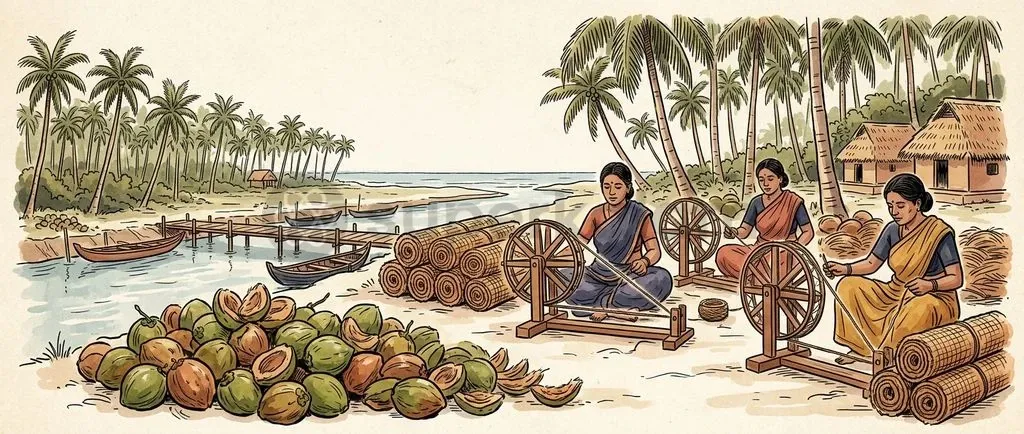
India's rural bio-economy is converting discarded coconut husks into high-value industrial materials such as coir geotextiles and coco peat. This shift generates steady export earnings while sustaining women-led micro-enterprises across coastal agro-climatic zones.
The valorisation cycle processes raw fibrous mesocarp into engineered inputs for civil infrastructure, soil remediation, and filtration systems.
According to the India Brand Equity Foundation (IBEF) and the Ministry of MSME, India manufactures over 70% of global coir output, producing 15.10 lakh metric tonnes in FY 2025-26. Decentralised processing clusters supported by state schemes combine traditional artisanship with global supply chains, building a clear model for green industrialisation.
Why Coconut By-Products Are in the Spotlight
Coconut by-products have transitioned from agricultural residue into globally traded ecological commodities. As of March 2026, international markets are replacing fossil fuel-based synthetic inputs with biodegradable alternatives, creating steady demand for natural fibres and soil conditioners.
India's total export value of coir and coir manufactured products reached US$ 757.4 million during FY 2025-26.
Global climate commitments and domestic industrial policies have accelerated this momentum. Coconut husk processing curbs open-field biomass burning and local water pollution, turning farm waste into direct revenue streams for primary cultivators. Agro-processing clusters across southern India now act as core nodes for sustainable manufacturing.
Understanding Coconut Husk Valorisation and the Coir Value Chain
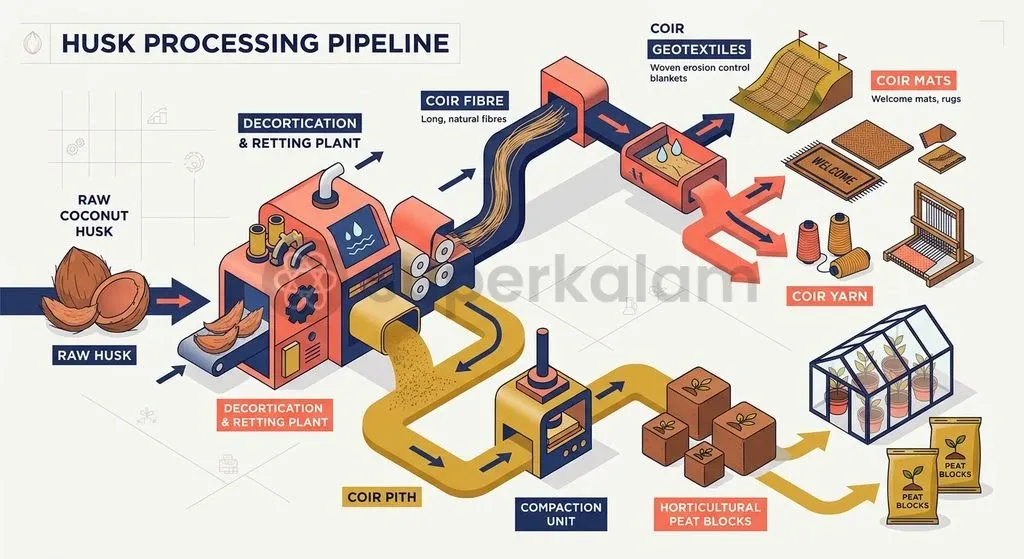
The Coir Board of India categorises husk processing into biological and mechanical stages to separate durable fibre from absorbent pith. Coconut husk consists of two primary components: high-tensile coir fibre embedded in an open cellular matrix of non-fibrous coir pith. Valorisation begins with extraction, shifting from manual water retting toward mechanised decortication units.
- Raw Biomass: Farm-gate green or dry mature husks undergo sorting and collection.
- Defibering & Retting: Mechanical decortication or bio-retting separates fibrous strands from pith.
- Fibre Stream: Yields bristle, mattress, or white fibre processed into geotextiles, ropes, and mats.
- Pith Stream: Coir dust is washed, dried, and compressed into agricultural substrates.
Commercial processing bifurcates based on husk maturity and extraction techniques:
- White Coir Fibre: Extracted from immature green husks after saline water retting, producing flexible, smooth fibres spun into yarn, ropes, and traditional floor coverings.
- Brown Coir Fibre: Mechanically extracted from mature dry husks, yielding thick, rigid bristles suited for industrial brushes, rubberised coir mattresses, and heavy-duty geotextile netting.
- Coir Pith (Coco Peat): The residual spongy dust generated during defibering, compressed into blocks for international horticultural and greenhouse substrates.
Biological innovation has modernised primary extraction. According to the Central Coir Research Institute (CCRI), deploying anaerobic microbial consortium formulations like 'Coirret' has compressed husk soaking time from several months to under a week while mitigating pollution in coastal backwaters.
| Processing Component | Traditional Processing | Modernised Bio-Processing |
|---|---|---|
| Primary Input | Green husks soaked in saline lagoons | Green or brown husks treated with microbial consortia |
| Processing Duration | 8 to 10 months of microbial retting | Under 7 days using enzymatic/bacterial formulation |
| Environmental Impact | High hydrogen sulphide emissions in water | Controlled anaerobic decomposition, minimal effluent |
| Primary Outputs | Coarse spinning yarn and raw mats | Standardised geotextiles, pith briquettes, composite panels |
Discuss with Superkalam
Which coconut by-product contributes the highest share to India's total coir export earnings?
Ask NowHow the Coir Sector Drives Rural Livelihoods and Women's Empowerment
The Ministry of Micro, Small and Medium Enterprises identifies the coir sector as a reliable engine for decentralised female employment across southern coastal belts. Production remains geographically concentrated across major coconut-producing states, notably Kerala, Tamil Nadu, Andhra Pradesh, Karnataka, and Odisha. These regions benefit from established raw material aggregation networks and proximity to major shipping ports.
The socio-economic footprint of the sector rests on high female labour participation:
- Livelihood Scale: The sector sustains over 7 lakh rural workers, functioning as an indispensable non-farm income source during agricultural off-seasons.
- Gender Inclusion: Women represent an estimated 80% of the total workforce, dominating labour-intensive stages including manual retting, wheel spinning, and mat weaving.
- Micro-Enterprise Formation: Decentralised Self-Help Groups (SHGs) operate rural production nodes, converting raw biomass directly into export-grade yarn and horticultural blocks.
Mechanisation has progressively reduced the physical drudgery associated with traditional manual thigh-spinning. Subsidised equipment deployment allows rural women to transition into micro-entrepreneurs, strengthening household financial resilience.
Discuss with Superkalam
How does microbial bio-retting using formulations like 'Coirret' resolve both environmental and productivity bottlenecks of traditional lagoon retting?
Ask NowIndustrial and Ecological Applications: From Geotextiles to Bio-Compost
The Central Coir Research Institute classifies coconut by-products into engineering, agricultural, and filtration applications based on their distinctive chemical structures. High lignin content makes coconut fibre exceptionally resistant to fungal decomposition, weathering, and mechanical abrasion compared to other natural lignocellulosic materials.
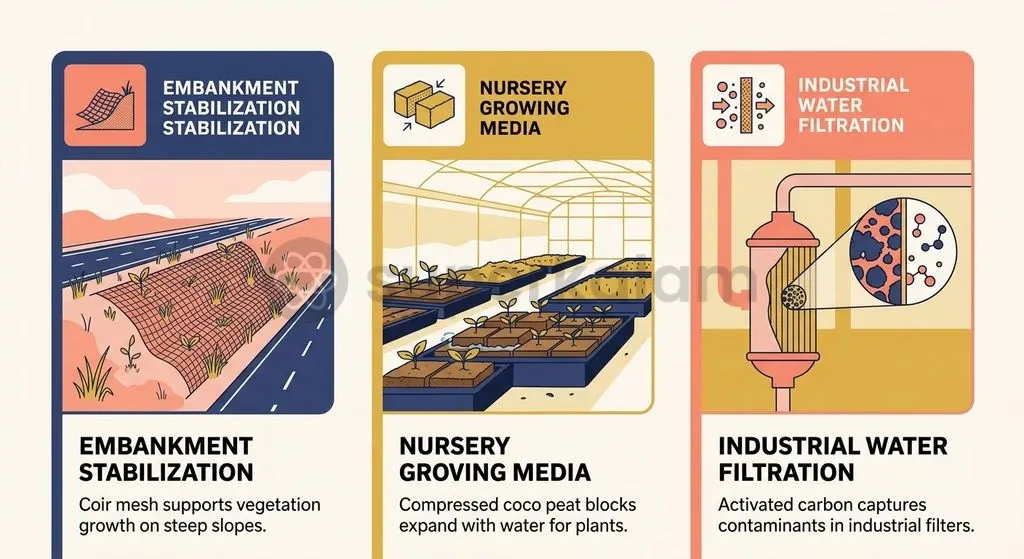
- Coir Geotextiles: Slope stabilisation, railway embankment reinforcement, and riverbank protection.
- Coir Pith (Peat): Peat moss alternative, greenhouse potting medium, and soil moisture conservation.
- Coconut Shell: Microporous activated carbon, industrial water filtration, and gold recovery.
- Coir Composites: Eco-friendly packaging, structural particle boards, and thermal insulation.
Industrial demand is driven by three main by-product applications:
- Coir Geotextiles for Bio-Engineering: Woven and non-woven coir blankets act as permeable soil-erosion barriers on vulnerable hill slopes, highways, and river embankments. These 100% biodegradable open-mesh fabrics degrade over 3 to 5 years, providing initial slope stabilisation while allowing natural vegetative cover to establish permanently.
- Coir Pith in Commercial Horticulture: Coir pith represents the single largest component of India's coir export trade, accounting for 59.63% of total export value, followed by tufted mats at 16.73% and raw coir fibre at 12.06%. It replaces peat moss because of its superior water-retention capacity and neutral pH.
- Activated Carbon from Pyrolysed Shells: Coconut shell-derived activated carbon features a dense microporous structure and high specific surface area, making it an essential industrial filtration medium for municipal water purification, precious metal recovery, and gas masking.
Key Government Policies and Institutional Support for the Coir Sector
The Coir Industry Act, 1953 establishes the statutory framework governing central policy interventions, cluster development schemes, and export promotion programmes. The Coir Board of India, a statutory body established under the Act and headquartered in Kochi, Kerala, directs scientific research, product standardisation, and export market development across producing states.
State institutional support operates through multiple targeted interventions:
- Coir Vikas Yojana (CVY): An umbrella scheme implemented by the Ministry of MSME with an approved financial outlay of ₹466.60 crore spanning FY 2021-22 to FY 2025-26, funding production infrastructure, export development, and domestic market promotion.
- Skill Upgradation and Mahila Coir Yojana: A specialised component under CVY providing stipendiary technical training and subsidised motorised spinning ratts directly to women artisans to support household-level spinning units.
- SFURTI Cluster Development: The Scheme of Fund for Regeneration of Traditional Industries establishes common facility centres and modern processing infrastructure for traditional artisan collectives in major production corridors.
- Inter-Ministerial Linkages: The Coir Board collaborates with the Coconut Development Board under the Ministry of Agriculture and Farmers Welfare to coordinate raw husk procurement at the farm-gate level.
Discuss with Superkalam
Evaluate the efficacy of providing subsidised motorised ratts under the Mahila Coir Yojana in transitioning rural women from informal wage labourers to viable micro-entrepreneurs.
Ask NowBottlenecks Holding Back the Rural Coir and Bio-Economy Ecosystem
The Ministry of MSME identifies persistent structural rigidities in processing technology, capital financing, and synthetic market competition as key impediments to sector growth. While policy targets substantial industrial expansion, micro-enterprises operate under tight technological and logistical constraints.
Key operational and structural challenges include:
- Technological Obsolescence: Manual extraction and rudimentary spinning wheels still persist across unorganised pockets, resulting in inconsistent yarn quality and low productivity per worker hour.
- High Capital Costs of Automation: Automated defibering and compacting machinery requires high upfront capital, restricting adoption among credit-constrained village enterprises.
- Raw Material Supply Fluctuations: High intra-state transportation costs and uncoordinated farm-level collection lead to acute seasonal shortages of raw husks at defibering centres.
- Competition from Synthetic Substitutes: Non-biodegradable synthetic polypropylene geotextiles and synthetic foam packaging maintain lower initial procurement costs, limiting natural coir adoption across public works projects.
Global Best Practices in Coconut Biomass Utilisation
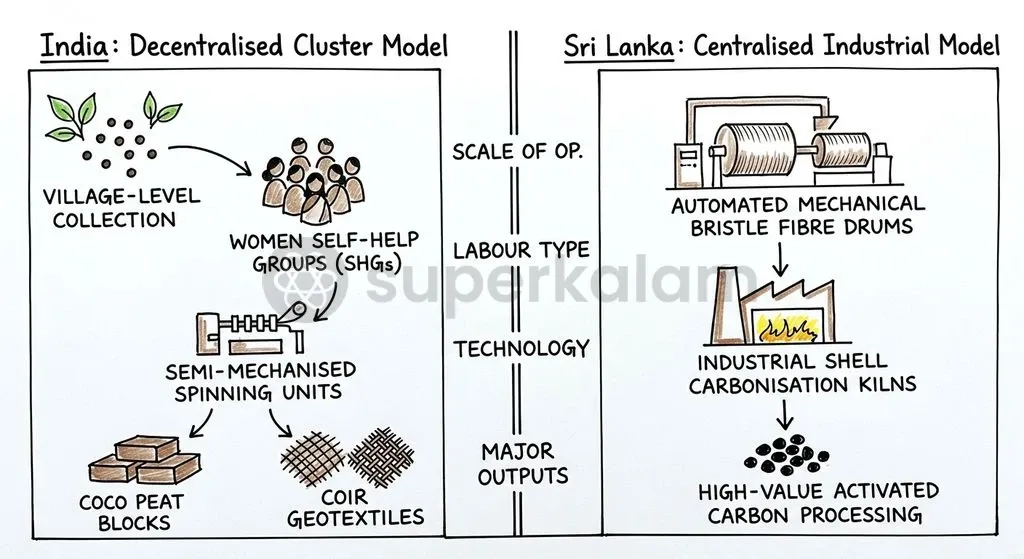
Sri Lanka and the Philippines provide proven international models for high-efficiency coconut husk extraction, advanced shell carbonisation, and farmer-centric trust fund deployment. Studying these operational models offers practical lessons for modernising India's downstream value-addition architecture.
International industrial benchmarks demonstrate diverse pathways for biomass valorisation:
- Sri Lanka's High-Value Export Model: Sri Lanka generated over USD 1.03 billion in coconut export revenue during the first 10 months of 2025 by optimising drum-system bristle fibre extraction, automated coco-peat compaction, and deep value-added shell conversion into high-grade activated carbon.
- The Philippines' Institutional Trust Fund: The Philippine Coconut Authority operates under Republic Act No. 11524 (Coconut Farmers and Industry Trust Fund Act) to finance modern husk processing hubs, shared testing laboratories, and direct farmer equity integration.
| Metric | India | Sri Lanka |
|---|---|---|
| Global Volume | >70% of global coir production | Major player in specialised grades |
| Export Mix | Dominated by coir pith (59.63%) | Balanced: fibre, peat, carbon |
| Primary Advantage | Expansive domestic artisan base | High automated processing depth |
Way Forward: Scaling Up India's Coconut-Based Circular Economy
The Coir Board of India requires targeted investments in biological retting technologies, cluster mechanisation, and carbon-credit accounting to scale rural industrial capacity. Transitioning from primary agro-waste handling to sophisticated bio-material manufacturing requires coordinated multi-tier interventions.
Strategic priorities for institutional and industrial scaling include:
- Cluster-Based Mechanised Infrastructure: Accelerate SFURTI common facility centres to provide micro-units with shared automated defibering, continuous drying, and hydraulic baling machinery.
- Bio-Engineering Mandates in Public Infrastructure: Enforce green procurement norms requiring coir geotextiles in national highway embankment stabilisation, rural road building, and watershed rehabilitation projects.
- Carbon Market Linkages: Per Coir Board of India vision briefings (as reported in May 2022), the sector aims to integrate with formal carbon credit mechanisms, leveraging coir's carbon sequestration capacity and its substitution of fossil fuel-intensive synthetic materials.
- Advanced R&D in Bio-Polymers: Deepen collaboration between the Central Coir Research Institute and national engineering laboratories to develop coir-reinforced polymer composites, biodegradable thermoformed packaging, and acoustic insulation panels.
Discuss with Superkalam
Propose an institutional coordination mechanism between the Coir Board and the Coconut Development Board to resolve raw husk supply chain disruptions across major producing states.
Ask NowKey Takeaways
- Global Production Leadership: India accounts for over 70% of global output, producing 15.10 lakh metric tonnes in FY 2025-26 with total exports valued at US$ 757.4 million.
- Socio-Economic Anchor: The coir sector sustains over 7 lakh rural livelihoods, with women comprising approximately 80% of the aggregate workforce, predominantly across coastal and southern agrarian regions.
- Export Composition: Coir pith (coco peat) forms the core of India's coir export basket at 59.63% of total export value, followed by tufted floor mats at 16.73% and coir fibre at 12.06%.
- Institutional Framework: Central policy execution is steered by the Coir Board of India (a statutory body under the Coir Industry Act, 1953) alongside flagship schemes such as the Coir Vikas Yojana (₹466.60 crore allocation for FY 2021-22 to FY 2025-26) and SFURTI.
- Ecological Applications: High-lignin coir geotextiles offer durable biodegradable solutions for slope protection and soil erosion control, while coconut shell activated carbon serves as a critical microporous medium for advanced filtration systems.
Mains Question
"By transforming agricultural residue into globally traded industrial inputs, the coir sector exemplifies decentralised rural industrialisation and female economic empowerment." In light of schemes like the Coir Vikas Yojana and Mahila Coir Yojana, elucidate. (150 words) (10 Marks)
Evaluate NowMains Question
"Despite commanding a dominant share in global production, India's coconut biomass and coir value chain faces severe technological, logistical, and competitive bottlenecks." Critically analyse the structural challenges impeding the sector and examine the institutional measures needed to foster a resilient circular bio-economy. (250 words) (15 Marks)
Evaluate NowPractice MCQs
QUESTION 1
With reference to coconut husk valorisation and coir processing in India, consider the following statements:
- White coir fibre is mechanically extracted from mature dry husks and used primarily for heavy-duty industrial netting.
- Brown coir fibre is obtained from green husks subjected to prolonged saline water retting.
- The high lignin content of coir fibre provides high resistance to fungal decomposition and weathering.
Which of the statements given above is/are correct?
QUESTION 2
Consider the following statements regarding the institutional and policy framework governing the coir sector in India:
- The Coir Board of India is a statutory body established under the Coir Industry Act, 1953, and is headquartered in Kochi, Kerala.
- The Mahila Coir Yojana provides subsidised motorised spinning ratts directly to women artisans under the Coir Vikas Yojana.
- Coir pith constitutes the single largest component of India's coir export value, surpassing tufted mats and raw coir fibre.
Which of the statements given above are correct?
QUESTION 3
Consider the following statements regarding biological advancements and applications in the coir sector:
- The deployment of anaerobic microbial consortium formulations like 'Coirret' compresses the retting duration of coconut husks from several months to under a week.
- Coir geotextiles used for slope stabilisation are non-biodegradable synthetic matrices engineered for permanent soil encapsulation.
- Activated carbon derived from pyrolysed coconut shells is utilised in industrial water purification and precious metal recovery due to its dense microporous structure.
Which of the statements given above is/are correct?
QUESTION 4
Which of the following coconut by-products accounts for the highest share in India's total coir export earnings?
QUESTION 5
Consider the following statements regarding the socio-economic and production profile of India's coir industry:
- India manufactures over 70% of total global coir output.
- Women constitute approximately 80% of the coir sector's total workforce in India.
- The coir production ecosystem is geographically concentrated primarily across northern inland agricultural belts.
Which of the statements given above is/are correct?