Can Tech Fix Public Exams? The Nandan Nilekani Task Force Gamble
Can digital public infrastructure and the Nilekani Task Force fix India's high-stakes public exam leaks?
Jul, 2026
•10 min read

Fig: India is pivoting toward digital public infrastructure to secure national competitive examinations against paper leaks.
As of July 2026, the Government of India constituted a six-member task force chaired by Nandan Nilekani to overhaul the National Testing Agency through technology-driven reforms following high-stakes examination paper leaks. This high-powered panel aims to integrate secure Digital Public Infrastructure, advanced candidate verification, end-to-end data encryption, and dependable logistics frameworks into competitive testing.
The mandate follows persistent administrative vulnerabilities within the National Testing Agency, an autonomous body under the Societies Registration Act, 1860, which conducts nationwide entrance exams for over 5.4 crore candidates annually.
While previous reforms under the K. Radhakrishnan Committee emphasised physical test-center security and paper printing, the Nilekani Task Force focuses on data security protocols and computer-based testing transitions. However, systemic risks like server hack breaches, distributed denial-of-service attacks, and severe permanent staffing shortages mean technological fixes must complement, rather than replace, institutional accountability, statutory enforcement under the Public Examinations (Prevention of Unfair Means) Act, 2024, and strict vendor oversight.
Why in the News: The Push for a Tech-Driven Testing Overhaul
On 26 July 2026, Prime Minister Narendra Modi announced a six-member task force headed by Nandan Nilekani to recommend tech-driven and structural reforms for India's examination system. As of July 2026, the executive push followed nationwide student agitation surrounding the alleged NEET-UG 2026 question paper leak controversy, which previously led to the resignation of Union Education Minister Dharmendra Pradhan on 25 July 2026.
On 27 July 2026, the Central Government informed the Supreme Court during petitions regarding NEET reforms that the Nilekani Task Force will formulate specific data security protocols and technological safeguards required for transitioning high-stakes tests from pen-and-paper to computer-based testing (CBT) formats.
TL;DR: Key Takeaways on Exam Reforms
- High-Powered Panel: On 26 July 2026, the Centre appointed Infosys co-founder Nandan Nilekani to lead a six-member task force tasked with securing the examination architecture of the National Testing Agency.
- DPI-Centric Architecture: Per Technology Framework for Exam Reforms (as reported, 27 July 2026), the Nilekani panel is expected to advocate a Digital Public Infrastructure (DPI) model featuring open digital protocols, biometric candidate verification, and end-to-end dynamic data encryption.
- Procedural vs Technological Split: The earlier K. Radhakrishnan Committee report from October 2024 emphasised physical security like 1,000 government-owned test centres and on-site encrypted paper printing, whereas the Nilekani Task Force prioritises online digital execution.
- Cybersecurity Hazards: The Supreme Court cautioned on 27 July 2026 that migrating national entrance exams to online platforms introduces severe vulnerabilities, including server hack breaches, remote malware access, insider tampering, and distributed denial-of-service (DDoS) attacks.
- Statutory Enforcement: Tech reforms operate alongside legal deterrence under the Public Examinations (Prevention of Unfair Means) Act, 2024, supported by the Public Examinations (Prevention of Unfair Means) Amendment Bill introduced in Lok Sabha on 27 July 2026.
Understanding the Nandan Nilekani Task Force Mandate
The Nandan Nilekani Task Force possesses a targeted mandate to build a secure, leak-proof, and transparent examination framework for the National Testing Agency. The panel brings together six experts across technology, space science, intelligence, academia, and logistics.
The composition of the task force includes:
- Nandan Nilekani (Chairman): Infosys co-founder and architect of India's Aadhaar digital identity project.
- S. Somanath: Former ISRO Chairman specialising in complex system architectures.
- Tapan Deka: Former Intelligence Bureau Director bringing security oversight.
- V. Kamakoti: IIT Madras Director offering expertise in cybersecurity and computer science.
- Anita Karwal: Former School Education Secretary providing administrative grounding.
- Amrit Lal Meena: Logistics expert addressing supply chain vulnerabilities.
The terms of reference focus on integrating advanced digital public infrastructure, candidate verification, logistics planning, and strong cybersecurity safeguards into public testing. On 27 July 2026, the Centre affirmed in Supreme Court proceedings that the task force will define technical parameters for switching paper-based entrance exams like NEET-UG to computer-based testing.
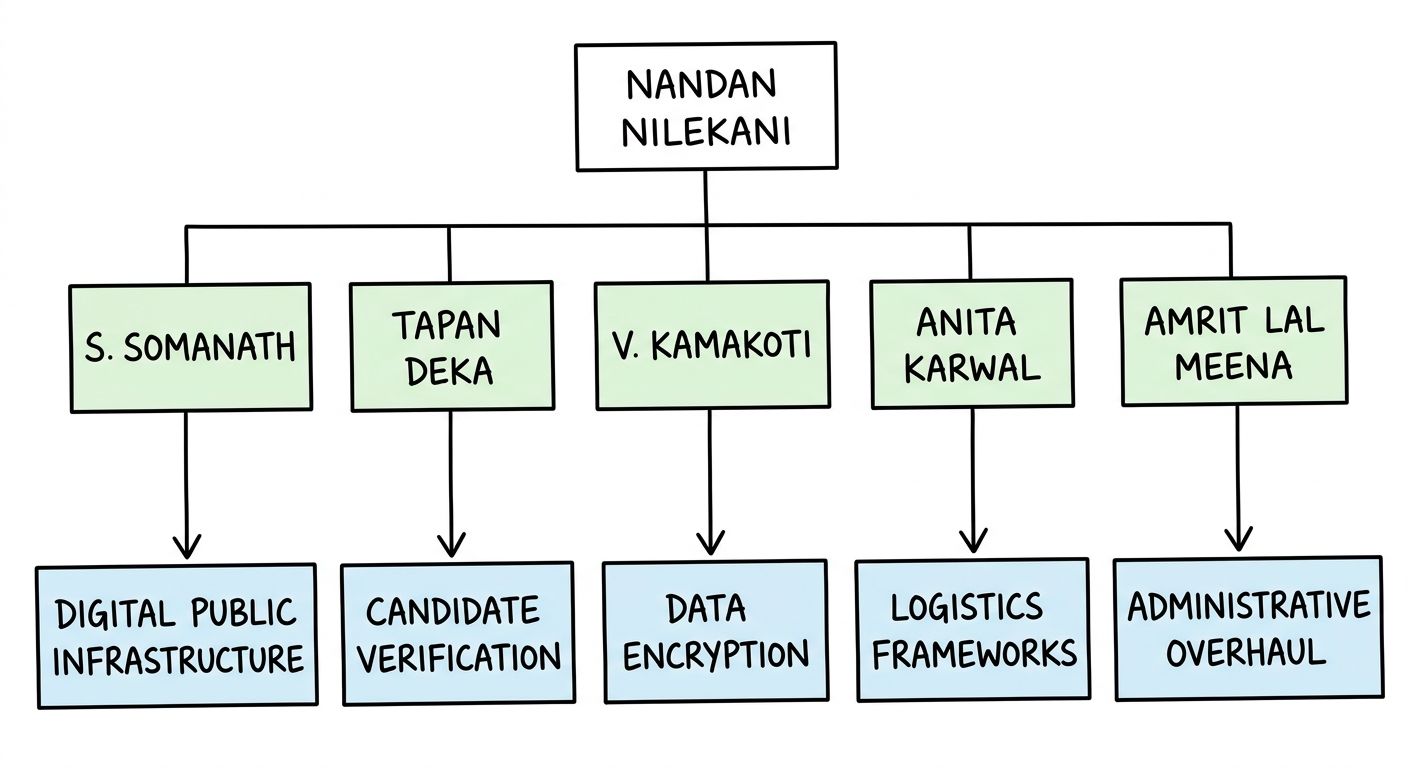
Fig: The six-member Nilekani Task Force combines expertise across technology, space science, intelligence, academia, and administrative logistics.
Discuss with Superkalam
Can you list the key administrative and technical background fields represented among the six members of the Nilekani Task Force?
Ask NowHow Digital Public Infrastructure Can Transform High-Stakes Testing
Digital Public Infrastructure offers an architectural approach to secure public examinations by replacing physical test-center policing with open digital protocols, end-to-end encryption, and biometric verification. Per Technology Framework for Exam Reforms (as reported, 27 July 2026), the Nilekani Task Force is expected to recommend adapting modular digital protocols to secure every stage of test generation, distribution, and evaluation.
Key Steps in the DPI Examination Flow:
- Candidate Registration & Identity Verification: Uses biometric and Aadhaar-linked digital identity authentication with automated seat allotment to prevent proxy test-takers.
- Dynamic Encrypted Question Generation: A centralised question bank creates encrypted exam packages, releasing decryption keys minutes before test initiation.
- Secure Terminal Transmission: Prevents local hard-drive saving on test-center workstations while conducting continuous session monitoring and biometric verification.
- Instant Evaluation & Audit Trail: Ensures immediate central cloud upload of candidate response logs alongside tamper-proof digital forensics logs for post-exam review.
The primary mechanisms for DPI-driven exam security include:
- Identity Verification: Linking candidate records with statutory biometric databases to prevent proxy candidates at examination centres.
- Dynamic Decryption: Transmitting encrypted question papers directly to test terminals, with decryption keys unlocked minutes before exam commencement.
- Terminal Isolation: Preventing local storage of test data on centre workstations, minimising physical handling and local leak opportunities.
Discuss with Superkalam
How can DPI prevent proxy test-taking in low-connectivity exam centers?
Ask NowBalancing the K. Radhakrishnan Committee and Nilekani Task Force Approaches
The K. Radhakrishnan Committee and the Nandan Nilekani Task Force provide complementary strategies for reforming the National Testing Agency across physical and digital operational dimensions. The Radhakrishnan Committee, constituted in June 2024, submitted its report in October 2024 with 101 recommendations focused heavily on physical and procedural safeguards.
As of July 2026, official review data indicates that 27 out of the 101 recommendations from the Radhakrishnan report remain pending or unimplemented. While the Radhakrishnan panel proposed Computer-assisted Secure Pen-and-Paper Testing (CPPT) with on-site encrypted printing, 1,000 government-owned test centers, and mobile jammers, the Nilekani Task Force prioritises end-to-end digital architecture.
| Reform Dimension | K. Radhakrishnan Committee (Oct 2024) | Nandan Nilekani Task Force (July 2026) |
Primary Focus | Physical & procedural test-center security | Digital Public Infrastructure & tech safeguards |
Testing Format | Computer-assisted Pen-and-Paper Testing (CPPT) | Computer-Based Testing (CBT) migration |
Paper Distribution | On-site encrypted printing at test centers | Direct cloud-to-terminal encrypted delivery |
Infrastructure Model | 1,000 government-owned secure centers | Secure open digital protocols across centers |
Administrative Structure | Restructuring NTA into 10 functional verticals | Digital governance & data security protocols |
Current Status | 27 of 101 recommendations pending (as of July 2026) | Formulating data protocols for Supreme Court |
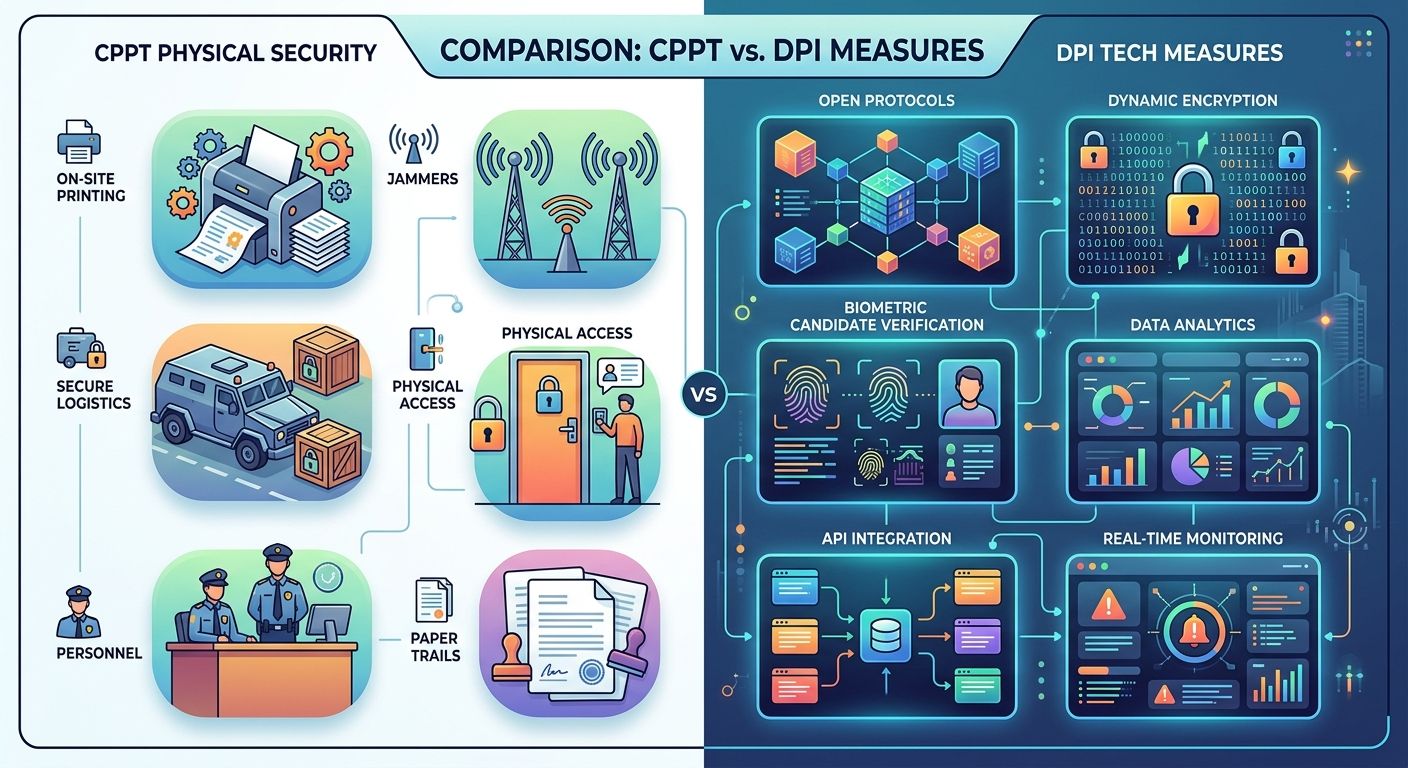
Fig: While the Radhakrishnan Committee fortified physical test centers, the Nilekani Task Force introduces dynamic end-to-end data encryption.
Discuss with Superkalam
Compare the vulnerabilities inherent in physical paper distribution with cyber vulnerabilities like DDoS attacks and server breaches in high-stakes exams.
Ask NowThe Cybersecurity and Systemic Risks of Tech-First Exams
Computer-based testing formats managed by the National Testing Agency present critical cybersecurity vulnerabilities, including potential server hack breaches, remote malware access, and distributed denial-of-service attacks. During Supreme Court proceedings on 27 July 2026, Justice P.S. Narasimha emphasised that securing database storage and server nodes is a non-negotiable prerequisite before transitioning paper-based tests to online formats.
Key vulnerability vectors in digital examination systems include:
- Server and Network Breaches: Centralised databases housing question banks face hacking attempts or unauthorised insider access prior to exam dates.
- Remote Access Malware: Commercial test centers using private computer infrastructure risk compromised software allowing unauthorised remote access to candidates.
- Privacy Compliance: Continuous facial recognition and candidate biometric tracking must strictly adhere to statutory safeguards under the Digital Personal Data Protection Act, 2023 (Act No. 22 of 2023).
- Staffing Deficits: Cadre data as of July 2026 reveals that out of 39 sanctioned permanent posts in the National Testing Agency, only 24 are filled, forcing reliance on 73 contractual employees and 124 outsourced personnel.
Although the National Testing Agency created 16 new permanent specialist posts in cybersecurity, digital forensics, assessment research, and test-center operations in July 2026, staffing shortfalls remain an administrative challenge.
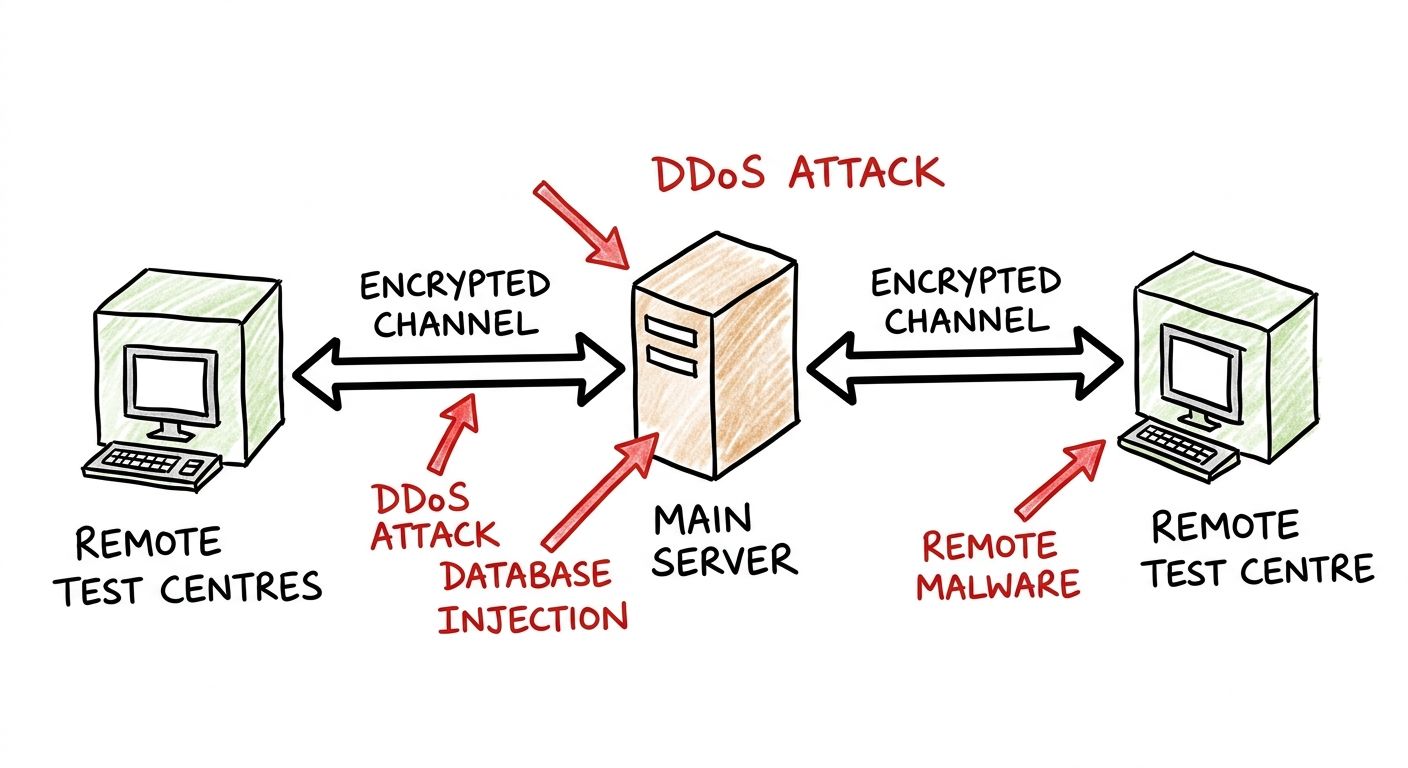
Fig: Transitioning to computer-based testing requires securing server nodes against DDoS attacks, malware, and insider database tampering.
The Road Ahead: Rebuilding Trust in Public Testing Systems
Rebuilding public trust in high-stakes testing requires the Ministry of Education to pair technological upgrades with structural restructuring of the National Testing Agency and strict statutory enforcement. Technology alone cannot eliminate malpractices if operational governance relies on unvetted private vendor centres without technical audits.
The strategic roadmap for comprehensive exam reform involves three administrative pillars:
- Structural Restructuring: Implementing the Radhakrishnan Committee recommendation to organise the National Testing Agency into an empowered Apex Body across 10 specialised functional verticals, including dedicated divisions for cybersecurity, research, and grievance redressal.
- Statutory Enforcement: Enforcing criminal penalties under the Public Examinations (Prevention of Unfair Means) Act, 2024 (Act No. 1 of 2024), which prescribes up to 10 years imprisonment and a minimum fine of ₹1 crore for organised paper leak syndicates.
- Judicial Deterrence: Establishing dedicated fast-track courts through the Public Examinations (Prevention of Unfair Means) Amendment Bill introduced in Lok Sabha on 27 July 2026 to ensure speedy trials for examination offences.
Mains Question
The National Testing Agency (NTA), an autonomous body under the Societies Registration Act, 1860, faces severe institutional and operational stresses in conducting nationwide examinations. Evaluate the role of multi-disciplinary expert panels and statutory frameworks in restoring trust in public testing systems.
Evaluate NowMains Question
Contrast the physical-procedural security approach of the K. Radhakrishnan Committee with the technology-first paradigm of the Nandan Nilekani Task Force. Elucidate how a hybrid reform model can secure national competitive examinations.
Evaluate NowMultiple Choice Questions
QUESTION 1
Q1. Consider the following statements regarding the National Testing Agency (NTA) and public examination reform initiatives in India:
- The NTA is an autonomous testing organization registered under the Societies Registration Act, 1860.
- The K. Radhakrishnan Committee recommended transitioning national entrance examinations exclusively to a Digital Public Infrastructure (DPI) computer-based testing model.
- The Nandan Nilekani Task Force was constituted as a six-member panel to formulate data security protocols and technological safeguards for high-stakes testing.
Which of the statements given above are correct?
QUESTION 2
Q2. Which of the following cyber and systemic vulnerabilities was explicitly highlighted by the Supreme Court regarding the transition of high-stakes entrance exams to online computer-based testing?
QUESTION 3
With reference to legal mechanisms for curbing malpractice in public examinations in India, consider the following statements:
-
The Public Examinations (Prevention of Unfair Means) Act, 2024 is Act No. 1 of 2024.
-
A Public Examinations (Prevention of Unfair Means) Amendment Bill was introduced in the Lok Sabha on 27 July 2026.
Which of the statements given above is/are correct?