Bt Cotton vs HTBt Cotton: What Is Legal in India?
Bt cotton provides insect resistance; HTBt adds herbicide tolerance. Read their differences, commercial approval status in India and biosafety concerns.
Oct, 2026
•10 min read
Overview
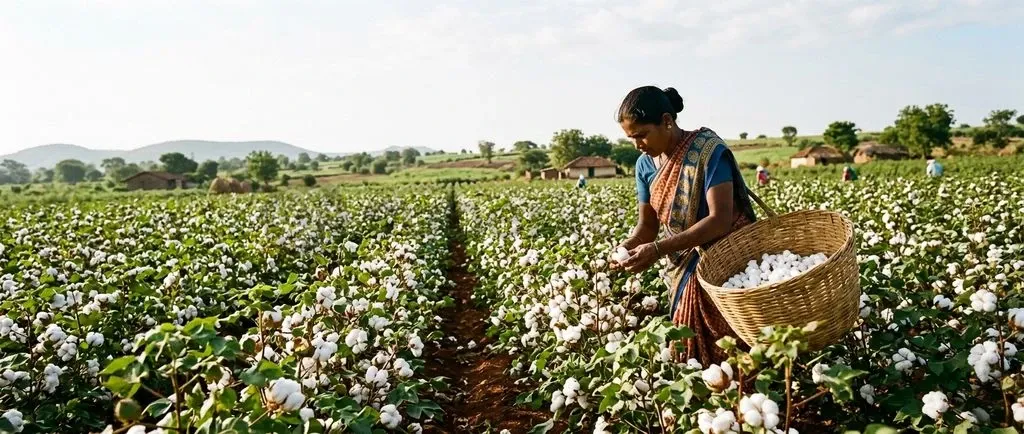
Herbicide-Tolerant Bt (HTBt) cotton remains completely unapproved for commercial cultivation in India, creating a stark legal and agronomic divide between authorised pest-resistant transgenic crops and illicit herbicide-tolerant varieties spreading across central and southern cotton belts. As of October 2026, Bt cotton stands as the sole genetically engineered crop cleared for open cultivation under statutory environmental safeguards. The unregulated proliferation of HTBt cotton highlights an agrarian crisis driven by surging manual weeding expenses, even as the unauthorized technology introduces severe biosafety liabilities. The debate over HTBt cotton is fundamentally a conflict between immediate farmer cost relief and the systemic risks of unmonitored agrochemical application, pesticide resistance, and the erosion of environmental governance under the Environment (Protection) Act, 1986.
Why Is HTBt Cotton in the News?
The Genetic Engineering Appraisal Committee (GEAC) recently re-opened regulatory assessments concerning Herbicide-Tolerant Bt cotton, reigniting nationwide scrutiny over unauthorised transgenic planting. In its 155th meeting held on June 9, 2025, the GEAC reconstituted an Expert Committee under the Department of Biotechnology (DBT) Co-Chair to re-evaluate the proposal submitted by M/s Mahyco Private Ltd for the open environmental release of Bollgard II Roundup Ready Flex cotton, based on events MON 15985 and MON 88913.
Mahyco-Monsanto Biotech had previously withdrawn this commercial clearance application from the GEAC in 2016 due to licensing disputes and regulatory caps on trait value fees. Meanwhile, organised farmer groups like the Shetkari Sanghatana in Maharashtra staged civil disobedience campaigns starting in 2019, openly sowing unapproved seeds to protest bureaucratic delays. This institutional friction pits strict statutory compliance against illicit field-level adoption.
Discuss with Superkalam
Which soil bacterium provides the Cry crystal proteins used in conventional Bt cotton, and which organism provides the cp4-epsps gene used in HTBt cotton?
Ask NowUnderstanding the Science: How Bt Cotton and HTBt Cotton Differ
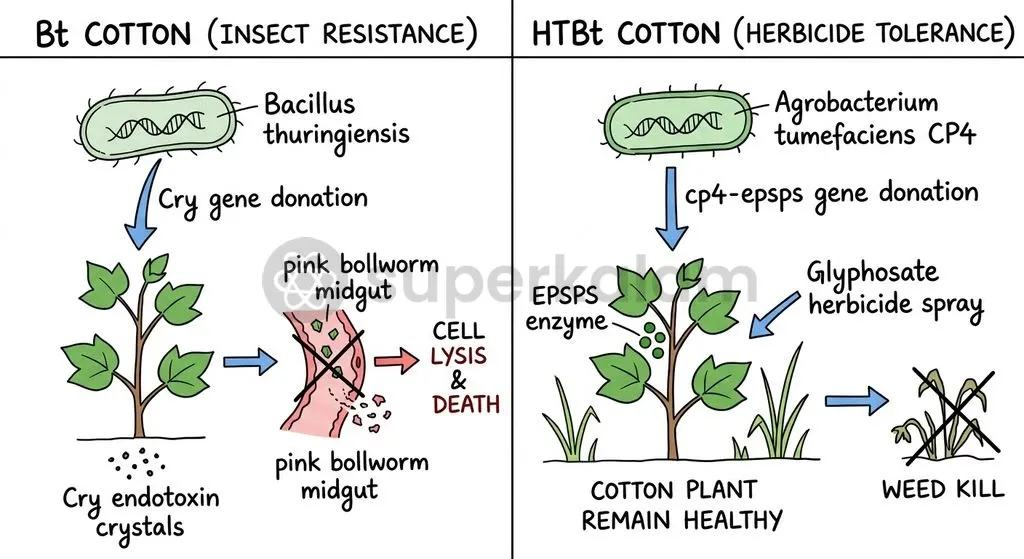
Transgenic cotton varieties in India rely on distinct recombinant genetic constructs designed to address separate agronomic constraints. The scientific mechanism of Bt cotton relies on Cry crystal proteins derived from the soil bacterium Bacillus thuringiensis, as documented by research in biotechnology dossiers. These endotoxins specifically disrupt the gut membrane of chewing lepidopteran pests, primarily American, spotted, and pink bollworms, providing targeted biological resistance without affecting plant physiology.
HTBt cotton incorporates an entirely different genetic mechanism using the cp4-epsps gene isolated from Agrobacterium tumefaciens strain CP4. This gene expresses an enzyme that remains functional even after exposure to glyphosate, a broad-spectrum herbicide that ordinarily halts protein synthesis across all plant tissues. By expressing this bacterial enzyme, the modified cotton plant survives blanket glyphosate sprays while surrounding weeds perish.
Advanced pest-resistance technologies have also introduced the Vip3A insecticidal protein, isolated from Bacillus thuringiensis, which binds to alternative receptor sites in bollworm larvae to circumvent emerging Cry-protein tolerance. However, according to the Indian Biosafety Knowledge Portal, neither Vip3A nor cp4-epsps transgenic events have received environmental clearance for commercial release in India.
Head-to-Head Comparison: Bt Cotton vs HTBt Cotton
The agronomic, legal, and biosafety differences between approved Bt cotton and unapproved HTBt cotton define India's biotechnology landscape:
| Feature / Dimension | Conventional Bt Cotton (Bollgard I & II) | Herbicide-Tolerant Bt Cotton (HTBt) |
|---|---|---|
| Genetic Constructs | Cry1Ac (Bollgard I); Cry1Ac + Cry2Ab (Bollgard II) from B. thuringiensis | Cry1Ac + Cry2Ab plus cp4-epsps from Agrobacterium tumefaciens |
| Primary Functional Trait | Targeted toxicity against lepidopteran bollworms | Bollworm resistance combined with broad-spectrum herbicide tolerance |
| Target Herbicide | None (sensitive to broad-spectrum chemical sprays) | Glyphosate (remains resistant during foliar spraying) |
| Legal Status in India | Fully approved for commercial release (cleared in 2002 and 2006) | Completely unapproved and illegal for commercial cultivation |
| Regulatory Authority | Cleared by the GEAC under the Ministry of Environment | Pending evaluation; unapproved by the GEAC |
| Seed Supply Channel | Authorised seed corporations and state-licensed retail channels | Unlicensed black-market operators and uncertified local networks |
| Consumer Redressal | Governed under the Seeds Act, 1966 with legal quality claims | Zero consumer protection or statutory compensation rights |
Discuss with Superkalam
How does the biological mechanism of targeted insect resistance in Bt cotton differ from broad-spectrum herbicide tolerance in HTBt cotton?
Ask NowThe Regulatory Framework for Genetically Modified Crops in India
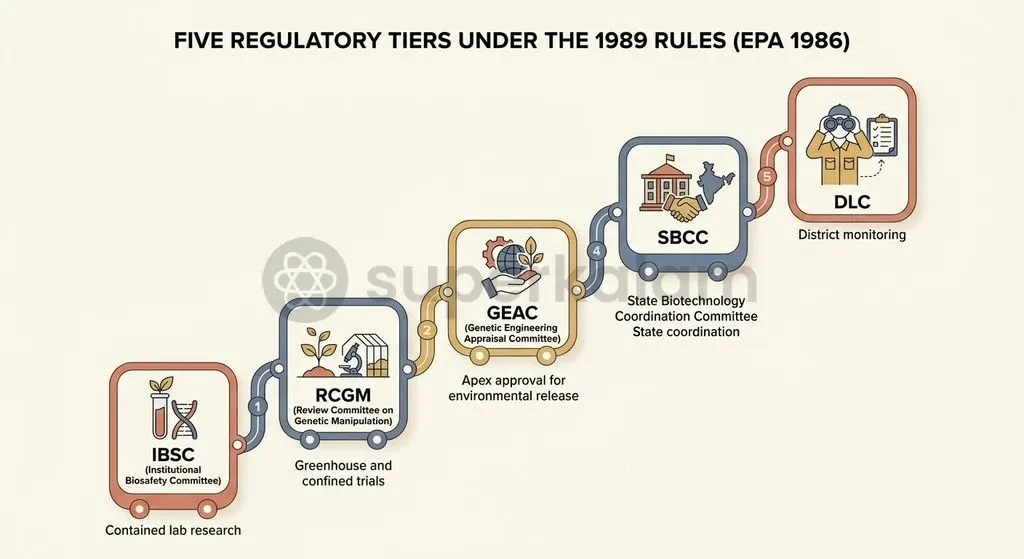
The Ministry of Environment, Forest and Climate Change regulates transgenic organisms under a rigorous five-tier statutory framework. Genetically engineered organisms are governed under the 1989 Rules framed under Sections 6, 8, and 25 of the Environment (Protection) Act, 1986. This governance architecture assesses ecological biosafety, food-feed safety, and gene-flow risks through institutional evaluation bodies before any environmental release:
- Institutional Biosafety Committee (IBSC): Evaluates laboratory-level genetic modifications and contained research trials within individual public and private research facilities.
- Review Committee on Genetic Manipulation (RCGM): Operates under the Department of Biotechnology to authorise contained greenhouse experiments and regulated multi-location field trials.
- Genetic Engineering Appraisal Committee (GEAC): Functions as the apex statutory authority under the Environment Ministry, possessing exclusive power to approve open environmental releases and commercial cultivation.
- State Biotechnology Coordination Committee (SBCC): Exercises state-level monitoring and inspection powers to investigate biosafety compliance and field trial breaches.
- District Level Committee (DLC): Operates at the grassroots district administration level to inspect transgenic test sites and enforce compliance measures.
Intellectual property boundaries surrounding transgenic seed technologies also face judicial oversight. The Supreme Court of India established in Monsanto Technology LLC v. Nuziveedu Seeds Ltd (2019) that summary rejections of transgenic patent claims under Section 3(j) of the Patents Act, 1970 cannot occur without a complete civil trial.
Why Is HTBt Cotton Illegal While Bt Cotton Is Allowed?
Bt cotton remains the only genetically engineered crop officially approved for commercial cultivation in India, following clearance by the GEAC in 2002. The technology was scaled from single-gene Bollgard I in 2002 to dual-gene Bollgard II in 2006, expanding to cover over 90% of national acreage. Official approval was granted because insecticidal endotoxins remain confined to plant tissues, presenting minimal direct environmental disturbance to neighbouring non-target flora.
Commercial planting of HTBt cotton remains explicitly prohibited because regulatory agencies have not validated its biosafety profile for open release. The unapproved cultivation or sale of genetically modified seeds directly violates the 1989 Rules. Under Section 15 of the Environment (Protection) Act, 1986, offenders face imprisonment up to five years, a financial penalty reaching ₹1,00,000, or both.
Chemical application rules further limit the legality of HTBt crops. The Ministry of Agriculture and Farmers Welfare issued Gazette notification S.O. 5010(E) under Section 27(2) of the Insecticides Act, 1968, restricting all glyphosate usage strictly through licensed Pest Control Operators. Applying glyphosate over standing cotton crops using manual or unregistered equipment constitutes a separate statutory offence under pesticide control regulations.
The Ground Reality: How Unapproved HTBt Cotton Spreads in Indian Farms
Economic pressures tied to agricultural labour have driven widespread illegal adoption across major cotton-producing zones. As reported by the Indian Express and agronomic assessments by the ICAR-Directorate of Weed Research, manual weeding costs farmers between ₹7,000 and ₹15,000 per acre each season, whereas chemical clearing with glyphosate over HTBt crops requires merely ₹800 to ₹1,500 per acre. This massive cost disparity makes unauthorised seeds highly attractive to smallholders grappling with farm labour shortages.
Field investigations reveal extensive illicit penetration in key agricultural states. The Department of Biotechnology constituted the Field Inspection and Scientific Evaluation Committee to investigate unapproved plantings following repeated complaints across Maharashtra, Gujarat, Telangana, and Andhra Pradesh. Seed industry surveys by the Federation of Seed Industry of India (FSII) and the South Asia Biotechnology Centre (SABC) reported in October 2026 that illegal HTBt cotton occupies between 15% and nearly 30% of cotton acreage in high-cultivation districts across these four states.
The commercial scale of this unregulated distribution network remains substantial. The National Seed Association of India reported to the Ministry of Agriculture in June 2025 that an estimated 75 to 88 lakh illicit seed packets circulate annually, generating a black market valued between ₹600 and ₹1,500 crore. These untraced packets are sold under deceptive labels without testing certificates, circumventing state agricultural quality inspections.
Discuss with Superkalam
If a farmer purchases illicit HTBt seeds from uncertified vendors and suffers crop failure, what legal recourse or protections exist under the Seeds Act, 1966?
Ask NowEnvironmental and Agronomic Risks of Herbicide Tolerance
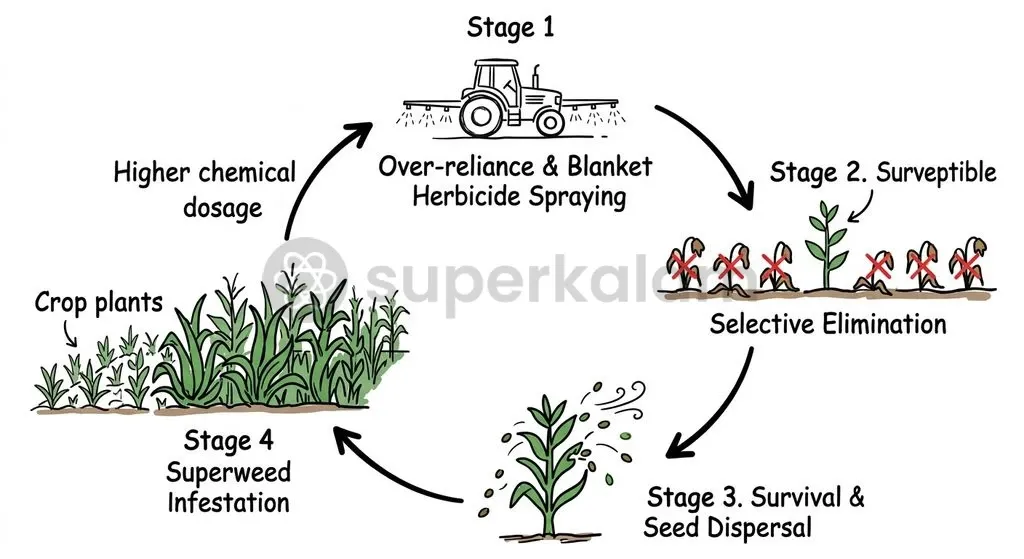
Unregulated cultivation of herbicide-tolerant varieties introduces long-term ecological damage to Indian agro-ecosystems. The ICAR-Directorate of Weed Research warns that continuous, unmonitored application of glyphosate generates intense selection pressure, accelerating the evolution of herbicide-tolerant superweeds. When invasive weed species develop tolerance to glyphosate, farmers lose their most economical chemical weed control method, prompting the application of heavier, more hazardous chemical cocktails.
Pest resistance dynamics have already degraded the initial efficacy of transgenic insect control. The Central Institute for Cotton Research (ICAR-CICR) confirmed that the pink bollworm (Pectinophora gossypiella) has developed widespread field-level resistance across central and southern cotton zones to both Cry1Ac and Cry2Ab proteins in Bollgard II cotton. Introducing herbicide tolerance without resolving pink bollworm vulnerability leaves crops prone to severe insect devastation.
Public health considerations compound these agricultural risks. The World Health Organization's International Agency for Research on Cancer classified glyphosate as probably carcinogenic to humans (Group 2A) in its Monograph 112 evaluation. Indiscriminate foliar spraying by farm labourers lacking personal protective gear raises direct toxicity and occupational health hazards in rural communities.
Ethical and Farmer Welfare Dimensions
The proliferation of unapproved HTBt cotton exposes deep ethical tensions between immediate farmer livelihoods, administrative governance, and technological justice. Smallholders facing acute rural indebtedness turn to unapproved biotechnology as an economic survival strategy to escape crippling manual weeding expenses. However, bypassing statutory evaluation exposes these same vulnerable farming communities to exploitation by unlicensed seed cartels.
Because illicit seeds operate outside the statutory mandate of the Seeds Act, 1966, farmers possess no legal recourse, quality guarantees, or compensation mechanisms if crops fail. When spurious seeds deliver zero herbicide tolerance or succumb to pest infestations, cultivators bear the entire financial loss without access to state-mandated grievance redressal.
Civil disobedience actions by farmer unions highlight systemic friction between formal regulatory processes and agrarian technological demand. While organisations such as the Shetkari Sanghatana defend seed access as an agrarian right, bypassing biosafety evaluations under the Environment (Protection) Act, 1986 undermines environmental jurisprudence. The ethical responsibility requires the state to guarantee accessible, transparent, and evidence-based biosafety appraisals rather than leaving farmers reliant on a predatory black market.
The Way Forward: Policy Enforcement and Safer Biotechnology
Resolving the HTBt cotton crisis demands coordinated regulatory enforcement, updated scientific assessments, and sustainable agronomic alternatives. The Ministry of Environment, Forest and Climate Change must ensure transparent, time-bound scientific evaluations of pending transgenic proposals through the reconstituted GEAC Expert Committee. Clearing or rejecting technologies must rely strictly on verifiable, publicly scrutinised biosafety data rather than protracted bureaucratic indecision.
Enforcement mechanisms require immediate structural strengthening across state boundaries:
- Inter-State Coordination: State Biotechnology Coordination Committees and District Level Committees must form joint task forces to intercept illicit seed production and interstate transit networks.
- Supply-Chain Verification: State agricultural departments should introduce digital QR-code tracking and barcode authentication under the Seeds Act, 1966 to eliminate unapproved varieties from retail supply chains.
- Enforcing Pesticide Regulations: State licensing authorities must strictly implement notification S.O. 5010(E), curbing unrestricted over-the-counter glyphosate sales and monitoring licensed pest control operations.
- Promoting Integrated Weed Management: The Indian Council of Agricultural Research (ICAR) should scale public investments in mechanical weeders, cover-cropping methods, and biological pest control to reduce dependence on chemical herbicides.
Discuss with Superkalam
Compare the economic incentives of reduced weeding costs with the regulatory biosafety liabilities associated with unauthorized transgenic crop cultivation.
Ask NowKey Takeaways
- Sole Commercial GM Crop: Bt cotton remains the only genetically modified crop approved for commercial farming in India, having secured GEAC clearance in 2002.
- Statutory Prohibition: Planting, producing, or distributing HTBt cotton is illegal and punishable under Section 15 of the Environment (Protection) Act, 1986 with up to five years imprisonment, a ₹1,00,000 fine, or both.
- Underlying Gene Mechanisms: Conventional Bt cotton utilizes Cry1Ac and Cry2Ab genes targeting lepidopteran bollworms, whereas HTBt cotton introduces the cp4-epsps gene conferring tolerance to the broad-spectrum herbicide glyphosate.
- Pesticide Restrictions: Glyphosate use is legally restricted under Section 27(2) of the Insecticides Act, 1968, requiring application strictly through licensed Pest Control Operators.
- Absence of Consumer Protection: Illicit HTBt seeds are traded outside the Seeds Act, 1966, leaving cultivators without statutory seed warranties, compensation claims, or grievance mechanisms during crop failure.
Mains Question
"The widespread cultivation of unapproved Herbicide-Tolerant Bt (HTBt) cotton across central and southern cotton belts highlights an acute friction between immediate agrarian economic imperatives and statutory environmental governance under the Environment (Protection) Act, 1986." Critically analyse. (15 Marks)
Evaluate NowMains Question
Elucidate the multi-tier regulatory architecture governing genetically modified crops in India under the 1989 Rules, highlighting the specific mandates of key institutional bodies. (10 Marks)
Evaluate NowPractice MCQs
QUESTION 1
With reference to the transgenic mechanisms deployed in genetically modified cotton, consider the following statements:
- Conventional Bt cotton uses Cry endotoxins derived from Bacillus thuringiensis to target lepidopteran bollworms.
- HTBt cotton expresses the cp4-epsps gene isolated from Agrobacterium tumefaciens strain CP4 to confer resistance against glyphosate.
- Both the Vip3A insecticidal protein and cp4-epsps transgenic events have received environmental clearance for commercial cultivation in India.
Which of the statements given above are correct?
QUESTION 2
Consider the following statements regarding the multi-tier regulatory framework governing genetically modified organisms in India:
- The 1989 Rules for transgenic organisms are framed under the provisions of the Environment (Protection) Act, 1986.
- The Review Committee on Genetic Manipulation (RCGM) functions under the Ministry of Environment, Forest and Climate Change as the apex body for commercial release.
- Grassroots-level monitoring and inspection of transgenic test sites are entrusted to the District Level Committee (DLC).
Which of the statements given above is/are correct?
QUESTION 3
Consider the following statements regarding the legal and regulatory provisions governing agrochemicals and genetically modified seeds in India:
- Cultivation of unapproved genetically modified crops attracts penal provisions under Section 15 of the Environment (Protection) Act, 1986, including imprisonment up to five years.
- Under notification S.O. 5010(E) of the Insecticides Act, 1968, the application of glyphosate is restricted exclusively through licensed Pest Control Operators.
- The Supreme Court in Monsanto Technology LLC v. Nuziveedu Seeds Ltd (2019) held that transgenic patent claims can be summarily rejected under Section 3(j) of the Patents Act, 1970 without a full civil trial.
Which of the statements given above is/are correct?
QUESTION 4
Which of the following committees was specifically constituted by the Department of Biotechnology to investigate the illicit cultivation and spread of unapproved Herbicide-Tolerant Bt cotton across states like Maharashtra, Gujarat, Telangana, and Andhra Pradesh?
QUESTION 5
With reference to agricultural biotechnology in India, what is the primary agronomic incentive prompting smallholders to cultivate unapproved HTBt cotton despite statutory prohibitions?