BRICS STI Framework: Chennai Declaration, Strategic Priorities, and BRICS+ Impact
As the expanded BRICS+ bloc navigates geopolitical tech divides, the Chennai Declaration tests India’s ability to balance shared science with strategic autonomy.
Aug, 2026
•9 min read
Overview
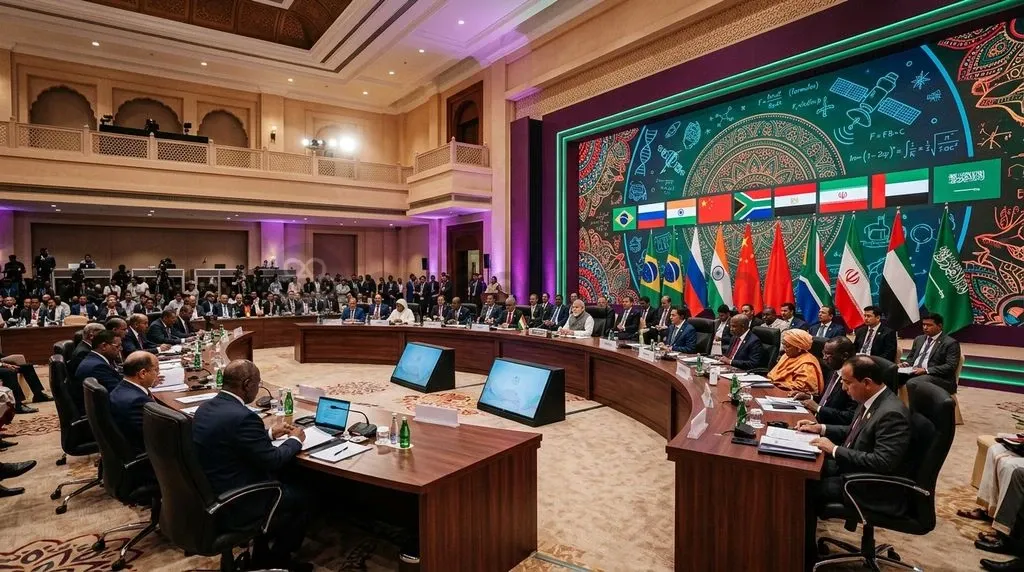
The 14th BRICS Science, Technology, and Innovation Ministerial Meeting held in Chennai adopted the Chennai Declaration. This established a shared roadmap for frontier technologies and research infrastructure across the expanded ten-member bloc. As of August 2026, this multilateral architecture formalises scientific collaboration across sectors including artificial intelligence, quantum computing, and biotechnology.
Guided by India's presidential vision of Building for Resilience, Innovation, Cooperation and Sustainability, the framework tackles technological divides across emerging markets. It prioritises open access to mega-science facilities, decentralised intellectual property arrangements, and digital public infrastructure to reconcile shared innovation goals with strategic national autonomy.
Why Is the 14th BRICS STI Meeting in the News?
The 14th BRICS Science, Technology, and Innovation (STI) Ministerial Meeting concluded on August 21, 2026, in Chennai under India’s BRICS Presidency with the adoption of the Chennai Declaration. According to the Press Information Bureau (PIB) Release on Chennai Declaration, member states agreed to deepen collaborative research under a people-centred framework guided by India’s Vishwa Bandhu Bharat vision.
The summit marked several operational and diplomatic milestones:
- First Expanded Ministerial: The summit brought together the full 10-member BRICS+ bloc, with delegations attending from Brazil, Russia, India, China, South Africa, Egypt, Ethiopia, Iran, Saudi Arabia, and the United Arab Emirates.
- Transition Roadmap: Ministers formally adopted a rolling STI Calendar for 2026–2027.
- Next Presidency Handover: The People's Republic of China will officially assume the chairship to host the 15th BRICS STI Ministerial Meeting in 2027.
What Is the BRICS Science, Technology, and Innovation (STI) Framework?
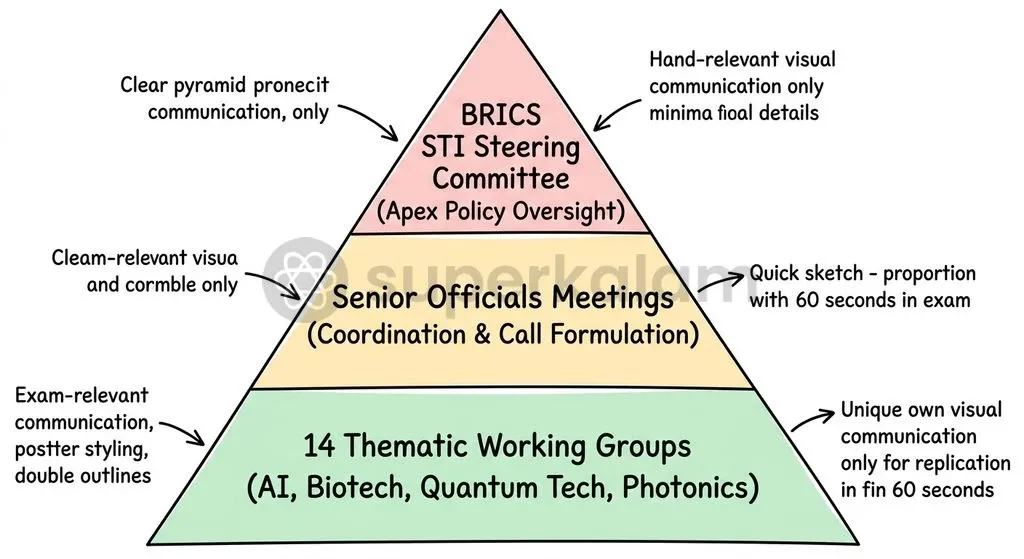
The BRICS STI Framework is the dedicated multilateral architecture set up by member states for collaborative research, technology transfer, and joint scientific capacity building. The governance of this institutional mechanism operates across three primary tiers:
- BRICS STI Steering Committee: The apex executive body responsible for strategic direction, policy oversight, and multi-year agenda setting.
- Senior Officials Meetings (SOM): The operational layer coordinating inter-ministerial positions, reviewing call proposals, and preparing ministerial declarations.
- 14 Thematic Working Groups: Specialised expert bodies managing research tracks across designated disciplines, ranging from biotechnology to geospatial applications.
The funding architecture functions through a decentralised resource-pooling model rather than a centralised common fund. Under the BRICS STI Framework Programme guidelines, joint research projects require consortia comprising entities from at least three BRICS nations. Participating nations fund their respective domestic researchers through national agencies, avoiding cross-border fiscal transfers.
| Governance Dimension | Operational Mechanism | Implementation Details |
|---|---|---|
| Executive Oversight | BRICS STI Steering Committee | Coordinates ministerial policy directives and institutional roadmaps |
| Consortium Rule | Minimum 3-country participation | Requires co-investigators from at least three member states per project |
| Funding Structure | Domestic agency co-funding | National funding agencies finance domestic researchers without cross-border cash transfers |
| Intellectual Property | Project Consortium Agreements | Decentralised IPR allocation negotiated per project; no supranational tribunal |
| Working Architecture | 14 Thematic Working Groups | Covers sectoral domains including AI, photonics, materials, and biotechnology |
Discuss with Superkalam
Recall the minimum number of participating member countries required to form an eligible research consortium under the BRICS STI Framework Programme.
Ask NowKey Outcomes of the Chennai Declaration
The Chennai Declaration codified tangible institutional milestones while launching new platforms for shared scientific infrastructure. According to the Press Information Bureau (PIB) Release on Chennai Declaration, the forum confirmed the completion of nine coordinated project calls under the BRICS STI Framework Programme, alongside 11 editions of the BRICS Young Scientist Forum and nine editions of the BRICS Young Innovators Prize.
The declaration prioritised seven core frontier technologies for future joint funding and research initiatives:
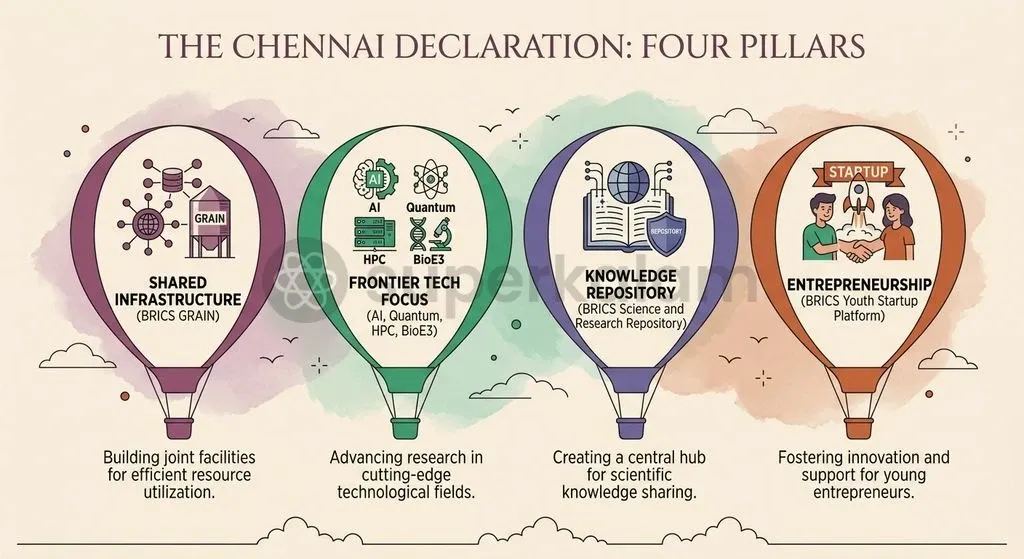
- Artificial Intelligence (AI) and High-Performance Computing (HPC): Developing sovereign compute capacities and shared algorithms for public service delivery.
- Quantum Technologies and Photonics: Exploring secure communications, quantum sensing, and foundational light-based technologies.
- Geospatial and Space Technologies: Pooling satellite telemetry and earth-observation datasets for environmental monitoring.
- Advanced Materials and Biotechnology: Engineering novel biomaterials and sustainable industrial inputs.
To widen access to capital-intensive research assets, the Chennai consensus accelerated the operationalisation of the BRICS GRAIN platform (Global Research Advanced Infrastructure Network). According to the Department of Science and Technology (DST) Official Release, BRICS GRAIN facilitates open, cross-border access to mega-science facilities, shared laboratories, and high-performance computing clusters across all member states.
The ministers also approved the creation of a BRICS Science and Research Repository. This digital clearinghouse will index researchers, institutional capabilities, open datasets, and joint collaborative opportunities across the ten member countries. To support grassroots enterprise, the summit endorsed the BRICS Youth Startup Platform to catalyse venture incubation and early-stage financing for young innovators.
India's Strategic Priorities in BRICS STI Cooperation
The Department of Science and Technology (DST) anchored India's multilateral agenda in scalable, affordable technologies designed to address shared developmental challenges across the Global South. During the ministerial address, India positioned its domestic mission-mode programmes as operational templates for wider multilateral collaboration.
India's primary sectoral contributions focus on four strategic verticals:
- National Quantum Mission and Supercomputing Mission: Offering domestic computational frameworks to support joint deep-tech simulations and algorithm validation.
- BioE3 Policy: Leveraging the Biotechnology for Economy, Environment and Employment policy framework to advance bio-manufacturing and circular green technologies.
- Digital Public Infrastructure (DPI): Sharing open, interoperable architectures for identity verification, digital payments, and data exchange.
- Frugal and Disaster-Resilient Technologies: Deploying low-cost medical diagnostics and climate-resilient civil engineering solutions for disaster mitigation.
To reinforce financing, India proposed utilising the newly established Anusandhan National Research Foundation (ANRF). This aims to bridge domestic private sector capital with multilateral BRICS STI flagship projects, as reported by the Department of Science and Technology (DST) Policy Blueprint on August 22, 2026.
Discuss with Superkalam
Explain how the decentralised co-funding model of the BRICS STI Framework avoids cross-border fiscal transfers while enabling joint multi-country projects.
Ask NowHow STI Cooperation Serves the Expanded BRICS+ Bloc
The expansion of BRICS into a 10-member bloc shifts multilateral scientific cooperation by combining diverse technological capabilities and economic scales. The accession of Egypt, Ethiopia, Iran, Saudi Arabia, and the United Arab Emirates broadens the geographical footprint across the Middle East and Africa, introducing varied research strengths.
However, the expansion also widens disparities in national research capabilities. Gross Domestic Expenditure on R&D (GERD) as a percentage of GDP varies significantly across the BRICS+ members, highlighting stark divides in domestic science financing:
- United Arab Emirates: Recorded at approximately 1.30% of GDP.
- Iran: Recorded at approximately 0.83% of GDP.
- Egypt: Recorded at approximately 0.72% of GDP.
- Saudi Arabia: Recorded at approximately 0.64% of GDP.
- Ethiopia: Recorded at approximately 0.27% of GDP.
This structural heterogeneity requires BRICS STI initiatives to design asymmetric capacity-building programmes. This ensures resource-constrained members gain equitable access to advanced compute platforms and shared laboratory infrastructure.
Major Challenges Facing Multilateral Research and Tech Sharing
Multilateral science initiatives within the BRICS+ architecture encounter severe structural, legal, and geopolitical constraints that impede deep technological integration. Operationalising joint calls across diverse institutional ecosystems presents persistent operational hurdles, as highlighted in the 14th BRICS STI Ministerial Meeting Outcomes Analysis (reported on August 23, 2026):
- Absence of Supranational IP Frameworks: There is no centralised patent authority or standing dispute-resolution tribunal within BRICS; intellectual property rights are managed strictly through individual Project Consortium Agreements (PCAs).
- Divergent Data Governance Regimes: Conflicting national statutes on cross-border data flows, data localisation, and digital privacy restrict the seamless pooling of scientific datasets.
- Voluntary Financial Commitments: The absence of legally binding funding quotas or a pooled financial corpus creates funding unpredictability for multi-year mega-science projects.
Geopolitical frictions present an equally complex operational barrier. Strategic divergences and technology supply-chain competition between India and China introduce alignment bottlenecks. Western export controls and sanctions impacting Russia and Iran add further friction.
These realignments directly constrain high-technology working groups, particularly those governing Artificial Intelligence, quantum computing, and high-performance computing. Because these technologies possess dual-use capabilities—serving both commercial and national defence applications—member states operate under acute security dilemmas regarding proprietary source-code sharing and critical hardware transfers.
For India, managing these multilateral platforms requires a calibrated hedging strategy. It actively leverages multilateral scientific exchanges for civil and developmental applications. At the same time, it safeguards domestic critical supply chains and preserves strategic autonomy through separate bilateral partnerships.
Discuss with Superkalam
Evaluate whether the absence of a supranational intellectual property tribunal poses a critical barrier to high-stakes, deep-tech research consortia within BRICS+.
Ask NowWay Forward: Building an Equitable Innovation Ecosystem
The Department of Science and Technology must institutionalise durable operational mechanisms to convert high-level declarations into commercialised technological solutions. Expanding the scope and industrial relevance of the BRICS STI framework demands targeted policy actions across domestic and multilateral channels:
- Establishing Common Tech-Transfer Guidelines: Formulating standardised intellectual property templates under Project Consortium Agreements to streamline cross-border commercialisation of joint discoveries.
- Leveraging ANRF for Co-Financing: Utilising the Anusandhan National Research Foundation to crowd-in private enterprise financing for multilateral projects in advanced materials and bio-manufacturing, per the Department of Science and Technology (DST) Policy Blueprint (reported on August 22, 2026).
- Operationalising BRICS GRAIN Clusters: Expediting high-speed digital interconnects and access protocols so academic researchers across smaller member nations can leverage shared supercomputing facilities.
- Standardising Open Data Protocols: Harmonising sectoral data-sharing architectures within the BRICS Science and Research Repository to facilitate collaborative machine-learning research without violating national data sovereignty laws.
- Institutionalising Youth Innovation Pipelines: Expanding the BRICS Youth Startup Platform into an active regional accelerator backed by multilateral venture syndicates.
Discuss with Superkalam
Design a policy mechanism through which India's Anusandhan National Research Foundation (ANRF) can effectively crowd-in private capital for multilateral STI initiatives.
Ask NowKey Takeaways
- The 14th BRICS STI Ministerial Meeting was held in Chennai on August 21, 2026, culminating in the unanimous adoption of the Chennai Declaration under India's 2026 BRICS Presidency.
- The summit advanced the BRICS GRAIN infrastructure network to provide open access to mega-science facilities, and approved the BRICS Science and Research Repository.
- Governance is structured through the BRICS STI Steering Committee, Senior Officials Meetings, and 14 thematic Working Groups, operating on a domestic co-funding model without cross-border cash transfers.
- Research spending varies across the expanded BRICS+ bloc, ranging from 1.30% of GDP in the UAE to 0.27% in Ethiopia.
- Intellectual property management remains decentralised via mandatory Project Consortium Agreements, with no central patent authority or standing dispute body.
- Strategic competition and Western export sanctions on Russia and Iran pose recurring alignment challenges to deep dual-use technology integration within the STI framework.
Mains Question
"The expansion of the BRICS STI framework into a ten-member bloc offers new avenues for South-South technological cooperation, yet stark structural asymmetries and institutional gaps pose significant hurdles." Critically analyse. (15 Marks)
Evaluate NowMains Question
"Guided by the 'Vishwa Bandhu Bharat' vision, India has sought to anchor multilateral scientific collaboration in scalable, domestic mission-mode templates." Elucidate in the context of the Chennai Declaration. (10 Marks)
Evaluate NowPractice MCQs
QUESTION 1
With reference to the governance and operational mechanism of the BRICS Science, Technology, and Innovation (STI) Framework, consider the following statements:
- Joint research projects require consortia comprising entities from a minimum of three member states.
- Projects are financed through a centralised common corpus managed by the BRICS STI Steering Committee with direct cross-border cash transfers.
- Intellectual property generated under joint research is adjudicated and registered through a supranational BRICS patent tribunal.
Which of the statements given above is/are correct?
QUESTION 2
Consider the following statements regarding the outcomes of the 14th BRICS STI Ministerial Meeting held in Chennai:
- The meeting adopted the Chennai Declaration, prioritising frontier domains including Artificial Intelligence, Quantum Technologies, and Biotechnology.
- The BRICS GRAIN platform was accelerated to enable open cross-border access to mega-science facilities and high-performance computing clusters.
- The People's Republic of China handed over the chairship of the 14th Ministerial Meeting to India, which will host the 15th Ministerial Meeting in 2027.
Which of the statements given above is/are correct?
QUESTION 3
With reference to the expanded 10-member BRICS+ STI architecture and domestic R&D spending, consider the following statements:
- The 14th STI Ministerial Meeting was the first ministerial meeting to convene delegations from the full 10-member BRICS+ bloc.
- Among the newly acceded BRICS+ members, the United Arab Emirates has a higher Gross Domestic Expenditure on R&D (GERD) as a percentage of GDP compared to Ethiopia.
- Mandatory, legally binding annual financial contributions have been instituted to ensure predictable funding for multi-year research projects.
Which of the statements given above is/are correct?
QUESTION 4
In the context of multilateral scientific collaboration under the BRICS framework, the 'BRICS GRAIN' initiative relates to which of the following?
QUESTION 5
Consider the following statements regarding India's strategic contributions to the BRICS STI Framework:
- India proposed leveraging its BioE3 policy framework to advance bio-manufacturing and circular green technologies across the bloc.
- India proposed deploying the Anusandhan National Research Foundation (ANRF) to bridge domestic private sector capital with multilateral BRICS STI flagship projects.
Which of the statements given above is/are correct?