BRICS NIMHANS Network: Scaling Mental Health in Primary Healthcare
As India decentralises psychiatric care to bridge massive specialist deficits, NIMHANS anchors a multilateral framework to scale community mental health.
Sep, 2026
•9 min read
Overview
The designation of the National Institute of Mental Health and Neuro Sciences as the coordinating apex for the BRICS Network of Centres of Excellence establishes a dedicated multilateral framework. It integrates psychiatric care directly into primary health systems.
Shifting institutional knowledge from tertiary psychiatric hospitals to community health centres creates a practical model for emerging economies facing severe workforce shortages.
As of March 2026, low- and middle-income nations across the Global South confront massive psychiatric treatment gaps and severe specialist deficits. Anchoring mental health delivery within comprehensive primary healthcare transforms psychiatric support into an accessible, rights-based public health entitlement rather than an urban clinical luxury.
Why is the BRICS NIMHANS Network in the News?
The National Institute of Mental Health and Neuro Sciences (NIMHANS), Bengaluru, was officially designated as the coordinating Centre of Excellence for the BRICS Network of Centres of Excellence on Mental Health and the BRICS Training Hub Network.
This institutional milestone involves key diplomatic developments:
- Multilateral Ratification: Endorsed during the 16th BRICS Health Ministers' Meeting and reaffirmed at the 18th BRICS Summit.
- Shared Clinical Mandate: Member nations agreed to pool clinical expertise, conduct multi-centric research, and scale community-oriented psychiatric solutions across the Global South.
- Shift in Health Priorities: The BRICS declaration formally recognises neuropsychiatric conditions as a major driver of chronic disability and economic output loss in developing economies.
Discuss with Superkalam
What is the recommended WHO benchmark for psychiatrists per 100,000 population compared to India's current availability?
Ask NowUnderstanding Mental Healthcare in India's Primary Health System
India's public mental healthcare architecture is shifting away from centralised asylum-based institutionalisation. It now focuses on decentralised community-level interventions through the National Mental Health Programme (NMHP), operationalised at the grassroots level through the District Mental Health Programme (DMHP).
The delivery model rests on three distinct tiers of administrative and clinical care:
- Primary Tier (Ayushman Arogya Mandirs): Frontline health workers conduct population-level screenings, offer basic psychoeducation, and dispense essential psychotropic medications under the Comprehensive Primary Health Care framework.
- Secondary Tier (Community Health Centres and District Hospitals): Medical officers, psychiatric nurses, and clinical psychologists under the DMHP provide outpatient consultations, emergency psychiatric stabilization, and counselling.
- Tertiary Tier (Centres of Excellence like NIMHANS): Specialised psychiatric institutes manage refractory disorders, run post-graduate training programmes, and guide national policy formulation.
| Level of Care | Primary Facility | Key Personnel | Core Mental Health Functions |
|---|---|---|---|
| Grassroots | Ayushman Arogya Mandirs | ASHAs, ANMs, Community Health Officers | Early identification, stigma reduction, basic screening, referral |
| Secondary | District Hospitals (DMHP Units) | Medical Officers, Clinical Psychologists, Psychiatric Social Workers | Diagnosis, psychopharmacotherapy, crisis intervention, suicide prevention |
| Tertiary | NIMHANS, Regional Mental Health Institutes | Specialist Psychiatrists, Neuroscientists | Specialized clinical care, manpower training, national capacity building |
This tiered decentralisation operationalises statutory mandates under the Mental Healthcare Act, 2017. Section 18 of the Act establishes a legally enforceable right to access affordable, non-discriminatory mental healthcare funded by the appropriate government.
Key Pillars of the BRICS Mental Health Network and NIMHANS's Role
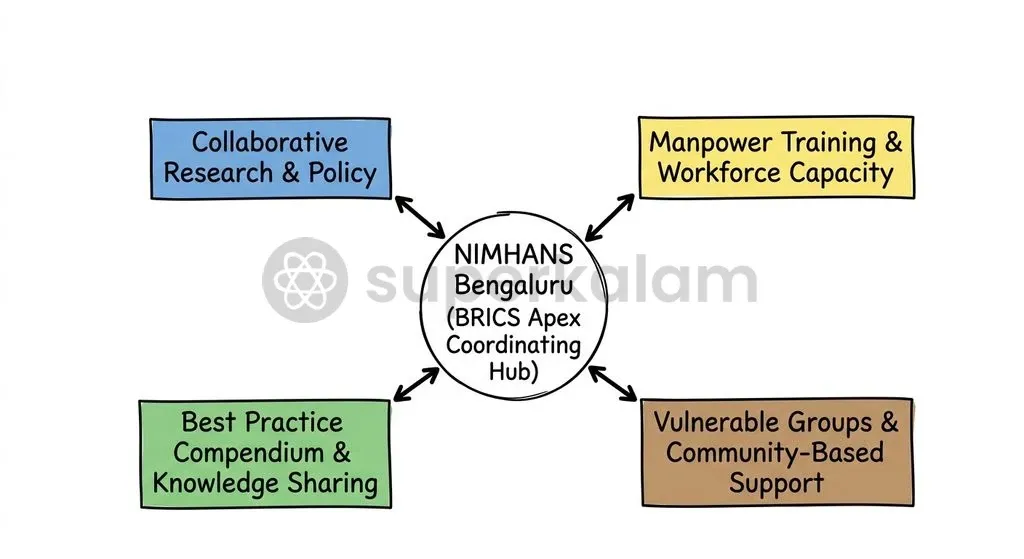
The BRICS Network of Centres of Excellence on Mental Health operates on four foundational pillars designed to bridge institutional deficits across member states. The 18th BRICS Summit New Delhi Declaration detailed these mechanisms to advance collaborative clinical research, policy harmonisation, digital health integration, and capacity building.
The operational pillars comprise:
- Collaborative Research and Epidemiological Surveillance: Establishing joint data registries to track the prevalence of common and severe mental disorders across diverse demographic cohorts.
- Standardised Manpower Training: Utilising the BRICS Training Hub Network at NIMHANS to upskill general medical practitioners, community nurses, and public health managers.
- Knowledge Translation and Best-Practice Scaling: Implementing the BRICS Compendium of Best Practices on Promotion of Mental Wellness to replicate validated low-cost interventions.
- Vulnerable Population Interventions: Delivering structured Mental Health and Psychosocial Support (MHPSS) strategies tailored for children, adolescents, and communities facing acute humanitarian or climate-induced crises.
NIMHANS is the technical anchor. It designs curricula and standardises clinical protocols across emerging health systems. By establishing common diagnostic matrices, the network enables emerging economies to bypass expensive Western models in favour of community-based psychosocial approaches.
Discuss with Superkalam
Explain how task-shifting to frontline workers at Ayushman Arogya Mandirs helps decentralise mental healthcare away from tertiary asylums.
Ask NowCurrent Challenges in Decentralising Mental Healthcare in India
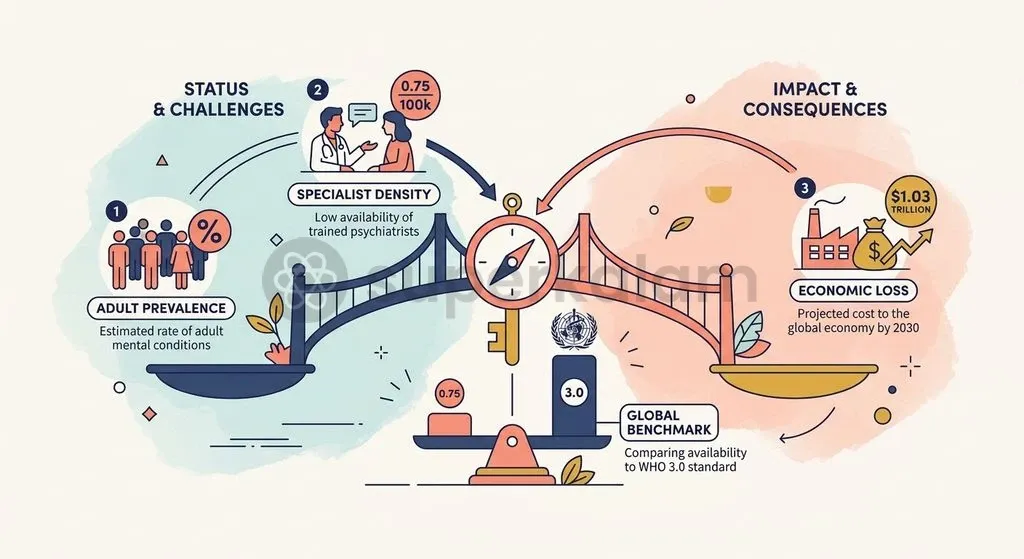
Decentralising psychiatric services across India faces structural bottlenecks that sustain a severe treatment gap. According to the National Mental Health Survey (NMHS 2015-16), 10.6% of Indian adults suffer from a diagnosable mental disorder, with lifetime prevalence reaching 13.7%.
The systemic treatment gap ranges between 70% and 92% across major psychiatric conditions, standing at 85% for common mental disorders and 73.6% for severe mental disorders. Several structural hurdles perpetuate this disparity:
- Severe Manpower Deficits: India possesses approximately 0.75 psychiatrists per 100,000 population, falling far short of the World Health Organization recommendation of at least 3 psychiatrists per 100,000.
- Fiscal Under-allocation: Public spending on mental healthcare accounts for less than 1% of India's total health budget, compelling families to bear substantial out-of-pocket expenses.
- Macroeconomic Losses: Studies published by the World Health Organization and the Lancet Commission estimate that mental health disorders will cost the Indian economy over $1.03 trillion in lost economic output between 2012 and 2030.
- Social Stigma and Urban Bias: Specialist mental health infrastructure remains heavily clustered in tertiary medical colleges in urban centres, leaving rural populations reliant on informal providers.
Policy Mechanisms: From Tele-MANAS to Ayushman Arogya Mandirs
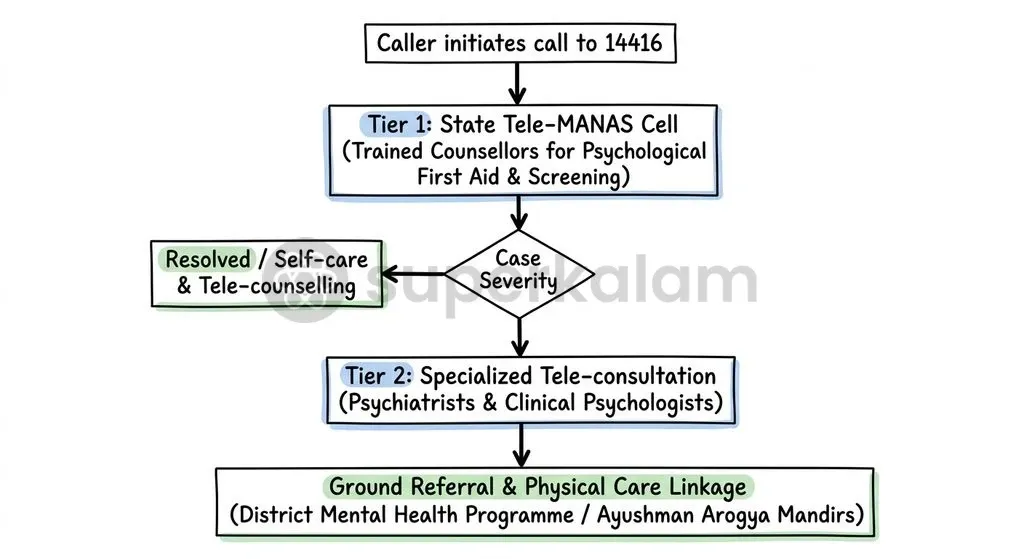
The Ministry of Health and Family Welfare (MoHFW) leverages digital architecture and task-shifting strategies to overcome clinical shortages. The National Tele Mental Health Programme operationalises Tele-MANAS (Tele Mental Health Assistance and Networking Across States) as a round-the-clock digital lifeline via toll-free numbers 14416 and 1800-891-4416, anchored by NIMHANS.
Tele-MANAS operates through a structured two-tier service delivery model:
- Tier 1 (State Tele-MANAS Cells): Staffed by trained clinical psychologists and tele-counsellors, this level handles inbound distress calls, triage, basic psychological first aid, and immediate crisis management.
- Tier 2 (Specialist Consultation and Linkage): When callers present severe psychiatric distress or active suicidal ideation, cases escalate to senior psychiatrists, clinical psychologists, and localised DMHP physical facilities for in-person management.
| Feature | Tele-MANAS Digital Grid | Ayushman Arogya Mandirs |
|---|---|---|
| Operational Tier | Virtual / Digital Helpdesk (Tier 1 & 2) | Physical Primary Health Infrastructure |
| Primary Personnel | Tele-counsellors, On-call Psychiatrists | Community Health Officers, ASHAs, ANMs |
| Core Function | 24x7 acute crisis triage, tele-counselling | Continuous community screening, drug dispensing |
| Reach & Scale | Pan-India digital connectivity | Grassroots village-level physical access |
At the physical frontline, task-shifting frameworks train Accredited Social Health Activists (ASHAs) and Auxiliary Nurse Midwives (ANMs). They learn to recognise early behavioural symptoms and lead community anti-stigma campaigns.
Concurrently, the District Mental Health Programme has been sanctioned across 767 districts, establishing an administrative footprint to anchor these primary referrals.
Discuss with Superkalam
Weigh the advantages and operational constraints of relying on virtual platforms like Tele-MANAS versus strengthening physical district-level psychiatric infrastructure.
Ask NowEthical Dimensions and Human Rights in Mental Health Governance
The governance of mental health intersects directly with human dignity and constitutional safeguards. Article 47 of the Constitution directs the state to raise public health standards as a Directive Principle of State Policy. Modern jurisprudence also locates mental well-being firmly within the enforceable fundamental right to life under Article 21.
The Mental Healthcare Act, 2017 introduced transformative rights-based protections:
- Decriminalisation of Suicide: Section 115 establishes a statutory presumption of severe stress for any individual attempting suicide. It explicitly places an affirmative duty on the government to provide care, treatment, and rehabilitation rather than prosecution.
- Advance Directives and Nominated Representatives: The law empowers individuals to legally document their treatment preferences in advance and nominate trusted representatives, checking involuntary confinement and clinical abuse.
- Protection of Civil Liberties: The legislation strictly curtails coercive practices, mandating that psychiatric treatment respect individual autonomy and bodily integrity.
Discuss with Superkalam
How can the knowledge-sharing mechanisms under the BRICS Mental Health Network be tailored to design low-cost psychosocial support programs in rural India?
Ask NowWay Forward: Building a Community-Centric Mental Health Framework
Sustainably closing India's psychiatric treatment gap requires structural health financing, institutional accountability, and continuous workforce expansion. Translating international declarations into community-level outcomes depends on targeted policy interventions:
- Enhancing Dedicated Budgetary Allocations: Progressively increasing mental health expenditure towards 5% of the total health budget is essential to ensure a reliable supply of essential psychotropic drugs across primary health centres.
- Institutionalising Task-Shifting Protocols: Legally empowering and incentivising Community Health Officers, ASHAs, and general medical officers to deliver basic cognitive interventions relieves pressure on tertiary facilities.
- Strengthening DMHP-Primary Health Linkages: Upgrading physical infrastructure across all 767 sanctioned DMHP districts ensures patients identified via Tele-MANAS receive seamless secondary clinical follow-up.
- Targeted School and Adolescent Interventions: Scaling evidence-based psychoeducation through national school health initiatives protects vulnerable youth from rising anxiety, depression, and self-harm.
Key Takeaways
- NIMHANS Bengaluru is the coordinating Centre of Excellence for the BRICS Network of Centres of Excellence on Mental Health and the BRICS Training Hub Network.
- India faces an acute shortage of mental health professionals, with only 0.75 psychiatrists per 100,000 population, against the World Health Organization benchmark of 3 per 100,000.
- The National Mental Health Survey (NMHS 2015-16) documented a treatment gap of 85% for common mental disorders and 73.6% for severe mental disorders.
- Section 18 of the Mental Healthcare Act, 2017 establishes a legally enforceable right to accessible mental healthcare, while Section 115 effectively decriminalises suicide attempts.
- Grassroots integration relies on a dual strategy: digital triage through the two-tier Tele-MANAS network and decentralised physical screening across Ayushman Arogya Mandirs and 767 DMHP districts.
Mains Question
"Anchoring mental health delivery within comprehensive primary healthcare transforms psychiatric support into an accessible, rights-based public health entitlement." In light of this statement, examine the role of the BRICS NIMHANS Network and India's tiered healthcare architecture in addressing systemic treatment gaps. (15 Marks)
Evaluate NowMains Question
Evaluate the efficacy of digital interventions such as Tele-MANAS in overcoming the structural hurdles of mental healthcare delivery in India. (10 Marks)
Evaluate NowPractice MCQs
QUESTION 1
With reference to mental healthcare infrastructure and policies in India, consider the following statements:
- Section 18 of the Mental Healthcare Act, 2017 establishes a legally enforceable right to access affordable mental healthcare funded by the appropriate government.
- The National Mental Health Survey (NMHS 2015-16) reported that India's treatment gap for severe mental disorders is higher than that for common mental disorders.
- The District Mental Health Programme (DMHP) has been sanctioned across all districts of India to deliver secondary-level psychiatric care. Which of the statements given above is/are correct?
QUESTION 2
Regarding the BRICS Network of Centres of Excellence on Mental Health, consider the following statements:
- The National Institute of Mental Health and Neuro Sciences (NIMHANS) has been designated as its coordinating apex and training hub.
- The multilateral framework was endorsed during the 16th BRICS Health Ministers' Meeting.
- The initiative aims to shift psychiatric care away from primary healthcare centres toward specialised tertiary asylum institutions. Which of the statements given above is/are correct?
QUESTION 3
With reference to the National Tele Mental Health Programme (Tele-MANAS), consider the following statements:
- Tele-MANAS operates on a two-tier service delivery model to provide 24x7 mental health support.
- Tier 1 consists of State Tele-MANAS Cells handling basic triage and psychological first aid.
- Tier 2 provides physical and specialist escalation by linking distress callers to senior psychiatrists and local District Mental Health Programme units. Which of the statements given above is/are correct?
QUESTION 4
According to findings and estimates cited in the National Mental Health Survey (NMHS 2015-16) and WHO reports, consider the following statements:
- Over 10% of Indian adults suffer from a diagnosable mental disorder.
- India currently exceeds the WHO recommendation of at least 3 psychiatrists per 100,000 population.
- Public expenditure on mental healthcare in India constitutes less than 1% of the total health budget. Which of the statements given above is/are correct?
QUESTION 5
Which among the following institutions serves as the technical anchor and coordinating Centre of Excellence for the BRICS Training Hub Network on mental health?