Borneo Peatland Fires: Why Rescues Cannot Halt Extinction
Beyond emergency primate rescues, halting Borneo's extinction crisis requires restoring drained peat domes and confronting landscape-scale habitat collapse.
Oct, 2026
•10 min read
Context
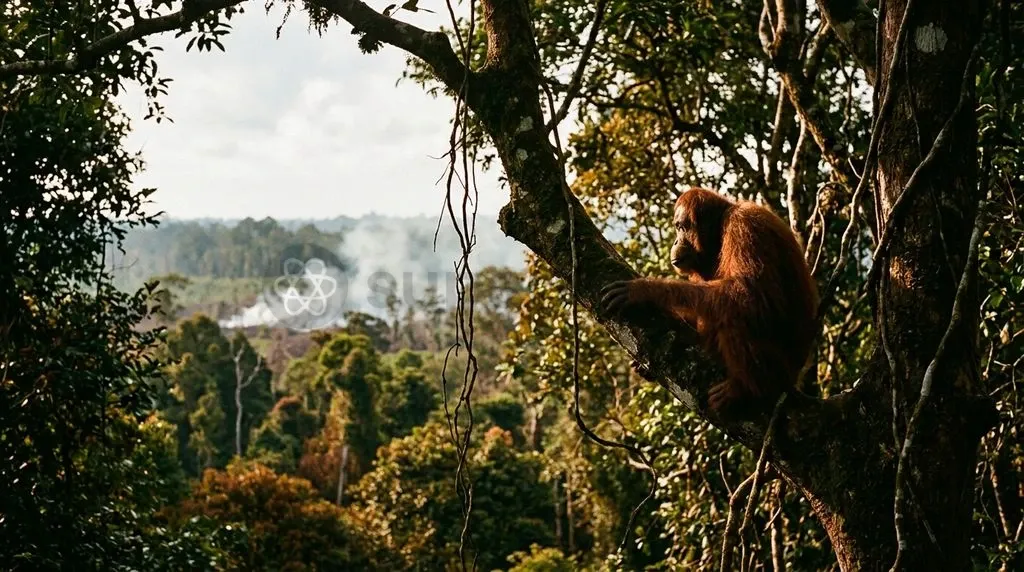
Southeast Asian tropical peatlands face systematic destruction through canal drainage and subterranean fires. These forces permanently erase the hydrological and canopy architecture essential for wildlife survival. Consequently, ex-situ primate rescue and translocation programmes cannot halt the extinction of Bornean orangutans.
Wildlife rehabilitation teams conduct headline-grabbing field rescues. Yet downstream interventions cannot compensate for landscape-scale habitat collapse. More than 100,000 Bornean orangutans were lost between 1999 and 2015 due to habitat destruction, logging, and landscape fires, according to research published in Current Biology. Resolving this ecological breakdown requires restoring degraded peat domes and closing legal loopholes that encourage fire-clearing.
Why in the News? The Resurgence of Wildfire Seasons Across Indonesian Peatlands
Wildfire seasons across Indonesian peatlands regularly trigger severe public health crises and cross-border environmental degradation throughout Southeast Asia. As of October 2026, wildlife response teams face mounting pressure across Indonesian Borneo. Seasonal dry spells regularly expose drained peat swamp forests to surface and subterranean ignition.
Emergency wildlife interventions reflect this landscape breakdown:
- Displaced Primates: The West Kalimantan Natural Resources Conservation Agency (BKSDA) and YIARI reported rescuing 46 displaced Bornean orangutans across Ketapang and North Kayong regencies between August and October 2026.
- Altered Landscapes: Decades of industrial concession clearings and deep canal networks have transformed naturally saturated wetlands into dry tinderboxes.
- Cross-Border Smouldering: Dried peat layers ignite readily during dry weather spells, sending smouldering toxic plumes across international boundaries.
These wildlife rescues reflect a structural crisis driven by landscape manipulation rather than isolated natural events.
Discuss with Superkalam
How many kilometres of drainage canals were excavated during the Mega Rice Project in Central Kalimantan?
Ask NowGround Zero in Central Kalimantan: How Canal Draining Turned Peat Swamps into Tinderboxes
Central Kalimantan became an ecological disaster zone following the excavation of over 4,400 kilometres of drainage canals during the 1990s Mega Rice Project (PLG). The state-sponsored project drained roughly one million hectares of ombrotrophic peat swamp forests to establish rice monocultures.
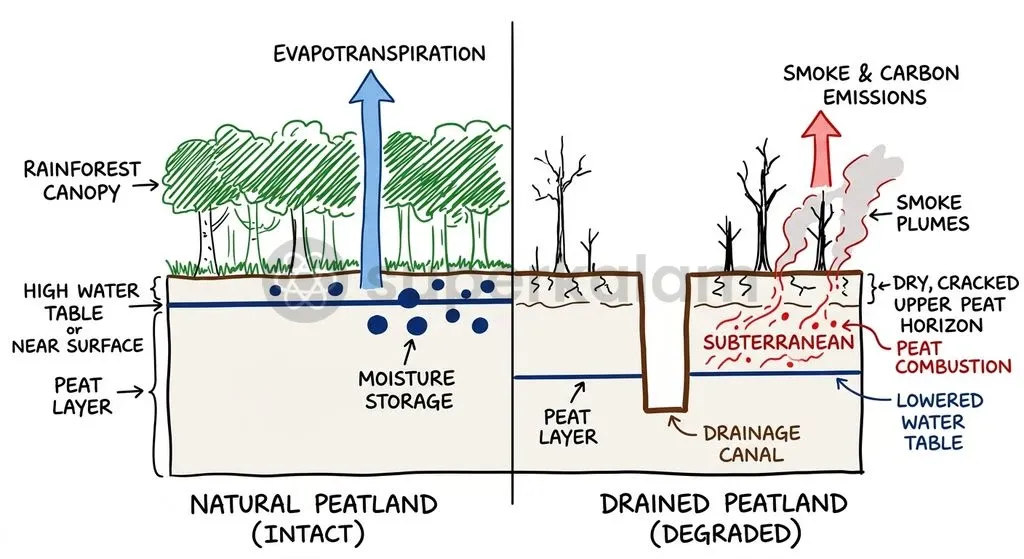
Peat soils consist of partially decayed vegetation saturated with water. Cutting deep drainage channels permanently altered regional hydrological dynamics and lowered the water table. This drawdown exposed thick subterranean layers of organic carbon to atmospheric oxygen and rapid desiccation.
When dry peat ignites, it produces subterranean smouldering combustion rather than standard open surface flames. According to the United Nations Environment Programme, tropical peat fires burn at temperatures between 500°C and 700°C within oxygen-poor soil horizons, sustaining invisible fires for months. Conventional surface firefighting techniques fail to extinguish these deep-seated fires without total water table replenishment.
The atmospheric fallout from these subterranean fires carries immense global consequences:
- Massive Carbon Pulses: Research in Nature revealed that the 1997–1998 Indonesian fires released between 0.81 and 2.57 gigatons of carbon, equivalent to 13% to 40% of mean annual global fossil fuel emissions at the time.
- Destruction of Peat Architecture: Sustained burning collapses the sponge-like matrix of the peat dome, preventing natural water retention during subsequent monsoons.
- Persistent Toxic Particulates: Underground smouldering generates high volumes of fine particulate matter and carbon monoxide, producing dense transboundary haze.
Agribusiness and Concession Politics: The Economic Drivers Fueling Landscape Ignitions
Corporate concession management and rural agricultural clearings remain primary economic catalysts for seasonal peatland fire cycles across Borneo. Large-scale drainage schemes were initially accelerated by commercial timber operations, followed by oil palm and pulpwood expansion.
Indonesian Law No. 32 of 2009 prohibits agricultural land clearing through intentional burning under Article 69(1)(h). However, enforcement remains uneven across complex provincial concession landscapes.
Article 69(2) of Law No. 32 of 2009 introduces an exception. It permits traditional communities to burn up to two hectares per household based on local customary wisdom (kearifan lokal). Unscrupulous actors often exploit this customary exemption to clear land cheaply without mechanical excavators.
The Indonesian government established administrative firebreaks to curb runaway commercial expansion:
- Primary Forest Moratorium: Presidential Instruction (Inpres) No. 5 of 2019 imposed a permanent moratorium on issuing new business licences across 66 million hectares of primary forests and peatlands.
- Corporate Supply Commitments: Voluntary No Deforestation, No Peat, No Exploitation (NDPE) corporate policies cover over 80% of Southeast Asian palm oil refining capacity.
- Market Leakage Vulnerabilities: Secondary domestic markets and unmapped smallholder supply chains operate outside NDPE monitoring systems, leaving unprotected peat landscapes vulnerable to ongoing fire clearance.
The Canopy Trap: How Fire Fronts and Forest Fragmentation Starve Borneo's Orangutans
Bornean orangutans (Pongo pygmaeus) suffer catastrophic population losses during fire seasons. Their largely arboreal lifestyles depend directly on continuous forest canopies.
Orangutans navigate through aerial pathways rather than traversing the ground. When low-intensity peat fires sweep through forest floor roots and undergrowth, the subterranean root networks burn out. This topples mature fruit trees and severs canopy bridges.
The IUCN Red List of Threatened Species classifies the Bornean orangutan as Critically Endangered, recording an overall population decline exceeding 80% across three generations. All species within the genus Pongo are also placed under Appendix I of the Convention on International Trade in Endangered Species of Wild Fauna and Flora (CITES), which bans commercial international trade.
| Biological Dimension | Bornean Orangutan Profile | Ecological and Conservation Impact |
|---|---|---|
| Locomotion Mode | Strictly arboreal travel via canopy | Canopy fragmentation causes stranding, starvation, and ground predation |
| Reproductive Spacing | Inter-birth interval of 7 to 9 years | Longest mammalian interval; cannot biologically rebound from rapid adult mortality |
| Demographic Vulnerability | Annual adult female mortality threshold <1% | Adult female losses exceeding 1% trigger irreversible population decline |
| CITES Protection | Appendix I listing | Complete ban on commercial international specimen trade |
| IUCN Status | Critically Endangered | Structural loss of more than 100,000 individuals between 1999 and 2015 |
Female orangutans nurse their young for extended periods, producing a single infant only once every seven to nine years. This biological pace makes the species exceptionally vulnerable to human-induced mortality.
A breeding population cannot withstand adult female mortality exceeding 1% per year without entering an extinction vortex. When fires consume continuous foraging territory, surviving populations become stranded in isolated forest pockets without adequate nutrition.
Discuss with Superkalam
Why does subterranean smouldering in drained peat domes pose a greater fire-management challenge than standard open-canopy forest fires?
Ask NowThe Translocation Dilemma: Why Rescuing Displaced Primates Does Not Prevent Population Collapse
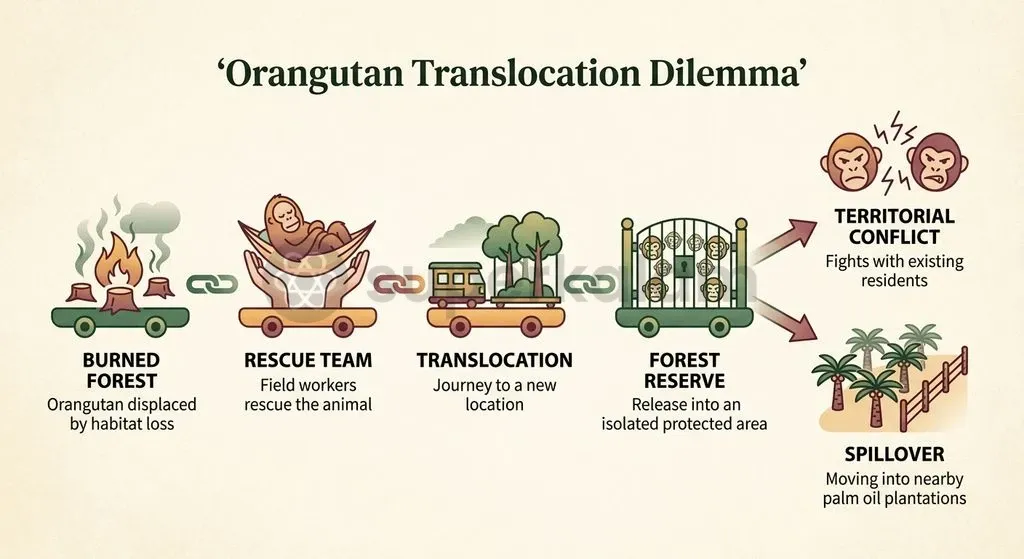
Wildlife translocations carried out during fire emergencies frequently fail to secure durable survival for displaced primates. On 9 October 2026, wildlife authorities reported translocating eight rescued orangutans into the 23,000-hectare Batu Nyambu Protected Forest in West Kalimantan. While emergency translocations provide immediate animal welfare relief, releasing primates into fragmented forest patches introduces severe ecological stress.
Published assessments in Biological Conservation reveal that translocating displaced wild apes into isolated reserves often elevates mortality because recipient habitats are already at carrying capacity. Introducing new individuals triggers violent territorial clashes between resident and translocated animals. Stressed primates frequently flee release reserves, crossing directly onto surrounding agricultural estates where they face fatal conflicts with farmworkers.
Ex-situ infant rehabilitation poses additional resource bottlenecks:
- Prolonged Training Period: Orphaned primates require between seven and ten years of intensive human rehabilitation to acquire wild foraging and nest-building behaviours.
- High Financial Costs: Raising a single orphaned infant to maturity costs upwards of $20,000 per animal while achieving variable post-release survival rates.
- Failure to Scale: Rescuing dozens of apes per season does not offset the systemic loss of thousands of wild individuals across burning concession zones.
Enforcement Gaps and Regional Fallout: The Failure to Contain Transboundary Haze
The ASEAN Agreement on Transboundary Haze Pollution (AATHP) is the primary regional legal instrument for mitigating transboundary smoke pollution. Signed in 2002, the multilateral treaty entered into force in 2003, though Indonesia did not ratify it until September 2014 via Law No. 26 of 2014. The agreement aims to prevent cross-border smoke pollution through joint monitoring, resource sharing, and early warning systems.
Regional and national regulatory frameworks face significant operational limits:
- AATHP Enforcement Deficits: The treaty lacks binding dispute settlement provisions and compliance sanctions, while ASEAN non-interference norms weaken regional accountability during major fire events.
- Extraterritorial Legislation: Singapore enacted the Transboundary Haze Pollution Act 2014, establishing extraterritorial civil liability and criminal fines of up to SGD 2 million on entities that cause air pollution within Singapore through land management practices overseas.
- Restoration Agency Scope: Presidential Regulation No. 120 of 2020 tasked the Peatland and Mangrove Restoration Agency (BRGM) with facilitating the rehabilitation of 1.2 million hectares of degraded peatlands across seven priority provinces.
- Lack of Sanctioning Authority: BRGM operates purely as a coordinating agency lacking independent policing and prosecutorial powers, leaving it unable to revoke corporate operating licences or sanction plantation concessions that drain peat soils.
Discuss with Superkalam
How might supply-chain monitoring frameworks address market leakage from smallholders operating outside voluntary NDPE commitments?
Ask NowRewetting Peat Domes: What Landscape Restoration Demands Beyond Corporate Moratoriums
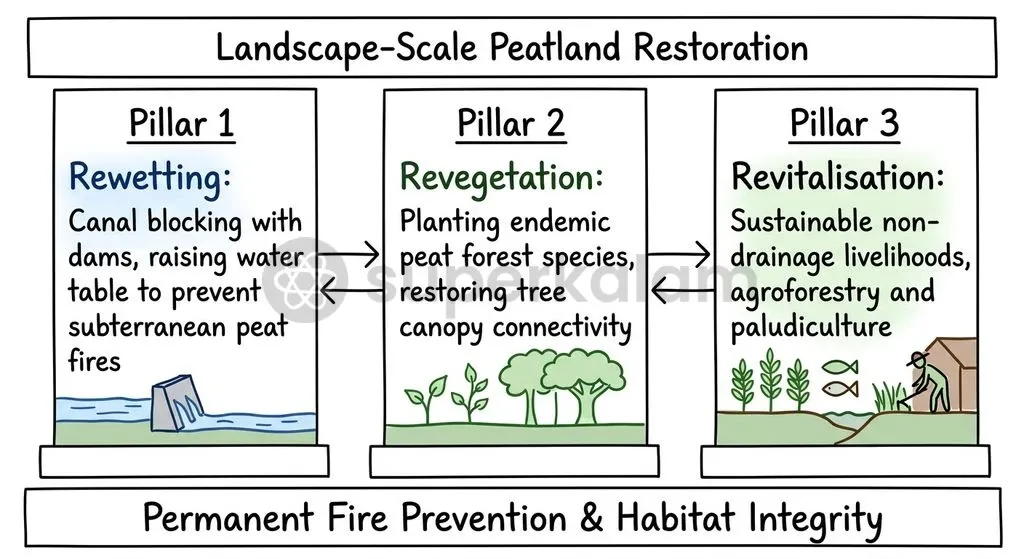
Effective peatland rehabilitation requires restoring hydrological saturation across entire peat domes rather than managing isolated fire outbreaks. Water flows downward across the gentle gradient of a peat dome. Consequently, digging a drainage canal along a concession edge desiccates the entire formation. Halting underground fires permanently requires blocking drainage canals with timber, sandbags, and compacted peat to raise water tables to the surface.
Rehabilitation teams implement the "3R" framework to restore degraded peat ecosystems:
- Rewetting (Rewetting): Constructing canal dams and deep wells to elevate the water table, keeping organic soil horizons saturated throughout dry seasons.
- Revegetation (Revegetation): Replanting native peat swamp tree species to regenerate canopy shade and re-establish continuous arboreal pathways for resident wildlife.
- Revitalisation (Revitalisation): Introducing sustainable non-drainage livelihoods, such as paludiculture crops and sustainable fisheries, so local communities do not rely on fire-based clearing.
Discuss with Superkalam
What are the primary ecological trade-offs between investing in ex-situ primate rehabilitation versus in-situ peat dome rewetting?
Ask NowWay Forward: Linking Peatland Hydrology, Supply-Chain Due Diligence, and Community Conservation
Protecting Southeast Asia's peatlands requires replacing emergency animal rescues with systematic landscape restoration and rigorous supply-chain enforcement. Emergency animal translocations cannot replace the loss of primary tropical forests. Regional conservation planning must combine hydrological rehabilitation, binding trade rules, and community-led protection.
Key policy and operational priorities include:
- Supply-Chain Traceability: Regulation (EU) 2023/1115 (the EU Deforestation Regulation, or EUDR) requires importers of oil palm, timber, and rubber to submit precise geographic coordinates verifying that products do not originate from land deforested after 31 December 2020. Strict plot-level traceability eliminates the domestic market loopholes that enable uncertified operators to clear peatlands using fire.
- Statutory Enforcement Powers: Institutional bodies like BRGM require statutory enforcement authority to hold concession holders legally and financially liable for draining peat domes. Granting enforcement agencies the legal power to seal concessions and mandate hydrological canal-blocking provides a structural defence against drainage-induced fires.
Combining landscape-level rewetting with legal accountability offers the only viable pathway to preserve Borneo's peat swamp forests and ensure the survival of its critically endangered great apes.
Key Takeaways
- The Bornean orangutan (Pongo pygmaeus) is classified as Critically Endangered on the IUCN Red List, having suffered an 80% population decline over three generations.
- Peat fires burn underground as smouldering combustion at temperatures between 500°C and 700°C, sustaining persistent fires that release immense stores of soil carbon.
- Orangutan reproductive biology, characterised by an inter-birth interval of 7 to 9 years, cannot withstand annual adult female mortality above 1%.
- Ex-situ rescues cannot halt population collapse because releasing displaced apes into remaining forest fragments triggers fatal territorial disputes in sites that are already at carrying capacity.
- Sustainable landscape preservation requires systematic hydrological rewetting, granting statutory regulatory powers to agencies like BRGM, and enforcing supply-chain standards such as the EU Deforestation Regulation.
Mains Question
"Downstream wildlife rescue and translocation programmes cannot compensate for landscape-scale ecological collapse." In the context of recurring tropical peatland fires in Southeast Asia, critically analyse this statement. (15 Marks)
Evaluate NowMains Question
Examine how commercial concession expansion and historical drainage projects, such as the Mega Rice Project (PLG), transformed naturally saturated peatlands into persistent wildfire zones. (10 Marks)
Evaluate NowPractice MCQs
QUESTION 1
Regarding the ecology and conservation status of the Bornean orangutan (Pongo pygmaeus), consider the following statements:
- It is classified as Critically Endangered on the IUCN Red List of Threatened Species.
- All species within the genus Pongo are listed under Appendix I of CITES.
- The species has an exceptionally short inter-birth interval, allowing rapid demographic recovery following habitat disturbances. Which of the statements given above are correct?
QUESTION 2
Consider the following statements regarding tropical peat fires and hydrological alterations in Borneo:
- Artificial canal excavation drains ombrotrophic peat swamps, exposing subterranean organic carbon to atmospheric oxygen.
- Tropical peat fires predominantly burn via open surface flames at temperatures exceeding 1200°C.
- Deep-seated subterranean smouldering combustion can persist for months within oxygen-poor soil horizons. Which of the statements given above is/are correct?
QUESTION 3
With reference to environmental regulations and policy frameworks in Indonesia, consider the following statements:
- Indonesian Law No. 32 of 2009 contains an absolute ban on burning land, providing no exemptions for customary practices.
- Presidential Instruction (Inpres) No. 5 of 2019 placed a permanent moratorium on issuing new business licences across primary forests and peatlands.
- Voluntary No Deforestation, No Peat, No Exploitation (NDPE) commitments cover more than 80% of Southeast Asian palm oil refining capacity. Which of the statements given above are correct?
QUESTION 4
Research published regarding the demographic threshold of Bornean orangutans indicates that an irreversible population decline is triggered when annual adult female mortality exceeds which of the following thresholds?
QUESTION 5
Consider the following statements regarding the challenges associated with primate translocation and rehabilitation:
- Releasing displaced primates into isolated protected forests can elevate mortality if the recipient ecosystems are already at carrying capacity.
- Orphaned infant orangutans typically require between seven and ten years of rehabilitation to acquire wild survival behaviours.
- Translocated primates never leave release reserves due to natural ecological boundaries. Which of the statements given above is/are correct?