Badri Cow OPU-IVF: Reviving Indigenous Himalayan Cattle
How assisted reproductive technology is multiplying climate-resilient native germplasm to reverse decades of ill-suited Himalayan dairy crossbreeding.
Sep, 2026
•8 min read
Overview
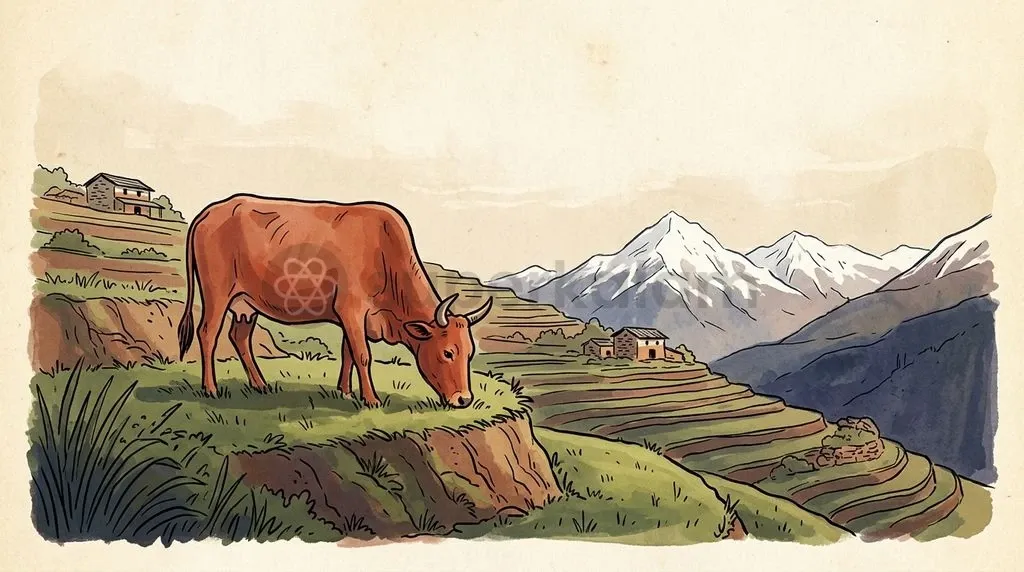
Uttarakhand has produced its first female Badri calf using Ovum Pick-Up and In Vitro Fertilisation (OPU-IVF). The breakthrough shows how assisted reproductive technologies can reverse decades of ill-suited crossbreeding in the hills.
Past livestock schemes pushed exotic genetics into the Central Himalayas. That policy created heavy cattle prone to disease on steep terrain. Under the Rashtriya Gokul Mission, scientists now apply female-line genetic selection to multiply climate-resilient mountain stock.
Why Badri Cattle is in the News
A healthy female Badri calf was born on 11 September 2026 at the Academic Dairy Farm of G.B. Pant University of Agriculture and Technology in Pantnagar. According to a PIB release on OPU-IVF Calf Born in Badri Cattle (PRID: 2054237), the calf was produced via Ovum Pick-Up and In Vitro Fertilisation (OPU-IVF) after scientists transferred a lab-cultured Badri embryo into a surrogate Sahiwal cow.
As of September 2026, this development opens a practical route to rebuild Uttarakhand's shrinking indigenous gene pool. It puts the goals of the Rashtriya Gokul Mission into action. The state can now move away from indiscriminate exotic crossbreeding toward elite native livestock multiplication.
Discuss with Superkalam
Recall the accession code and the year under which the Badri cow was registered as Uttarakhand's first certified indigenous cattle breed.
Ask NowThe Ecological Crisis: Why Exotic Crossbreeding Failed in the Himalayas
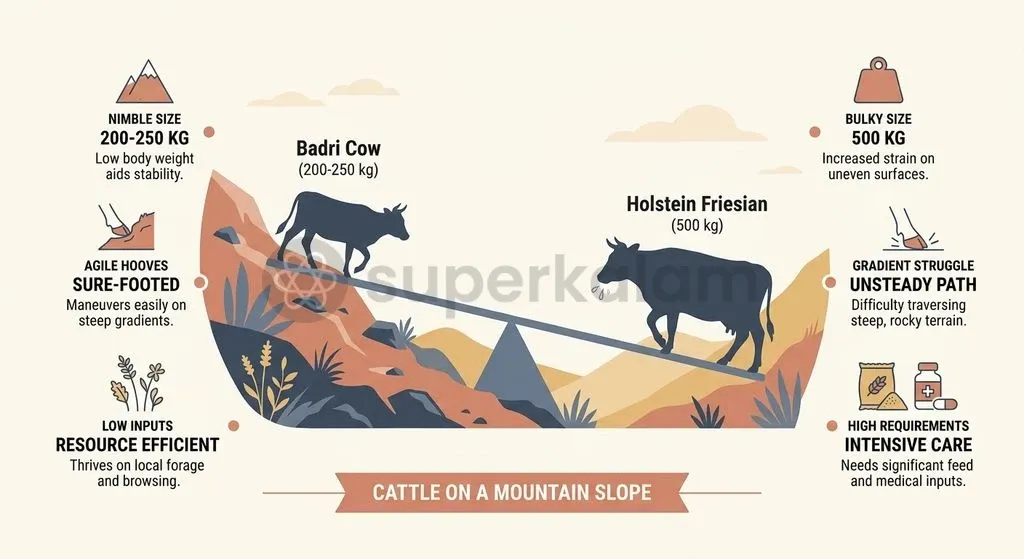
European dairy breeds disrupted Central Himalayan agrarian ecology. State programmes brought in Jersey and Holstein Friesian genetics to lift volumetric milk output. In practice, the animals failed in mountain environments.
- Excessive Body Mass: Heavy frames and poor agility caused joint trauma and reduced mobility on steep gradients.
- Unsustainable Feed Demands: High concentrate feed requirements imposed unaffordable stall-feeding costs on hill households.
- Unviable Male Progeny: Crossbred bullocks lacked the agility needed for terrace draught work, leading to mass abandonment.
According to the Uttarakhand Livestock Development Board (ULDB) Breed Conservation Profile, exotic crossbreeds suffer from heavy body mass, high tick-borne disease risks, and severe concentrate feed demands. Mountain smallholders could not afford expensive stall feeding. The cattle were simply too bulky to navigate narrow terrace paths safely.
Crossbreeding also triggered a socio-ecological fallout. As noted in the Uttarakhand State Animal Husbandry Department Policy Review, crossbred male calves were unfit for mountain draught operations. Abandoned male cattle escalated human-wildlife conflict, trampled crops, and worsened grazing pressure across alpine pastures.
What Makes the Badri Cow Unique to High-Altitude Pastoralism?
Centuries of natural selection shaped the Badri cow across the Central Himalayas. ICAR-National Bureau of Animal Genetic Resources registered Badri as Uttarakhand's first certified indigenous cattle breed in 2016 under accession code INDIA_CATTLE_2400_BADRI_03040.
A joint study by the Uttarakhand State Council for Science and Technology (UCOST) and IIT Roorkee highlighted that Badri cattle produce milk featuring an A2 beta-casein protein allele frequency of nearly 90%, alongside rich solid-not-fat and micronutrient concentrations. These traits reflect the animal's grazing habits. Herds forage freely across alpine meadows on wild medicinal herbs and shrubs.
| Trait Dimension | Indigenous Badri Cattle | Exotic Crossbreeds (Jersey / Holstein Friesian) |
|---|---|---|
| Physical Stature | Compact frame (200–250 kg) with agile hooves | Bulky, heavy frame exceeding 450–550 kg |
| Terrain Suitability | Adapted to steep slopes and narrow terrace paths | Prone to joint trauma on rocky mountain gradients |
| Nutritional Regimen | Sustained on alpine grazing and wild shrubs | Requires high-density commercial concentrate feed |
| Disease Resilience | High natural resistance to local tick infestations | High vulnerability to tropical and tick-borne diseases |
| Milk Protein Profile | Nearly 90% A2 beta-casein allele frequency | Predominantly A1 beta-casein profile |
| Draught Utility | Nimble oxen suited for terraced hill ploughing | Heavy oxen unsuitable for narrow mountain terraces |
Discuss with Superkalam
Explain how the combination of OPU-IVF technology and sex-sorted semen resolves the long-standing problem of male calf abandonment in mountain farming.
Ask NowThe Technology: How Ovum Pick-Up and In-Vitro Fertilization (OPU-IVF) Works
Assisted reproductive technology bypasses the limits of natural breeding by collecting female germplasm directly from living donors. Standard dairy operations rely almost entirely on sire selection through Artificial Insemination (AI).
- Transvaginal Aspiration: Immature oocytes are harvested from an elite Badri donor cow via ultrasound guidance.
- In Vitro Maturation & Fertilisation: Harvested oocytes are matured in the laboratory and fertilised with pedigreed semen.
- Embryo Culture: Fertilised eggs are cultured to the blastocyst stage.
- Surrogate Transfer: Blastocysts are cryopreserved or transferred fresh into a synchronized surrogate cow (such as a Sahiwal) to deliver an elite Badri calf.
According to the ICAR-National Dairy Research Institute (NDRI) Bovine Reproduction Manual, conventional Artificial Insemination leverages only paternal genetics and produces approximately one calf per cow annually. In contrast, Ovum Pick-Up involves transvaginal ultrasound-guided aspiration of immature oocytes from elite donor cows every 2 to 3 weeks. These oocytes are matured, fertilised in vitro using pedigreed semen, and cultured to the blastocyst stage before non-surgical transfer into synchronized recipient surrogate cows. This process yields 20 to 25 calves per year from a single elite female donor.
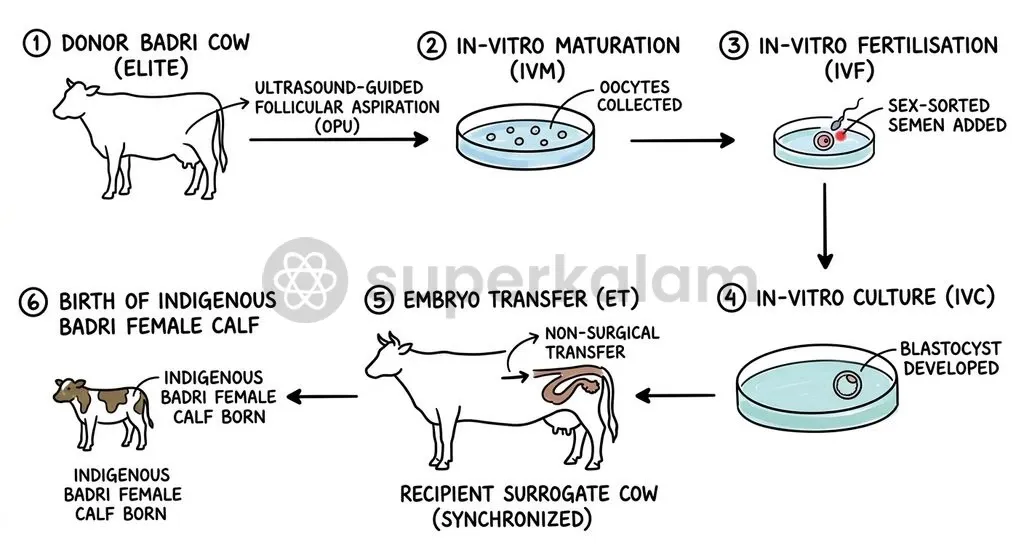
To prevent male calf abandonment, technicians combine in vitro fertilisation with sex-sorted semen. The Operational Guidelines of Rashtriya Gokul Mission specify that sex-sorting technology achieves an 85% to 90% female calf birth rate. This pairing accelerates female herd growth and spares hill farmers the expense of maintaining unviable male stock.
Discuss with Superkalam
Analyse why exotic cattle crossbreeding policies, which succeeded in plains dairying, resulted in socio-ecological distress across Himalayan terraced ecosystems.
Ask NowBreeding Revolution vs Field Reality: Ground Challenges in Hill Terrain
Delivering bovine biotechnology across remote Himalayan villages presents steep logistical challenges. Laboratory success does not translate automatically to hill farms.
- Cryogenic Cold-Chain Breakdown: According to the Department of Animal Husbandry and Dairying (DAHD) RGM Annual Evaluation Report, maintaining the cryogenic storage chain of Liquid Nitrogen at -196°C represents a major operational vulnerability along disaster-prone mountain roads prone to landslides and winter blockades.
- Capital and Consumable Costs: High consumable expenses and the limited availability of specialised transvaginal ultrasound transducers restrict routine IVF operations.
- Shortage of Specialised Embryologists: As highlighted in a PIB release on Achievements of Rashtriya Gokul Mission, cattle IVF requires skilled veterinary embryologists, confining current procedures primarily to state agricultural universities rather than rural veterinary dispensaries.
- Recipient Herd Synchronisation: Remote pastoral holdings often lack the standardised nutritional management necessary to prepare local recipient cows for high-success embryo implantation.
Discuss with Superkalam
Design a decentralized extension strategy to overcome the cryogenic cold-chain and embryologist shortage barriers when deploying cattle IVF in remote mountain districts.
Ask NowEthical, Environmental, and Livelihood Implications for Mountain Communities
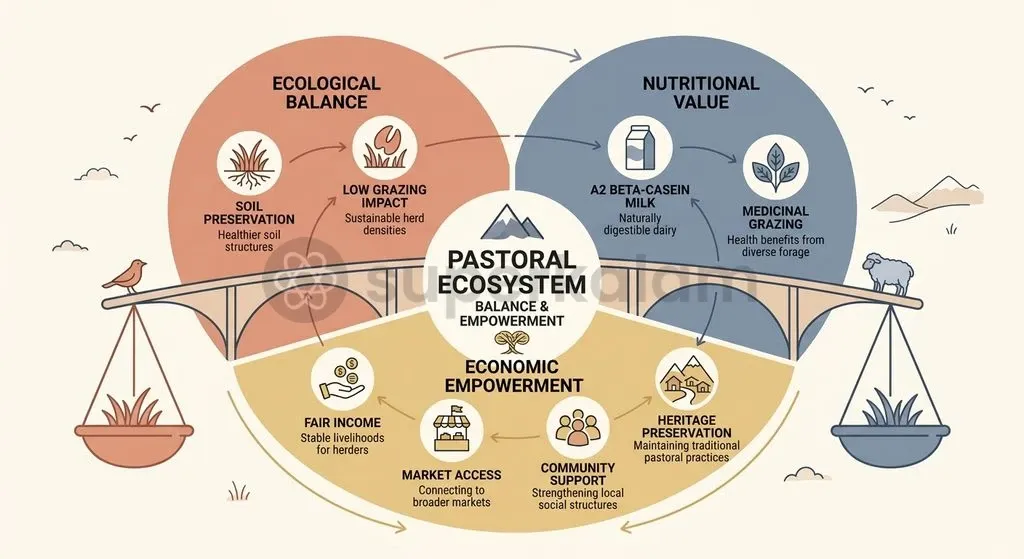
Restoring indigenous cattle genetics rebuilds ecological balance and creates high-value dairy micro-economies. Native cattle leave a substantially lighter ecological footprint than exotic crossbreeds.
- Climate Resilience: Indigenous cattle exhibit lower methane intensity and adapt naturally to rugged terrain.
- Livelihood Security: High solid-not-fat and A2 properties yield premium market prices for hill dairy farmers.
- Ecological Protection: Smaller body mass prevents soil compaction, erosion, and excessive pasture grazing.
Badri cows support biodiversity through light grazing. They do not require intensive fodder crops that drive deforestation. Their lighter body weight protects steep Himalayan slopes from soil compaction, reducing runoff during heavy monsoon rains.
Commercialising Badri dairy products provides tangible livelihood gains. Because Badri milk carries verified A2 beta-casein properties and high solid-not-fat levels, mountain cooperatives can sell fluid milk and clarified butter (ghee) at premium rates. Better returns give mountain communities a direct economic reason to conserve native biodiversity.
Policy Roadmap: Scaling Indigenous Germplasm in Fragile Ecosystems
Scaling indigenous reproductive tools across hill regions requires institutional coordination, targeted fiscal subsidies, and decentralised infrastructure. State departments must link university laboratories with village-level veterinary extension.
The Uttarakhand Livestock Development Board operates a dedicated Animal Breeding Farm at Nariyalgaon in Champawat to spearhead the selective breeding and pedigreed germplasm propagation of Badri cattle. Under the Rashtriya Gokul Mission's Accelerated Breed Improvement Programme, the Central Government provides an assured financial subsidy of ₹5,000 per IVF pregnancy to participating dairy farmers.
- Institutional Nucleus: Maintain a dedicated elite breeding facility at Nariyalgaon (Champawat).
- Direct Farmer Subsidies: Provide an assured subsidy of ₹5,000 per confirmed IVF pregnancy under the Rashtriya Gokul Mission.
- Sex-Sorted Semen Incentives: Deliver up to a 50% capital subsidy on sex-sorted semen doses to eliminate unwanted male progeny.
- Decentralised Field Extension: Deploy rugged mobile cryogenic tankers and train rural para-veterinarians.
State agencies need mobile cryogenic units with durable liquid nitrogen containers suited to rough mountain roads. Expanding the 50% capital subsidy on sex-sorted semen will help smallholders adopt assisted reproduction without taking on debt. Finally, regional training centres must train field staff to move embryo transfer out of university labs and into village veterinary dispensaries.
Key Takeaways
- Badri cattle represents the first certified indigenous cattle breed of Uttarakhand, registered by ICAR-NBAGR in 2016 under accession code INDIA_CATTLE_2400_BADRI_03040.
- Decades of exotic crossbreeding with European breeds (Jersey, Holstein Friesian) failed in the Himalayas due to excessive animal body weight, high concentrate feed costs, tick vulnerability, and the widespread abandonment of unusable male calves.
- Ovum Pick-Up and In Vitro Fertilisation (OPU-IVF) enables an elite Badri cow to produce 20 to 25 calves annually, compared to just one calf under conventional Artificial Insemination.
- Rashtriya Gokul Mission supports adoption by providing a financial subsidy of ₹5,000 per assured IVF pregnancy and up to a 50% capital subsidy on sex-sorted semen to ensure an 85% to 90% female calf birth rate.
- Field scaling remains constrained by cryogenic liquid nitrogen (-196°C) cold-chain disruptions across mountain roads and a shortage of trained veterinary embryologists.
Mains Question
"The introduction of exotic crossbred dairy cattle into the Central Himalayas overlooked vital agro-ecological linkages, triggering both environmental degradation and agrarian distress." In light of this statement, critically analyse the socio-ecological consequences of ill-suited crossbreeding policies and elucidate the role of indigenous breeds like Badri in sustainable mountain pastoralism. (10 Marks)
Evaluate NowMains Question
"While assisted reproductive technologies such as Ovum Pick-Up and In-Vitro Fertilization (OPU-IVF) under the Rashtriya Gokul Mission offer a pathway to multiply elite indigenous germplasm, translating laboratory success to decentralized hill farms presents formidable challenges." Evaluate. (15 Marks)
Evaluate NowPractice MCQs
QUESTION 1
Consider the following statements regarding the indigenous Badri cattle breed:
- Badri cattle was registered by ICAR-NBAGR in 2016 as Uttarakhand's first certified indigenous cattle breed.
- Milk produced by Badri cattle exhibits an A2 beta-casein protein allele frequency of nearly 90%.
- Unlike exotic crossbreeds, Badri cattle possess a bulky body frame exceeding 450 kg to withstand rugged alpine slopes. Which of the statements given above is/are correct?
QUESTION 2
Consider the following statements regarding bovine reproductive technologies mentioned under the Rashtriya Gokul Mission:
- Conventional Artificial Insemination primarily leverages paternal genetics, yielding approximately one calf per cow annually.
- Ovum Pick-Up combined with In Vitro Fertilisation (OPU-IVF) enables a single elite female donor to yield 20 to 25 calves per year.
- Sex-sorted semen technology combined with IVF achieves an 85% to 90% female calf birth rate. Which of the statements given above are correct?
QUESTION 3
Consider the following statements regarding government initiatives and institutional frameworks for Badri cattle conservation:
- The Uttarakhand Livestock Development Board operates a dedicated Animal Breeding Farm at Nariyalgaon in Champawat for pedigreed Badri propagation.
- The Central Government provides an assured financial subsidy of ₹5,000 per confirmed IVF pregnancy under the Rashtriya Gokul Mission.
- The Rashtriya Gokul Mission delivers up to a 50% capital subsidy on sex-sorted semen doses to reduce unviable male stock. Which of the statements given above are correct?
QUESTION 4
With reference to the ecological and economic fallout of introducing exotic European dairy breeds (Jersey and Holstein Friesian) into the Central Himalayas, consider the following statements:
- Heavy body frames and poor agility caused joint trauma and reduced cattle mobility on steep mountain gradients.
- High concentrate feed requirements imposed unaffordable stall-feeding costs on hill households.
- Crossbred male calves proved agile and ideal for terraced draught work, significantly lowering agricultural labour costs. Which of the statements given above is/are correct?
QUESTION 5
Which of the following is identified as a major logistical vulnerability in scaling cattle IVF and embryo transfer technologies across remote Himalayan terrain?