Australe Basin: Chandrayaan-1 Archival Data Uncovers Ancient Lunar Giant
How re-analysing Chandrayaan-1 archival data helped Indian scientists uncover an ancient lunar impact basin older than the South Pole-Aitken structure.
Sep, 2026
•7 min read

Overview
Scientists at the Physical Research Laboratory in Ahmedabad have uncovered a concealed, ancient impact structure named the Australe Basin in the Moon's southeastern hemisphere. They made the find by re-analysing archival hyperspectral data from India's maiden lunar orbiter.
Published in The Planetary Science Journal, the study suggests this newly identified feature predates the South Pole-Aitken basin. That timeline makes it the oldest impact basin identified on the Moon. Mineralogical mapping uncovered these heavily eroded structures that standard topographic cameras missed, proving that legacy planetary data still reshapes our understanding of early Solar System bombardment.
Why in the News: The Discovery from Chandrayaan-1 Archival Data
The Physical Research Laboratory (PRL) in Ahmedabad confirmed the existence of the concealed Australe Basin by mining archival records from the Moon Mineralogy Mapper spectrometer. As of September 2026, researchers showed that the structure evaded detection for decades because billions of years of space weathering, secondary impacts, and surface erosion completely flattened its outer rims.
The research team re-examined observations gathered by the Moon Mineralogy Mapper (M3), an imaging spectrometer provided by NASA that operated aboard the Chandrayaan-1 spacecraft. India's maiden lunar mission was launched by the Indian Space Research Organisation (ISRO) using a PSLV-C11 rocket on October 22, 2008, carrying 11 scientific payloads. This re-analysis proves that legacy planetary archives remain active scientific assets capable of delivering frontline discoveries.
Discuss with Superkalam
Which instrument aboard Chandrayaan-1 provided the hyperspectral data used to discover the Australe Basin?
Ask NowWhat is the Australe Impact Basin?
The Australe Basin is an ancient lunar impact structure in the Moon's southeastern hemisphere hypothesised to predate the South Pole-Aitken basin. Planetary models suggest that roughly 300 giant impact basins formed across lunar history, yet only about 74 have been detected and catalogued to date. The Australe Basin fills one of these major gaps.
Unlike typical lunar maria covered by vast flood-basalt plains, Mare Australe displays an atypical volcanic layout:
- Discrete Basalt Distribution: The region contains 248 small basalt ponds arranged in a circular distribution pattern rather than a single continuous volcanic plain.
- Anomalous Mineralogy: Basalts inside the basin feature lower calcium concentrations and higher magnesium content relative to standard high-calcium lunar mare basalts.
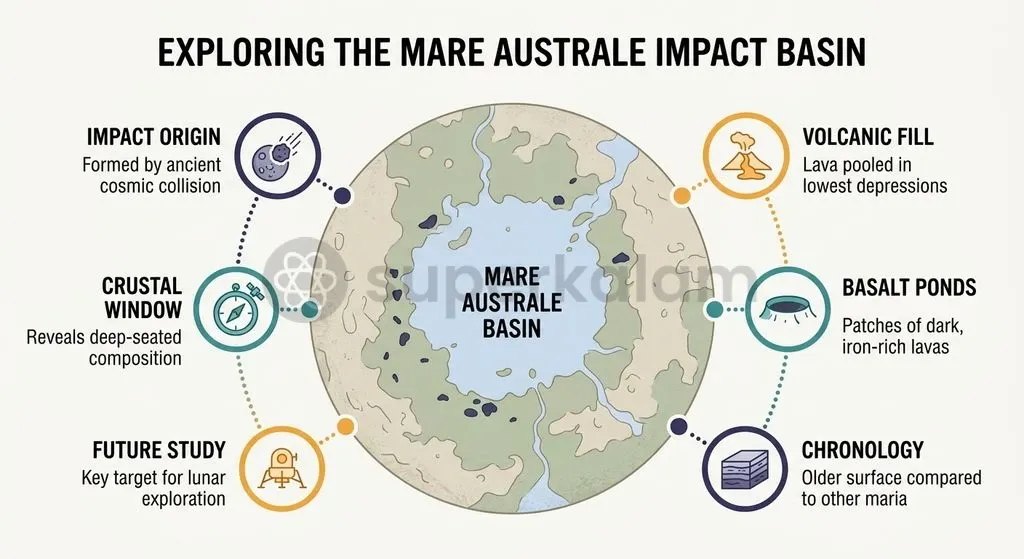
How Moon Mineralogy Mapper Data Revealed the Ancient Basin
The Moon Mineralogy Mapper (M3) aboard Chandrayaan-1 identified the Australe Basin by mapping distinct surface absorption bands of diagnostic minerals. Optical cameras could not locate topographic basin walls after billions of years of cosmic bombardment, so researchers turned to compositional mapping.
Key spectroscopic and geophysical markers include:
- Orthopyroxene Mineral Ring: The core signature identifying the structure is a widespread ring of orthopyroxene minerals encircling the Mare Australe region. Orthopyroxenes are magnesium- and iron-bearing silicate minerals that typically originate from deeper crustal or upper mantle layers exposed during mega-impact events.
- Dual-Impact History: The spatial distribution of this orthopyroxene ring links the Australe Basin directly with the Australe North Basin, a sub-surface mass anomaly previously indicated by NASA's Gravity Recovery and Interior Laboratory (GRAIL) mission. This geographical alignment points to a dual-impact cratering history, where two massive cosmic bodies struck the region in close geological succession.
Discuss with Superkalam
Why was compositional mineral mapping successful in uncovering the Australe Basin when standard topographic imaging failed?
Ask NowWhy Pre-South Pole-Aitken Basins Matter for Lunar History
Pre-South Pole-Aitken structures hold the key to decoding the earliest bombardment regime of the inner Solar System. Until this discovery, the South Pole-Aitken (SPA) basin, spanning approximately 2,500 kilometres across the lunar farside, was universally classified as the oldest and largest confirmed impact basin on the Moon.
Identifying an impact basin older than the South Pole-Aitken structure provides empirical evidence for the earliest stages of planetary crustal evolution:
- Preserved Planetary Record: Because the Moon lacks plate tectonics and atmospheric weathering, its crust preserves an ancient record of giant impactors that also struck the early Earth.
- Chronology Recalibration: Validating pre-SPA basins allows scientists to recalibrate lunar crater-counting models and establish a more accurate timeline for early Solar System history.
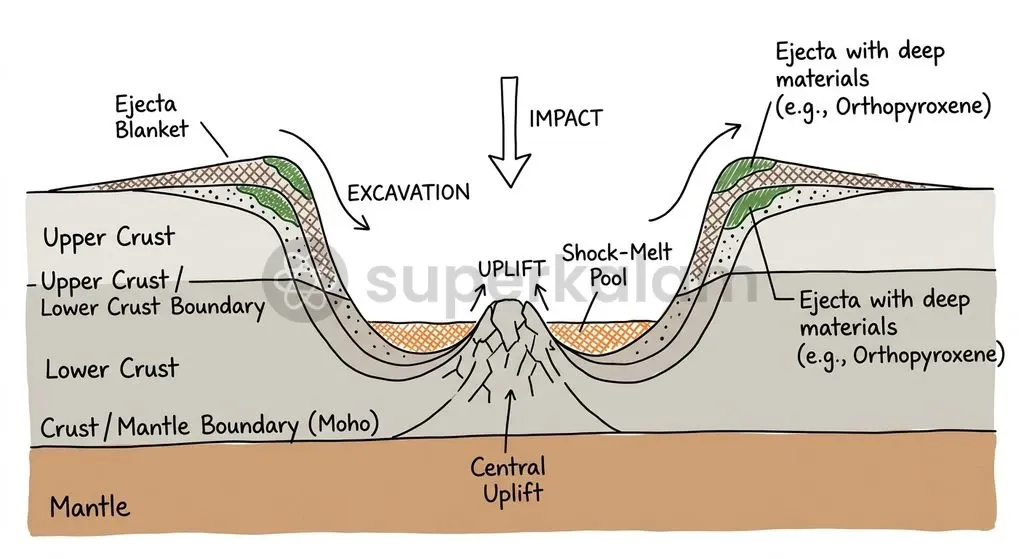
Comparing Lunar Giants: Australe Basin vs South Pole-Aitken Basin
The South Pole-Aitken (SPA) basin and the newly confirmed Australe Basin represent two distinct eras and observational signatures in lunar geology.
| Feature / Dimension | Australe Basin | South Pole-Aitken (SPA) Basin |
|---|---|---|
| Primary Location | Southeastern hemisphere of the Moon | Lunar farside (southern polar region) |
| Discovery Mechanism | Hyperspectral mineral mapping via M3 orthopyroxene detection | Topographic elevation mapping and radar altimetry |
| Chronological Placement | Hypothesised Pre-SPA (potentially oldest identified) | Established benchmark for oldest and largest impact basin |
| Volcanic Morphology | 248 small basalt ponds in a circular distribution pattern | Extensive, deep interior flood basalts |
| Dominant Mineral Signature | Low-calcium, high-magnesium basalts with an orthopyroxene ring | Deep crustal and upper mantle pyroxenes across a vast depression |
| Detection Status | Topographically degraded; revealed via compositional analysis | Topographically distinct with a rim diameter of ~2,500 km |
Discuss with Superkalam
How does cross-referencing Chandrayaan-1's spectral data with NASA's GRAIL gravity data help establish a dual-impact cratering history?
Ask NowSignificance of Archival Data Mining in Modern Space Exploration
Archival scientific data mining allows planetary researchers to generate first-order discoveries without deploying new high-cost deep space hardware. Space agencies such as ISRO and NASA maintain open-access repositories, enabling scientists worldwide to re-examine observations using newer analytical tools.
The Physical Research Laboratory in Ahmedabad, an autonomous research institution under India's Department of Space founded in 1947 by Dr. Vikram Sarabhai, demonstrated the power of this research model. By applying refined spectroscopic processing to M3 data nearly two decades after Chandrayaan-1 completed its mission, researchers unlocked insights that original processing pipelines bypassed. Open data platforms maximise public return on investment by ensuring that every planetary mission yields long-term dividends.
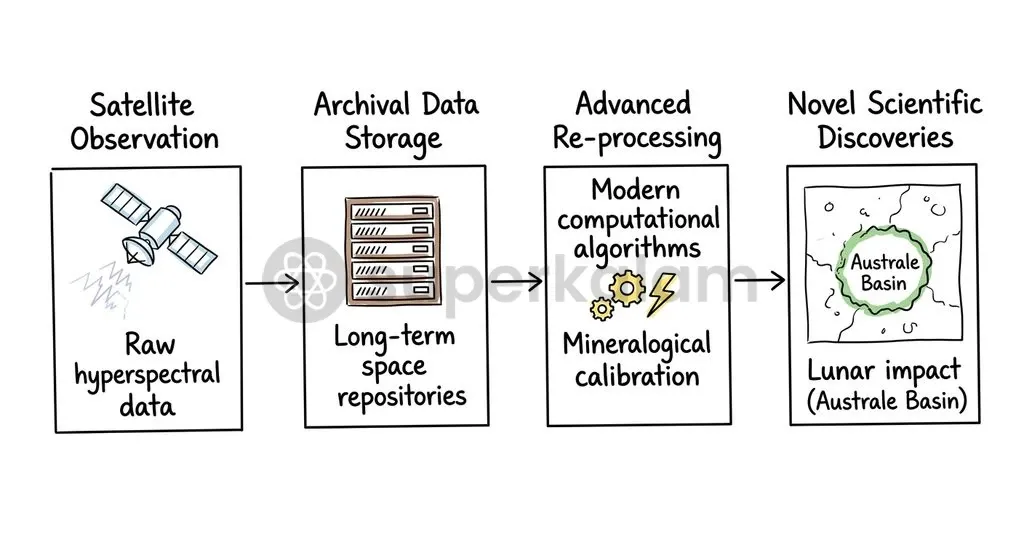
What This Discovery Means for India's Future Lunar Missions
The Indian Space Research Organisation can use the identification of the Australe Basin to refine target sites for future lunar exploration. Updating the lunar impact chronology through ancient basins directly informs site selection and scientific objectives for upcoming missions such as Chandrayaan-4 and LuPEX, alongside NASA's Artemis programme.
Targeting ancient impact regions enables upcoming sample-return missions to collect pristine rocks from deeper crustal layers. Analysing samples from the anomalous basalt ponds of Mare Australe would clarify how early volcanic melting differed from later lunar maria formation. These insights ensure that India's planned lunar surface architectures target high-yield geological sites that answer fundamental planetary science questions.
Discuss with Superkalam
How should space agencies balance funding between launching new planetary probes and mining legacy archival datasets?
Ask NowWay Forward: Unlocking the Early Evolution of the Solar System
Global planetary science must combine legacy orbital datasets with upcoming in-situ surface missions to resolve the Moon's early geological timeline. International cooperation and data-sharing frameworks are vital to building complete multi-instrument maps of the Moon's hidden structures.
- Integrate Multi-Mission Datasets: Researchers should systematically cross-reference Chandrayaan-1's M3 hyperspectral data with gravity data from NASA's GRAIL and high-resolution imaging from Chandrayaan-2 to detect the remaining missing lunar impact basins.
- Target Sample-Return Architecture: Mission planners should prioritise ancient basin floor deposits, such as the low-calcium basalts in Mare Australe, for upcoming robotic sample retrieval missions like Chandrayaan-4.
- Institutionalise Archival Mining Programmes: Space agencies must establish dedicated funding streams and computational infrastructure to support regular re-analysis of legacy datasets by universities and research institutes.
Key Takeaways
- Ancient Impact Discovery: Researchers from the Physical Research Laboratory (PRL), Ahmedabad, confirmed a concealed impact structure named the Australe Basin in the Moon's southeastern hemisphere.
- Predates South Pole-Aitken: The Australe Basin is hypothesised to predate the 2,500-kilometre-wide South Pole-Aitken (SPA) basin, potentially making it the oldest impact basin identified on the Moon.
- Chandrayaan-1 Legacy: The discovery was achieved by re-analysing archival hyperspectral data gathered by the Moon Mineralogy Mapper (M3) onboard India's Chandrayaan-1 mission, which was launched in 2008.
- Distinct Mineral Markers: The structure features a widespread ring of orthopyroxene minerals and 248 discrete basalt ponds with anomalous low-calcium, high-magnesium compositions.
- Informing Future Exploration: This refined impact chronology directly guides site selection and sampling priorities for upcoming missions, including Chandrayaan-4 and LuPEX, alongside NASA's Artemis programme.
Mains Question
'The re-examination of legacy planetary data can redefine scientific paradigms without the immediate deployment of capital-intensive deep space missions.' In the light of the recent discovery of the Australe Basin using Chandrayaan-1 archival data, elucidate the significance of archival data mining for planetary exploration. (10 Marks)
Evaluate NowMains Question
Discuss how the compositional identification of the Australe Basin alters our understanding of lunar geological evolution, and evaluate its implications for India's upcoming lunar missions. (15 Marks)
Evaluate NowPractice MCQs
QUESTION 1
With reference to the newly discovered Australe Basin on the Moon, consider the following statements:
- It is located in the Moon's southeastern hemisphere and is hypothesised to predate the South Pole-Aitken basin.
- Unlike typical lunar maria, it features discrete basalt ponds arranged in a circular distribution pattern.
- The basalts inside the basin exhibit higher calcium concentrations and lower magnesium content compared to standard lunar mare basalts.
Which of the statements given above is/are correct?
QUESTION 2
Consider the following statements regarding the Moon Mineralogy Mapper (M3) and the Chandrayaan-1 mission:
- The Moon Mineralogy Mapper was an imaging spectrometer provided by NASA aboard Chandrayaan-1.
- Chandrayaan-1 was launched by ISRO using a PSLV-C11 rocket carrying 11 scientific payloads.
- The Australe Basin was identified primarily through topographic elevation cameras rather than mineralogical absorption spectra.
Which of the statements given above are correct?
QUESTION 3
With reference to lunar geology and impact structures, consider the following statements:
- Orthopyroxenes are magnesium- and iron-bearing silicate minerals that typically originate from deeper crustal or upper mantle layers exposed during mega-impacts.
- Gravity anomalies identified by NASA's GRAIL mission align with an orthopyroxene ring, indicating a dual-impact cratering history in the Australe region.
- The South Pole-Aitken basin spans approximately 2,500 kilometres across the lunar farside.
Which of the statements given above are correct?
QUESTION 4
Which of the following institutions conducted the research that confirmed the existence of the ancient Australe Basin using Chandrayaan-1 archival data?
QUESTION 5
The discovery and characterisation of pre-South Pole-Aitken structures such as the Australe Basin are scientifically significant because they directly aid in:
- Recalibrating lunar crater-counting models.
- Providing empirical evidence for early Solar System bombardment history.
- Refining landing and sampling targets for future missions like Chandrayaan-4 and LuPEX.
Select the correct answer using the code given below: