Article 348: Why English Governs the Supreme Court and High Courts
As petitions seek Hindi in the apex court, constitutional provisions balance democratic accessibility against the imperative of national judicial integration.
Oct, 2026
•9 min read
Overview
Article 348(1)(a) of the Constitution mandates that all proceedings in the Supreme Court must be conducted in English until Parliament legislates otherwise. This rule creates an express constitutional insulation, preserving judicial coherence across twenty-five High Courts against recurring demands for linguistic change.
While proponents argue that regional languages bridge the divide between citizens and formal justice, legal integration demands a neutral national medium. The constitutional framework balances accessibility and institutional unity by keeping English as the courtroom working language while deploying digital translation tools for public dissemination.
Why Is the Language of the Supreme Court Back in the News?
Repeated public interest petitions seeking the introduction of Hindi into the Supreme Court have brought judicial linguistic policies back under institutional scrutiny. Recent apex court rulings have firmly rejected these pleas on federal grounds:
- 4 November 2024 Dismissal: A three-judge Bench led by Chief Justice D.Y. Chandrachud dismissed a petition seeking Hindi proceedings. The bench observed that the court hears appeals from all Indian states and cannot function through a single regional vernacular.
- 25 September 2026 Dismissal: A three-judge Bench headed by Chief Justice Surya Kant dismissed a plea seeking a commission on court language. During the hearing, Justice V. Mohana questioned whether judicial review could compel a constitutional amendment to Article 348.
These challenges underline continuous friction between democratic linguistic aspirations and the functional needs of an integrated pan-Indian judicial hierarchy.
What Does the Constitution Say About Official Languages?
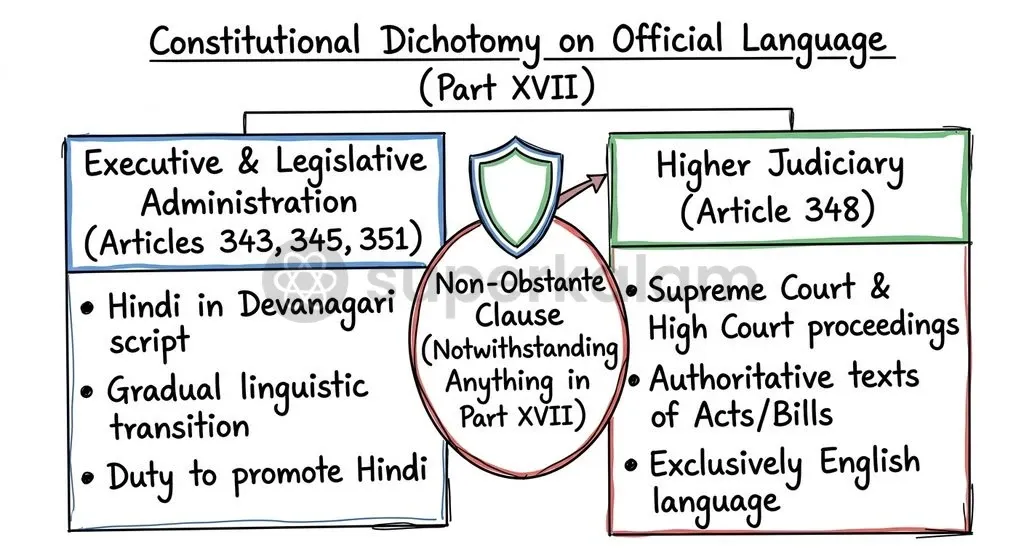
Part XVII of the Constitution establishes a dual structure dividing administrative business from formal higher court adjudication. Under Article 343(1), Hindi written in the Devanagari script is the official language of the Union, establishing an administrative baseline for governance.
The framers recognised that administrative governance differs from judicial precedent. Consequently, Part XVII shields adjudicatory institutions from general administrative linguistic transitions through dedicated institutional exceptions.
Discuss with Superkalam
Which four High Courts have formally permitted Hindi in their courtroom proceedings, and in what years were they sanctioned?
Ask NowArticle 348: Why English Remains the Language of the Higher Judiciary
Article 348 of the Constitution forms a self-contained code governing judicial language that overrides general directives. Under Article 348(1)(a), all proceedings in the Supreme Court and in every High Court must be conducted in English until Parliament enacts contrary legislation.
This operates alongside Article 348(1)(b), requiring that the authoritative texts of all Parliamentary and State Bills, Acts, Ordinances, and subordinate rules appear in English. The framers crafted this provision around three structural imperatives:
- Doctrinal Uniformity Under Article 141: Law declared by the apex court binds all Indian courts, demanding a standardised legal vocabulary to avoid interpretive fragmentation across High Courts.
- Inter-State Judicial Mobility Under Article 222: High Court judges face inter-state transfer, a policy workable only if pleadings, files, and orders share a common language.
- National Appellate Cohesion: Litigants from non-Hindi-speaking states require a neutral procedural medium guaranteeing equal standing for counsel nationwide.
Parliament has never used its plenary power under Article 348(1) to replace English in the Supreme Court, leaving the original constitutional default intact.
The Constitutional Tug-of-War: Articles 343 and 351 vs. Article 348
Tension arises when commentators conflate the executive language duties of the Union with the distinct rules governing the judiciary. The text resolves this tension through specific constitutional barriers:
- The Non-Obstante Override: Article 348 opens with an express non-obstante clause. This text explicitly overrides the general executive provisions of Article 343(1).
- The Directive Limitation: Article 351 directs the Union to promote Hindi as an expression of composite culture. However, this promotional mandate provides no self-executing authority to alter court procedure without an Act of Parliament.
- The Mutual Comprehension Principle: In Madhu Limaye & Anr v. Ved Murti & Ors (1970), a seven-judge Constitution Bench cancelled an intervener's audience after he insisted on arguing exclusively in Hindi despite judges and opposing counsel stating they could not follow it.
The Madhu Limaye ruling confirmed that personal linguistic preference cannot override mutual comprehension in the courtroom.
Discuss with Superkalam
How does the non-obstante clause in Article 348 insulate the higher judiciary from the general official language mandates of Article 343?
Ask Now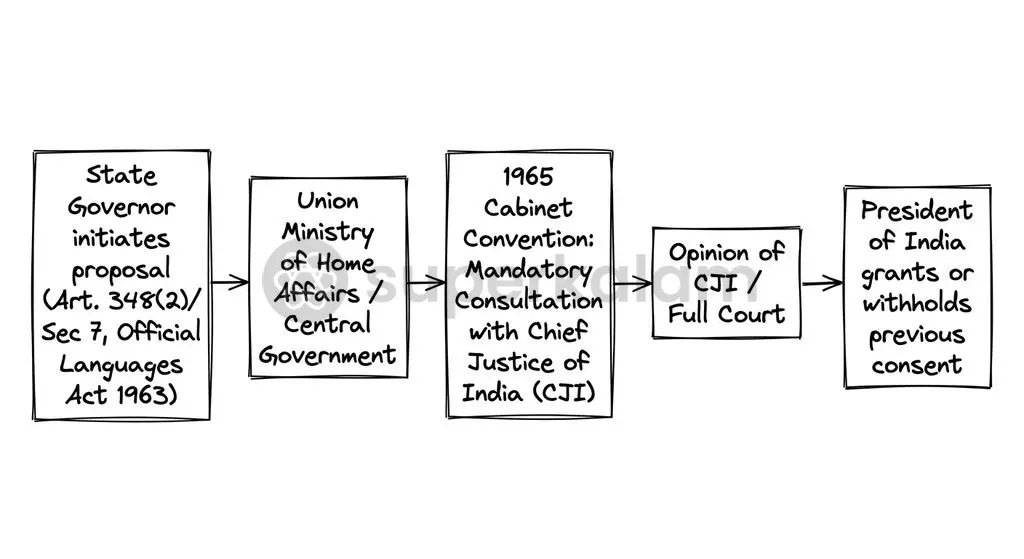
How Do High Courts Already Handle Regional Languages?
The Constitution establishes a sharp procedural asymmetry between the Supreme Court and the High Courts. Under Article 348(2), the Governor of a State may, with the previous consent of the President, authorise Hindi or another official state language in High Court proceedings.
Article 348(2) expressly bars this authorisation from applying to judgments, decrees, or orders. To bridge this gap, Parliament enacted Section 7 of the Official Languages Act, 1963, permitting vernacular judgments only if accompanied by an authoritative English translation.
Four High Courts have formally permitted Hindi in their courtroom proceedings:
- Rajasthan High Court: Authorised in 1950 directly under the provisions of Article 348(2).
- Allahabad High Court (Uttar Pradesh): Formally sanctioned in 1969.
- Madhya Pradesh High Court: Approved for Hindi use in 1971.
- Patna High Court (Bihar): Authorised for Hindi proceedings in 1972.
These post-1965 approvals complied with a Union Cabinet Committee decision dated 21 May 1965. That policy requires prior consultation and concurrence of the Chief Justice of India before presidential sanction. The Full Court of the Supreme Court has consistently resolved—in 1997, 1999, 2012, and 2016—against expanding regional languages in High Courts, citing risks to judicial transfers and pan-Indian coherence.
The Case for Allowing Hindi and Regional Languages in Apex Courts
Advocates for judicial indigenisation argue that maintaining an English procedural monopoly restricts participatory democracy. When litigants cannot follow courtroom dialogue, access to justice becomes mediated entirely by legal counsel, which weakens civic trust.
Proponents raise two primary structural arguments for broadening courtroom language:
- Vernacular Alignment with Subordinate Courts: Lower courts operate predominantly in regional vernaculars. Requiring voluminous trial records to undergo English translation before reaching the Supreme Court introduces substantial financial expense and administrative delay.
- Democratic Legitimacy: Broadening language options aligns court administration with democratic self-governance, reducing alienation for ordinary citizens navigating the apex bench.
Discuss with Superkalam
If a High Court judge from Tamil Nadu is transferred to the Allahabad High Court under Article 222, what procedural hurdles arise if pleadings are submitted exclusively in Hindi?
Ask NowWhy Jurists and Non-Hindi States Strongly Oppose the Move
Opposition to introducing Hindi into apex court proceedings centres on federal equality, professional fairness, and institutional integrity. The Supreme Court represents a multilingual federation of twenty-eight states and eight Union territories.
- Asymmetry in Federal Representation: Sanctioning Hindi gives an unfair advantage to northern practitioners while placing southern and eastern advocates at a functional disadvantage.
- Barriers to Inter-State Transfers: Judicial transfers under Article 222 would stall if judges assigned to different High Courts encountered pleadings and orders drafted in scripts they could not read.
- Risk to Legal Precedent: Judicial terms of art carry centuries of settled meaning. Hasty vernacular substitutions risk semantic ambiguity, complicating the application of precedent under Article 141.
The Official Languages Act of 1963 does not authorise non-English languages for the Supreme Court. Jurists stress that elevating one vernacular over others would damage linguistic neutrality and fracture the unified all-India bar.
What Key Law Commissions and Committees Have Recommended
The Law Commission of India evaluated apex court language rules in detail. In its 216th Report, submitted in December 2008 and titled 'Non-Feasibility of Introduction of Hindi as Compulsory Language in the Supreme Court of India', the Commission advised against compulsory vernacular adoption.
The Commission highlighted specific institutional safeguards:
- Preservation of the All-India Bar: Higher judicial language must sustain an all-India bar and bench, ensuring that advocates nationwide compete on equal procedural footing.
- Protection Against Coercion: The report cautioned that language must never be thrust upon unwilling populations, noting that compulsory Hindi would trigger divisive regional friction.
- Focus on Technical Translation: The Commission advised retaining English as the primary medium for higher court deliberations while funding high-precision translations for public reference.
This approach safeguards doctrinal rigour without leaving non-English-speaking citizens in the dark.
Discuss with Superkalam
Compare the constitutional mechanisms governing language use in High Courts under Article 348(2) with the rules governing the Supreme Court under Article 348(1).
Ask NowThe Way Forward: Balancing Linguistic Inclusion with Judicial Unity
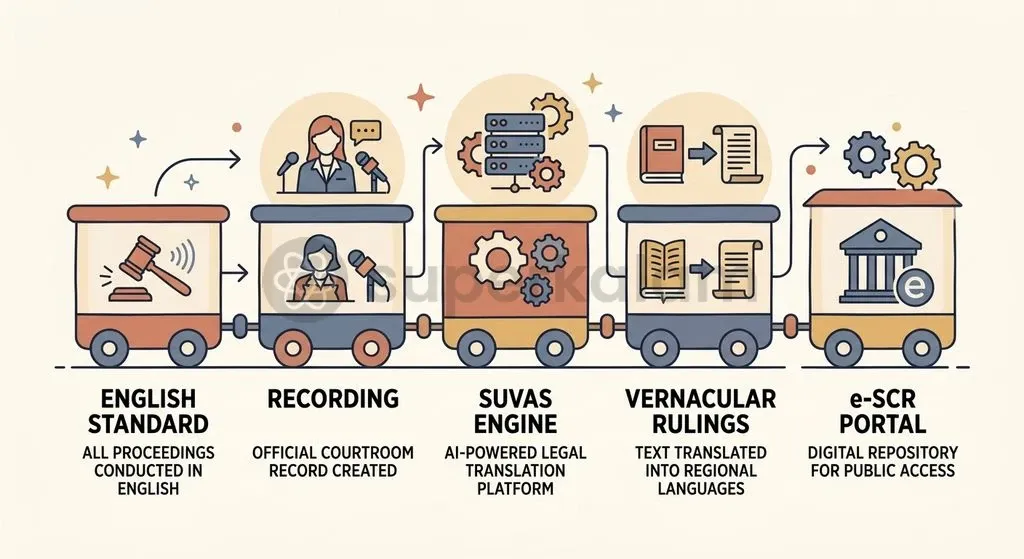
Resolving the friction between judicial unity and citizen accessibility requires technological innovation rather than altering courtroom procedural rules. The Supreme Court maintains English for litigation while expanding vernacular access to final rulings.
The judiciary implements this balance through two primary digital mechanisms:
- SUVAS Software Engine: The apex court deployed SUVAS (Supreme Court Vidhik Anuvaad Software), an AI-trained machine-assisted translation tool developed with technical assistance from the Ministry of Electronics and Information Technology (MeitY). SUVAS translates English judgments into regional languages recognised under the Eighth Schedule.
- e-SCR Digital Repository: Translated rulings are uploaded to the electronic Supreme Court Reports (e-SCR) portal, allowing citizens to read judgments in their mother tongues without altering apex courtroom argumentation.
In the long term, this dual strategy—retaining English under Article 348 while deploying AI translations—safeguards federal cohesion while widening public access to justice.
Key Takeaways
- Constitutional Monopoly of English: Under Article 348(1)(a), all proceedings in the Supreme Court and High Courts must be conducted in English until Parliament enacts legislation providing otherwise.
- Non-Obstante Protection: The opening clause of Article 348 overrides Article 343(1) and Article 351, preventing general Union language mandates from applying automatically to the higher judiciary.
- High Court Distinction: Under Article 348(2) and Section 7 of the Official Languages Act, 1963, four High Courts (Rajasthan, Uttar Pradesh, Madhya Pradesh, and Bihar) use Hindi, subject to CJI consultation under a 1965 Cabinet convention.
- Apex Court Feasibility: The 216th Law Commission Report concluded that introducing Hindi in the Supreme Court is non-feasible because it would disrupt judge transfers under Article 222 and harm the all-India bar.
- Technological Resolution: The judiciary bridges the linguistic divide by deploying the SUVAS translation tool and e-SCR digital portal, offering vernacular translations while keeping courtroom proceedings in English.
Mains Question
"Article 348 of the Constitution establishes an express constitutional insulation for the higher judiciary that overrides general official language directives." In this context, elucidate how the constitutional framework balances the demand for linguistic accessibility with the imperative of judicial unity. (10 Marks)
Evaluate NowMains Question
The Law Commission of India in its 216th Report cautioned against the compulsory introduction of Hindi in the apex court, emphasizing the preservation of an all-India bar and bench. Critically examine the arguments for and against introducing regional languages in the Supreme Court. (15 Marks)
Evaluate NowPractice MCQs
QUESTION 1
With reference to the constitutional provisions governing languages in the Indian judiciary, consider the following statements:
- Under Article 348(1), proceedings in both the Supreme Court and High Courts must be in English until Parliament by law provides otherwise.
- The Governor of a State may, with the prior consent of the Chief Justice of India, authorise the use of Hindi in the proceedings of the High Court.
- Article 348(2) permits the Governor to authorise the use of Hindi or other official state languages in High Court judgments without needing an English translation.
Which of the statements given above is/are correct?
QUESTION 2
Consider the following statements regarding the official language framework under Part XVII of the Constitution of India:
- Article 348 begins with a non-obstante clause that explicitly overrides the general provisions of Article 343(1).
- Article 351 acts as a self-executing mandate that empowers courts to replace English with Hindi in higher judicial proceedings.
- The Official Languages Act of 1963 explicitly authorises the use of Hindi in the proceedings of the Supreme Court of India.
Which of the statements given above is/are correct?
QUESTION 3
Which of the following High Courts was the first to authorise Hindi in its proceedings directly under Article 348(2) in 1950?
QUESTION 4
Consider the following statements regarding institutional views on language in the higher judiciary:
- In Madhu Limaye & Anr v. Ved Murti & Ors (1970), the Supreme Court ruled that personal linguistic choice cannot override the principle of mutual comprehension in court.
- The 216th Report of the Law Commission of India recommended the compulsory introduction of Hindi in the Supreme Court to foster participatory democracy.
- The Full Court of the Supreme Court has consistently rejected resolutions proposing the expansion of regional languages in High Courts.
Which of the statements given above is/are correct?
QUESTION 5
With reference to technological initiatives in the Indian judiciary, 'SUVAS' refers to which of the following?