Anti-Hijacking Act 2016: Extraterritorial Reach and Enforcement Roadblocks
While India's anti-hijacking statute projects sovereign power into global airspace, extradition roadblocks and digital hoax threats test its legal boundaries.
Oct, 2026
•12 min read

Context
The Anti-Hijacking Act, 2016 provides India with a comprehensive legal architecture incorporating the 2010 Beijing Protocol, establishing extraterritorial jurisdiction over foreign nationals and overseas flights while mandating capital punishment or natural-life imprisonment alongside asset confiscation for hijacking offences. Enacted to repeal the Anti-Hijacking Act, 1982, the statute expands the legal threshold of hijacking from physical cockpit takeovers to technological interference and credible intimidation against an aircraft in service. While Section 7 empowers Indian agencies like the National Investigation Agency to prosecute cross-border offenders, practical enforcement faces severe friction from foreign sovereignty, dual criminality, and death penalty exceptions in bilateral extradition treaties. Furthermore, modern asymmetric disruptions, including widespread digital hoax threats, expose operational limits in applying rigid statutory penalties designed primarily for physical seizures.
Why in the News: The Surge in Hoax Threats and Modern Aviation Security
As of November 2024, the Ministry of Civil Aviation initiated a comprehensive review after over 1,000 bomb hoax threats disrupted commercial airlines across domestic and international sectors. Aviation operations witnessed massive flight diversions, unscheduled fuel dumping, and severe logistical strains, prompting civil aviation authorities to re-examine the thresholds of India's anti-hijacking legal framework. The wave of social media hoaxes highlighted a statutory mismatch in the Anti-Hijacking Act, 2016, whose disproportionate life sentence cannot readily apply to remote hoaxes lacking physical takeover intent, per Ministry of Civil Aviation and Bureau of Civil Aviation Security policy reviews (as reported on 16 November 2024).
The central analytical argument of this piece is that while the Anti-Hijacking Act, 2016 creates an expansive statutory regime to project sovereign jurisdiction across international airspace, its enforcement remains hamstrung by international extradition hurdles and a structural mismatch against remote, non-physical asymmetric threats.
Extraterritorial enforcement under the 2016 Act was tested when the National Investigation Agency invoked cross-border powers following international incidents. In an exercise of extraterritorial jurisdiction under Section 3 of the Anti-Hijacking Act, 2016 and Section 16 of the Unlawful Activities (Prevention) Act, 1967, the agency registered a First Information Report on 9 October 2026 concerning a mid-air assault on Indian Captain Smit Machchhar aboard flydubai flight 1073 (as reported on 10 October 2026 per the National Investigation Agency FIR and Economic Times reporting). Prosecuting such offences tests the limits of extraterritoriality when foreign nations assert concurrent jurisdiction.
Beyond Physical Takeover: How the 2016 Act Redefined 'Hijacking'
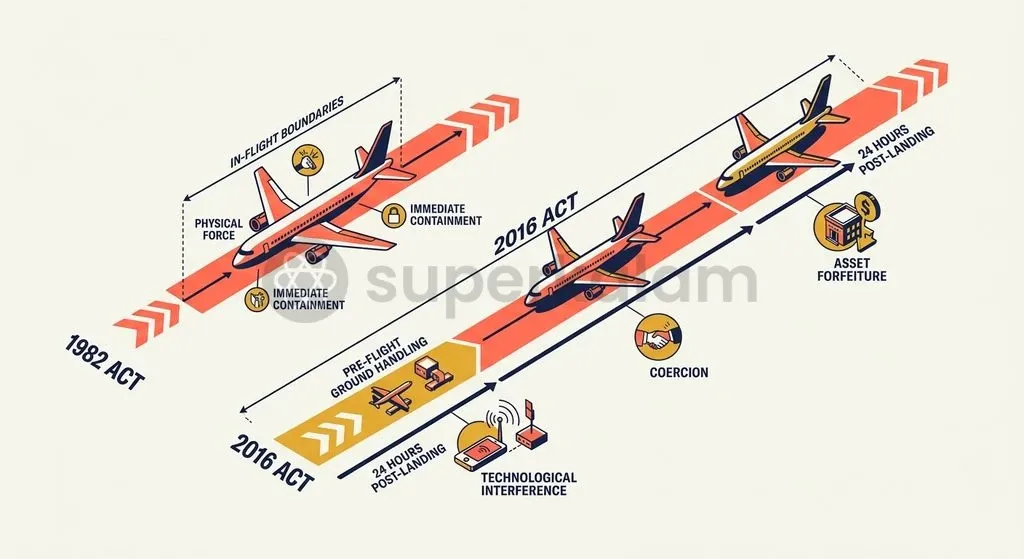
Section 3(1) of the Anti-Hijacking Act, 2016 fundamentally expands the definition of hijacking by penalising seizures executed through technological means, coercion, or any form of intimidation. The earlier Anti-Hijacking Act, 1982 was restricted to physical force or threats during flight, leaving gaps exposed by evolving aviation technologies. Section 21 of the 2016 Act repealed the 1982 legislation to give domestic legal effect to the 1970 Hague Convention and the 2010 Beijing Protocol Supplementary to the Convention.
The revised statute broadens both the scope of unlawful conduct and the operational timeframe during which an aircraft enjoys statutory protection:
- Technological Seizure: Section 3(1) penalises unlawfully and intentionally seizing or exercising control of an aircraft by force, threat of force, coercion, any form of intimidation, or by any technological means.
- Deemed Hijacking: Section 3(2) extends culpability to making credible threats, attempts, abetment, directing or organising others, acting as an accomplice, and knowingly assisting an offender to evade arrest.
- Expanded Operational Window: Section 3(4) defines an aircraft as being in service from the commencement of pre-flight preparation by ground personnel or crew until twenty-four hours after landing, or until competent authorities assume custody following a forced landing.
| Dimension | Anti-Hijacking Act, 1982 | Anti-Hijacking Act, 2016 |
|---|---|---|
| Treaty Anchor | 1970 Hague Convention | 1970 Hague Convention and 2010 Beijing Protocol |
| Means of Seizure | Restricted to force or threat of force | Includes force, coercion, intimidation, or any technological means |
| Temporal Scope | Limited to aircraft 'in flight' | Extended to aircraft 'in service' from pre-flight preparation to 24 hours post-landing |
| Prescribed Sentences | Life imprisonment and fine | Mandatory death penalty if death results, or imprisonment for remainder of natural life |
| Property Penalties | Standard statutory fines | Mandatory confiscation of movable and immovable property |
Discuss with Superkalam
Recall the two international treaties that form the statutory foundation of India's Anti-Hijacking Act, 2016.
Ask NowStatutory Teeth: Death Penalty, Life Imprisonment, and Asset Confiscation
Section 4 of the Anti-Hijacking Act, 2016 prescribes mandatory capital punishment if a hijacking causes the death of a hostage, security personnel or another non-involved person as a direct consequence, alongside natural-life imprisonment and property confiscation for other hijacking offences. The legislative design strips judicial discretion regarding the minimum custodial term, establishing severe penalties to deter airborne terrorism. Under Section 4(a), capital punishment is mandatory where the offence causes the death of a hostage, security personnel, or any non-involved person as a direct consequence.
Where the hijacking does not cause death, Section 4(b) mandates imprisonment for natural life, fine, and liability to confiscation of movable and immovable property. Section 19 provides that property confiscated by order of the Designated Court stands forfeited to the Central Government free from all encumbrances. Unlike the general anti-terror provisions under Sections 15 and 16 of the Unlawful Activities (Prevention) Act, 1967, the Anti-Hijacking Act operates as an aviation-specific lex specialis mandating non-discretionary natural-life imprisonment or capital punishment.
Procedural safeguards are tilted in favour of prosecution through specialised mechanisms:
- Designated Courts: Section 8(2) establishes that Special Courts constituted under Section 11 or Section 22 of the National Investigation Agency Act, 2008 function as Designated Courts for trials.
- Stringent Bail Conditions: Section 12(1) bars bail unless the Public Prosecutor is heard and the court finds reasonable grounds of innocence.
- Reverse Presumption of Guilt: Section 16 mandates a statutory reverse presumption if the accused possesses arms or explosives, or if force against crew and passengers is established.
Judicial scrutiny, however, tests the evidentiary threshold required under these provisions. On 8 August 2023, the Gujarat High Court acquitted Birju Kishorekumar Salla in R/CR.A/1523/2019, overturning the first-ever conviction and life sentence handed down by an NIA Special Court under the Anti-Hijacking Act, 2016. The High Court held that the prosecution failed to prove criminal intent to seize control of the aircraft, demonstrating that rigorous statutory presumption cannot bypass standard evidentiary burdens.
Extraterritorial Reach: India's Legal Claim Over Foreign Skies and Nationals
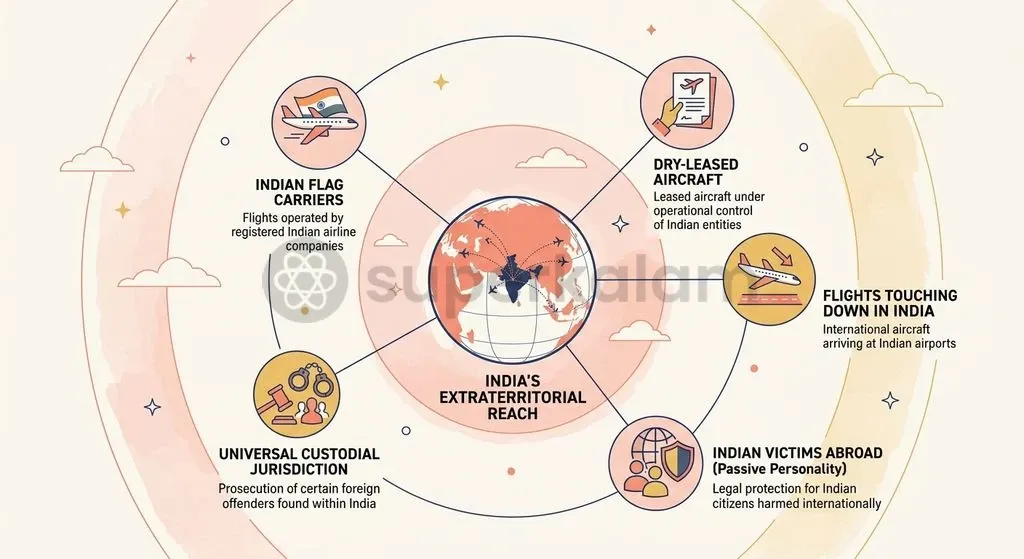
Section 7 of the Anti-Hijacking Act, 2016 establishes sweeping extraterritorial jurisdiction, permitting Indian designated courts to try foreign nationals for offences committed aboard foreign aircraft outside Indian airspace. Under Section 1(2) and Section 7(1), offences committed outside India by any person may be dealt with as if committed at any place within India where the accused is found. This statutory reach links domestic criminal law directly to international conventions.
Indian courts are empowered to assert jurisdiction under Section 7(2) through several connecting factors:
- Flag-State Jurisdiction: When the offence takes place aboard an aircraft registered in India.
- Leased Aircraft Nexus: When committed aboard an aircraft leased without crew (dry-leased) to a lessee whose principal place of business is in India.
- Territorial Landing: When the aircraft lands in Indian territory with the alleged offender still on board.
- Active and Passive Personality: When the offence is committed by an Indian citizen, or against an Indian citizen.
- Universal Custodial Jurisdiction: Section 7(2)(f) and 7(2)(g) grant jurisdiction over offences committed abroad by stateless persons habitually resident in India, or by foreign offenders present in India who are not extradited to another state.
Investigative powers are anchored within central internal security agencies. Section 6(1) of the Act empowers the Central Government to confer powers of arrest, investigation, and prosecution on officers of the National Investigation Agency or any Central Government officer. Hijacking is an enumerated Scheduled Offence under Entry 3 of the Schedule to the National Investigation Agency Act, 2008, giving the federal agency automatic jurisdiction to investigate cross-border offences.
Discuss with Superkalam
Explain how the definition of an aircraft 'in service' under Section 3(4) provides greater operational protection than the traditional 'in flight' standard.
Ask NowWhere Law Meets Geopolitics: Extradition Friction and Sovereignty Dilemmas
Bilateral extradition treaties often conflict with the Anti-Hijacking Act, 2016 because foreign abolitionist states refuse extradition where capital punishment remains a statutory sentencing option under Section 4. While Section 11(1) statutorily deems hijacking offences to be included as extraditable offences in all existing bilateral treaties between India and Hague Convention countries, real-world surrenders encounter legal and diplomatic barriers. Section 11(3) bars foreign states from refusing extradition or Mutual Legal Assistance solely on the ground of a political offence exception, yet external legal systems maintain sovereign grounds for refusal.
The death penalty provision under Section 4(a) creates a structural deadlock with jurisdictions across Europe and Latin America. Under Section 34C of the Extradition Act, 1962, alongside standard bilateral treaty terms, abolitionist countries mandate binding diplomatic assurances that the death penalty will neither be sought nor executed prior to surrendering a fugitive. Because Section 4(a) mandates capital punishment when a death occurs, Indian prosecutors face constitutional and statutory limits in offering executive assurances that override mandatory sentencing text.
Extraterritorial enforcement collides with national sovereignty barriers:
- Non-Extradition of Nationals: Many civil-law jurisdictions and Gulf states operate under constitutional or penal prohibitions against extraditing their own citizens, asserting sovereign jurisdiction to prosecute locally under domestic penal codes.
- Dual Criminality Complexities: Extradition requires the conduct to constitute an equivalent serious offence in both jurisdictions, causing friction when foreign definitions of hijacking do not recognise non-physical coercion or intimidation.
- Concurrent Jurisdiction Disputes: When an incident involves a foreign carrier, foreign airspace, and foreign nationals, the territorial state typically asserts priority, relegating India's passive personality claims under Section 7(2) to secondary diplomatic negotiations.
Discuss with Superkalam
If a foreign national assaults a flight commander on a foreign-registered aircraft flying between two overseas destinations, assess whether Indian agencies can assert jurisdiction under the 2016 Act if an Indian national is affected.
Ask NowThe Response Mechanism: How the Crisis Management Group (CMG) Takes Command
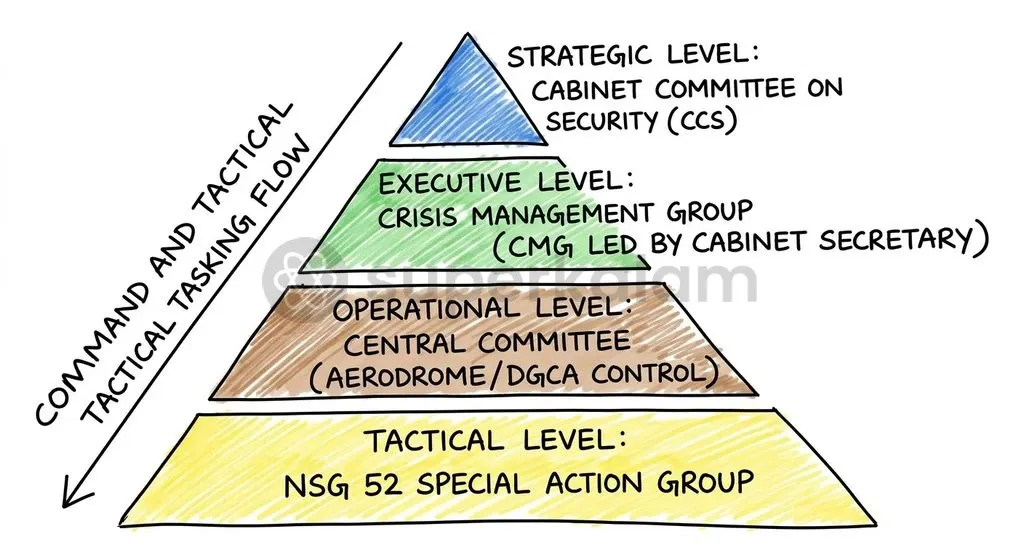
The Crisis Management Group, chaired by the Cabinet Secretary, functions as India's apex bureaucratic command authority coordinating inter-ministerial tactical responses during civil aviation hijack emergencies. Situated within the Cabinet Secretariat, the body assesses intelligence, reviews operational options, and directly advises the Cabinet Committee on Security, which holds ultimate executive authority to sanction armed intervention or international negotiations.
Standard operating procedures split strategic command from local tactical handling:
- Strategic Direction (CMG): The Cabinet Secretary convenes representatives from the Ministry of Civil Aviation, Ministry of Home Affairs, Ministry of Defence, Ministry of External Affairs, and intelligence heads to oversee strategic decisions, cross-border airspace clearances, and federal force deployments.
- Tactical Coordination (Central Committee): Ground-level operations are executed by the Central Committee, chaired by the Directorate General of Civil Aviation with the Director General of the Bureau of Civil Aviation Security acting as convener.
- Command Post Operations: The Central Committee functions from the Central Control and Command Room at Indira Gandhi International Airport in New Delhi, issuing operational directives to airport-level Aerodrome Crisis Management Committees.
- Armed Intervention: When an aircraft is immobilised on Indian soil and hostage negotiations fail, tactical assault duties fall to the 52 Special Action Group of the National Security Guard, India's dedicated federal counter-hijack strike force.
The New Frontline: Hoax Threats, Cyber Interference, and Enforcement Deficits
The National Investigation Agency encounters critical statutory constraints when confronting modern aviation threats, as the Anti-Hijacking Act, 2016 lacks calibrated mechanisms to prosecute digital disruptions and hoaxes. While Section 3(1) incorporates technological means, the statute was drafted primarily around physical takeovers of passenger airframes. Applying the Act's severe penalties to non-custodial digital threats reveals significant legal gaps.
Asymmetric threats create three distinct operational challenges:
- The Hoax Threat Deficit: Social media bomb threats trigger massive fuel dumping, emergency diversions, and extensive passenger screening. However, prosecuting remote digital hoaxes under Section 3(2) as a deemed hijacking carries a disproportionate mandatory sentence of natural-life imprisonment, leading trial courts to resist conviction in the absence of takeover intent.
- Cyber Interference in Avionics: Modern aircraft rely on digital fly-by-wire avionics and networked flight management systems. Remotely spoofing Automatic Dependent Surveillance-Broadcast signals or hacking satellite links could disrupt flights without physical infiltration, testing the technical capacity of federal investigators.
- Investigative Attribution: Tracing transnational digital threats routed through Virtual Private Networks and dark-web channels requires real-time foreign law-enforcement cooperation, which frequently stalls in the absence of dual criminality.
Discuss with Superkalam
Analyse the structural contradictions between mandatory death penalty provisions in domestic anti-hijacking laws and the requirements of bilateral extradition treaties.
Ask NowWay Forward: Updating Standard Operating Procedures for Asymmetric Aviation Risks
Parliament enacted the Bharatiya Vayuyan Adhiniyam, 2024 on December 11, 2024, providing a foundation to overhaul statutory penalties alongside operational protocols under the Bureau of Civil Aviation Security. Replacing the colonial Aircraft Act, 1934, the new legislation modernises civil aviation governance and updates regulatory enforcement penalties. To address modern vulnerabilities, statutory and operational reforms must follow targeted priorities:
- Graduated Statutory Penalties for Hoaxes: Amend civil aviation security regulations to introduce calibrated criminal offences for digital bomb threats and hoaxes, pairing financial restitution for airline fuel dumping with non-bailable custodial terms below the rigid natural-life threshold of the Anti-Hijacking Act.
- Strengthening Extradition Compatibility: Negotiate bilateral supplementary protocols that reconcile Section 4(a) capital punishment mandates with international human rights requirements, establishing viable avenues for sovereign prosecution abroad under the principle of aut dedere aut judicare (extradite or prosecute).
- Cyber-Avionics Security Standards: Upgrade the Bureau of Civil Aviation Security's national programmes to mandate cyber-hardening protocols for ground-based air traffic management networks and in-flight communication systems.
- Real-Time Inter-Agency Interoperability: Streamline coordination channels between the Central Control and Command Room at Indira Gandhi International Airport, the National Investigation Agency, and foreign civil aviation counterparts to ensure rapid forensic attribution during cross-border threats.
Key Takeaways
- The Anti-Hijacking Act, 2016 repealed the 1982 Act to implement the 1970 Hague Convention and the 2010 Beijing Protocol, expanding the definition of hijacking to include coercion, intimidation, and technological interference.
- Under Section 3(4), an aircraft is deemed in service from pre-flight ground preparations until twenty-four hours after landing, significantly expanding the temporal jurisdiction of civil aviation security authorities.
- Penalties under Section 4 are severe and non-discretionary, mandating the death penalty if the offence causes the death of a hostage, security personnel or another non-involved person as a direct consequence, and natural-life imprisonment with property confiscation for all other hijacking convictions.
- Section 7 establishes broad extraterritorial jurisdiction, granting Indian Special Courts authority over offences committed on Indian-registered aircraft, dry-leased aircraft, flights landing in India, or offences against Indian citizens worldwide.
- Extraterritorial prosecution faces persistent barriers due to death penalty objections from foreign abolitionist states, bilateral extradition constraints, and constitutional bans on extraditing foreign nationals.
- Operational responses are led by the Cabinet Secretary-chaired Crisis Management Group, while on-ground crisis management is executed by the DGCA-led Central Committee and tactical counter-hijack operations are handled by the NSG 52 Special Action Group.
Mains Question
"While the Anti-Hijacking Act, 2016 incorporates international conventions to establish sweeping extraterritorial reach, its enforcement encounters significant sovereignty and geopolitical roadblocks." Elucidate. (15 Marks)
Evaluate NowMains Question
Highlighting the statutory expansion of the definition of 'hijacking' under the Anti-Hijacking Act, 2016, critically examine the structural limitations of the Act in dealing with contemporary asymmetric threats such as bomb hoax calls. (10 Marks)
Evaluate NowPractice MCQs
QUESTION 1
With reference to the Anti-Hijacking Act, 2016, consider the following statements:
- It gives domestic legal effect to both the 1970 Hague Convention and the 2010 Beijing Protocol.
- Under the Act, an aircraft is considered to be 'in service' only while it is 'in flight' from the moment external doors are closed.
- The Act incorporates seizures executed through technological means as an offence of hijacking. Which of the statements given above are correct?
QUESTION 2
Under Section 7 of the Anti-Hijacking Act, 2016, Indian Designated Courts can assert extraterritorial jurisdiction when an offence is committed outside India under which of the following circumstances?
- Aboard an aircraft registered in India.
- Aboard an aircraft dry-leased to a lessee whose principal place of business is in India.
- By a foreign national against an Indian citizen on a foreign aircraft abroad.
- When the alleged offender is present in India and is not extradited to another foreign state. Select the correct answer using the code given below:
QUESTION 3
Which of the following bodies functions as the Designated Court for conducting trials of offences under the Anti-Hijacking Act, 2016?
QUESTION 4
Consider the following statements regarding the institutional and legal mechanisms governing hijacking in India:
- Hijacking is an enumerated Scheduled Offence under the National Investigation Agency Act, 2008.
- Bail can be granted under the Anti-Hijacking Act, 2016 without hearing the Public Prosecutor if the accused surrenders their passport.
- The Act empowers the Central Government to confer powers of arrest, investigation, and prosecution directly upon officers of the National Investigation Agency. Which of the statements given above is/are correct?