Anganwadis as Early Childhood Education Hubs: Key Governance Reforms
Transforming 14 lakh rural care centres into foundational learning hubs bridges India's early cognitive divide while testing an overworked frontline workforce.
Sep, 2026
•10 min read
Overview
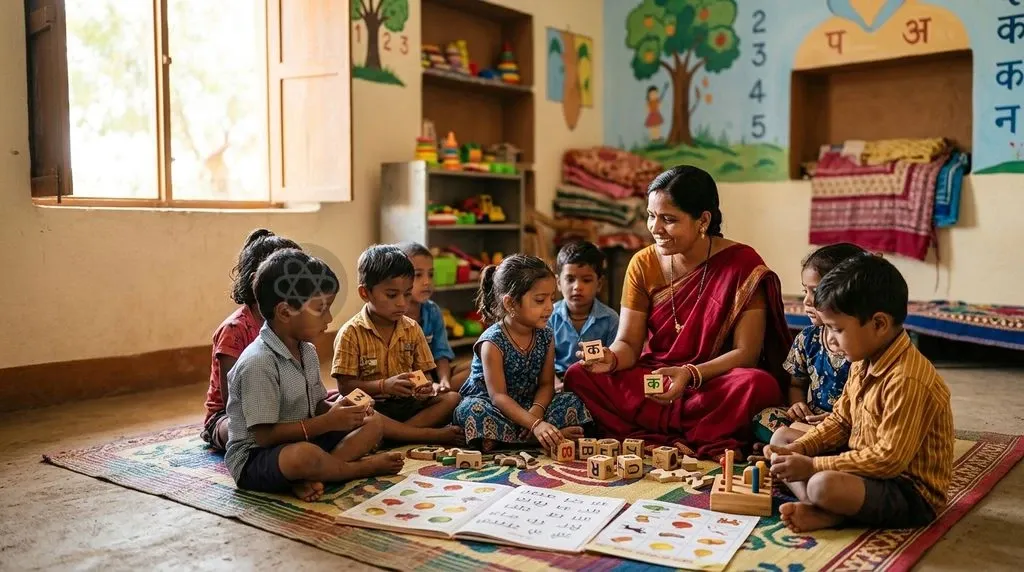
The Ministry of Women and Child Development is executing a structural transition across India's 14-lakh Anganwadi network. The shift turns supplementary nutrition outposts into pedagogical centres for Early Childhood Care and Education (ECCE). Driven by the National Education Policy 2020 and the Poshan Bhi Padhai Bhi campaign, this reform integrates community childcare into the formal school continuum.
The push targets critical cognitive windows before age six. However, its long-term success depends on transforming an under-resourced, honorary frontline workforce into recognised, certified early childhood educators.
Why in the News: The Policy Push for Foundational Learning in Anganwadis
The Ministry of Women and Child Development launched the Poshan Bhi Padhai Bhi initiative on 10 May 2023 to transform Anganwadis into universal early childhood education hubs. As of February 2026, the Union Government has accelerated this overhaul across states to operationalise foundational learning mandates outlined in recent policy blueprints.
This transformation directly bridges two distinct constitutional provisions:
- Article 45 (Directive Principle): Directs the State to endeavour to provide early childhood care and education for all children until they complete the age of six years as a non-justiciable provision under Part IV.
- Article 21A (Fundamental Right): Establishes free and compulsory education as a justiciable Fundamental Right for children aged 6 to 14 years.
Public spending priorities are shifting from calorie tracking to cognitive architecture. Democratising early childhood pedagogy through community Anganwadis offers the highest developmental return for bridging India's rural-urban learning divide, provided structural workforce constraints are resolved.
From Food Delivery to Foundational Learning: What Has Changed?
The Integrated Child Development Services framework has evolved from an emergency child survival intervention into a comprehensive cognitive and socio-emotional development model. Launched in 1975, the Integrated Child Development Services (ICDS) primarily targeted severe child malnutrition, infant mortality, and maternal health in underserved geographies.
Under Mission Saksham Anganwadi and Poshan 2.0, Early Childhood Care and Education is formally institutionalised as one of six core services. The complete package comprises:
- Supplementary Nutrition Programme (SNP)
- Pre-school Non-formal Education (now structured ECCE)
- Nutrition and Health Education
- Immunisation support
- Health Check-ups
- Referral Services
According to the National Education Policy 2020, over 85% of cumulative brain development occurs prior to the age of six years. Depriving children of structured stimulation during this period creates lasting cognitive penalties. Research by Nobel laureate James Heckman demonstrates that high-quality early childhood interventions yield an annual rate of return of 7% to 10% through improved schooling outcomes, reduced remedial expenditure, and higher adult productivity.
Annual Status of Education Report (ASER) assessments consistently indicate that children entering Grade 1 without structured preschooling suffer persistent deficits in foundational literacy and numeracy. Anganwadis are therefore tasked with closing developmental deficits before formal schooling commences.
Discuss with Superkalam
Which constitutional articles govern early childhood care and compulsory schooling in India, and at what age does the transition occur?
Ask NowPolicy Blueprint: NEP 2020, NCF-FS, and the 'Poshan Bhi Padhai Bhi' Framework
The National Education Policy 2020 integrates three years of Anganwadi preschool education into the formal five-year foundational stage of Indian schooling. Under the 5+3+3+4 educational structure, the initial Foundational Stage covers children aged 3 to 8 years, merging three years of Anganwadi preschool (ages 3–6) with primary Grades 1 and 2 (ages 6–8).
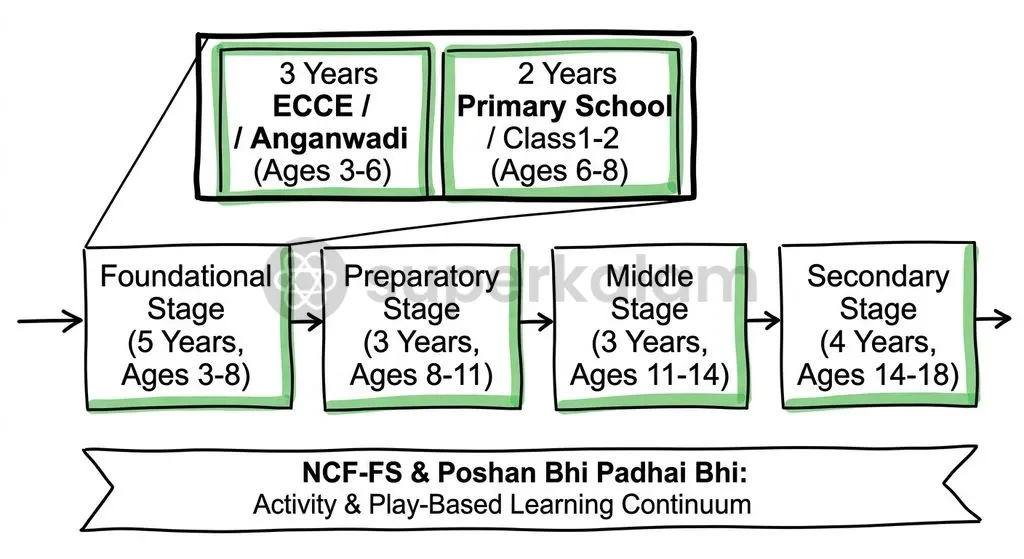
Curricular standardisation relies on national frameworks developed to guide pedagogical activity across the country:
- NCF-FS 2022 Alignment: The National Curriculum Framework for Foundational Stage (NCF-FS) replaces rote chalk-and-talk instruction with play-based, activity-oriented learning domains covering physical, socio-emotional, cognitive, and early language development.
- Aadharshila Framework (Ages 3–6): The Ministry of Women and Child Development introduced 'Aadharshila', a national ECCE curriculum structured around a 36-week active learning calendar with 5+1 days of weekly play-based pedagogy. Under 'Poshan Bhi Padhai Bhi', centres must conduct a minimum of two hours of daily structured learning delivered exclusively in the child's mother tongue.
- Navchetana Framework (Ages 0–3): Designed for infants and toddlers, 'Navchetana' equips Anganwadi Workers and caregivers with developmental guidelines for sensory and cognitive stimulation during routine home visits.
- Vidyarambh Transition Protocol: The ministry established the Vidyarambh ECCE Certificate to document developmental readiness and support a seamless transition from Anganwadis into primary school.
Discuss with Superkalam
How does the 5+3+3+4 structure under NEP 2020 bridge the historical gap between Anganwadis and formal primary schooling?
Ask NowComparison: Traditional Anganwadis vs Modern ECCE Learning Hubs
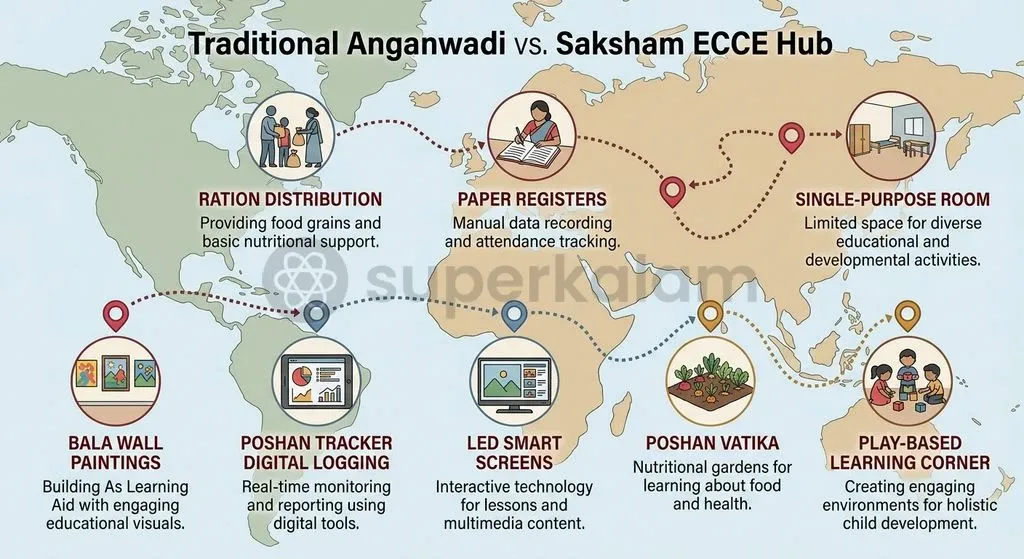
Modern Saksham Anganwadis differ fundamentally from traditional child-care outposts by combining upgraded physical infrastructure with structured, play-based pedagogical calendars. The transition marks a decisive shift in operational focus, monitoring mechanisms, and spatial design.
| Dimension | Traditional Anganwadi Model | Modern Saksham ECCE Hub |
|---|---|---|
| Core Operational Mandate | Focused on food distribution, immunization drives, and supplementary nutrition. | Delivers a dual mandate of nutrition and a minimum of two hours of structured play pedagogy daily. |
| Curricular Structure | Unstandardised, informal pre-school activities without a unified national calendar. | Governed by the 36-week Aadharshila calendar aligned with NCF-FS guidelines. |
| Physical Learning Environment | Basic single-room rented spaces often lacking dedicated pedagogical corners. | Upgraded with Building as Learning Aid (BALA) artwork, LED screens, and Poshan Vatikas. |
| Digital Administration | Manual paper registers for tracking child attendance and nutrition quotas. | Monitored via the Poshan Tracker, logging over 2.56 crore monthly preschool activities. |
| Primary School Linkage | Functioned as isolated community outposts with no formal institutional alignment. | Integrated through co-location inside primary schools and standard Vidyarambh certificates. |
Discuss with Superkalam
If assigned as a District Magistrate, how would you resolve operational overlaps between Anganwadis and co-located primary schools?
Ask NowStructural Bottlenecks: Worker Burnout, Infrastructure Deficits, and Inter-Ministerial Coordination
Anganwadi Workers face severe operational friction because their administrative and public health duties compete directly with daily preschool teaching responsibilities. While policy blueprints envision structured pedagogical instruction, structural ground realities constrain classroom delivery.
A major challenge involves the dual-burden dilemma. Anganwadi Workers (AWWs) are officially classified as honorary community voluntary workers who receive an honorarium rather than statutory government teacher salaries. They distribute supplementary rations, conduct house surveys, manage immunisation logistics, and log real-time data on the Poshan Tracker. Adding structured preschool teaching to these responsibilities risks instructional dilution and worker burnout.
Infrastructure disparities further complicate nationwide implementation:
- Upgradation Backlog: Mission Poshan 2.0 approved the modernisation of 2 lakh Anganwadis into Saksham Anganwadis during the 15th Finance Commission cycle. As of December 2025, a total of 94,077 centres have completed physical upgrades.
- Sanitation and Water Gaps: Many non-upgraded rural and urban centres continue to operate out of cramped rented rooms lacking dedicated child-friendly toilets, clean drinking water, and outdoor activity spaces.
- Inter-Ministerial Friction: Institutional overlap between the Ministry of Women and Child Development (MWCD) and the Ministry of Education (MoE) poses logistical hurdles. The issuance of joint guidelines on 3 September 2025 aimed to streamline the co-location of Anganwadis within Government Primary Schools. Approximately 2.9 lakh Anganwadi Centres are co-located in primary schools as of early 2026, yet administrative control, infrastructure budgets, and supervisory reporting lines remain split between separate line departments.
Discuss with Superkalam
Examine the tension between treating Anganwadi Workers as honorary voluntary personnel and demanding standardised pedagogical outcomes.
Ask NowState Innovations and Global Models in Community-Based Early Learning
Global models and Indian state pilots show that decentralised community ownership and maternal engagement significantly improve early childhood development outcomes. Several regional administrations have introduced institutional adaptations to deliver community-rooted early education.
State-level interventions demonstrate the impact of contextualised learning materials and specialised cadrisation:
- Decentralised Learning Materials: Several states have developed indigenous learning toys and mother-tongue teaching aids using locally sourced, non-toxic materials, making play-based tools accessible without expensive commercial kits.
- Dedicated Pre-Primary Cadres: Select states have experimented with deputing dedicated ECCE educators alongside traditional Anganwadi workers to decouple early education from health and nutrition delivery.
- School Co-location Synergies: States that have systematically integrated Anganwadi centres into primary school complexes report smoother Grade 1 enrolment transitions and improved shared access to mid-day meal infrastructure and play facilities.
International experience reinforces the value of community-based early childhood interventions. The Cuna Más programme in Peru and early childhood development networks across Nordic nations demonstrate that community-rooted centres achieve superior outcomes when frontline facilitators receive continuous on-site coaching, structured curricular guidance, and equitable remuneration.
Discuss with Superkalam
Weigh the economic and developmental arguments for increasing fiscal outlays toward Anganwadi preschool infrastructure versus remedial school-age spending.
Ask NowWay Forward: Professionalising the Anganwadi Cadre and Sustaining Quality
Sustaining quality early education requires professionalising the Anganwadi workforce through institutional accreditation, fair compensation, and durable inter-ministerial coordination. Moving from ambitious policy formulations to transformative classroom realities demands systemic reforms across four strategic pillars.
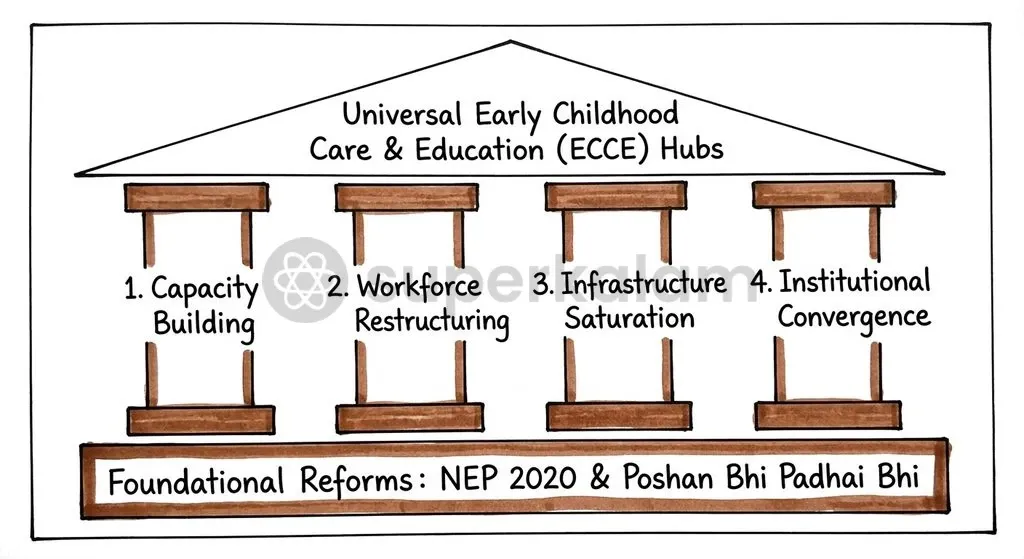
Implementation priorities must focus on structural professionalisation and institutional synergy:
- Professional Capacity Building: Under the Poshan Bhi Padhai Bhi training cascade, 41,645 State Level Master Trainers (SLMTs) and over 10.05 lakh Anganwadi Workers were trained in play-based pedagogy by February 2026. To institutionalise these gains, the mandate under NEP 2020 Clause 1.7 must be fully enforced: AWWs with 10+2 qualifications should complete a structured 6-month ECCE certificate programme, while those with lower educational qualifications undergo a one-year diploma programme delivered through distance learning.
- Workforce Restructuring and Cadrisation: Anganwadi operations should adopt a two-worker model that assigns dedicated pedagogical tasks to one certified early educator while a second worker manages health, immunisation, and supplementary nutrition logistics. Gradually regularising pay structures and offering career progression avenues will reduce attrition and enhance teaching quality.
- Accelerating Infrastructure Saturation: Upgrading the remaining target of Saksham Anganwadis requires priority capital allocation for clean drinking water, child-friendly sanitation, and solar-powered digital aids. Co-locating more centres within primary school compounds will optimise resource sharing and ease administrative transitions.
- Institutionalised Convergence: The Ministry of Women and Child Development and the Ministry of Education should establish a permanent Joint Directorate for Foundational Learning to harmonise curriculum design, monitoring indicators, and budget transfers across departments.
Key Takeaways
- The Ministry of Women and Child Development is restructuring the Anganwadi network from food-distribution centres into comprehensive Early Childhood Care and Education (ECCE) hubs under the Poshan Bhi Padhai Bhi campaign.
- The National Education Policy 2020 formally places three years of Anganwadi education (ages 3–6) within the five-year Foundational Stage under the 5+3+3+4 school architecture.
- New pedagogical tools include the Aadharshila 36-week play-based curriculum for ages 3–6 and the Navchetana stimulation framework for ages 0–3, requiring a minimum of two hours of daily mother-tongue learning.
- Out of 2 lakh approved Saksham Anganwadis, 94,077 centres have completed infrastructure modernisation as of December 2025, supported by the Poshan Tracker platform.
- The training cascade has reached 41,645 State Level Master Trainers and over 10.05 lakh Anganwadi Workers by February 2026, but long-term success requires solving the frontline worker dual-burden and honorarium compensation constraints.
Mains Question
"Transforming Anganwadis from supplementary nutrition centres into early childhood education hubs is essential for cognitive architecture, yet it strains an already overburdened frontline cadre." Critically analyse the institutional and structural bottlenecks in operationalising the 'Poshan Bhi Padhai Bhi' framework. (15 Marks)
Evaluate NowMains Question
Highlighting the provisions of the 'Aadharshila' and 'Navchetana' frameworks, elucidate how structured early childhood care and education (ECCE) operationalises the constitutional vision under Article 45. (10 Marks)
Evaluate NowPractice MCQs
QUESTION 1
With reference to Early Childhood Care and Education (ECCE) under the National Education Policy (NEP) 2020, consider the following statements:
- The 5+3+3+4 educational design places children aged 3 to 8 years under the Foundational Stage.
- Anganwadi preschool education covers three years of early childhood learning for children aged 3 to 6 years.
- The policy states that more than 85% of cumulative brain development occurs prior to the age of six years.
Which of the statements given above are correct?
QUESTION 2
Consider the following pairs regarding national early childhood curricular frameworks:
- Aadharshila Framework: Designed for children aged 3 to 6 years with a 36-week active learning calendar.
- Navchetana Framework: Targeted at infants and toddlers aged 0 to 3 years for early stimulation.
- Vidyarambh: A digital dashboard tracking real-time preschool attendance and nutrition delivery.
Which of the pairs given above is/are correctly matched?
QUESTION 3
Consider the following statements regarding the 'Poshan Bhi Padhai Bhi' initiative:
- It mandates a minimum of two hours of daily structured learning in Anganwadis.
- The structured learning pedagogy under this framework is delivered exclusively in the child's mother tongue.
- It aims to operationalise the non-justiciable directive under Article 45 of the Indian Constitution.
Which of the statements given above is/are correct?
QUESTION 4
Which of the following constitutes the primary rationale for investing in early childhood development, as highlighted by Nobel laureate James Heckman's research mentioned in the policy discourse?
QUESTION 5
With reference to the governance and infrastructure modernisation of Anganwadis under Mission Poshan 2.0, consider the following statements:
- Mission Poshan 2.0 approved the transformation of 2 lakh Anganwadis into Saksham Anganwadis during the 15th Finance Commission cycle.
- Anganwadi Workers are statutorily designated as permanent civil servants entitled to regular government teacher pay scales.
- The Ministry of Women and Child Development and the Ministry of Education issued joint guidelines to streamline the co-location of Anganwadis inside primary schools.
Which of the statements given above is/are correct?





Social Justice and Ethical Dimensions: Leveling the Early Childhood Playing Field
Early childhood education is a structural equaliser under Article 45 by bridging socio-economic learning gaps before children enter primary school. Wealthier households routinely access high-cost private pre-schools offering sensory-rich pedagogical environments, whereas low-income rural and urban households rely almost exclusively on public Anganwadis.
Universalising quality ECCE addresses multiple systemic inequities: