Amoebic Meningoencephalitis: Brain-Eating Amoeba [UPSC]
Learn about amoebic meningoencephalitis, its types, transmission through freshwater, symptoms, treatment options, and prevention measures for UPSC preparation.
Jan, 2026
•4 min read
Why in the News?
Amoebic meningoencephalitis is in the news due to rising fatal cases in Kerala, caused by the brain-eating amoeba, prompting health alerts, surveillance, and public awareness measures across India amid warming freshwater conditions.
Why Cover this Topic for UPSC?
- High Relevance for Prelims & Current Affairs
- GS Paper II: Governance & Social Justice (Health)
- GS Paper III: Science & Technology & Disaster Management
- GS Paper III: Environment & Climate Change
- GS Paper IV (Ethics): Raises ethical issues of public safety, timely disclosure, and risk communication
What is Amoebic Meningoencephalitis?
Amoebic meningoencephalitis is an acute, fatal infection of the central nervous system caused by free-living amoebae found in warm freshwater.
- Named after Malcolm Fowler, an Australian pathologist who first identified it in 1956.
- The disease is mainly caused by Naegleria fowleri, commonly known as the “brain-eating amoeba”.
- The infection comes from warm freshwater like lakes, rivers, hot springs, and stagnant water.
- The amoeba does not require human hosts to complete its life cycle; it reproduces independently in freshwater.
- The disease does not spread from person to person.
- Entry into the body occurs exclusively through the nasal passages during water exposure.
Types of Amoebic Meningoencephalitis
Amoebic meningoencephalitis presents in two distinct forms depending on the causative organism and disease mechanism.
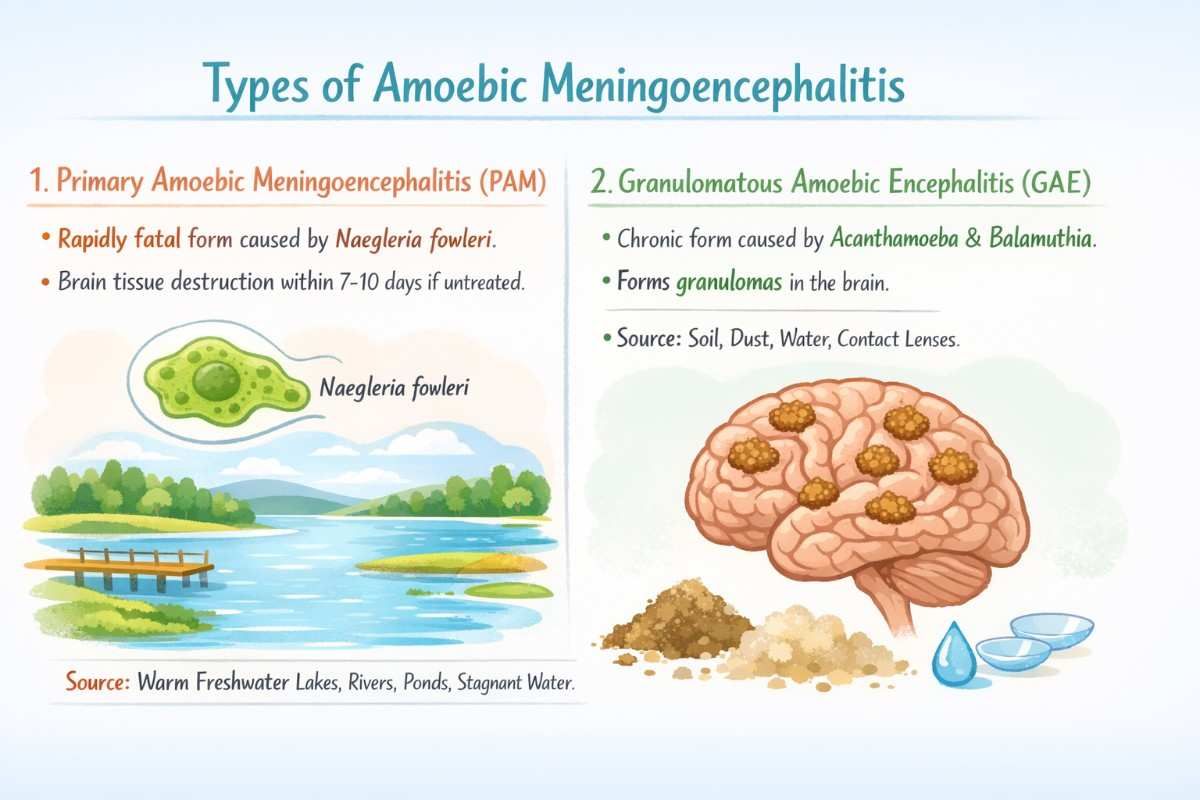
1. Primary Amoebic Meningoencephalitis (PAM)
The most rapidly fatal form caused by Naegleria fowleri causes brain tissue destruction within 7-10 days if untreated.
- It comes from warm freshwater sources like lakes, rivers, ponds, and stagnant water.
- Acute onset causes hemorrhagic necrosis of brain tissue.
- Amoebae invade the brain parenchyma directly, causing massive inflammation and tissue destruction.
- Nearly all recent Kerala cases fall into this category.
2. Granulomatous Amoebic Encephalitis (GAE)
A chronic form with slower progression caused by Acanthamoeba and Balamuthia species.
- Forms granulomas (protective scar tissue) in the brain.
- It comes from Soil, dust, water, and contact lenses.
- More commonly affects immunocompromised individuals.
- Slightly higher recovery rates compared to PAM due to slower progression.
Also read: Thalassaemia in India: UPSC Current Affairs Notes [2025]
Transmission of Amoebic Meningoencephalitis
Amoebic meningoencephalitis is transmitted exclusively through nasal inhalation of contaminated warm freshwater during water activities.
- Entry point: Water enters the body through the nose during swimming, diving, bathing, or other water sports.
- First barrier: Trophozoites (active feeding stage of the amoeba) are consumed by cells lining the olfactory neuroepithelium.
- Path to the brain: Amoebae penetrate the cribriform plate, a thin bone separating the nasal passages from the brain.
- Brain invasion: Organisms enter the subarachnoid space (fluid-filled area surrounding the brain).
- Final destination: Amoebae migrate into the brain parenchyma (functional brain tissue), causing infection.
Key Transmission Characteristics:
- Not transmitted through drinking water: Oral consumption of contaminated water does NOT result in infection.
- No person-to-person spread: Infected individuals cannot transmit the disease to others.
- Water temperature dependency: Naegleria fowleri thrives in warm freshwater (optimal growth around 25-35°C).
- Seasonal pattern: Higher risk during summer months when water temperatures peak.
Symptoms and Treatment
The disease progresses rapidly with severe symptoms appearing within days; early diagnosis and immediate treatment are essential for survival.
1. Initial Phase (First 1-3 Days):
- Sudden onset of bifrontal or bitemporal headaches
- High fever
- Alterations in taste and smell
- Nausea and vomiting
2. Progressive Phase (Days 3-7):
- Neurological deterioration
- Seizures
- Photophobia
- Coma
3. Terminal Phase (Days 7-10 Without Treatment):
- Death typically occurs 7 to 10 days after symptom onset if diagnosis and treatment are delayed.
- Cerebral edema (brain swelling) develops rapidly and is disproportionate to the clinical severity.
- Cardiac complications and myocardial necrosis have been documented in severe cases.
4. Treatment: Aggressive Multi-Drug Regime
- Amphotericin B: An antifungal drug that directly kills the amoeba causing the brain infection.
- Miltefosine: An oral drug that damages the amoeba’s cell membrane and has significantly improved survival rates.
- Azithromycin: An antibiotic that supports treatment by weakening the amoeba.
- Fluconazole: An antifungal medicine that helps stop the growth of the amoeba.
- Rifampin: An antibiotic that enhances the effect of other drugs against the infection.
- Dexamethasone: A steroid used to reduce brain swelling and inflammation.
- Mannitol: A medicine that lowers pressure inside the brain by removing excess fluid.
- Hypertonic Saline (3%): A salt solution used to control raised brain pressure.
UPSC Prelims MCQ on Brain-Eating Amoeba
QUESTION 1
With reference to the transmission of Naegleria fowleri infection, which of the following statements is/are correct?
- The amoeba can be transmitted from person to person through direct contact.
- Infection occurs when contaminated freshwater enters the nasal passages.
- Proper chlorination of swimming pools (1-3 ppm free chlorine) can effectively prevent infection.
- Drinking boiled water is the primary prevention method against this infection.
Which of the above statements are correct?"
Preventive Measures for Brain-Eating Amoeba
As amoebic meningoencephalitis has a very high fatality rate, prevention is the most effective strategy.
- Avoid swimming or diving in warm freshwater bodies such as lakes, ponds, and rivers, especially during summer.
- Prevent water from entering the nose by using nose clips or keeping the head above water.
- Avoid stagnant or poorly maintained water bodies.
- Use boiled, distilled, or properly filtered water for nasal rinsing or religious practices.
- Ensure proper chlorination of swimming pools.
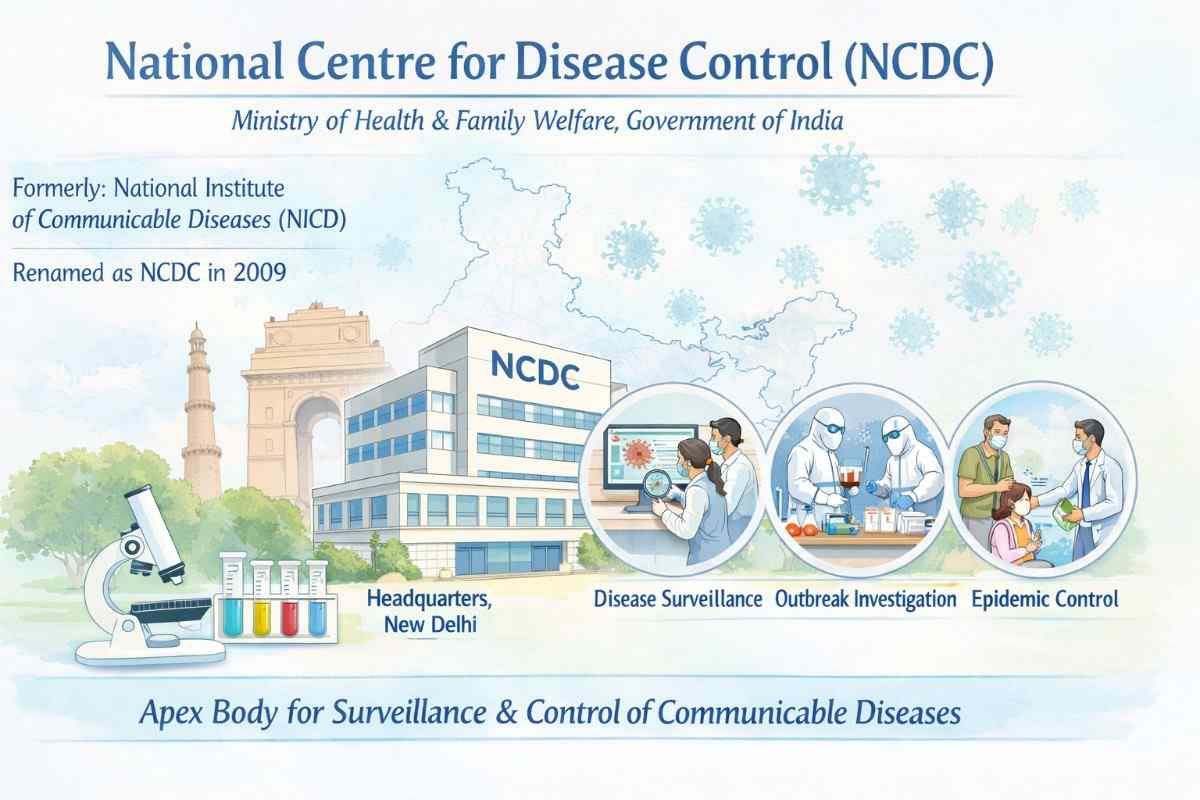
- Follow health advisories issued by NCDC and State health authorities.
UPSC Mains Practice Question
How can India strengthen disease surveillance systems to detect and control emerging parasitic infections like amoebic meningoencephalitis?
Evaluate Your Answers nowWay Forward
To reduce deaths from amoebic meningoencephalitis, a multi-level public health approach is required. Prevention, early detection, awareness, and coordinated governance have been emphasised by health authorities.
- Disease monitoring and laboratory networks have been strengthened.
- People are being advised to avoid water entering the nose while swimming, stay away from stagnant freshwater, and use boiled or distilled water for nasal cleaning.
- Recreational water bodies are being monitored, and proper chlorination of swimming pools and safe treatment of tap water are being ensured.
- Doctors have been alerted to suspect amoebic infection in severe meningitis cases.
These steps aim to prevent infections, ensure early diagnosis, and improve survival outcomes.
Unlock your UPSC potential with SuperKalam, get instant doubt resolution, personalised study plans, unlimited MCQ practice, and rapid Mains answer evaluation.
Join thousands of aspirants excelling with India’s leading AI-powered super mentor today!