AI in School Classrooms: Lessons from NYC’s Ban for India’s NEP 2020
As global schools restrict generative AI to protect foundational learning, India must balance NEP 2020 digital expansion with child data safeguards.
Sep, 2026
•9 min read

Context
Technology in foundational schooling needs pedagogical safeguards, not blind adoption. When New York City public schools restricted student-facing generative AI across primary grades, the decision highlighted a global dilemma.
Uncalibrated algorithms encourage cognitive offloading. They also expose young learners to data extraction before basic reading and math take root. For India, which is modernising school curricula under the National Education Policy (NEP) 2020 and expanding DIKSHA, this shift offers direct lessons. Policy must set clear age limits, enforce statutory safeguards under the Digital Personal Data Protection Act, 2023, and maintain human-in-the-loop teaching.
Why in the News: The New York City Public Schools AI Moratorium
The New York City Department of Education instituted a moratorium prohibiting student-facing generative AI tools in 2-K through Grade 8 classrooms while permitting vetted AI systems for high schoolers as of September 2026. Urban school systems are shifting toward age-stratified deployment models.
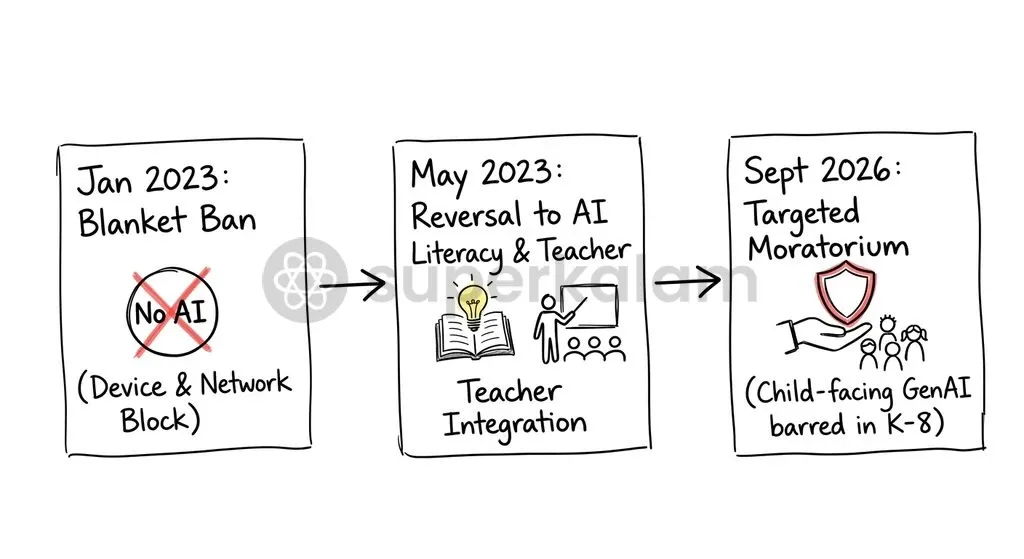
The decision caps a three-year policy cycle:
- January 2023 (Blanket Restriction): District administrators blocked ChatGPT across school networks and devices over plagiarism risks and developmental worries.
- May 2023 (Cautious Reversal): Chancellor David C. Banks reversed that outright ban, calling the initial reaction hasty and introducing educator training alongside controlled digital literacy.
- September 2026 (Stratified Moratorium): The district drew a hard line, barring direct child-facing interfaces in early schooling while allowing monitored high-school access.
For Indian education planners implementing NEP 2020, this trajectory proves that foundational learning environments need stricter regulatory baselines than secondary classrooms.
What Triggered the Ban: Cognitive Dependence, Plagiarism, and Data Privacy
New York school administrators and child psychologists observed clear developmental risks when generative chatbots went straight to young pupils. The primary threat moved beyond simple cheating to the systemic erosion of foundational cognitive capacities.
- Cognitive Offloading: When learners rely on automated engines for basic writing, reading synthesis, and elementary arithmetic, they bypass essential mental friction. Premature generative AI usage weakens foundational neural pathways necessary for memory consolidation, mental calculation, and deep reading comprehension.
- Plagiarism and Integrity: Large language models produce synthetically coherent prose, making it difficult for educators to evaluate authentic student output and track genuine skill acquisition.
- Commercial Profiling: EdTech platforms frequently harvest granular prompt histories, biometric telemetry, and voice inputs, exposing minors to surreptitious commercial tracking.
Discuss with Superkalam
What is the minimum age threshold prescribed by UNESCO for student interaction with generative AI tools?
Ask NowHow Other Countries Are Regulating AI in Primary Classrooms
International educational governance bodies have increasingly rejected unguided student access to conversational AI, replacing permissive frameworks with strict developmental safeguards. Cross-country regulatory approaches demonstrate an emerging consensus around age boundaries and algorithmic oversight in early education.
| Jurisdiction / Body | Primary Mechanism | Age Threshold | Core Mandate |
|---|---|---|---|
| UNESCO | Global Guidance Framework | Minimum 13 years | Enforces human-in-the-loop pedagogy to prevent automated tools from supplanting teachers. |
| New York City (US) | District-wide Moratorium | Grade 9+ (approx. 14 years) | Prohibits child-facing generative AI from 2-K through Grade 8 while allowing vetted high-school tools. |
| India (NCF-FS Baseline) | Curriculum Framework | Foundational Stage (Ages 3–8) | Recommends that AI and machine learning solutions must be strictly avoided for direct child-facing interactions. |
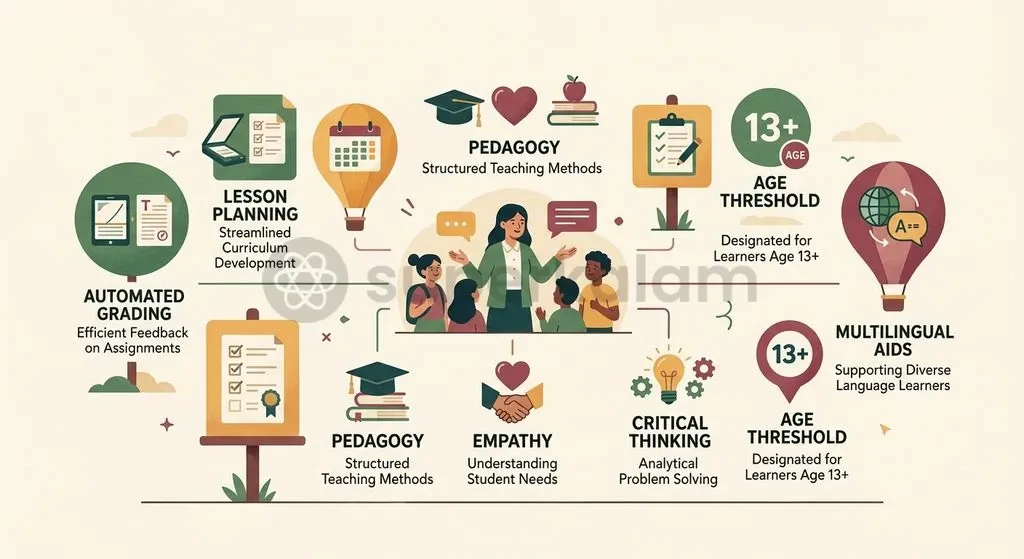
According to UNESCO's 'Guidance for Generative AI in Education and Research', generative AI must augment rather than replace human educators in fostering critical thinking and empathy. This global standard reinforces the principle that algorithmic tools should assist teacher productivity rather than mediate early childhood learning.
India’s Digital Push: How NEP 2020 and DIKSHA Approach EdTech
The National Education Policy (NEP) 2020 establishes a comprehensive vision for modernising India's school system through structured technology integration. Rather than treating software as a total replacement for classroom pedagogy, the policy positions digital architecture as an instructional enabler.
According to the National Education Policy 2020, technology adoption is guided by two institutional pillars:
- National Educational Technology Forum (NETF): NEP 2020 mandates the creation of the NETF as an autonomous body to provide evidence-based guidance on technology integration and AI deployment across educational institutions.
- Personalised Adaptive Learning (PAL): NEP 2020 promotes the use of PAL and AI-driven assessment software to identify individual learning gaps and generate customised remedial pathways for students.
The Ministry of Electronics and Information Technology (MeitY) has expanded the reach of these initiatives by integrating the Bhashini Mission into public educational infrastructure such as the Digital Infrastructure for Knowledge Sharing (DIKSHA). By leveraging speech-to-text models across 22 scheduled languages, DIKSHA provides regional-language access while keeping the digital curriculum anchored in teacher-led instructional design.
Discuss with Superkalam
Explain the concept of 'cognitive offloading' and why bypassing mental friction during early arithmetic or reading can hinder neural development.
Ask NowThe Foundational Learning Crisis: Why Generative AI Is a Double-Edged Sword for NIPUN Bharat
India's primary education system is currently focused on overcoming widespread learning deficits through the NIPUN Bharat Mission. The scheme targets universal Foundational Literacy and Numeracy (FLN) for every child by the end of Grade 3 by 2026–27. Within this mission, automated digital tutors present significant opportunities alongside critical pedagogical risks.
| Dimension | Application under NIPUN Bharat (Target: FLN by 2026–27) |
|---|---|
| Potential Benefits | Multilingual speech tutoring, real-time pronunciation support, and diagnostic mathematics feedback. |
| Structural Risks | Cognitive offloading, reduced handwriting and mental calculation practice, and direct conflict with NCF-FS guidelines. |
Structured technology-aided instruction has demonstrated measurable learning gains in rural classrooms. A randomised evaluation by Muralidharan et al. on the Mindspark PAL platform found that students using personalised adaptive software gained the equivalent of 1.9 years of learning in mathematics within 17 months.
Similarly, an ASER Centre evaluation of Google's AI speech-recognition reading app 'Bolo' across 200 villages in Uttar Pradesh showed that 64% of enrolled children improved their reading proficiency within 3 months.
However, conversational generative AI introduces substantial developmental risks if deployed indiscriminately. Direct student-facing conversational agents can prompt premature cognitive reliance, causing children to skip phonics practice, handwriting, and mental arithmetic. Recognising these concerns, the National Curriculum Framework for Foundational Stage (NCF-FS 2022) explicitly prescribes that AI and machine learning solutions must be strictly avoided for direct child-facing interactions during foundational years.
Governance Gaps: Children’s Data Protection under the DPDP Act 2023
Deploying digital software in primary schools creates serious regulatory exposure regarding minor data harvesting. Parliament addressed these risks by introducing statutory obligations for platforms processing children's data under the Digital Personal Data Protection (DPDP) Act, 2023.
The DPDP Act, 2023 sets out three strict compliance mandates for Data Fiduciaries handling children's data:
- Mandatory Parental Consent: Section 9(1) stipulates that Data Fiduciaries must obtain verifiable parental consent before processing any personal data of a child under 18 years.
- Ban on Behavioural Profiling: Section 9(3) explicitly prohibits Data Fiduciaries from undertaking behavioural monitoring, tracking, or targeted advertising directed at children.
- Protection from Harm: Section 9(2) forbids processing personal data in a manner likely to cause detrimental effects on a child's well-being, backed by statutory penalties reaching up to ₹200 crore for non-compliance under the Act's Schedule.
Despite these statutory safeguards, commercial EdTech applications frequently bundle diagnostic assessments with background engagement analytics. Without strict auditing by the National Educational Technology Forum and state school boards, third-party software risks building predictive behavioural profiles of young learners in violation of Section 9(3).
Discuss with Superkalam
Assess whether Section 9 of the DPDP Act, 2023 provides sufficient safeguards against commercial profiling in EdTech applications deployed in public schools.
Ask NowEthical Dilemmas: Screen Addiction, Deepening Divides, and Teacher Autonomy
Unchecked digital adoption in primary education raises profound ethical and structural questions for Indian classrooms. These challenges span developmental psychology, social equity, and classroom pedagogy.
According to the NCERT National Curriculum Framework for School Education (NCF-SE 2023), substituting teacher-student relational interaction with automated algorithmic feedback risks diminishing socio-emotional learning, moral development, and pastoral oversight in early childhood education. Automated systems cannot replicate human mentorship, ethical guidance, or empathetic responses.
Technology deployment also risks widening existing socio-economic disparities between school types and geographic regions:
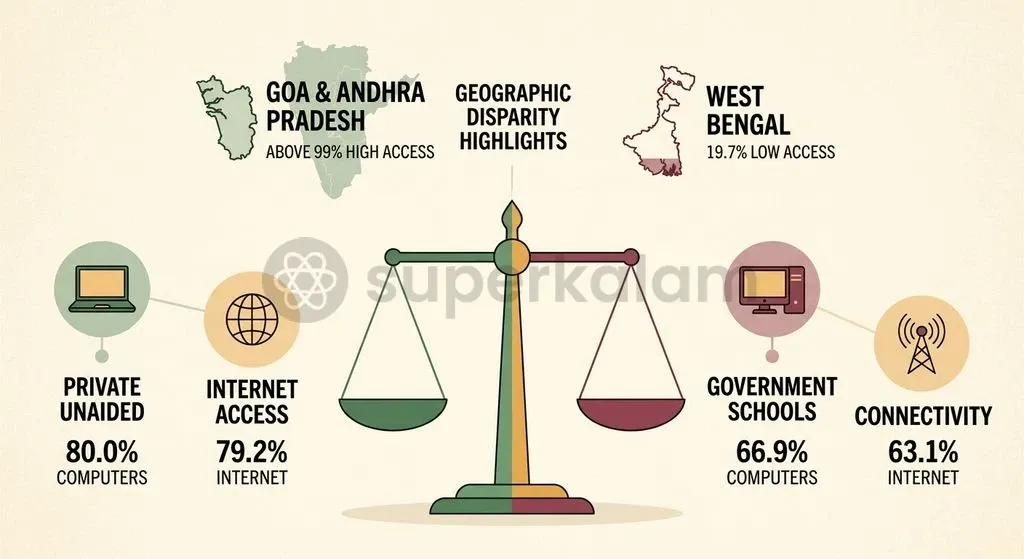
- Public versus Private Infrastructure Divide: According to the Ministry of Education's UDISE+ 2025-26 report, national school internet connectivity reached 67.4%, rising from 53.9% in 2023-24. However, private unaided schools maintain 80.0% computer availability and 79.2% internet access, compared to 66.9% computers and 63.1% internet access in government schools.
- Interstate Disparities: UDISE+ 2025-26 data reveals that while school internet access exceeds 99% in Goa and Andhra Pradesh, it stands at only 19.7% in West Bengal and remains under 40% across several northeastern states.
Premature mandates for advanced AI-enabled learning tools risk institutionalising learning advantages for well-equipped private schools while under-resourced public institutions struggle with basic connectivity.
Discuss with Superkalam
How can the National Educational Technology Forum (NETF) design a stratified AI roadmap that balances diagnostic benefits with child data protection?
Ask NowThe Way Forward: Building an India-Centric AI Education Framework
India's strategy for artificial intelligence in primary education must move beyond binary debates between total prohibition and unregulated adoption. Policymakers should build an evidence-based, phased framework that aligns technology deployment with developmental psychology.
- Establish Age-Stratified Access Baselines: The Ministry of Education and NETF should formalise a national age threshold, aligning domestic policy with UNESCO's recommendation barring independent child-facing generative AI below age 13. AI tools in primary schooling (Grades 1 to 5) should remain restricted to backend teacher assistance, lesson planning, and administrative workflow support.
- Prioritise Backend Teacher Enablement: EdTech tools should be designed as teacher aids rather than student surrogates. Equipping educators with multilingual translation modules via the Bhashini Mission and diagnostic rubrics on DIKSHA enhances teaching quality without subjecting young children to unmonitored screen interfaces.
- Rigorous DPDP Act Compliance Audits: State education departments must institute mandatory data privacy audits for all EdTech vendors seeking access to public schools. Contracts must strictly enforce Section 9(3) bans on tracking, ensuring that child diagnostic data is never repurposed for commercial profiling.
- Bridge the Public School Digital Divide: Targeted infrastructure investments must prioritise government schools in states with low digital penetration, such as West Bengal and the northeastern region, ensuring equitable access to basic digital infrastructure before introducing advanced adaptive platforms.
Key Takeaways
- The New York City Department of Education's September 2026 moratorium bars student-facing generative AI tools across Grades 2-K to 8, illustrating global movement toward age-stratified technology regulation in basic schooling.
- UNESCO guidance establishes a recommended minimum age limit of 13 years for independent student use of generative AI tools, advocating a strict human-in-the-loop pedagogical framework.
- India's NEP 2020 guides technology adoption through the National Educational Technology Forum (NETF) and Personalised Adaptive Learning (PAL), while NCF-FS 2022 explicitly avoids direct child-facing AI in foundational years.
- Section 9 of the DPDP Act, 2023 mandates verifiable parental consent for minors, strictly prohibits behavioural tracking and targeted advertising directed at children, and imposes penalties of up to ₹200 crore for harmful processing.
- The UDISE+ 2025-26 report documents expanding national school internet connectivity at 67.4%, but persistent divides remain between private (79.2%) and government schools (63.1%), alongside acute interstate disparities.
Mains Question
"Technology in foundational schooling needs pedagogical safeguards, not blind adoption." In light of New York City's stratified moratorium on generative AI and the guidelines of NCF-FS 2022, critically analyse the impact of introducing conversational AI in early childhood classrooms. (15 Marks)
Evaluate NowMains Question
Examine how the Digital Personal Data Protection (DPDP) Act, 2023 addresses the governance and privacy vulnerabilities arising from the integration of EdTech platforms in Indian schools. (10 Marks)
Evaluate NowPractice MCQs
QUESTION 1
With reference to the Digital Personal Data Protection (DPDP) Act, 2023, consider the following statements:
- Data Fiduciaries must obtain verifiable parental consent before processing personal data of any child under 18 years.
- The Act permits behavioural tracking and targeted advertising directed at children provided parental consent is secured.
- The statutory penalty for non-compliance regarding processing children's data can reach up to ₹200 crore under the Act's Schedule. Which of the statements given above are correct?
QUESTION 2
Consider the following statements regarding the integration of technology under India's National Education Policy (NEP) 2020:
- The National Educational Technology Forum (NETF) is mandated as an autonomous body to provide evidence-based guidance on technology integration.
- Personalised Adaptive Learning (PAL) is promoted under NEP 2020 to generate customised remedial pathways for students.
- The National Curriculum Framework for Foundational Stage (NCF-FS 2022) mandates direct child-facing generative AI tools in pre-primary schooling to boost foundational literacy. Which of the statements given above is/are correct?
QUESTION 3
Consider the following statements regarding global and domestic frameworks regulating AI in school education:
- UNESCO's 'Guidance for Generative AI in Education and Research' sets a minimum age threshold of 13 years and enforces human-in-the-loop pedagogy.
- The New York City public school system instituted a moratorium barring student-facing generative AI in 2-K through Grade 8 classrooms while permitting vetted AI for high schoolers.
- The NIPUN Bharat Mission aims to achieve universal Foundational Literacy and Numeracy (FLN) by the end of Grade 3 by 2026–27. Which of the statements given above are correct?
QUESTION 4
In the context of primary education and developmental psychology, the term 'Cognitive Offloading' most accurately refers to which of the following?
QUESTION 5
With reference to digital tools deployed for primary education in India, consider the following statements:
- DIKSHA integrates speech-to-text models across 22 scheduled languages by leveraging the Bhashini Mission.
- An ASER Centre evaluation of Google's 'Bolo' speech-recognition app found reading proficiency improvements among 64% of enrolled children in rural Uttar Pradesh. Which of the statements given above is/are correct?