AI Data Centre Cooling in India: Managing Power, Water, and Policy
As high-density AI clusters strain India's power grid and urban aquifers, balancing digital growth with resource equity has become a vital governance challenge.
Sep, 2026
•8 min read
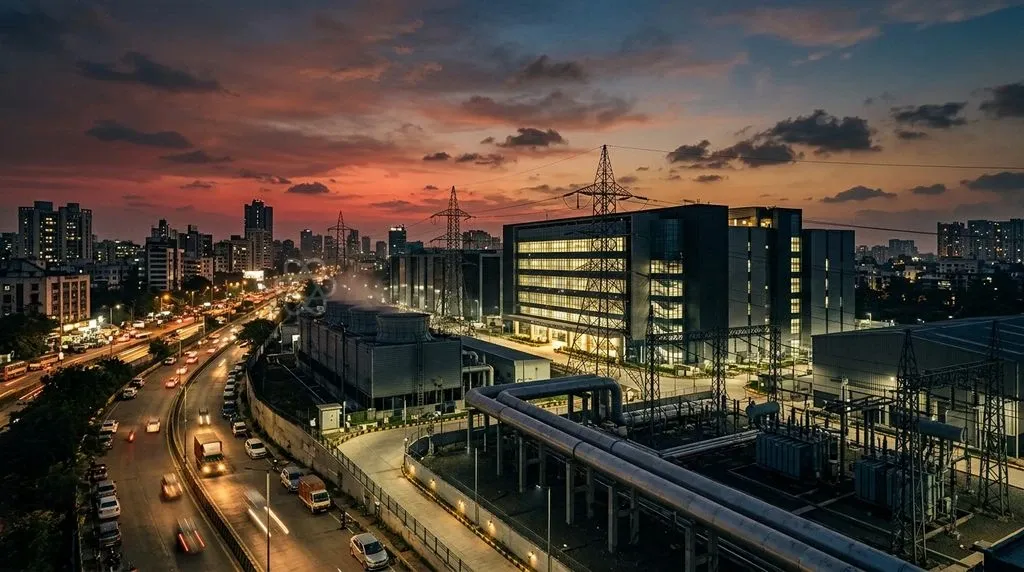
Overview
Cooling next-generation artificial intelligence data centres presents a severe infrastructure challenge in India. High-density computing clusters generate immense thermal loads. Removing this heat requires up to 3,000 times more efficient heat transfer than traditional setups.
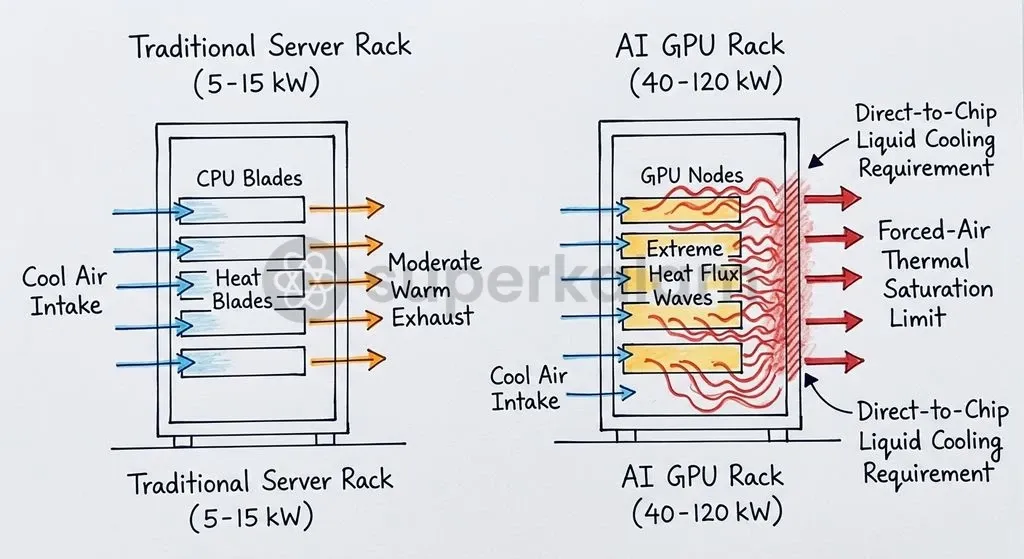
Modern artificial intelligence clusters draw between 40 kW and 120+ kW per server rack. This intense heat flux breaches the thermodynamic limits of legacy air cooling.
Meeting this demand requires a fast technological transition. Operators must pivot from water-intensive evaporative chillers to advanced closed-loop liquid cooling, captive renewable power, and enforceable resource-efficiency mandates.
Why in the News: The Rise of Hyperscale AI Data Centres in India
India's computing infrastructure is expanding at an unprecedented pace, driven by structural policy support and intense enterprise demand:
- Surging Power Demand: National data centre electrical power demand is projected to scale from an operational base of 1.1 to 1.7 GW up to 26.3 GW by FY 2031–32.
- Strategic Policy Incentives: The Department of Economic Affairs granted Infrastructure Status to data centres exceeding 5 MW capacity in 2022. This classification unlocks institutional credit, external commercial borrowings, and lower-cost debt financing.
- Rapid Compute Expansion: As of July 2026, accelerated deployments under the national IndiaAI Mission and generative computing adoption have triggered multi-megawatt and gigawatt-scale construction across major metropolitan centres.
Hyperscale facilities require uninterrupted power and continuous thermal management. Without stable cooling, silicon processors throttle or suffer permanent thermal degradation.
Discuss with Superkalam
What is the threshold power capacity above which the Department of Economic Affairs granted Infrastructure Status to data centres?
Ask NowUnderstanding the Shift: Traditional Data Centres vs High-Density AI Workloads
Legacy data centres and modern AI clusters differ fundamentally in processor architecture and thermal concentration:
- Traditional Enterprise Facilities: Standard central processing units (CPUs) handle sequential web hosting, database management, and basic cloud compute tasks. Racks draw modest power densities of 5 to 15 kW per rack. Standard computer room air handlers circulate and exhaust this heat.
- High-Density AI Infrastructure: Massively parallel graphics processing units (GPUs) and accelerators, such as Nvidia H100 and GB200 configurations, process dense mathematical models. These clusters draw between 40 kW and 120+ kW per rack, packing unprecedented thermal loads into compact footprints.
Legacy forced-air cooling methods fail above 30 to 40 kW per rack. Air simply cannot circulate fast enough through tight chassis spaces to remove concentrated heat.
The Thermal Challenge: Why AI Chips Require Exponentially More Cooling
Silicon semiconductor dies concentrate intense heat flux over miniature surface areas. During continuous model training workloads, internal junction temperatures rapidly approach safe operating thresholds of 85 to 100 degrees Celsius.
Liquid cooling architectures bridge this thermodynamic gap:
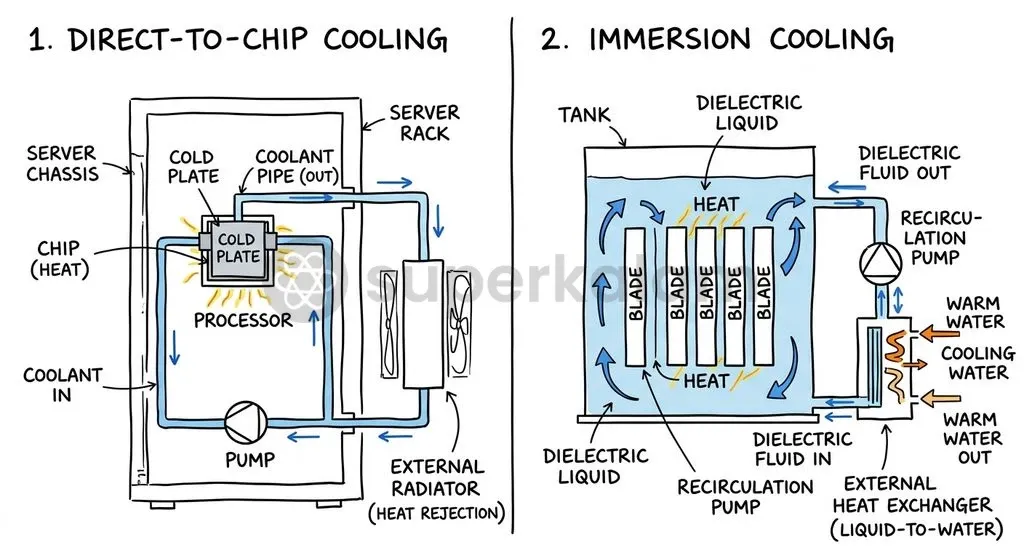
- Superior Thermal Conductivity: Direct-to-chip liquid cooling and dielectric immersion dissipate heat with fluid thermal conductivity up to 3,000 times greater than air.
- Improved Energy Efficiency: Non-conductive dielectric fluids and chilled water blocks contact hot processor surfaces directly. This design pushes Power Usage Effectiveness (PUE) ratios down from legacy averages of 1.5–1.8 toward optimal ranges of 1.2–1.3.
Power Usage Effectiveness measures total facility energy divided by actual IT equipment energy. A score closer to 1.0 indicates minimal energy wasted on auxiliary cooling, fans, and power conversion.
Discuss with Superkalam
Explain why legacy forced-air cooling becomes thermodynamically ineffective when server rack density surpasses 30 to 40 kW.
Ask NowThe Resource Strain: Power Consumption and Grid Reliability
The Central Electricity Authority faces serious grid-balancing challenges as round-the-clock hyperscale loads strain regional transmission systems. Hyperscale data centres run with baseload capacity factors exceeding 90 percent, unlike seasonal agricultural or commercial power demand.
Grid integration and clean energy supply involve several key mechanisms:
- Green Energy Open Access Rules (2022): The Ministry of Power lowered the open-access eligibility threshold from 1 MW to 100 kW for renewable consumers.
- Grid Stability and Storage: Intermittent solar and wind generation cannot supply 24/7 hyperscale uptime alone. Operators must install dedicated battery energy storage systems, off-site pumped hydro reserves, or dual-grid utility feeds.
Discuss with Superkalam
How can data centre operators in water-stressed Tier-1 Indian cities balance the trade-off between Power Usage Effectiveness (PUE) and Water Usage Effectiveness (WUE)?
Ask NowComparing Data Centre Cooling Architectures
Data centre operators evaluate thermal architectures across capital cost, spatial footprint, electrical consumption, and water utilisation rates.
| Cooling Technology | Typical Rack Density Supported | Power Usage Effectiveness (PUE) | Water Usage Effectiveness (WUE) | Operational Trade-offs |
|---|---|---|---|---|
| Direct Air Cooling (CRAC/CRAH) | 5 – 20 kW/rack | High (1.5 – 1.8) | Low (Dry systems) to High (Evaporative) | Limited thermal capacity; excessive fan noise and high power overhead. |
| Evaporative Cooling Towers | 15 – 35 kW/rack | Moderate (1.3 – 1.5) | Very High (1.8 – 9.5 L/kWh) | Low electrical draw in dry climates, but causes severe local freshwater depletion. |
| Direct-to-Chip (Liquid Cold Plates) | 40 – 100 kW/rack | Low (1.15 – 1.25) | Low (Closed-loop) | High thermal efficiency; requires complex internal plumbing and leak-detection sensors. |
| Dielectric Liquid Immersion | 80 – 120+ kW/rack | Ultra-low (1.05 – 1.15) | Zero (Closed-loop) | Submerges entire server chassis in engineered fluid; higher initial capital cost. |
Policy and Regulatory Landscape: Draft Data Centre Policy and Green Norms
The Ministry of Electronics and Information Technology (MeitY) circulated the Draft National Data Centre Policy to encourage domestic computing infrastructure through single-window clearances, Data Centre Economic Zones (DCEZs), and standardised building codes. However, the policy remained non-statutory through mid-2026, leaving environmental compliance governed by fragmented state guidelines.
The regulatory landscape shows significant enforcement gaps alongside strict international benchmarks:
- Domestic Standards Gap: The Bureau of Energy Efficiency (BEE) enforces the Energy Conservation Building Code (ECBC) under the Energy Conservation Act, 2001 (as amended in 2022). Yet data centres lack mandatory cooling caps and water ceilings under the Perform, Achieve, and Trade (PAT) scheme.
- State Policy Inconsistencies: State policies in Maharashtra, Tamil Nadu, and Uttar Pradesh provide land subsidies and electricity duty waivers. However, fewer than one-third of state policies mandate water recycling or captive zero-liquid-discharge (ZLD) plants.
- European Union Mandate: Directive 2023/1791 (Article 12) mandates that all data centres with an installed IT capacity of 500 kW or more publish annual audited metrics on PUE, WUE, and Energy Reuse Factor to a public database.
- Germany's EnEfG Standard: The Energy Efficiency Act legally requires new data centres commissioned from July 2026 onwards to achieve a target PUE of 1.2 or lower, alongside compulsory waste-heat reuse for municipal district heating.
Discuss with Superkalam
In light of the Supreme Court's rulings on the Public Trust Doctrine under Article 21, assess whether municipal authorities should restrict potable water supply to industrial data centres during peak summer heatwaves.
Ask NowEthical and Environmental Justice Dimensions: Resource Allocation vs Tech Growth
The Supreme Court of India established in Subhash Kumar v. State of Bihar (1991) and affirmed in M.C. Mehta v. Kamal Nath (1997) that access to clean water is a fundamental right under Article 21 of the Constitution, governed by the Public Trust Doctrine. Under this doctrine, the State holds natural resources like rivers and aquifers in trust for public use.
Allocating potable municipal water to industrial cooling towers creates distributive friction in water-stressed regions:
- Domestic Water Inequity: Diverting millions of litres of daily freshwater to cool digital infrastructure during heatwaves shifts environmental burdens onto local farming communities and domestic consumers.
- Equitable Resource Governance: Public administration frameworks must balance digital sovereignty with constitutional commitments to equitable resource distribution and inter-generational environmental justice.
Discuss with Superkalam
Propose a regulatory framework combining BEE energy efficiency standards and state industrial policies to incentivize zero-liquid-discharge (ZLD) adoption in high-density computing hubs.
Ask NowWay Forward: Sustainable Cooling Technologies, Renewable Integration, and Urban Planning
Sustainable expansion of India's computing infrastructure requires institutionalising statutory cooling standards, geographical decentralisation, and circular resource management across all hyperscale projects.
- Mandatory Statutory Efficiency Standards: The Bureau of Energy Efficiency should incorporate hyperscale facilities as designated consumers under the PAT framework, setting mandatory PUE ceilings below 1.3 and capping potable water consumption.
- Adoption of Closed-Loop and Immersion Systems: Industrial approvals should mandate direct-to-chip liquid cooling or closed-loop dielectric immersion for racks exceeding 30 kW, eliminating open evaporative cooling towers.
- Mandatory Greywater and Tertiary Recycling: State pollution control boards should prohibit the extraction of potable groundwater for data centre cooling, requiring operators to utilise treated municipal wastewater or captive zero-liquid-discharge systems.
- Spatial Decentralisation to Tier-2 Cities: State planning agencies should incentivise developers to build outside congested Tier-1 aquifers, establishing computing clusters in coastal zones that can utilise seawater heat exchangers or regions with cooler ambient climates.
- District Heat Reuse Networks: Industrial zones should explore thermal co-location models where low-grade waste heat from liquid-cooled data centres supplies industrial processes, agricultural drying facilities, or commercial heating systems.
Key Takeaways
- Artificial intelligence clusters running advanced GPUs draw between 40 kW and 120+ kW per rack, breaching conventional air-cooling limits and necessitating direct liquid or immersion systems.
- India's data centre electrical demand is projected to surge from 1.1–1.7 GW to 26.3 GW by FY 2031–32 according to Ministry of Power parliamentary disclosures.
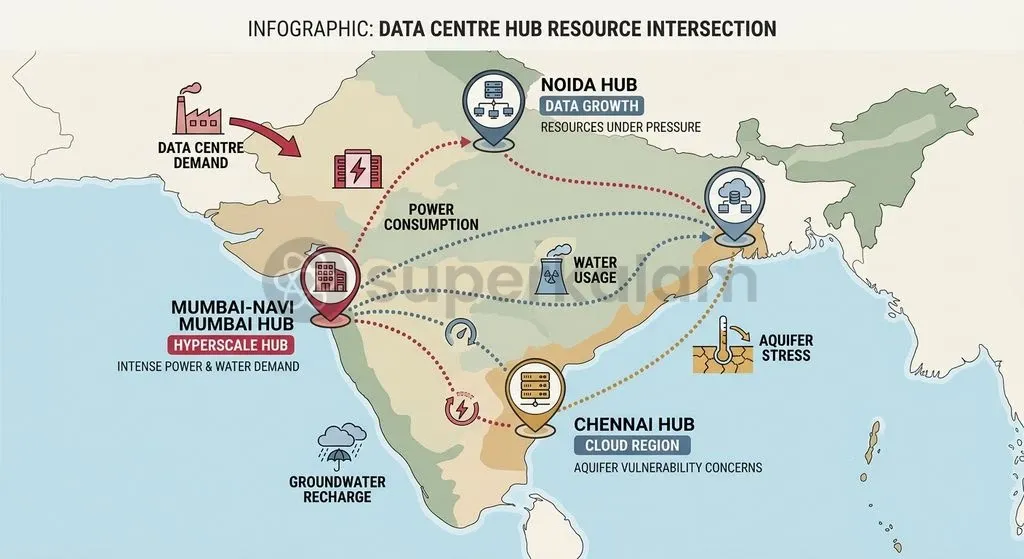
- Over 65 percent of operational and planned capacity sits concentrated in water-stressed metropolitan hubs including Mumbai, Chennai, and Noida.
- Evaporative cooling creates a direct resource trade-off by consuming 1.8 to 9.5 litres of water per kWh of IT load to achieve lower power overheads.
- Sustainable governance requires mandatory BEE efficiency targets, closed-loop cooling mandates, and strict protection of municipal aquifers under Article 21.
Mains Question
The concentration of hyperscale data centres in water-stressed urban corridors highlights the tension between digital infrastructure expansion and the Public Trust Doctrine established under Article 21. Critically analyse. (15 Marks)
Evaluate NowMains Question
Evaluating the thermal demands of high-density AI workloads, discuss how technological shifts from traditional air cooling to advanced liquid cooling architectures impact energy efficiency and resource governance in India. (10 Marks)
Evaluate NowPractice MCQs
QUESTION 1
With reference to the cooling architectures of data centres, consider the following statements:
- Direct air cooling systems generally maintain lower Power Usage Effectiveness (PUE) compared to direct-to-chip liquid cooling systems.
- Dielectric liquid immersion cooling can support higher rack power densities than conventional forced-air cooling.
- Evaporative cooling towers require negligible water consumption compared to closed-loop liquid cooling systems.
Which of the statements given above is/are correct?
QUESTION 2
Regarding the policy and regulatory framework governing data centres and power consumption in India, consider the following statements:
- The Department of Economic Affairs granted Infrastructure Status to data centres exceeding 5 MW capacity.
- Under the Green Energy Open Access Rules (2022), the eligibility threshold for renewable energy consumers was reduced from 1 MW to 100 kW.
- The Bureau of Energy Efficiency has made cooling caps and water ceilings mandatory for all data centres under the Perform, Achieve, and Trade (PAT) scheme.
Which of the statements given above is/are correct?
QUESTION 3
Consider the following statements regarding the thermal challenges of artificial intelligence computing clusters:
- Non-conductive dielectric fluids and direct-to-chip liquid cooling exhibit thermal conductivity significantly higher than air.
- A Power Usage Effectiveness (PUE) ratio closer to 1.0 indicates higher energy waste in auxiliary cooling systems.
- Legacy forced-air cooling methods face thermodynamic limitations when rack power densities exceed 30 to 40 kW.
Which of the statements given above is/are correct?
QUESTION 4
According to the Council on Energy, Environment and Water (CEEW) findings mentioned in the article, over 65 percent of India's data centre capacity is geographically clustered in which of the following urban and coastal hubs?
QUESTION 5
With reference to international regulatory standards for data centre energy efficiency mentioned in the article, consider the following pairs:
- European Union Directive 2023/1791: Mandates audited public reporting of PUE and WUE for data centres with capacity of 500 kW or more.
- Germany's Energy Efficiency Act (EnEfG): Legally mandates new data centres to achieve a target PUE of 1.2 or lower and compulsory waste-heat reuse.
Which of the pairs given above is/are correctly matched?