Agnipath Scheme Changes: Armed Forces Proposals and Defence Modernisation
Armed forces proposals to raise Agniveer retention highlight the vital balance between fiscal rationalisation and specialized combat readiness in modern defence.
Oct, 2026
•8 min read

Overview
The Ministry of Defence is reviewing internal service proposals to recalibrate the Agnipath recruitment model. The review focuses on raising permanent retention quotas and lengthening technical instruction.
This policy reassessment addresses operational feedback across the Indian Army, Indian Navy, and Indian Air Force. It aims to protect combat readiness, technical proficiency, and regimental cohesion before the first cohort completes its four-year tenure in late 2026.
- Demographic profile: The policy was designed to lower the military's average age.
- Fiscal sustainability: It sought to trim ballooning pension liabilities.
- Technical continuity: Frontline feedback shows technical branches need higher retention to run advanced platforms.
Reconciling high-technology warfare with long-term fiscal discipline remains the defining task of modern Indian defence planning.
Why in the News? Internal Reviews and Proposed Adjustments to Agnipath
The Department of Military Affairs initiated a comprehensive performance review of the Agnipath scheme as the inaugural batch nears the end of its four-year engagement. As of October 2026, the first cohorts enlisted in early 2023 approach their transition period. This milestone prompted service headquarters to submit empirical feedback on operational efficacy.
The review addresses three primary operational dimensions:
- Institutional memory: Protecting technical knowledge in specialised combat and support units.
- Combat readiness: Ensuring front-line formations maintain seasoned manpower during ongoing operational commitments.
- Statutory flexibility: Modifying recruitment parameters through the Union Cabinet without legislative amendments, as service conditions remain notified under the Army Act, 1950, the Air Force Act, 1950, and the Navy Act, 1957.
Background: How the Agnipath Scheme Works and Why It Was Introduced
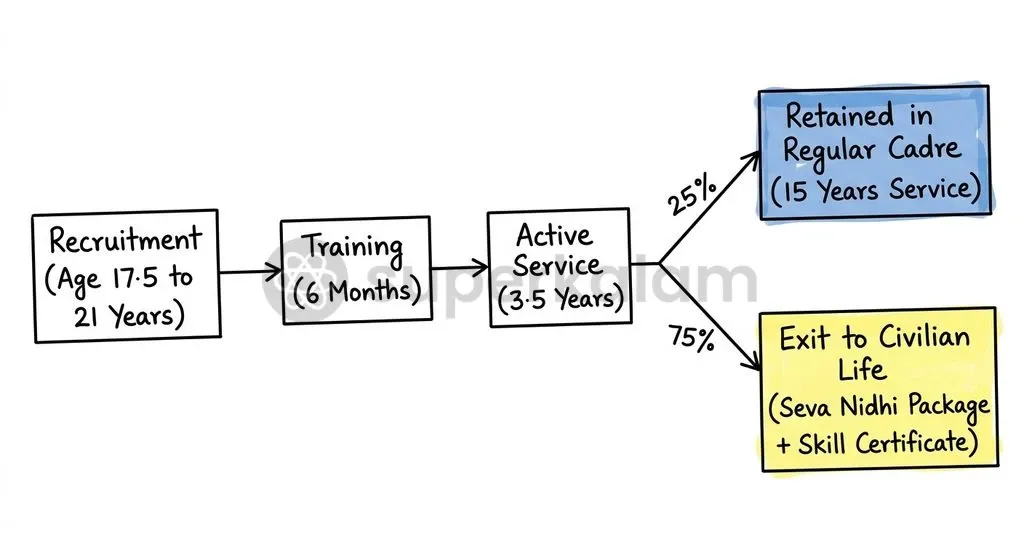
The Union Cabinet approved the Agnipath Scheme on 14 June 2022, replacing legacy recruitment systems for Personnel Below Officer Rank (PBOR) across the three armed services. The policy established an all-India, all-class enlistment model to lower the average age of serving personnel from 32 years to 26 years.
The baseline framework rests on distinct structural pillars:
- Tour of duty: Recruits enlist as Agniveers for four years, including an initial training phase of approximately six months.
- Permanent absorption cap: Upon tenure completion, up to 25% of each cohort can be absorbed into the regular cadre for a minimum 15-year engagement, while the remaining 75% exit.
- Severance package: Exiting personnel receive the Seva Nidhi package of approximately ₹11.71 lakh, formed by a 30% monthly salary contribution matched equally by the Central Government with accrued interest.
- Fiscal restructuring: The policy aimed to arrest escalating revenue expenditure and pension liabilities that constrained capital allocations for modernisation.
Discuss with Superkalam
Recall the original retention ceiling and basic training duration specified under the 2022 Agnipath framework.
Ask NowDiscuss with Superkalam
Explain why technical branches like the Corps of Signals and the Indian Navy require longer training pipelines and higher retention than general infantry units.
Ask NowComparison: Original Agnipath Framework vs Proposed Reforms
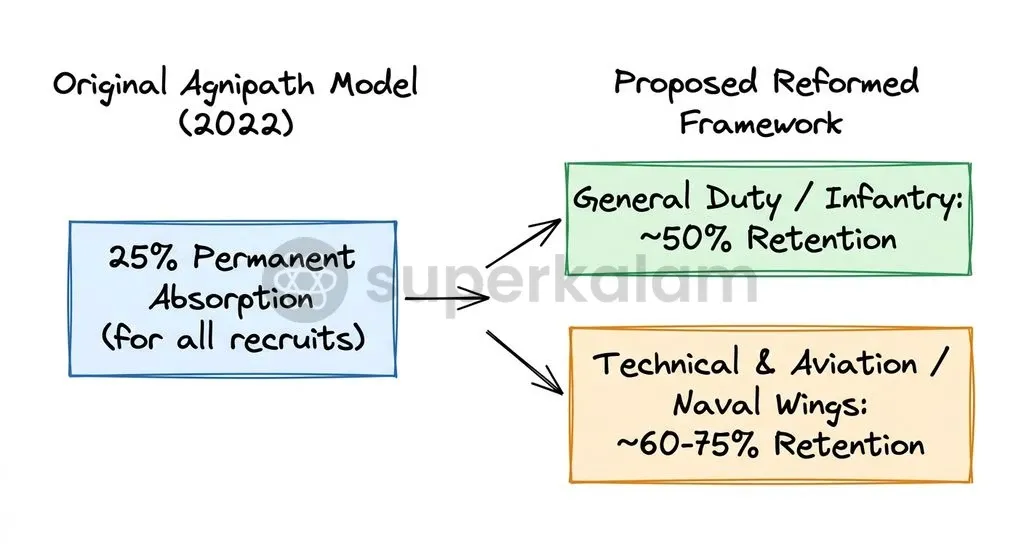
The Ministry of Defence is evaluating a transition from uniform enlistment terms toward service-differentiated retention models. Operational lessons gathered across dynamic operational theatres have highlighted the limitations of a one-size-fits-all personnel architecture.
| Dimension | Original 2022 Framework | Proposed Adjustments (Internal Review) |
|---|---|---|
| Regular Cadre Retention | Fixed ceiling of up to 25% across all three services | 50% for Army and IAF; 70% to 75% for Navy |
| Technical Cadre Policy | Uniform 25% cap across general and technical streams | 60% to 75% retention for Signals, EME, Engineers, and Radar units |
| Training Duration | 24 weeks (6 months) basic and trade instruction | Extended specialist training pipelines for advanced electronic and aviation systems |
| Operational Ethos | Intense intra-cohort competition for regular absorption | Focus on preserving regimental bonding and cohesion |
| Disability & Casualty Framework | Graded one-time ex-gratia: ₹44 lakh (100%), ₹25 lakh (75%), ₹15 lakh (50%) | Proposals for lifelong medical coverage and regular family subsistence support |
Balancing Combat Readiness and Pension Costs: The Strategic Dilemma
The Ministry of Defence faces a structural trade-off between fiscal rationalisation and frontline operational capability. Historical defence expenditure data reveals that defence pensions routinely consume over 20% of the total annual defence budget, exceeding ₹1.71 lakh crore in FY 2026-27 budgetary projections. This recurring revenue commitment historically constrained capital acquisitions, research, and indigenous defence procurement.
The strategic tension manifests across three core areas:
- Fiscal headroom vs capability: Short-service tenures curtail long-term pension liabilities to free funds for capital modernisation, yet cutting service durations risks losing experienced personnel.
- Unit cohesion: Military commanders observe that excessive fiscal emphasis can dilute unit bonding, historically anchored in the regimental ethos of Naam, Namak, Nishan (honour, loyalty, identity).
- Operational experience: Protracted standoffs in high-altitude environments require seasoned combatants, making technical cadre retention an operational necessity rather than a fiscal choice.
Discuss with Superkalam
How might a transition from a uniform 25% retention cap to service-differentiated quotas impact inter-service parity and operational readiness?
Ask NowSocio-Economic and Morale Concerns for Agniveers After Service
The Parliamentary Standing Committee on Defence and strategic analysts have examined the socio-economic transition of demobilised personnel returning to civilian life. In February 2024, the Parliamentary Standing Committee recommended that next of kin of Agniveers who die in the line of duty receive parity in welfare benefits with regular service personnel.
Under baseline provisions, families of Agniveers killed in action receive a non-contributory insurance payout of ₹48 lakh, an ex-gratia of ₹44 lakh, the accumulated Seva Nidhi fund, unserved pay for the four-year tenure, and ₹8 lakh from the Armed Forces Battle Casualty Fund. However, exiting personnel do not receive lifelong military healthcare or official Ex-Servicemen (ESM) status.
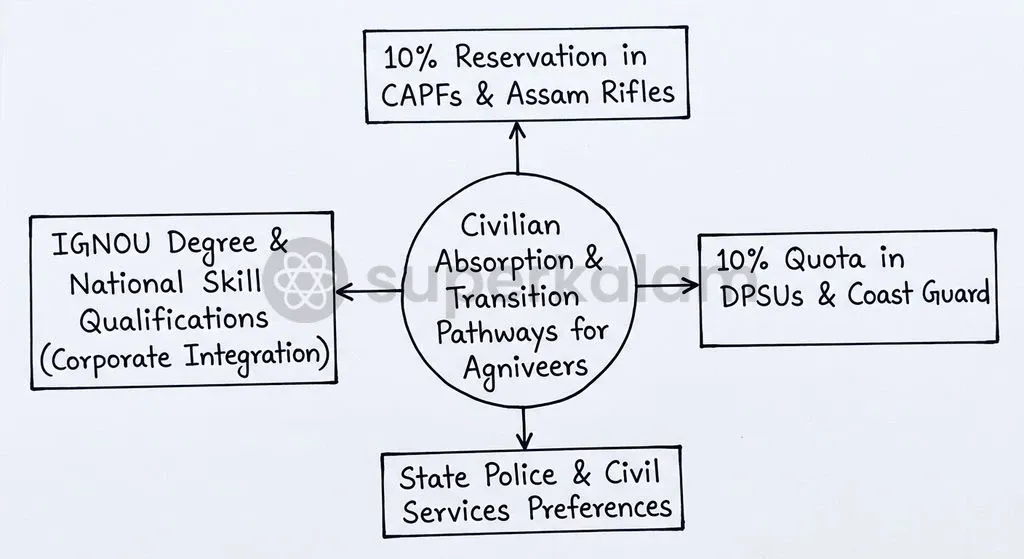
Multiple statutory and executive avenues have been established to facilitate civil re-employment:
- Paramilitary reservations: The Ministry of Home Affairs instituted a 10% horizontal reservation in Central Armed Police Forces (CAPFs) and Assam Rifles, accompanied by upper-age relaxations.
- Defence sector absorption: The Ministry of Defence sanctioned a 10% quota across civilian posts, the Indian Coast Guard, and 16 Defence Public Sector Undertakings (DPSUs).
- State police recruitment: State governments, including Uttar Pradesh, Haryana, Madhya Pradesh, Rajasthan, and Odisha, formulated recruitment preferences or reserved quotas in state police and correctional services.
- Educational accreditation: The Ministry of Education and IGNOU established a dedicated three-year skill-based bachelor's degree granting up to 50% academic credits for technical military training.
Discuss with Superkalam
Analyse the strategic trade-off between reducing pension liabilities to fund capital modernisation and maintaining seasoned combat experience in high-altitude environments.
Ask NowGlobal Models: How Other Nations Balance Short-Service and Regular Cadres
Armed forces globally deploy varied enlistment models to maintain ready combat cadres while managing personnel budgets. Advanced militaries generally rely on two distinct approaches:
- Mandatory national conscription: Forces in South Korea and Israel enlist all eligible citizens for mandatory tours ranging from 18 to 32 months. These models prioritise massive reserve mobilisation capabilities rather than long-term professionalisation.
- Voluntary contract systems: All-volunteer forces, such as the United States military, rely on multi-year enlistment contracts paired with substantial GI Bill educational benefits to facilitate civilian reintegration.
The Indian armed forces operate in a distinct security environment requiring permanent forward deployments along disputed borders. India's operational needs demand a hybrid enlistment framework that sustains both youthful expeditionary agility and the specialised expertise necessary for protracted conventional deterrence.
Way Forward: Building a Sustainable Model for Armed Forces Modernisation
The Department of Military Affairs can institutionalise a sustainable recruitment architecture by adopting flexible, service-specific retention norms. A targeted set of reforms can align operational capability with fiscal sustainability:
- Service-specific retention: Permitting the Indian Navy and technical branches of the Army and Air Force to retain up to 75% of recruits will preserve critical engineering and electronic warfare competencies without undermining the goal of a younger force profile.
- Curriculum extension: Extending specialised trade courses beyond the standard 24-week timeline will ensure personnel achieve proficiency on modern platforms before frontline deployment.
- Merit-based transparency: Implementing transparent selection criteria for regular absorption will sustain healthy motivation while preserving vital regimental trust.
- Enhanced post-service security: Expanding formal post-service welfare mechanisms—including transition benefits, continuous healthcare coverage for service-attributable injuries, and seamless lateral entry into central security organs—will protect the institutional standing of the armed forces.
Calibrating the Agnipath scheme ensures India builds a technologically proficient military while maintaining long-term fiscal resilience.
Key Takeaways
- The Union Cabinet approved the Agnipath Scheme in June 2022 to lower the armed forces' average age from 32 to 26 years while managing escalating pension obligations.
- The Indian Army and Indian Air Force have proposed increasing the permanent retention rate from 25% to approximately 50%, while the Navy has suggested retaining 70% to 75% of Agniveers.
- Internal feedback recommends retaining 60% to 75% of recruits in technical branches, including Signals, Engineers, and EME, alongside expanding specialised training beyond 24 weeks.
- Demobilised personnel receive an accumulated Seva Nidhi corpus of approximately ₹11.71 lakh and benefit from 10% reservations in CAPFs, DPSUs, and various state police forces.
- The Parliamentary Standing Committee on Defence has recommended extending full parity in welfare benefits to the families of Agniveers who lose their lives in the line of duty.
Mains Question
'Reconciling high-technology warfare with long-term fiscal discipline remains the defining task of modern Indian defence planning.' In light of the ongoing internal review of the Agnipath scheme, examine the operational and fiscal imperatives driving proposed modifications to the recruitment model. (15 Marks)
Evaluate NowMains Question
The Parliamentary Standing Committee on Defence and armed forces feedback have highlighted welfare and post-service transition concerns regarding the Agnipath model. Evaluate the measures instituted for the socio-economic rehabilitation and casualty security of Agniveers. (10 Marks)
Evaluate NowPractice MCQs
QUESTION 1
With reference to the original framework of the Agnipath Scheme approved in 2022, consider the following statements:
- It established an all-India, all-class enlistment model for Personnel Below Officer Rank (PBOR).
- The initial training window was set for approximately six months (24 weeks).
- It capped the permanent absorption of recruits into the regular cadre at a fixed ceiling of 50%. Which of the statements given above is/are correct?
QUESTION 2
Consider the following statements regarding the internal review recommendations submitted by the service headquarters on the Agnipath scheme:
- The Indian Navy proposed a retention quota of 70% to 75% due to extensive qualification cycles on complex platforms.
- Proposals recommend absorbing 60% to 75% of Agniveers serving in technical arms such as the Corps of Signals and EME.
- Modification of recruitment parameters requires a formal constitutional amendment through Parliament. Which of the statements given above is/are correct?
QUESTION 3
Regarding the financial and welfare provisions under the Agnipath scheme, consider the following statements:
- The Seva Nidhi package is financed entirely by non-contributory grants from the Central Government.
- Exiting Agniveers who complete their four-year engagement are granted official Ex-Servicemen (ESM) status and lifelong military healthcare.
- The Ministry of Home Affairs provides a 10% horizontal reservation for demobilised Agniveers in Central Armed Police Forces (CAPFs) and Assam Rifles. Which of the statements given above is/are correct?
QUESTION 4
Which of the following compensation components are extended to the families of Agniveers killed in the line of duty under baseline provisions?
- Non-contributory insurance payout of ₹48 lakh
- Ex-gratia payment of ₹44 lakh
- Full lifelong family pension with Ex-Servicemen (ESM) benefits
- Accumulated Seva Nidhi fund and unserved pay for the four-year tenure Select the correct answer using the code given below:
QUESTION 5
What is the primary operational rationale behind the Indian Navy and technical corps proposing significantly higher retention rates (60% to 75%) compared to the original Agnipath policy ceiling?





