Additive Manufacturing in India: 3D Printing and NSAM
Additive manufacturing builds parts layer by layer. Read India's National Strategy, 3D printing applications, targets and manufacturing challenges.
Oct, 2026
•10 min read
Overview
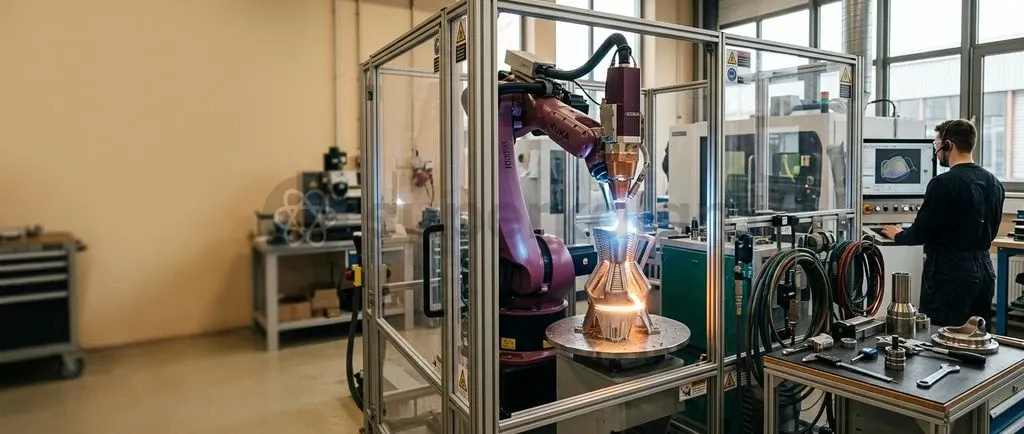
Additive manufacturing offers India a transformative pathway to bypass legacy prototyping constraints across aerospace, defence, and precision engineering, yet it cannot entirely leapfrog the foundational metallurgy, physical foundries, and mass-employment assembly lines that sustain industrialised economies. According to the Ministry of Electronics and Information Technology, India seeks to capture a strategic share of the global digital manufacturing ecosystem. Breakthrough deployments by space startups and the military demonstrate genuine technological agility in high-value, low-volume components. However, structural deficits in domestic alloy feedstock, machinery, and testing standards mean additive manufacturing must complement, rather than substitute, India's broader industrial base.
Why 3D Printing Is Moving from Labs to Strategic Frontiers
The Ministry of Electronics and Information Technology has steered 3D printing into mission-critical defence, aerospace, and public infrastructure projects across India. As of October 2026, official data shows additive manufacturing transitioning from experimental prototyping to core national supply chains, backed by specialized technological centres.
Several factors explain why public agencies and deep-tech enterprises have embraced this pivot:
- Compressed deployment cycles: Complex engineering assemblies that previously took months across multiple vendors can now be fabricated within weeks.
- Geopolitical supply resilience: On-demand digital fabrication insulates critical sectors from foreign supply-chain shocks and long logistics tails.
- Topological optimization: Components are engineered with internal cooling channels and lattice structures impossible to fabricate via standard machine tools.
The central analytical question for Indian policymakers is whether additive manufacturing can enable India to execute an industrial leapfrog. The argument holds that digital fabrication might let India bypass the resource-heavy, smoke-stack industrial phase, much like mobile cellular technology allowed the nation to bypass landline telecommunications infrastructure. Yet, physical manufacturing requires strict adherence to physical metallurgy, machine tooling, and material science that software algorithms alone cannot substitute.
Discuss with Superkalam
Identify the four key operational targets set under MeitY's National Strategy on Additive Manufacturing when it was launched in 2022.
Ask NowHow Additive Manufacturing Works: Beyond Plastic Trinkets
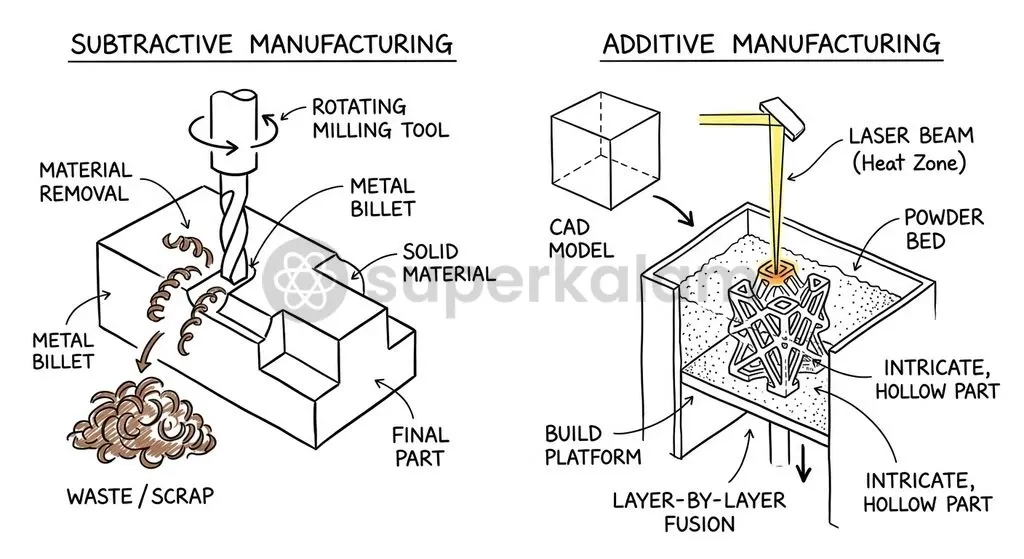
Additive manufacturing builds three-dimensional physical structures layer-by-layer directly from computer-aided design files without requiring dedicated cutting tools or custom casting moulds. Unlike hobbyist thermoplastic extrusion, industrial additive fabrication synthesizes high-performance metal alloys, specialized ceramics, and structural concrete.
According to the Ministry of Electronics and Information Technology's strategy document, traditional subtractive manufacturing cuts away bulk material from solid billets, generating material wastage ratios often exceeding 80%. Additive systems operate near-net-shape, depositing feedstock precisely where structural loads demand material.
| Dimension | Subtractive Manufacturing (Traditional) | Additive Manufacturing (3D Printing) |
|---|---|---|
| Fabrication Mechanism | Material removal via milling, turning, drilling, and grinding | Layer-by-layer deposition and selective thermal fusing |
| Material Wastage | High buy-to-fly waste ratios, frequently exceeding 80% | Minimal waste, producing near-net-shape structures |
| Tooling & Setup | Requires expensive custom dyes, jigs, fixtures, and cutting heads | Tool-free direct fabrication driven entirely by digital files |
| Geometric Flexibility | Constrained by tool access, cutter radii, and casting draft angles | Capable of fabricating consolidated lattices and internal fluid channels |
| Economic Viability | Highly economical at mass scale through volume amortization | Cost-effective for low-volume, high-complexity customization |
Industrial adoption spans several standard processes, including Selective Laser Melting, Electron Beam Melting, and Directed Energy Deposition. Each mechanism subjects metal powders or wire feedstock to thermal energy sources, fusing microscopic layers into solid parts with tailored mechanical properties.
Decoding the National Strategy on Additive Manufacturing
The Ministry of Electronics and Information Technology released the National Strategy on Additive Manufacturing in February 2022 to position India within global digital production networks. The strategy set an initial national target to secure a 5% global market share and add USD 1 billion to gross domestic product by 2025.
Under this framework, the Central Government outlined four specific operational targets:
- Develop 50 India-specific additive manufacturing technologies across hardware, software, and materials.
- Incubate 100 deep-tech startups focused on industrial 3D printing solutions.
- Commercialize 500 domestic additive manufacturing products across engineering sectors.
- Train 1 lakh skilled engineers, technicians, and machine operators.
Institutional progress materialized through the establishment of the National Centre for Additive Manufacturing at Hyderabad, structured as a Section 8 non-profit enterprise jointly created by the Ministry of Electronics and Information Technology, the Government of Telangana, and private industry. In June 2024, MeitY held the first National Additive Manufacturing Symposium in New Delhi, announcing that seven specialized operational centres had been set up across the country to advance solutions in optoelectronics, medical devices, and clean energy.
As of October 2026, official review data revealed that national strategy initiatives had surpassed workforce benchmarks by training over 1.54 lakh personnel and supporting more than 50 startups during the transition to NSAM 2.0.
Discuss with Superkalam
Explain why subtractive manufacturing results in high material wastage compared to near-net-shape additive manufacturing.
Ask NowThe Leapfrog Promise: Frontier Wins in Space and Border Defence
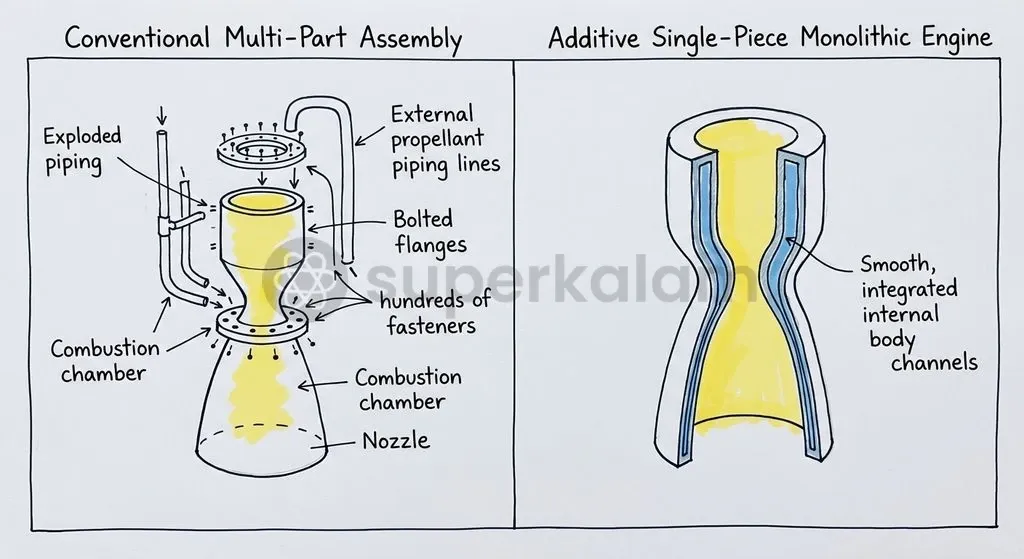
The Indian aerospace sector provides compelling evidence of how additive manufacturing eliminates assembly complexity in high-performance propulsion systems. On May 30, 2024, space startup Agnikul Cosmos achieved a historic milestone by launching Agnibaan SOrTeD, powered by Agnilet, the world's first single-piece 3D-printed semi-cryogenic rocket engine.
Traditional rocket engines require the precision fabrication and manual integration of hundreds of individual pipes, injectors, cooling jackets, and manifolds. Agnilet consolidated this entire assembly into a single integrated build, minimizing failure points while cutting manufacturing lead times. Recognizing the potential of this architecture, the Technology Development Board under the Department of Science and Technology sanctioned ₹200 crore in September 2026 to support Agnikul Cosmos in developing a reusable launch vehicle powered by 3D-printed propulsion.
Strategic utility extends equally into national defence and expeditionary infrastructure:
- High-altitude border defences: The Indian Army, under Project PRABAL, operationalized indigenous vehicle-portable 3D concrete printing robotic systems to construct permanent defences, sentry posts, and extreme-weather habitats along sensitive border frontiers in Eastern Ladakh, Sikkim, and Arunachal Pradesh.
- Seismic-resilient military housing: In December 2022, the Indian Army operationalized its first 3D-printed two-storey dwelling unit for troops in Ahmedabad, constructed in 12 weeks to withstand seismic Zone-3 ground motions.
- Rapid civil infrastructure: In August 2023, India inaugurated its first functional 3D-printed public building, a 1,021-square-foot post office at Cambridge Layout in Bengaluru, built in 43 days by Larsen & Toubro alongside IIT Madras.
Discuss with Superkalam
How can military engineering units apply vehicle-portable 3D concrete printing to disaster-relief scenarios in earthquake-prone regions?
Ask NowConventional Factory vs 3D Printer: What India Can and Cannot Replace
The Observer Research Foundation notes that additive manufacturing cannot substitute for conventional assembly-line factories in mass-employment manufacturing. The economic logic of production explains why digital printing complements, rather than displaces, traditional factories.
Traditional subtractive and forming methods require substantial upfront capital expenditures for dies, stamping presses, and assembly tooling. Once paid for, the marginal cost per additional unit drops steeply, making mass production extraordinarily cheap for consumer products like smartphones, bicycles, or apparel. In contrast, 3D printing exhibits flat unit cost curves across production volumes. A 3D printer costs virtually the same amount to build the thousandth unit as it does the first, making it unsuitable for mass-market consumer output.
Testing the popular "telecom leapfrog" analogy clarifies the limits of additive manufacturing. India famously leapfrogged landlines by deploying wireless cellular towers, bypassing the vast capital expenditure of laying copper wire to every household. Proponents argue that 3D printing can similarly allow India to bypass the development of heavy industrial factories, foundries, and stamping mills.
This analogy fails because telecommunications transmits pure informational bits, whereas manufacturing alters physical matter. As an analytical study by the Observer Research Foundation underlines, additive manufacturing requires pre-existing advanced metal foundries, vacuum heat-treatment furnaces, and precision surface-grinding shops. A nation cannot produce printed titanium aerospace brackets without the metallurgical industrial depth required to refine, atomize, and certify titanium alloy powders.
Furthermore, traditional manufacturing remains indispensable for absorbing low-skill labour. Because additive systems run on automated design algorithms, multi-axis robotics, and computer numerical control software, they generate demand for specialized software engineers and materials scientists rather than assembly-line operators.
Discuss with Superkalam
Compare the cost curves of traditional factory assembly lines with industrial 3D printing across low and high production volumes.
Ask NowThe Structural Bottlenecks: Feedstock Imports, High Costs, and Standards
The Bureau of Indian Standards and domestic manufacturers face significant supply-chain and regulatory hurdles that restrict the wider adoption of industrial 3D printing. Despite national policy support, key dependencies on foreign intellectual property and imported raw materials remain unresolved.
Critical structural challenges include:
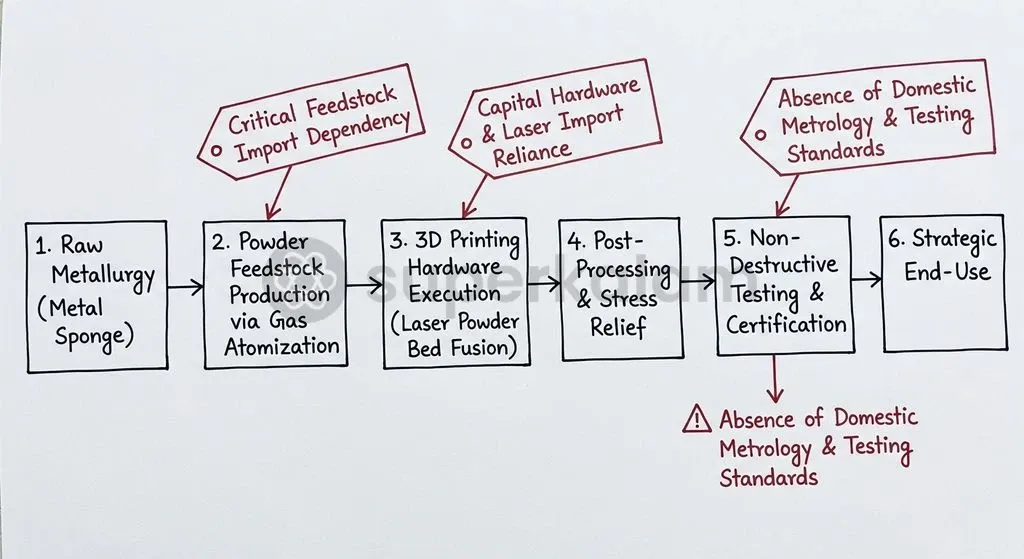
- Heavy feedstock import dependence: According to MeitY's strategy paper, domestic fabricators depend almost entirely on imports for spherical metal powders, specialized titanium and Inconel gas-atomized alloys, and engineering photopolymers.
- Proprietary hardware ecosystems: Selective Laser Melting and Electron Beam Melting systems are largely imported from manufacturers in Germany, the United States, and Japan, which utilize closed software architectures that lock users into expensive proprietary powders.
- Absence of testing standards: Domestic commercialization faces persistent hurdles because the Bureau of Indian Standards has yet to issue fully harmonized testing protocols and regulatory guidelines for anisotropic fatigue and microporosity in printed components.
- High capital and power requirements: Industrial metal printers require clean room conditions, high inert gas consumption (such as argon), and uninterrupted electrical power supplies, resulting in elevated per-hour operational costs.
Material anisotropy presents a particularly stubborn engineering challenge. Because parts are fused layer-by-layer along a single build direction, their tensile and shear strengths differ across planes, introducing microscopic voids. Certifying these mission-critical components for commercial aviation, railway rolling stock, or nuclear reactors demands rigorous, non-destructive validation that India's domestic laboratory network is only beginning to build out.
Discuss with Superkalam
Assess whether India should prioritize heavy foundry manufacturing or digital additive fabrication to achieve long-term industrial self-reliance.
Ask NowWay Forward: Building Domestic Materials, Tooling, and Industrial Scale
The Ministry of Electronics and Information Technology must coordinate with science agencies and industrial consortia to build end-to-end self-reliance in domestic additive manufacturing. Addressing structural input dependencies is essential if digital manufacturing is to strengthen India's industrial backbone.
Policy reforms should concentrate on the following priority tracks:
- Indigenizing gas-atomization capacity: India's public sector metal producers and defence laboratories should scale up domestic atomization facilities to produce spherical titanium, nickel-based superalloys, and stainless-steel powders from domestic ores.
- Formulating open-architecture machine frameworks: Research institutions should collaborate with machine tool builders to develop indigenous printers operating on open software protocols, ending the reliance on proprietary foreign consumables.
- Establishing rapid BIS certification benchmarks: The Bureau of Indian Standards should expedite dedicated performance standards for structural additive components, focusing on fatigue lifecycles and non-destructive ultrasonic evaluation.
- Integrating additive technology with traditional MSMEs: Rather than viewing 3D printing as an isolated sector, industrial clusters in Coimbatore, Rajkot, and Ludhiana should adopt additive systems specifically for rapid tooling, die repair, and casting patterns.
- Incentivizing public procurement: Defence public sector undertakings and railway workshops should mandate minimum quotas for domestically certified 3D-printed replacement parts, guaranteeing early volume demand for local startups.
Key Takeaways
- The Ministry of Electronics and Information Technology launched the National Strategy on Additive Manufacturing in 2022, targeting a 5% global market share and a USD 1 billion GDP contribution by 2025.
- Frontier deployments in space and border security prove additive manufacturing's strategic value, highlighted by Agnikul's single-piece 3D-printed Agnilet engine and the Indian Army's Project PRABAL border defences.
- Additive manufacturing features a flat unit cost curve, making it optimal for high-complexity, low-volume customization, but uncompetitive against traditional mass-production assembly lines.
- The concept of industrial leapfrogging remains constrained because 3D printing depends on foundational industrial assets, including metal foundries, gas-atomized alloy powders, and precision post-processing.
- Persistent bottlenecks include heavy import dependence for high-grade spherical alloy powders, proprietary machine locks from foreign OEMs, and an absence of harmonized Bureau of Indian Standards fatigue-testing protocols.
Mains Question
"Additive manufacturing cannot substitute for conventional assembly-line factories in mass-employment manufacturing; it must complement, rather than displace, India's broader industrial base." Critically analyse this statement in light of the economic characteristics of digital fabrication. (10 Marks)
Evaluate NowMains Question
The National Strategy on Additive Manufacturing (NSAM) seeks to position India as a global digital production hub. In this context, evaluate India's progress in frontier sectors and the structural constraints in achieving full industrial scale. (15 Marks)
Evaluate NowPractice MCQs
QUESTION 1
Consider the following statements regarding the National Strategy on Additive Manufacturing (NSAM):
- It was formulated by the Ministry of Electronics and Information Technology.
- It aimed to secure a 5% global market share in additive manufacturing and add USD 1 billion to GDP by 2025.
- Under its institutional framework, the National Centre for Additive Manufacturing was set up in Hyderabad as a Section 8 non-profit company.
Which of the statements given above are correct?
QUESTION 2
With reference to the industrial characteristics of Additive Manufacturing compared to conventional Subtractive Manufacturing, consider the following statements:
- Subtractive manufacturing frequently generates material wastage ratios exceeding 80%, whereas additive systems operate near-net-shape.
- Unlike traditional mass manufacturing where marginal unit costs drop sharply, additive manufacturing displays relatively flat unit cost curves across production volumes.
- Additive manufacturing requires substantial upfront investments in custom dies and fixtures for every design iteration.
Which of the statements given above is/are correct?
QUESTION 3
With reference to recent domestic applications of 3D printing technology in India, consider the following pairs:
- Agnilet : World's first single-piece 3D-printed semi-cryogenic rocket engine
- Project PRABAL : Indigenous vehicle-portable 3D concrete printing robotic systems for border defence
- Bengaluru Cambridge Layout post office : India's first functional 3D-printed public building
How many of the above pairs are correctly matched?
QUESTION 4
In the context of the National Strategy on Additive Manufacturing released by the Ministry of Electronics and Information Technology, which of the following was NOT among the specific operational targets initially set under the framework?
QUESTION 5
Consider the following statements regarding the structural limits of using additive manufacturing to bypass traditional industrialization:
- Additive manufacturing cannot substitute conventional assembly lines because its unit cost does not decline significantly with mass volume.
- The telecom leapfrog analogy directly applies to additive manufacturing because digital fabrication replaces physical matter with informational code.
Which of the statements given above is/are correct?