Acceptance of Necessity in Defence Procurement: Decoding DAC Clearance
While DAC clearance signals a massive push for tri-service modernisation, asset deployment hinges on overcoming complex multi-stage procurement bottlenecks.
Sep, 2026
•9 min read

Overview
On September 7, 2026, the Defence Acquisition Council cleared capital acquisition proposals worth approximately ₹1.10 lakh crore. The council granted Acceptance of Necessity to initiate formal procurement for military hardware. Nearly 98 percent of the total value is earmarked for domestic manufacturers.
This administrative clearance triggers the issuance of Requests for Proposal under the Defence Acquisition Procedure 2020 rather than disbursing funds immediately. The capital push bolsters operational readiness across the armed forces while deepening structural indigenisation.
Acceptance of Necessity is the procedural starting gun that defines capability requirements and procurement pathways. Turning the ₹1.10 lakh crore clearance into deployed hardware hinges on compressing contracting timelines, avoiding tender retractions, and executing domestic production.
Why in the News: The Latest ₹1.10 Lakh Crore DAC Approvals
The Defence Acquisition Council cleared capital acquisition proposals worth approximately ₹1.10 lakh crore on September 7, 2026, to bolster tri-service operational capabilities. According to a Press Information Bureau release, approximately 98 percent of this total procurement value is earmarked for sourcing from the domestic defence industry.
The approved proposals cover vital modernisation requirements across all three armed services:
- Indian Army: Clearance encompasses CBRN Reconnaissance Vehicles, High Mobility Vehicles (HMVs), Self-Propelled Mechanical Mine Layers (MMLs), Advanced Light Helicopters (ALHs), Trawl Tanks, and the Sarvatra Bridge System.
- Indian Navy: Approvals include the procurement of Arudhra Radars to replace legacy Air Route Surveillance Radars, alongside the design, development, and subsequent procurement of Marine Gas Turbines.
- Indian Air Force: Cleared packages include electronic-warfare upgrades across aircraft fleets, Ground-Based Multi-Purpose Jammers (GBMPJ), and the Defence Forces Secure Access Card (DEFSAC) System.
These approvals represent a broad technological sweep aimed at addressing operational gaps across mobility, combat engineering, airborne surveillance, and electronic defence.
Discuss with Superkalam
Recall the composition of the Defence Acquisition Council: who chairs it and which key military officials sit on it?
Ask NowWhat is the Defence Acquisition Council and Who Heads It?
The Defence Acquisition Council is the apex decision-making body for military procurement under the Ministry of Defence, established in 2001 post-Kargil War reforms. The Council was instituted following the recommendations of the Group of Ministers on reforming the national security framework, aiming to create an integrated institutional structure for capital acquisitions.
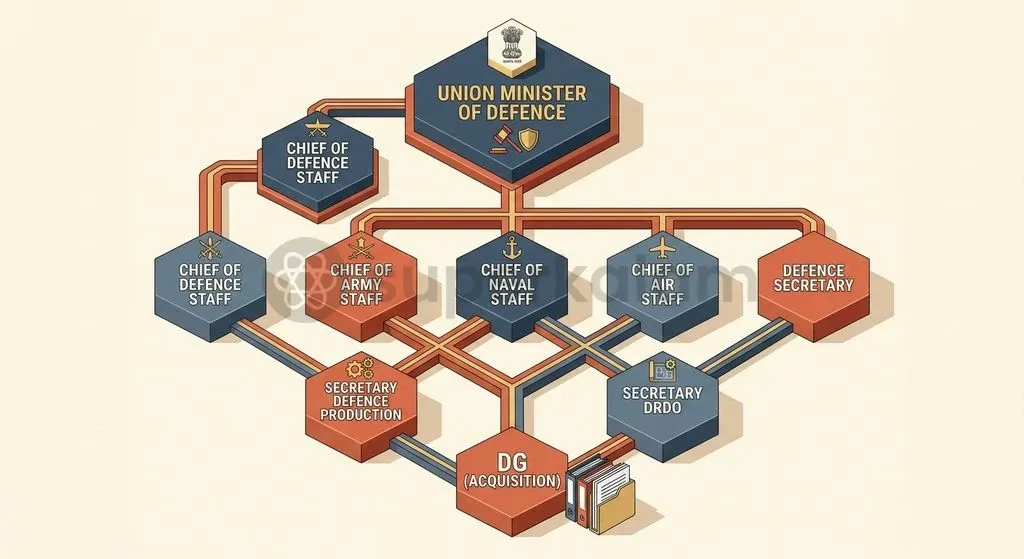
The Council is chaired by the Union Minister of Defence (Raksha Mantri). Its high-level composition ensures that military operational requirements align with financial planning and domestic manufacturing capacities:
- Chairman: Union Minister of Defence (Raksha Mantri)
- Military Leadership: Chief of Defence Staff (CDS), Chief of the Army Staff, Chief of the Naval Staff, and Chief of the Air Staff
- Civilian and Technical Leadership: Defence Secretary, Secretary Defence Production, Secretary Department of Defence R&D (Chairman DRDO), and Director General (Acquisition)
The primary mandate of the Council includes granting in-principle approval for capital acquisitions, categorising procurement schemes into specific routes, and monitoring long-term acquisition plans of the armed forces.
Understanding AoN: The Starting Gun, Not the Final Cheque
Acceptance of Necessity represents the formal in-principle administrative clearance granted by the Defence Acquisition Council to initiate a capital procurement project. Under Chapter II of the Defence Acquisition Procedure 2020, an AoN accords institutional validation to a stated military capability requirement and assigns it a specific procurement category.
An AoN is frequently misunderstood as a commercial payout, but it follows strict institutional boundaries:
- Procedural Authorisation Only: AoN authorises the acquisition wing to release a formal Request for Proposal (RFP). It does not disburse budget funds, execute a commercial contract, or start factory production.
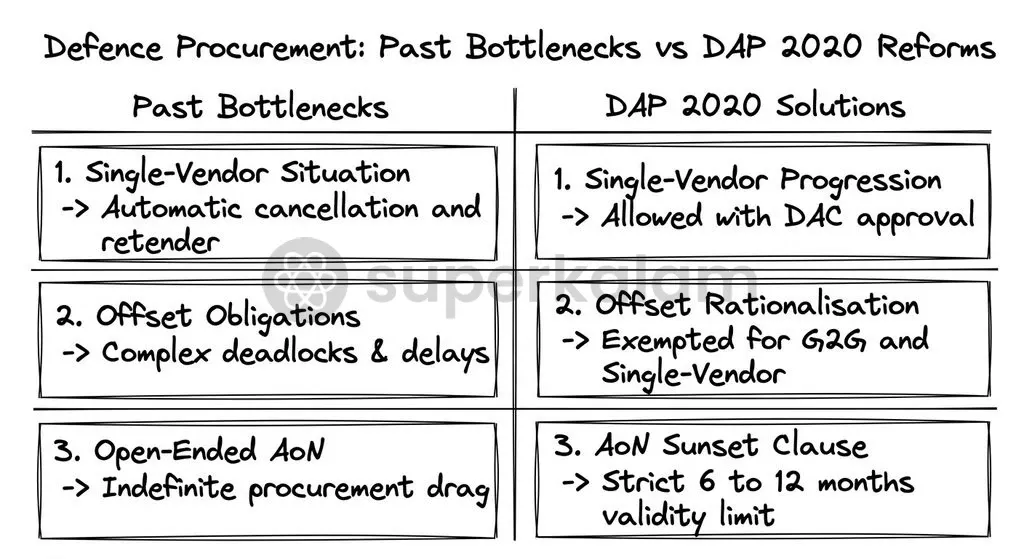
- Time-Bound Windows: The validity of an AoN is restricted to six months for 'Buy' category cases and one year for 'Buy & Make (Indian)' cases, within which the acquisition wing must formally issue the tender.
- Sunset Discipline: Strict expiration windows prevent procurement proposals from stalling indefinitely after receiving in-principle clearance.
Discuss with Superkalam
Explain why obtaining an Acceptance of Necessity (AoN) does not guarantee that a defence contract will be signed or funded immediately.
Ask NowFrom AoN to Handover: The Multi-Stage Defence Procurement Lifecycle
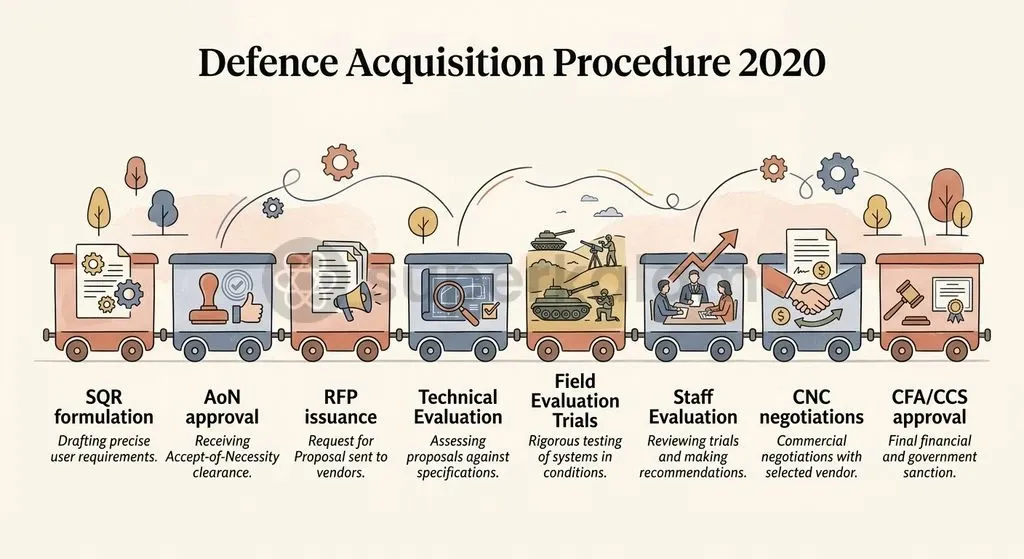
The Defence Acquisition Procedure 2020 mandates an eight-stage sequential acquisition pipeline between preliminary requirements and final operational asset induction. Each capital scheme must successfully navigate these rigorous technical, field, and financial benchmarks.
The standard procurement lifecycle proceeds through distinct phases:
- Formulation of SQRs: The Services define precise operational parameters as Services Qualitative Requirements.
- Accord of AoN: The Defence Acquisition Council evaluates capability needs and grants the AoN with a designated procurement category.
- Issue of RFP: The Ministry of Defence issues detailed tender documents to eligible vendors.
- Technical Evaluation: A Technical Evaluation Committee assesses vendor compliance with the stated qualitative requirements.
- Field Evaluation Trials (FET): Shortlisted equipment undergoes extensive trials across desert, high-altitude, and coastal terrains on a 'No Cost, No Commitment' basis.
- Staff Evaluation: The service headquarters analyses trial outcomes and identifies technically compliant platforms.
- Commercial Negotiations: The Contract Negotiation Committee establishes the final price and delivery schedules with the lowest compliant bidder (L1).
- Competent Financial Authority (CFA) Approval and Signing: For large-scale acquisitions exceeding delegated ministerial limits, final financial sanction is accorded by the Cabinet Committee on Security (CCS) chaired by the Prime Minister prior to contract execution.
To compress these procedural stages for smaller acquisitions, a single-stage accord of AoN is instituted for capital procurement cases up to ₹500 crore.
Categorisation Under DAP 2020: Buy (Indian-IDDM) vs Global Sourcing
The Defence Acquisition Procedure 2020 establishes a descending five-tier hierarchy that prioritises indigenous design, development, and manufacturing over foreign arms imports. The framework structures acquisition categories to ensure domestic technological capabilities are exhausted before foreign options are explored.
| Acquisition Category | Indigenous Content (IC) Requirement | Primary Focus & Strategic Objective |
|---|---|---|
| Buy (Indian-IDDM) | Minimum 50% IC with indigenous design; minimum 65% IC without indigenous design | Highest priority category; mandates local design and manufacturing |
| Buy (Indian) | Minimum 60% IC for indigenous design; minimum 50% for other cases | Procurement from domestic vendors using established technologies |
| Buy and Make (Indian) | Minimum 50% IC in the 'Make' portion of the contract | Initial buy followed by licensed production and transfer of technology |
| Buy (Global - Manufacture in India) | Minimum 50% IC in the manufactured portion | Foreign vendor establishes production lines within India |
| Buy (Global) | Sourced directly from foreign or domestic vendors | Direct off-the-shelf purchase; lowest priority in the hierarchy |
Table 1: Prioritised Capital Acquisition Categories under DAP 2020.
In April 2022, the Ministry of Defence amended the procedure to mandate that all modernisation requirements of the Armed Forces and Coast Guard be indigenously sourced by default. Direct foreign procurement under the Buy (Global) category is permitted only as a rare exception requiring explicit approval from the Defence Acquisition Council.
Discuss with Superkalam
Analyse how the revised rules regarding 'single-compliant vendor' cases help resolve historical bottlenecks in Indian defence contracting.
Ask NowWhy Indigenous Defence Orders Take Years to Materialise
Capital defence acquisitions frequently encounter multi-year procedural delays across technical field evaluation trials, complex cost negotiations, and stringent vendor compliance assessments. Historically, Indian defence procurement suffered from structural bottlenecks that stalled major platforms, including multi-year delays seen in long-running tank and submarine acquisition programmes.
Three major systemic hurdles have historically contributed to procurement timelines extending across several years:
- The Single-Vendor Dilemma: In past decades, if trial evaluations eliminated all but one competing vendor, the entire procurement process was frequently cancelled and re-tendered. Under DAP 2020, cases resulting in a single compliant vendor at the bid submission or Technical Evaluation stage are no longer automatically retracted and can progress with due justification and Council approval.
- Trial and Evaluation Complexities: Field trials require testing complex platforms across extreme climate zones, ranging from the Thar Desert to the Siachen Glacier. These evaluations often face logistical constraints and lengthy re-testing cycles.
- Offset Execution Delays: Mandatory offset clauses requiring foreign suppliers to reinvest 30 percent of contract value into Indian industry often created administrative friction. DAP 2020 addressed this by removing the 30 percent offset obligation from Inter-Governmental Agreements, Government-to-Government pacts, and ab-initio single-vendor contracts.
Recent Structural Reforms: Domestic Capital Budgets and Positive Indigenisation Lists
The Ministry of Defence introduced structural policy interventions to fast-track self-reliance, including dedicated domestic capital procurement budgets and phased import embargoes. These mechanisms provide sustained demand signals to domestic public and private defence manufacturing sectors.
Key institutional reforms driving this transition include:
- Domestic Capital Budget Ring-Fencing: The Ministry of Defence progressively escalated the reservation of its annual capital procurement budget for domestic industry, locking in 75 percent for domestic vendors starting in Financial Year 2023-24.
- Positive Indigenisation Lists: The Department of Military Affairs and Department of Defence Production have notified multiple Positive Indigenisation Lists that embargo the import of hundreds of military platforms, weapons systems, and high-value components across phased deadlines.
- Introduction of Military Leasing: DAP 2020 introduced equipment leasing under Lease (Indian) and Lease (Global) categories, enabling the armed forces to operate operational assets such as transport aircraft, trainers, and surveillance systems without incurring massive upfront capital outlays.
Discuss with Superkalam
Evaluate the strategic trade-offs between mandating high domestic indigenous content (IDDM) and ensuring rapid tri-service modernization during emergent security threats.
Ask NowWay Forward: Streamlining Contracting Timelines for Strategic Readiness
Compressing Indian defence acquisition timelines requires rigorous enforcement of procedural sunset clauses, objective trial standards, and seamless inter-agency financial approvals. While policy reforms have systematically eliminated historical procedural traps, institutional execution must remain agile to meet evolving security challenges.
To bridge the gap between in-principle approvals and asset deployment, the procurement ecosystem must focus on clear operational priorities:
- Strict Enforcement of AoN Validity: Adhering firmly to the six-month and twelve-month validity windows for RFP issuance ensures that capability requirements do not become technologically obsolete before commercial negotiations begin.
- Rationalisation of Qualitative Requirements: Service headquarters must draft realistic, achievable Services Qualitative Requirements rather than aspirational specifications that lead to prolonged developmental cycles.
- Tier-2 and MSME Integration: The domestic defence industrial base requires targeted supply chain integration, ensuring that large platform manufacturers actively develop local component ecosystems to satisfy mandatory indigenous content thresholds.
- Strengthening Fast-Track Procedures: Expanding the scope of single-stage AoN approvals and simplified trial procedures will allow critical operational capability gaps to be plugged within compressed operational timeframes.
Key Takeaways
- The Defence Acquisition Council, chaired by the Raksha Mantri, cleared capital acquisition proposals worth approximately ₹1.10 lakh crore on September 7, 2026, with 98 percent earmarked for domestic industry.
- Acceptance of Necessity (AoN) represents formal administrative and capability clearance to issue tenders; it does not constitute financial disbursement or contract execution.
- The Defence Acquisition Procedure (DAP) 2020 establishes Buy (Indian-IDDM) as the highest-priority acquisition category, requiring at least 50 percent indigenous content with domestic design.
- DAP 2020 introduced vital structural reforms, including allowing single-compliant-vendor progression, removing offset requirements from G2G/IGA contracts, and restricting AoN validity to 6–12 months.
- The Ministry of Defence reserves 75 percent of its annual capital acquisition budget for domestic industry alongside phased import embargoes under Positive Indigenisation Lists.
Mains Question
"Acceptance of Necessity (AoN) serves merely as the procedural starting gun rather than a final commercial commitment in defence procurement." Elucidate the institutional significance of AoN and examine the procedural stages involved in translating it into deployed hardware under DAP 2020. (10 Marks)
Evaluate NowMains Question
The Defence Acquisition Procedure (DAP) 2020 establishes a prioritised hierarchy favouring indigenisation over direct foreign imports. Critically analyse the structural safeguards, categorisation norms, and systemic hurdles associated with executing domestic capital defence acquisitions. (15 Marks)
Evaluate NowPractice MCQs
QUESTION 1
Consider the following statements regarding the Defence Acquisition Council (DAC):
- It was established following the recommendations of the Group of Ministers on reforming the national security framework post-Kargil War.
- It is chaired by the Chief of Defence Staff (CDS).
- It is the apex decision-making body for military procurement under the Ministry of Defence. Which of the statements given above are correct?
QUESTION 2
With reference to the 'Acceptance of Necessity' (AoN) under the Defence Acquisition Procedure (DAP) 2020, consider the following statements:
- Granting of an AoN implies immediate disbursement of budgetary funds and commercial contract execution.
- The validity of an AoN is restricted to six months for 'Buy' category cases.
- A single-stage accord of AoN is instituted for capital procurement cases up to ₹500 crore. Which of the statements given above is/are correct?
QUESTION 3
Under the Defence Acquisition Procedure (DAP) 2020, which of the following acquisition categories holds the highest priority in the capital procurement hierarchy?
QUESTION 4
Consider the following statements regarding capital procurement provisions under the Defence Acquisition Procedure (DAP) 2020:
- Sourcing under the 'Buy (Global)' category is allowed by default for all tri-service modernisations.
- Procurement cases resulting in a single compliant vendor at technical evaluation are no longer automatically retracted.
- The 30 percent offset obligation has been eliminated from Inter-Governmental Agreements and Government-to-Government pacts. Which of the statements given above is/are correct?
QUESTION 5
In the multi-stage defence procurement lifecycle outlined under DAP 2020, on what basis are Field Evaluation Trials (FET) conducted across different terrains?