72nd National Film Awards: Winners List, History and Key Facts
The 72nd National Film Awards, presented on 22 September 2026 at Ekta Nagar: full winners list, the awards’ 1954 origins, NFDC governance and category endowments.
Sep, 2026
•7 min read

Overview
The National Film Awards are India's apex cinematic honour. They balance artistic excellence with constitutional principles of cultural federalism, linguistic diversity, and national cohesion across regional film ecosystems.
Instituted under the Ministry of Information and Broadcasting, the awards operationalise state patronage by recognising cinema across all Eighth Schedule and non-scheduled languages. The National Film Development Corporation now administers the framework, expanding it from a certificate regime into an active creative-economy driver.
Today, the platform extends beyond traditional exhibition to cover Animation, Visual Effects, Gaming, and Comics disciplines. They remain central to how public policy, artistic freedom under Article 19(1)(a), and cultural diplomacy intersect in modern India.
Why in the News?
The announcement of the 72nd National Film Awards for films certified in 2024 marked a notable geographic shift in cultural governance. As of September 2026, the central government scheduled the felicitation ceremony for 22 September 2026 at Ekta Nagar in Kevadia, Gujarat.
Key highlights from the announcement include:
- Historic Venue Shift: This moved the national event outside New Delhi for the first time under the Ek Bharat, Shreshtha Bharat initiative.
- Highest Cinematic Honour: The 72nd edition conferred the prestigious Dadasaheb Phalke Award on veteran actor Anant Nag.
- Broad Linguistic Representation: The awards celebrated multi-lingual productions across diverse regional traditions.
History and Genesis: From 1954 State Awards to Cultural Benchmark
The origin of the National Film Awards traces back to post-independence cultural reconstruction. Following recommendations of the 1949 Film Enquiry Committee, the central government instituted the awards in 1954 under the title State Awards for Films to honour films certified in 1953.
The core mandate focused on clear cultural objectives:
- Encouraging films of high aesthetic and technical standard
- Promoting works of educational and cultural value
- Providing structured state-backed cultural patronage across feature and documentary formats
Over the decades, the platform was renamed the National Film Awards. It expanded its mandate from basic certificates of merit to substantial cash endowments and medallions.
Discuss with Superkalam
Which committee's recommendations in 1949 led to the creation of the State Awards for Films in 1954?
Ask NowInstitutional Architecture: Ministry of I&B, NFDC, and the Jury Framework
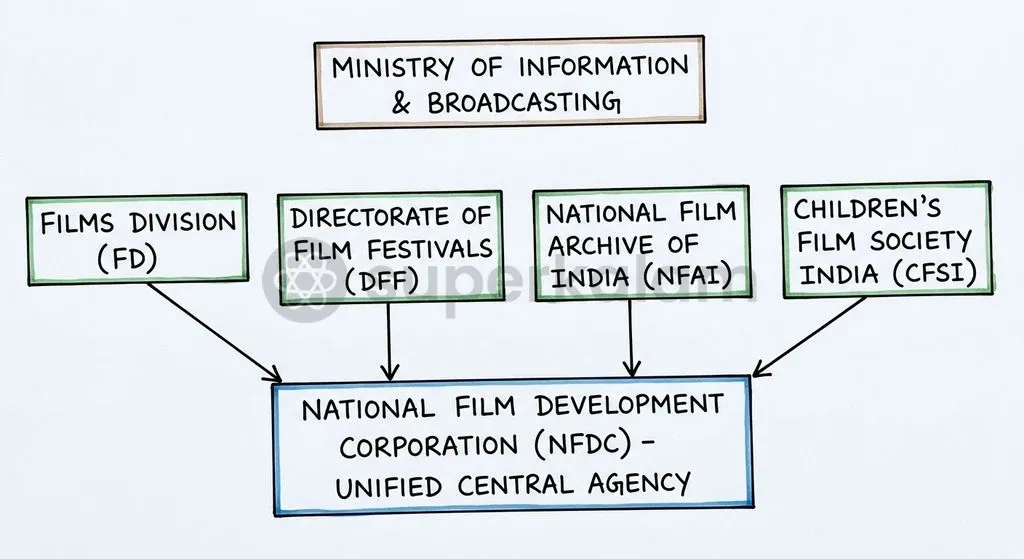
The administrative architecture governing the awards underwent a major restructuring to streamline public resources. In March 2022, the Ministry of Information and Broadcasting completed the transfer and merger of four media units into the National Film Development Corporation.
This consolidation brought the Directorate of Film Festivals, Films Division, Children's Film Society India, and National Film Archives of India under a single umbrella.
An independent, multi-tiered jury appointed annually by the central government evaluates all entries across distinct panels:
- Feature Film Jury: Evaluates national and regional narrative cinema.
- Non-Feature Film Jury: Assesses short films, social documentaries, and non-fiction works.
- Best Writing on Cinema Jury: Reviews critical film literature, historical treatises, and film criticism.
Jurors are selected from eminent filmmakers, critics, and academicians across linguistic zones to ensure regional balance.
Discuss with Superkalam
How does the consolidation of four media units under the NFDC streamline film administration and archiving in India?
Ask NowAward Categories Demystified: Swarna Kamal, Rajat Kamal, and Dadasaheb Phalke
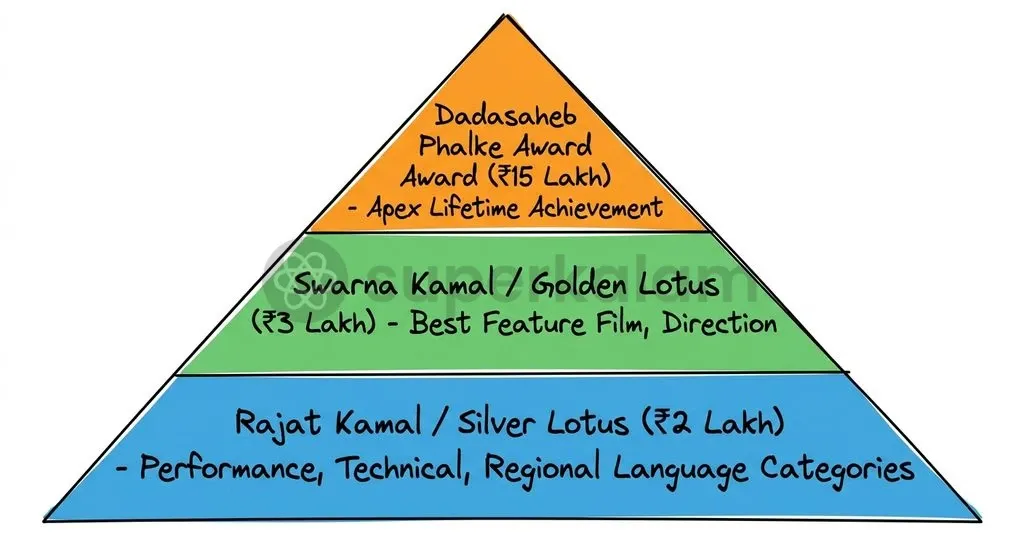
The National Film Awards taxonomy classifies recognitions into distinct tiers based on artistic scope, cultural significance, and lifetime contributions. Following recommendations from the rationalisation committee headed by Additional Secretary Neerja Sekhar, the government revised category structures and prize endowments starting from the 70th edition.
| Dimension | Swarna Kamal (Golden Lotus) | Rajat Kamal (Silver Lotus) | Dadasaheb Phalke Award |
|---|---|---|---|
| Institutional Scope | Apex national categories (Best Feature Film, Best Direction, Best Debut) | Specific technical and regional performance categories | Lifetime contribution to Indian cinematic arts |
| Standard Cash Endowment | ₹3,00,000 | ₹2,00,000 | ₹15,00,000 |
| Insignia & Medallion | Golden Lotus medallion and citation | Silver Lotus medallion and citation | Golden Lotus medallion, cash prize, and a traditional shawl |
| Year of Inception | 1954 | 1954 | 1969 (commemorating Raja Harishchandra) |
72nd National Film Awards: Full Winners Breakdown and Thematic Highlights
The 72nd National Film Awards honoured certified cinematic releases from 2024, highlighting a blend of high-budget thrillers, historical biographies, and folk allegories.
The political thriller Article 370, directed by Aditya Suhas Jambhale, won Best Feature Film. Lead actor Yami Gautam secured the award for Best Actress in a Leading Role.
The Best Actor in a Leading Role category saw a joint conferment:
- Mammootty for his performance in the Malayalam period mystery Bramayugam.
- Kartik Aaryan for portraying an athlete in the Hindi biographical drama Chandu Champion.
In the non-feature and literary categories, the 72nd edition recognised grassroots storytelling:
- Best Non-Feature Film: Bangaar
- Best Documentary: Ram-Nami
- Best Book on Cinema: Naaniruvude Nimagaagi Naadiruvude Nanagaagi
- Best Film Critic: Sanjeev Shrivastava
Discuss with Superkalam
In what ways can the inclusion of non-scheduled languages like Garhwali and Tulu in national honours support linguistic preservation in grassroots communities?
Ask NowShifting Paradigms: Regional Cinema's Ascendancy and Cultural Federalism
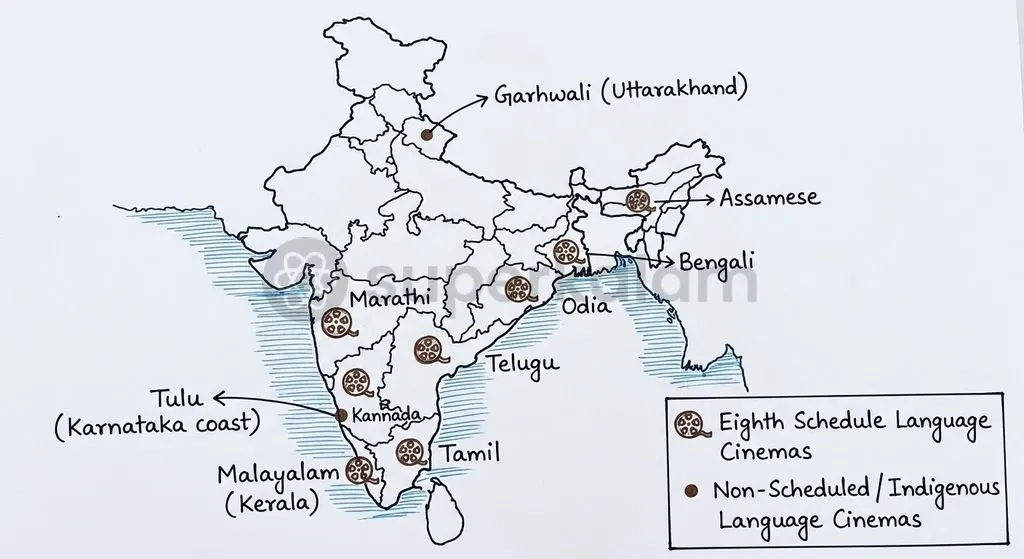
The National Film Awards advance linguistic pluralism by mandating dedicated honours for every language in the Eighth Schedule of the Constitution. Beyond scheduled languages, juries regularly recognise non-scheduled linguistic traditions.
In the 72nd edition, the Garhwali film Dholi and the Tulu film IMBU secured special category awards, validating indigenous storytelling ecosystems.
This framework strengthens cultural federalism in Indian arts:
- Malayalam, Kannada, Tamil, and Telugu industries routinely win top technical and screenwriting honours.
- Decentralised selections dismantle historic Hindi-centric dominance across national platforms.
- State honours offer critical visibility and archival preservation for micro-budget films that lack commercial marketing budgets.
Cinema as Soft Power: Cultural Integration and the Creative Economy
Cinema is a primary pillar of India's cultural diplomacy and soft power projection. High-standard cinematic productions act as cultural ambassadors, generating international interest in Indian heritage and socio-economic life.
To support digital media industries, the Ministry of Information and Broadcasting introduced the Best Film in AVGC category, targeting Animation, Visual Effects, Gaming, and Comics.
This modern track has expanded technical recognition across mainstream releases:
- Brahmastra: Part 1 – Shiva won the award at the 70th edition.
- Hanu-Man secured the honour at the 71st edition.
- The category incentivises domestic technological self-reliance across post-production pipelines.
Discuss with Superkalam
Compare the role of technical categories like AVGC with traditional narrative honours in promoting India's soft power globally.
Ask NowKey Challenges: Jury Autonomy, State Patronage, and Representation Gaps
The operational interface between state patronage and artistic evaluation faces recurring scrutiny over institutional neutrality.
Key areas of debate include:
- Jury Dissent and Political Polarisation: At the 71st National Film Awards, feature jury member Pradeep Nair publicly revealed internal dissent, noting he formally opposed awarding Best Director to Sudipto Sen for The Kerala Story over social polarisation concerns. Jury chairperson Ashutosh Gowariker defended the decision on cinematic craft and technical execution.
- Controversies over Thematic Categories: Conferring the Nargis Dutt Award for Best Feature Film on National Integration on The Kashmir Files at the 69th edition drew criticism from leaders like Tamil Nadu Chief Minister M.K. Stalin and RJD MP Manoj Jha, who argued contentious themes contradicted the award's mandate. Conversely, the jury and government supporters maintained the film documented citizen displacement, qualifying it as an examination of national integration challenges.
Discuss with Superkalam
To what extent can objective scoring rubrics reconcile the tension between artistic freedom under Article 19(1)(a) and state-sponsored cultural patronage?
Ask NowWay Forward: Modernising Film Governance and Globalizing Indian Cinema
To preserve institutional prestige, India's cultural governance must strengthen jury autonomy and selection transparency:
- Standardised Scoring Protocols: Implementing objective rubrics across technical, narrative, and social parameters will insulate jury outcomes from political controversies.
- Global Distribution Linkages: Integrating the National Film Development Corporation's distribution network with international film festivals will turn award-winning titles into viable cultural exports.
- Enhanced Regional Archiving: Expanding modern digital preservation under the National Film Archives of India will safeguard non-scheduled linguistic heritage for future generations.
Key Takeaways
- The National Film Awards were established in 1954 as the State Awards for Films based on the 1949 Film Enquiry Committee recommendations.
- In March 2022, the Ministry of Information and Broadcasting merged the Directorate of Film Festivals, Films Division, CFSI, and NFAI into the National Film Development Corporation.
- Prize endowments stand rationalised at ₹3,00,000 for Swarna Kamal and ₹2,00,000 for Rajat Kamal, while the Dadasaheb Phalke Award carries ₹15,00,000.
- Veteran actor Anant Nag was conferred the Dadasaheb Phalke Award for 2024 at the 72nd edition.
- The 72nd National Film Awards recognised Article 370 as Best Feature Film, with Best Actor awarded jointly to Mammootty and Kartik Aaryan.
- The awards advance cultural federalism by honouring constitutional Eighth Schedule languages alongside non-scheduled languages such as Garhwali and Tulu.
Mains Question
"The National Film Awards operationalise state patronage to foster cultural federalism and linguistic pluralism, yet the interface between state-backed evaluation and jury autonomy faces recurring institutional scrutiny." Critically analyse. (15 Marks)
Evaluate NowMains Question
Evaluate the role of the National Film Development Corporation (NFDC) and the restructuring of film media units in advancing India's creative economy and soft power. (10 Marks)
Evaluate NowPractice MCQs
QUESTION 1
With reference to the National Film Awards in India, consider the following statements:
- The awards trace their origins to the recommendations of the 1949 Film Enquiry Committee and were instituted in 1954 as the 'State Awards for Films'.
- The institutional framework mandates awards exclusively for films produced in languages listed under the Eighth Schedule of the Constitution.
- The Dadasaheb Phalke Award carries a standard cash endowment higher than that of the Swarna Kamal award. Which of the statements given above are correct?
QUESTION 2
Regarding the institutional architecture of film governance under the Ministry of Information and Broadcasting, consider the following statements:
- In March 2022, four media units—including the Directorate of Film Festivals and the National Film Archives of India—were merged into the National Film Development Corporation (NFDC).
- The evaluation of entries is conducted by a single unified jury panel that assesses feature films, documentaries, and critical writing on cinema together.
- A category dedicated to AVGC (Animation, Visual Effects, Gaming, and Comics) was introduced to incentivize domestic post-production capabilities. Which of the statements given above is/are correct?
QUESTION 3
Consider the following pairs regarding the 72nd National Film Awards:
- Best Feature Film : Article 370
- Dadasaheb Phalke Award : Anant Nag
- Best Non-Feature Film : Ram-Nami Which of the pairs given above is/are correctly matched?
QUESTION 4
With reference to the category and endowment structure of the National Film Awards post-rationalisation, consider the following statements:
- The Swarna Kamal (Golden Lotus) carries a cash endowment of ₹3,00,000.
- The Rajat Kamal (Silver Lotus) carries a cash endowment of ₹2,00,000.
- The Dadasaheb Phalke Award was instituted in 1954 alongside the inception of the State Awards for Films. Which of the statements given above is/are correct?
QUESTION 5
The decision to hold the 72nd National Film Awards ceremony at Ekta Nagar in Kevadia, Gujarat, represents a milestone in cultural administration primarily because it: