GS 2: GovernanceGS 2: PolityGS 3: Environment & EcologyPrelimsGS 3: Conservation, Pollution and Degradation
SC strikes balance on ecology, public interest, Pg10
Supreme Court sets aside blanket post-facto environmental clearances, allowing narrowly tailored amnesty schemes in public interest, balancing ecology and development.
Practice MCQs
811 Students attempted
Key Highlights:
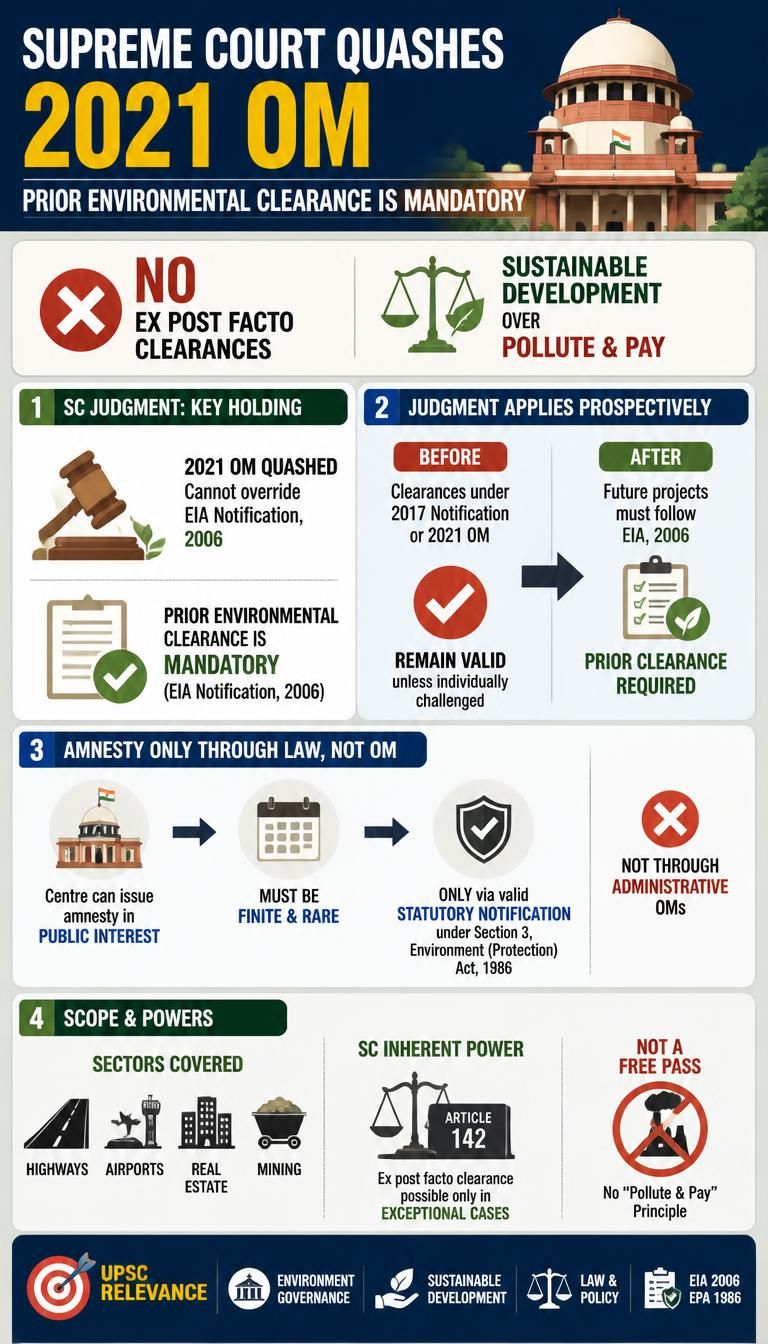
- The Supreme Court of India, on July 29, 2026, quashed the Ministry of Environment, Forest and Climate Change's (MoEFCC) 2021 Office Memorandum (OM) that allowed for perpetual ex-post facto environmental clearances (ECs).
- The Court ruled that administrative orders cannot create a permanent mechanism for retrospective project authorizations, emphasizing the mandatory nature of prior environmental clearance under the Environment (Protection) Act, 1986, and the EIA Notification of 2006.
- While setting aside the OM, the Supreme Court clarified that a "narrowly tailored amnesty scheme" for ex-post facto ECs may be permissible if it is based on a statutory notification and justified by "supervening public interest."
- This judgment applies prospectively, meaning existing environmental clearances granted under the 2021 OM will remain valid unless challenged individually.
- The ruling balances environmental protection with developmental needs, transforming open-ended administrative discretion into a circumscribed constitutional exception.
EP Act.jpg
Detailed Insights:
- The 2021 OM was deemed to have created a "perpetual amnesty scheme" that indiscriminately regularized projects, violating the principle of "pollute and then pay" rather than promoting sustainable development.
- The Court's decision marks an evolution in its stance, moving from a strict prohibition on ex-post facto clearances in its May 2025 judgment to allowing for statutory, public interest-driven exceptions.
- The Alembic Pharmaceuticals Ltd v Rohit Prajapati (2020) case previously established that retrospective clearances contradict the fundamental principles of environmental jurisprudence.
- The Court's insistence on proportionality aligns with India's environmental jurisprudence, which has long interpreted Article 21 (Right to Life) to include the right to a healthy environment.
- Future amnesty schemes must demonstrate compelling public interest, strict necessity for relaxation, and a thorough weighing of environmental costs against anticipated public benefits.
- Examples of projects that might qualify for such narrowly tailored amnesty include critical infrastructure like AIIMS medical colleges, cancer centers, airports, slum rehabilitation, and irrigation projects in drought-prone areas.
Key Concepts Involved:
- Environmental Impact Assessment (EIA): A process to evaluate the potential environmental, social, and economic impacts of a proposed project before decision-making, aiming to predict and mitigate adverse effects.
- Precautionary Principle: A principle stating that lack of full scientific certainty should not be a reason to postpone measures to prevent serious or irreversible environmental damage.
- Post-facto Environmental Clearance: Environmental approval granted to a project after it has already commenced construction or operation without prior mandatory clearance.
- Article 21 (Right to Life): A fundamental right in the Indian Constitution, judicially interpreted to encompass the right to a clean and healthy environment essential for a dignified life.

SuperKalam is your personal mentor for UPSC preparation, guiding you at every step of the exam journey.
Download the App


STUDY RESOURCES
CONTACT US
ⓒ Snapstack Technologies Private Limited