GS 2: GovernanceGS 3: Environment & EcologyGS 3: EconomyPrelimsGS 3: Infrastructure: Energy, Ports, Roads, Airports, Railways etc.
For renewable energy answers, ask the right questions, Pg10
CERC's controversial market coupling plan for power exchanges threatens India's renewable energy growth by centralizing control, hindering innovation and efficient grid integration.
Practice MCQs
811 Students attempted
Key Highlights:
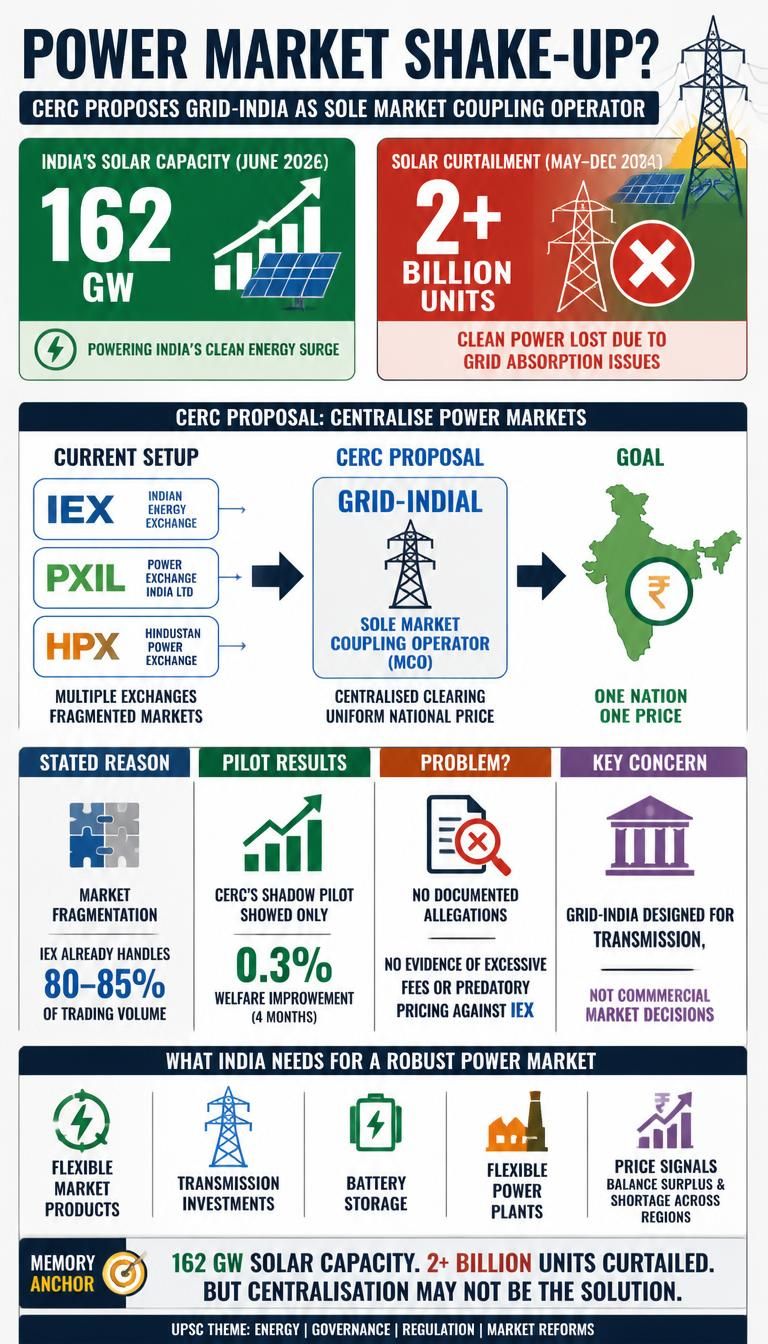
- India's solar capacity expanded to 162 GW by June 2026, driven by falling module prices and government policy.
- Over two billion units of solar electricity were curtailed between May and December last year due to grid absorption issues.
- The Central Electricity Regulatory Commission (CERC) proposed making Grid-India the sole Market Coupling Operator (MCO) for power exchanges.
- Grid-India, a government utility, is primarily designed for managing transmission systems, not commercial market decisions.
- The proposal aims to create a uniform national price by pooling bids from exchanges like IEX, PXIL, and HPX.
Power Market.jpg
Detailed Insights:
- The rapid growth in renewable energy necessitates flexible market products, transmission investments, battery storage, and flexible power plants.
- A robust electricity market is crucial to manage surplus generation in one region and shortages in another, using price signals.
- CERC's proposal, made in July 2025 and January 2026, suggests a centralized clearing algorithm under Grid-India.
- The stated rationale for the MCO is market fragmentation, but IEX already handles 80-85% of trading volumes.
- CERC's own shadow pilot indicated a minimal welfare improvement of only 0.3% over four months from market coupling.
- There are no documented allegations of excessive fees or predatory pricing against IEX, questioning the problem CERC is addressing.
- CERC previously ordered the discontinuation of user-defined hourly contracts in the Term-Ahead Market (TAM), hindering market innovation.
- Grid-India itself, in a June 8 submission, urged CERC to reconsider and suggested a round-robin system for the MCO role.
- Centralizing the clearing algorithm under a public utility could slow down market innovation and product development.
- The renewable sector requires a market architecture that rewards flexible capacity and enables competitive markets for services like frequency regulation.
Key Concepts Involved:
- Central Electricity Regulatory Commission (CERC): The statutory body that regulates the power sector in India, including tariffs and market operations.
- Grid-India: Formerly POSOCO, it is the national grid operator responsible for the integrated operation of the Indian power system.
- Market Coupling Operator (MCO): An entity that pools bids and offers from multiple power exchanges to determine a single, uniform market clearing price.
- Day-Ahead Market (DAM): A spot market where electricity is traded for delivery on the following day.
- Real-Time Market (RTM): A spot market where electricity is traded for delivery within a short timeframe, typically 15-minute blocks.
- Term-Ahead Market (TAM): A market segment for electricity contracts for delivery beyond the day-ahead, often for specific periods or blocks.

SuperKalam is your personal mentor for UPSC preparation, guiding you at every step of the exam journey.
Download the App


STUDY RESOURCES
CONTACT US
ⓒ Snapstack Technologies Private Limited