GS 2: GovernanceGS 2: International RelationsPrelimsGS 4: Ethical Issues in International Relations and FundingGS 2: Bilateral, Regional and Global Groupings and Agreements
Should permanent membership, veto powers of the UNSC be abolished?, Pg11
France proposes regulating UNSC veto power in humanitarian crises, sparking debate on P5 accountability and broader UN Security Council reforms.
Practice MCQs
782 Students attempted
Key Highlights:
- France has proposed regulating the UN Security Council (UNSC) veto in humanitarian crises, building on the French-Mexican initiative from 2015.
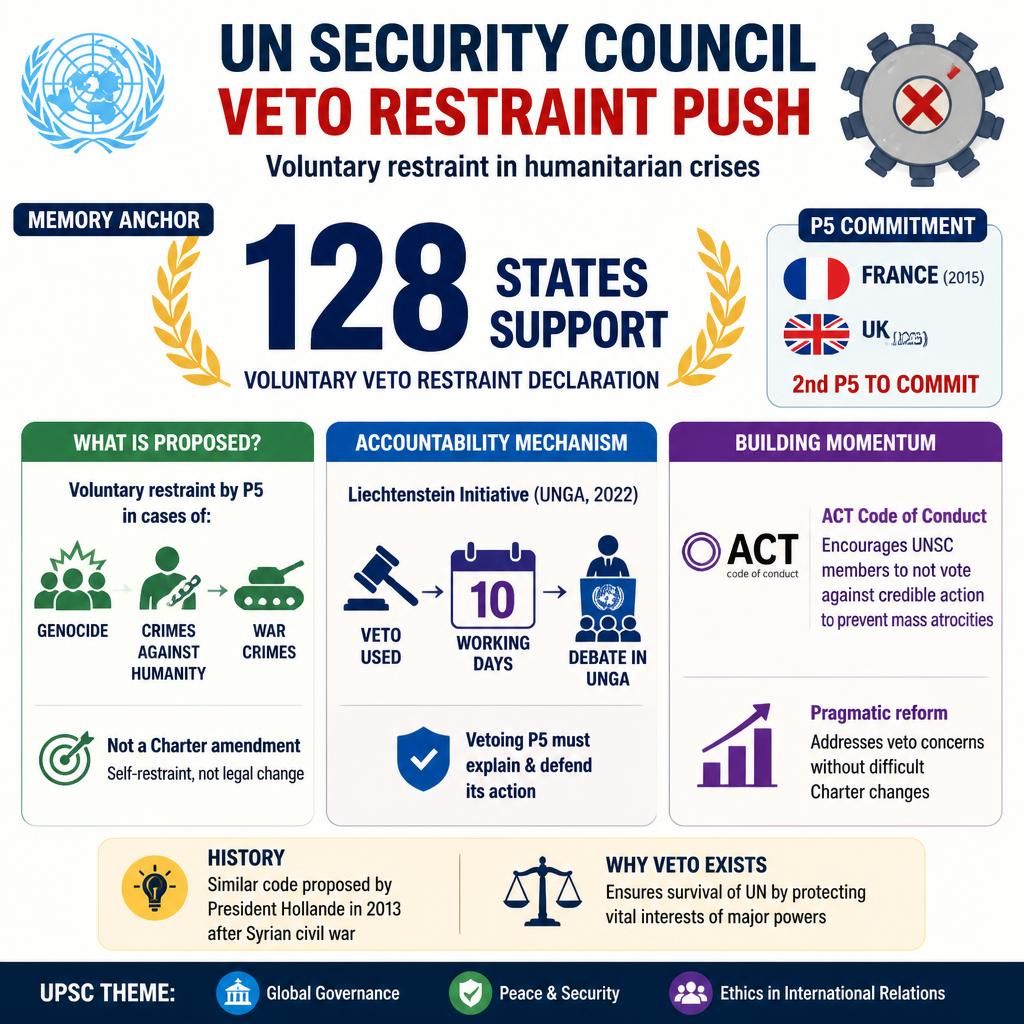
- This initiative advocates for P5 members to voluntarily refrain from using the veto in cases of genocide, crimes against humanity, and war crimes.
- Currently, 128 states support this declaration, with the United Kingdom joining France as the second P5 member to commit to voluntary restraint.
- The Liechtenstein initiative, adopted by the UN General Assembly (UNGA) in 2022, mandates a UNGA debate within 10 working days whenever a veto is cast.
- The ACT code of conduct encourages all UNSC members to not vote against credible action to prevent mass atrocities.
UNSC.jpg
Detailed Insights:
- The French proposal, articulated by President Emmanuel Macron, is a renewed push for self-restraint rather than an attempt to amend the UN Charter.
- The commitment of two P5 members (France and UK) adds significant political momentum to the voluntary restraint principle.
- Historically, a similar 'code of good conduct' was proposed by then-French President Francois Hollande in 2013 following the Syrian civil war and chemical attacks.
- The veto power, though not explicitly mentioned in the UN Charter, was established to ensure the survival of the international organization by not acting against major powers' interests.
- The Liechtenstein initiative aims to increase accountability by requiring the vetoing P5 member to explain and defend its action before the UNGA.
- These initiatives represent pragmatic, reformist approaches to address veto concerns without requiring the difficult process of UN Charter amendment.
Key Concepts Involved:
- UN Security Council (UNSC): Primary UN body responsible for maintaining international peace and security, with 15 members (5 permanent, 10 non-permanent).
- Veto Power: The right of the five permanent members of the UNSC to reject any substantive resolution, regardless of the level of international support.
- P5 (Permanent Five): The five permanent members of the UNSC: China, France, Russia, the United Kingdom, and the United States.
- UN General Assembly (UNGA): The main deliberative, policymaking, and representative organ of the United Nations, comprising all 193 member states.
- UN Charter: The foundational treaty of the United Nations, establishing its purposes, principles, and organizational structure.

SuperKalam is your personal mentor for UPSC preparation, guiding you at every step of the exam journey.
Download the App


STUDY RESOURCES
CONTACT US
ⓒ Snapstack Technologies Private Limited