GS 1: World GeographyGS 2: International RelationsPrelimsGS 2: Bilateral, Regional and Global Groupings and AgreementsGS 2: Effect of Policies and Politics of Developed and Developing Countries on India's Interests
A Chance To Retreat, Pg10
US secures expanded military access in Greenland through a new security deal with Denmark, bolstering Arctic strategy against China and Russia.
Practice MCQs
782 Students attempted
Key Highlights:
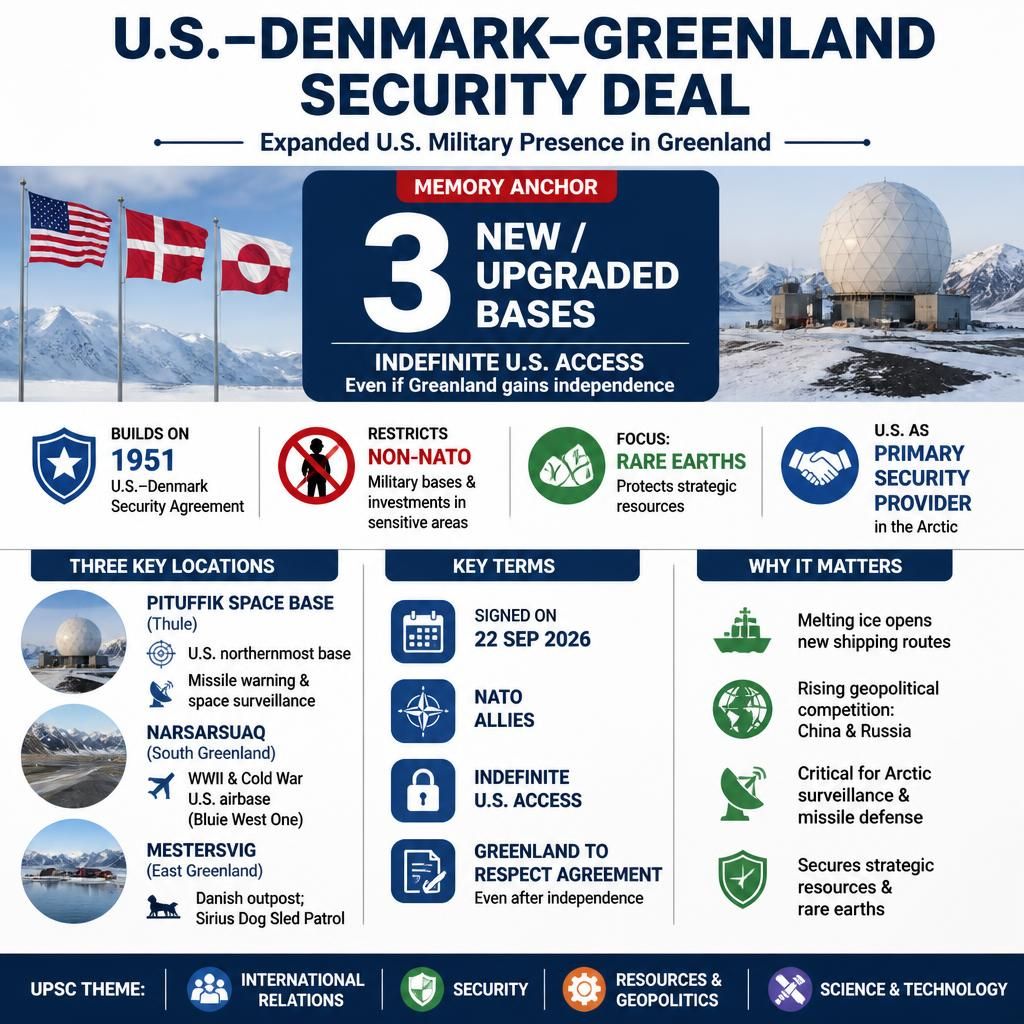
- A new security deal was signed on September 22, 2026, between the U.S., Denmark, and Greenland, allowing for an expanded U.S. military presence on the island.
- The agreement permits the U.S. to build new military facilities in Narsarsuaq and Mestersvig, and to modernize its existing Pituffik Space Base.
- This deal follows former President Donald Trump's earlier proposals to acquire Greenland and aims to solidify the U.S. role as a primary security provider in the Arctic region.
- The agreement formalizes restrictions, preventing non-NATO countries from establishing military installations or investing in sensitive areas, particularly those rich in rare earths.
US-Denmark-Greenland Deal.jpg
Detailed Insights:
- The new agreement builds upon the existing 1951 U.S.-Denmark security agreement, which grants the U.S. broad rights for military activities in Greenland.
- Pituffik Space Base, formerly Thule Air Base, is the U.S. Department of Defense's northernmost installation, crucial for missile warning and space surveillance.
- Narsarsuaq in southern Greenland was a significant U.S. military airbase (Bluie West One) during World War II and the Cold War.
- Mestersvig, located in eastern Greenland, is currently a Danish military outpost used by the Sirius Dog Sled Patrol.
- The Arctic region is increasingly vital due to melting ice opening new shipping routes and heightened geopolitical competition from countries like China and Russia.
- The deal ensures indefinite U.S. access to Greenland's military facilities and stipulates that Greenland will respect the agreement even if it gains independence.
Key Concepts Involved:
- NATO: A military alliance established in 1949, comprising North American and European countries, for collective defense.
- Rare Earths: A group of 17 metallic elements crucial for high-tech applications, with Greenland possessing significant deposits.
- Arctic Region: The northernmost polar region of Earth, gaining strategic importance due to climate change and geopolitical interests.

SuperKalam is your personal mentor for UPSC preparation, guiding you at every step of the exam journey.
Download the App


STUDY RESOURCES
CONTACT US
ⓒ Snapstack Technologies Private Limited