GS 2: International RelationsGS 3: EconomyPrelimsGS 3: Indian Economy, Planning, Mobilization of Resources, Growth, Development and EmploymentGS 2: Bilateral, Regional and Global Groupings and Agreements
What are the alternatives to the SWIFT payment system?, Pg12
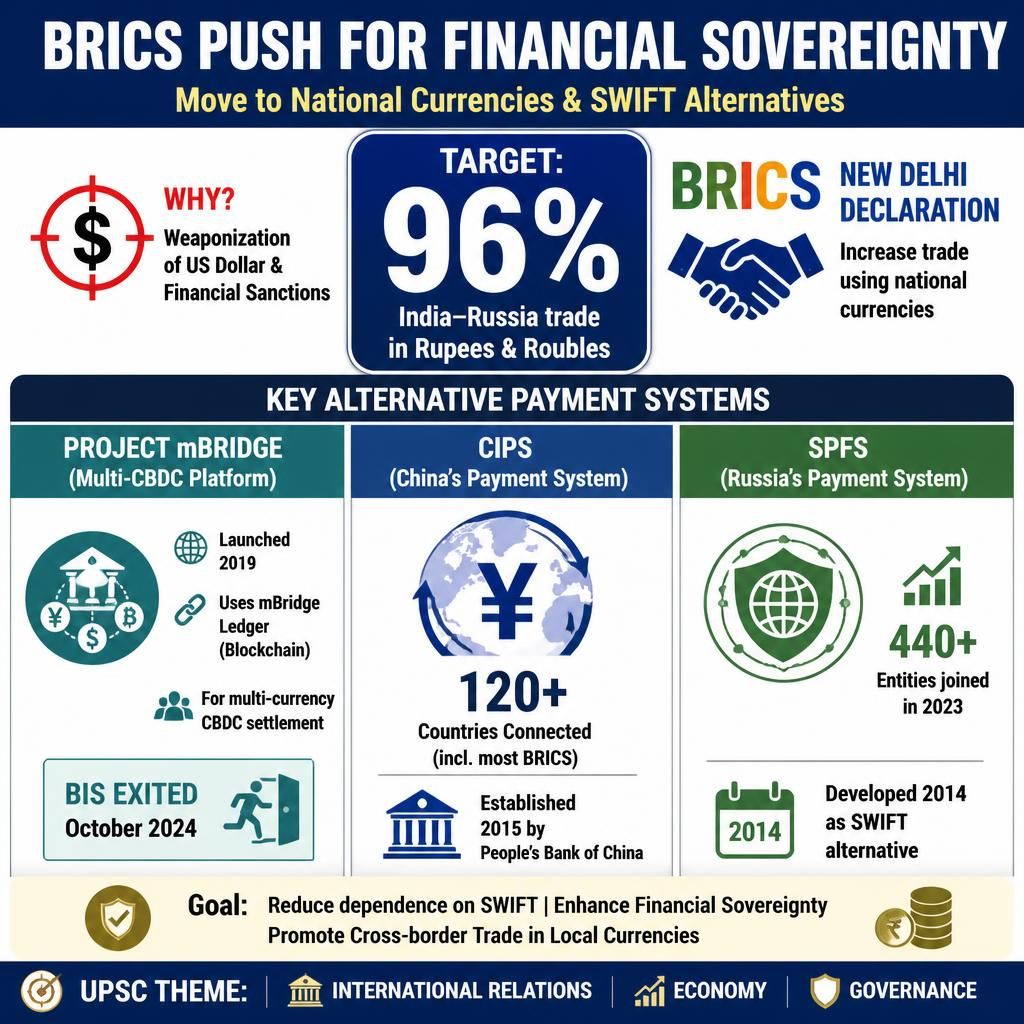
Global South nations, including BRICS, develop alternative payment systems like CIPS, SPFS, and mBridge to circumvent SWIFT amidst US dollar weaponization and sanctions.
Practice MCQs
782 Students attempted
Key Highlights:
- The New Delhi Declaration from the recent BRICS Summit resolved to increase trade among member countries using national currencies.
- Countries are actively seeking alternatives to the SWIFT payment system due to the increasing use of financial sanctions and the weaponization of the U.S. dollar.
- Key alternatives include Project mBridge, China's Cross-Border Interbank Payment System (CIPS), and Russia's System for Transfer of Financial Messages (SPFS).
- Project mBridge, a multi-CBDC platform, achieved minimum viability, with the Bank for International Settlements (BIS) exiting its support in October 2024.
- CIPS has expanded its reach to over 120 countries, including most BRICS members, facilitating significant yuan-denominated transactions.
- Russia's SPFS experienced rapid growth in 2023, with over 440 entities joining after Russian banks were disconnected from SWIFT.
- India and Russia conduct 96% of their bilateral trade using roubles and rupees, supported by 22 Russian and 17 Indian banks.
SWIFT Alternatives.jpg
Detailed Insights:
- The BRICS Summit in New Delhi considered linking Central Bank Digital Currencies (CBDCs) for cross-border payments, though this proposal was not included in the final declaration.
- The push for alternative payment systems is driven by geopolitical factors, particularly the impact of U.S. financial sanctions on countries in the Global South.
- Project mBridge was launched in 2019 by the Hong Kong Monetary Authority and the Bank of Thailand to enable direct peer-to-peer CBDC settlement.
- The platform utilizes the mBridge Ledger, a custom-built blockchain designed by central banks for multi-currency cross-border payments using CBDCs.
- The Bank for International Settlements (BIS)'s exit from Project mBridge in October 2024 raised speculation about its potential use to circumvent sanctions.
- CIPS was established by the People’s Bank of China in 2015 to promote the international use of the yuan by allowing direct onshore clearing of transactions.
- The inclusion of the renminbi in the Special Drawing Right (SDR) basket by the International Monetary Fund has contributed to the increased acceptance of CIPS.
- Despite its growth, CIPS processes a smaller volume of transactions compared to established global systems like the U.S.-based Clearing House Interbank Payments System.
- Russia developed SPFS in 2014 as a contingency against Western sanctions, which became critical when its banks were cut off from SWIFT in 2022.
- Iran's local interbank system, SEPAMA, is connected to SPFS, demonstrating a growing network of non-Western financial communication channels.
- The robust payment infrastructure between India and Russia, utilizing national currencies, is considered a highly effective mechanism for Russia's international trade settlements.
Key Concepts Involved:
- SWIFT: A global messaging network used by financial institutions to securely send and receive information and payment instructions.
- Central Bank Digital Currency (CBDC): A digital form of a country's fiat currency, issued and backed by its central bank.
- Bank for International Settlements (BIS): An international financial institution owned by central banks that fosters global monetary and financial cooperation.
- Special Drawing Right (SDR): An international reserve asset created by the International Monetary Fund to supplement member countries' official reserves.
- Global South: A term referring to countries in Asia, Africa, and Latin America, often characterized by developing economies and historical colonial ties.

SuperKalam is your personal mentor for UPSC preparation, guiding you at every step of the exam journey.
Download the App


STUDY RESOURCES
CONTACT US
ⓒ Snapstack Technologies Private Limited