GS 2: GovernanceGS 2: Social JusticeGS 2: International RelationsPrelimsGS 2: Government policies and interventions for development in various sectors
India’s foreign policy must look seaward, Pg6
India's foreign policy must urgently protect 3.2 lakh seafarers facing abandonment and conflict risks, demanding robust consular protocols and international cooperation.
Practice MCQs
767 Students attempted
Key Highlights:
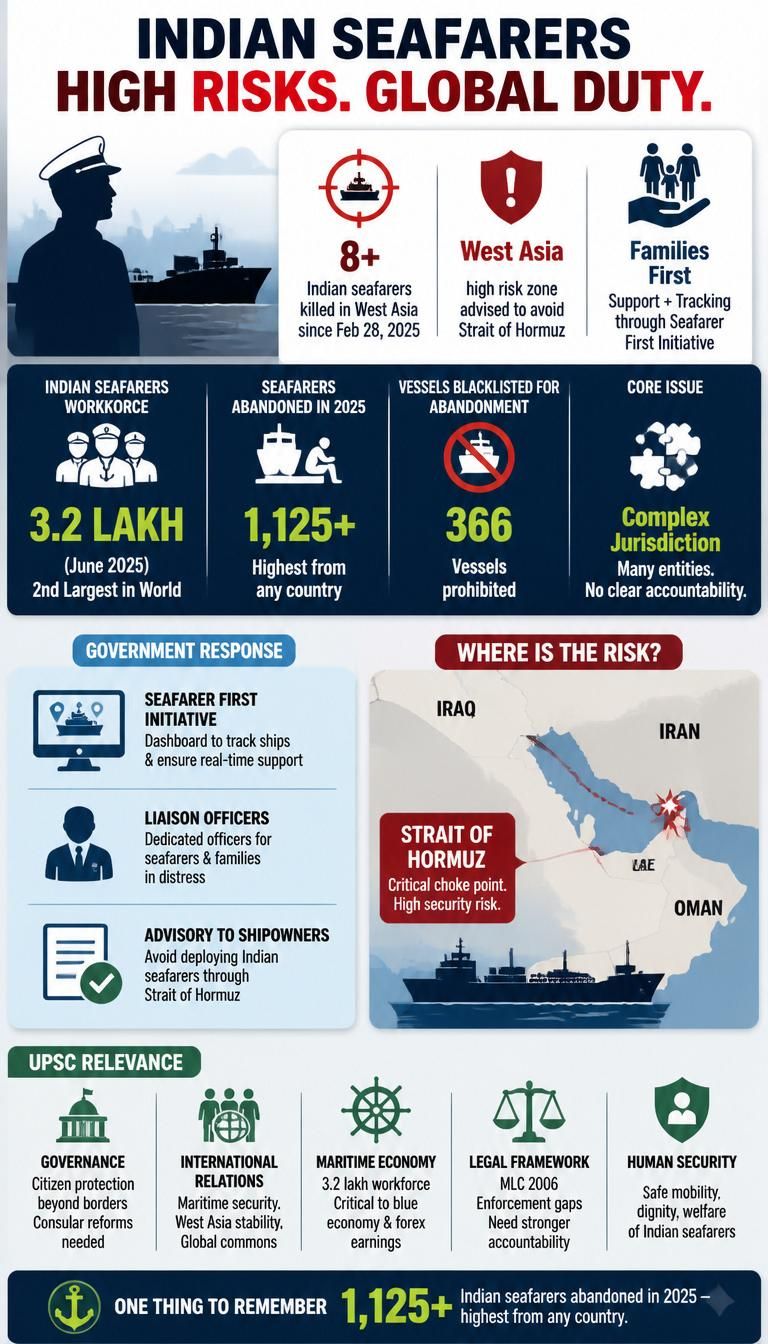
- Indian seafarers face significant risks globally, including attacks in West Asia and abandonment, despite India having the second-largest seafarer workforce.
- At least eight Indian seafarers were killed in West Asia since February 28, highlighting the dangers in conflict zones.
- The government launched the Seafarer First response initiative, including a dashboard to track ships and liaison officers for affected families.
- India advised shipowners to avoid deploying Indian seafarers through the Strait of Hormuz due to security concerns.
- The Directorate General of Shipping prohibited licensed recruitment agencies from placing Indian seafarers on 366 vessels linked to abandonment.
Seafarer.jpg
Detailed Insights:
- The complex international maritime framework often obscures responsibility for seafarer welfare, involving multiple jurisdictions and entities.
- India's seafarer workforce reached 3.2 lakh by June 2025, ranking second globally, underscoring the need for robust protection mechanisms.
- The current consular system, organized by territory, struggles to support mobile seafarers who cross multiple jurisdictions during voyages.
- Over 1,125 Indian seafarers were abandoned in 2025, the highest from any country, indicating systemic issues in enforcement of maritime labor laws.
- The Seafarer First response aims to proactively account for Indian seafarers in high-risk regions and provide support.
- Beyond West Asia, seafarers face threats from missiles, drones, and mines in the Black Sea and Red Sea, and piracy off the Gulf of Aden and West Africa.
- India needs a standing maritime consular protocol to define clear responsibilities from the moment a distress signal is received.
- Indian missions in major shipping centers require designated officers with local contacts to effectively assist seafarers.
- India should collaborate with the Philippines and Indonesia to advocate for common standards on repatriation at the International Maritime Organization and International Labour Organization.
- Seafarers should have the right to know vessel ownership, routes, sanctions status, and insurance validity before signing contracts.
Key Concepts Involved:
- Flag State: The country under whose laws a merchant ship is registered or licensed, determining its nationality.
- Maritime Labour Convention (MLC): An International Labour Organization convention setting out seafarers' rights to decent working and living conditions.
- International Maritime Organization (IMO): A specialized agency of the United Nations responsible for regulating shipping.
- Directorate General of Shipping: The Indian government body responsible for maritime administration and safety.

SuperKalam is your personal mentor for UPSC preparation, guiding you at every step of the exam journey.
Download the App


STUDY RESOURCES
CONTACT US
ⓒ Snapstack Technologies Private Limited