GS 3: Science & TechnologyGS 3: EconomyPrelimsGS 3: Indian Economy, Planning, Mobilization of Resources, Growth, Development and EmploymentGS 3: Indigenization of Technology and New Technology Development
India’s Tech Sector Needs Deeper Pools Of Risk Capital, Pg13
Despite a massive developer base, India's tech sector needs deeper risk capital to foster product ownership amidst declining seed funding for early-stage ventures.
Practice MCQs
760 Students attempted
Key Highlights:
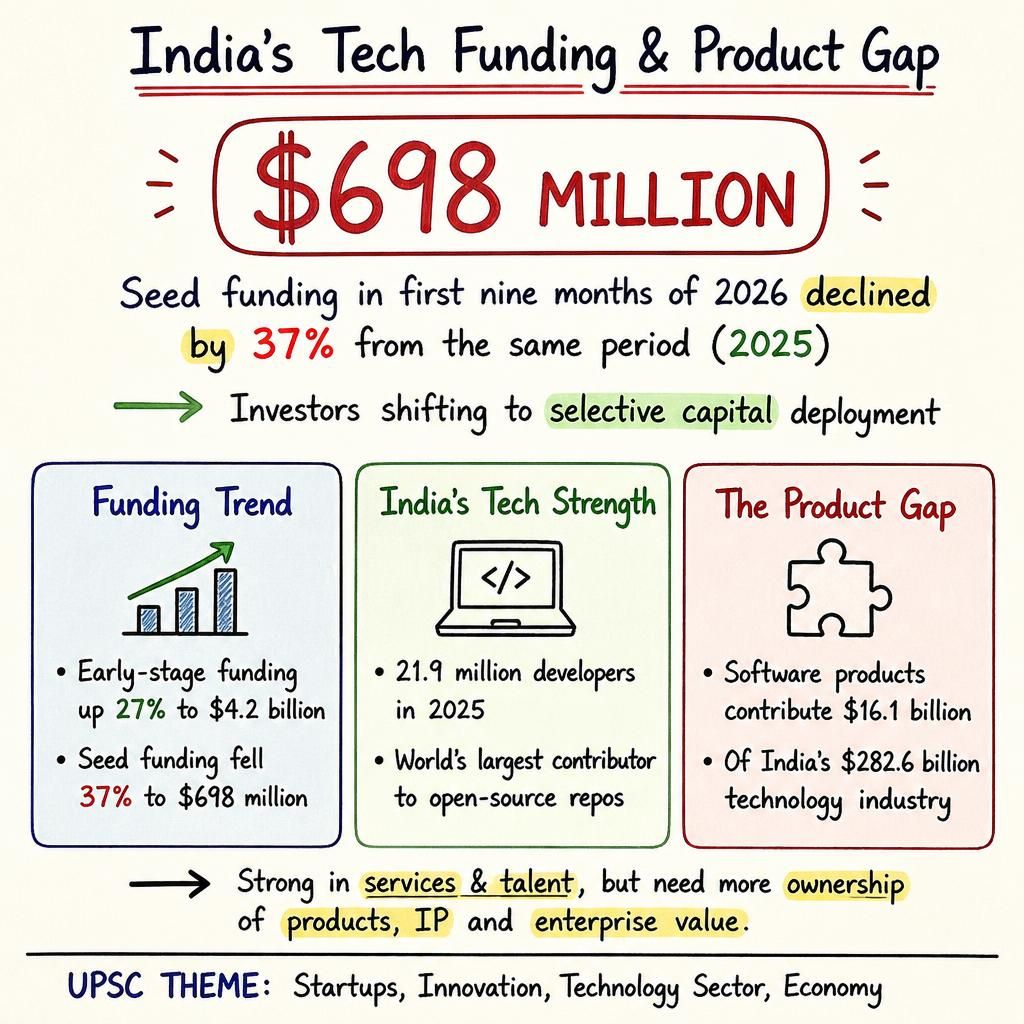
- In the first nine months of 2026, seed funding for Indian tech startups declined by 37% to $698 million, following a 30% drop in 2025.
- Concurrently, early-stage funding increased by 27% to $4.2 billion, indicating a shift towards more selective capital deployment by investors.
- India's developer base reached 21.9 million in 2025, making it the world's largest contributor to public and open-source repositories, according to GitHub estimates.
- The Indian technology industry employs approximately 5.8 million people, with Global Capability Centers (GCCs) alone employing about 2.36 million.
- NASSCOM estimates that software products contribute only $16.1 billion to India's $282.6 billion technology industry, highlighting a gap in product ownership.
Tech Funding.jpg
Detailed Insights:
- The decline in seed funding suggests that capital is becoming more selective, favoring companies with demonstrated traction over early-stage ideas.
- India excels in technology services and global delivery, but lags in building and owning globally scaled software products and platforms.
- The economic value created by India's large developer base is captured primarily through jobs, salaries, and profits from technology services.
- GCCs in India are evolving to handle high-value work like product engineering, AI, and R&D, contributing to deeper expertise within the country.
- The challenge lies in transitioning from a strong talent and services base to greater ownership of products, intellectual property, and enterprise value.
- While India has invested in innovation infrastructure, this cannot substitute for sufficient risk capital willing to fund unproven ideas.
- The current funding trend makes it harder for talented individuals to pursue product ownership through startups due to increased uncertainty.
- The future of the technology race is increasingly about who owns what developers build, especially with the advent of AI.
Key Concepts Involved:
- Seed Funding: The earliest stage of venture capital financing, typically provided to startups for initial product development and market research.
- Risk Capital: Financial capital provided to companies where there is a significant risk of loss, but also the potential for substantial returns.
- Global Capability Centers (GCCs): Offshore units of multinational corporations that perform high-value functions like R&D, IT, and business process management.

SuperKalam is your personal mentor for UPSC preparation, guiding you at every step of the exam journey.
Download the App


STUDY RESOURCES
CONTACT US
ⓒ Snapstack Technologies Private Limited