GS 3: Science & TechnologyGS 2: International RelationsPrelimsGS 2: Bilateral, Regional and Global Groupings and AgreementsGS 3: Space Technology
A piece of Mars's moon: Why Japan has sent a mission to Phobos, Pg15
Japan's JAXA launches MMX mission to Mars's moon Phobos, aiming to retrieve samples by 2031, advancing planetary exploration and international space cooperation.
Practice MCQs
760 Students attempted
Key Highlights:
- The Japan Aerospace Exploration Agency (JAXA) is undertaking the Martian Moons Exploration (MMX) mission, targeting Mars's moon Phobos.
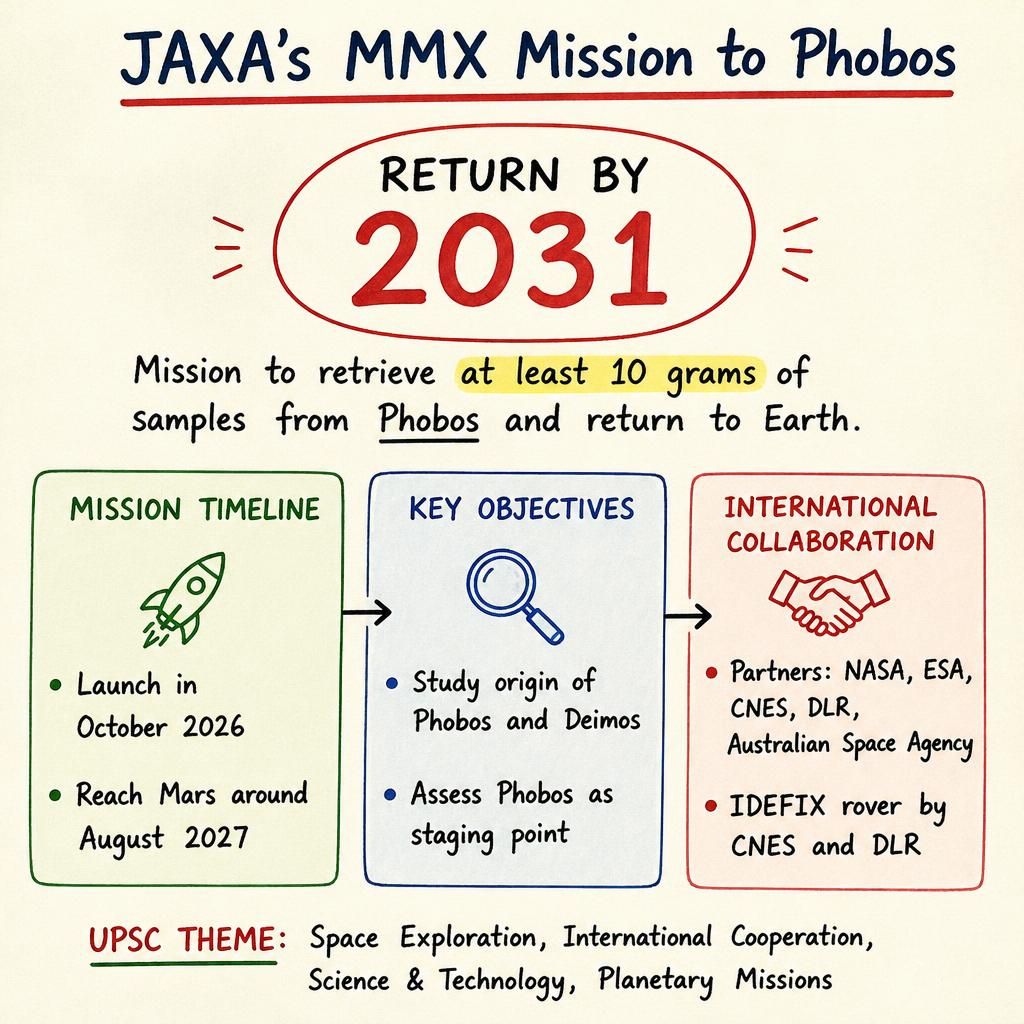
- The mission aims to retrieve at least 10 grams of physical samples from Phobos and return them to Earth by 2031.
- MMX is scheduled for launch in October 2026, with the spacecraft expected to reach Mars around August 2027.
- The mission seeks to study the origin of Mars's moons, Phobos and Deimos, and assess Phobos's potential as a staging point for future crewed missions to Mars.
- It involves international collaboration with agencies like NASA, European Space Agency (ESA), CNES (France), DLR (Germany), and the Australian Space Agency.
Jaxa Mission.jpg
Detailed Insights:
- The MMX mission will be the first to collect samples from a moon of Mars and return them to Earth, building on Japan's expertise in sample-return missions.
- Scientists are particularly interested in Phobos and Deimos due to two main theories regarding their origin: they are either captured asteroids or formed from debris after a large impact on Mars.
- The spacecraft will enter a quasi-satellite orbit around Phobos to conduct detailed observations of its topography and chemical composition before selecting a landing spot.
- A key component of the mission is the IDEFIX rover, developed jointly by CNES and DLR, which will be deployed on Phobos by the main craft.
- The mission will test advanced technologies for future deep-space exploration, including autonomous navigation and landing in extremely weak gravity environments.
- Phobos's weak gravity makes it an attractive potential staging point for crewed Mars missions, as landing and taking off would require significantly less fuel than from Mars itself.
- The mission's timing coincides with a period where major space powers are advancing planetary exploration capabilities, positioning Japan as a leader in this field.
- In contrast, the NASA-ESA Mars Sample Return program, which aimed to bring samples from Mars itself, was effectively halted due to budgetary constraints and technical challenges.
Scientific/Technical Concepts Involved:
- Phobos and Deimos: The two small, irregularly shaped natural satellites orbiting Mars.
- Quasi-satellite orbit: An orbit where an object appears to orbit a planet but is primarily gravitationally bound to the Sun, with the planet's gravity influencing its path.
- Sample-return mission: A space mission designed to collect samples from a celestial body and bring them back to Earth for detailed analysis.

SuperKalam is your personal mentor for UPSC preparation, guiding you at every step of the exam journey.
Download the App


STUDY RESOURCES
CONTACT US
ⓒ Snapstack Technologies Private Limited