GS 2: GovernanceGS 3: Environment & EcologyGS 3: EconomyPrelimsGS 3: E Technology in Aid of Farmers
Harvesting the Sun, and powering the farm, Pg13
India to host Agrivoltaics World Conference, promoting AgriPV for farmer empowerment, clean energy, and rural prosperity under PM-KUSUM.
Practice MCQs
760 Students attempted
Key Highlights:
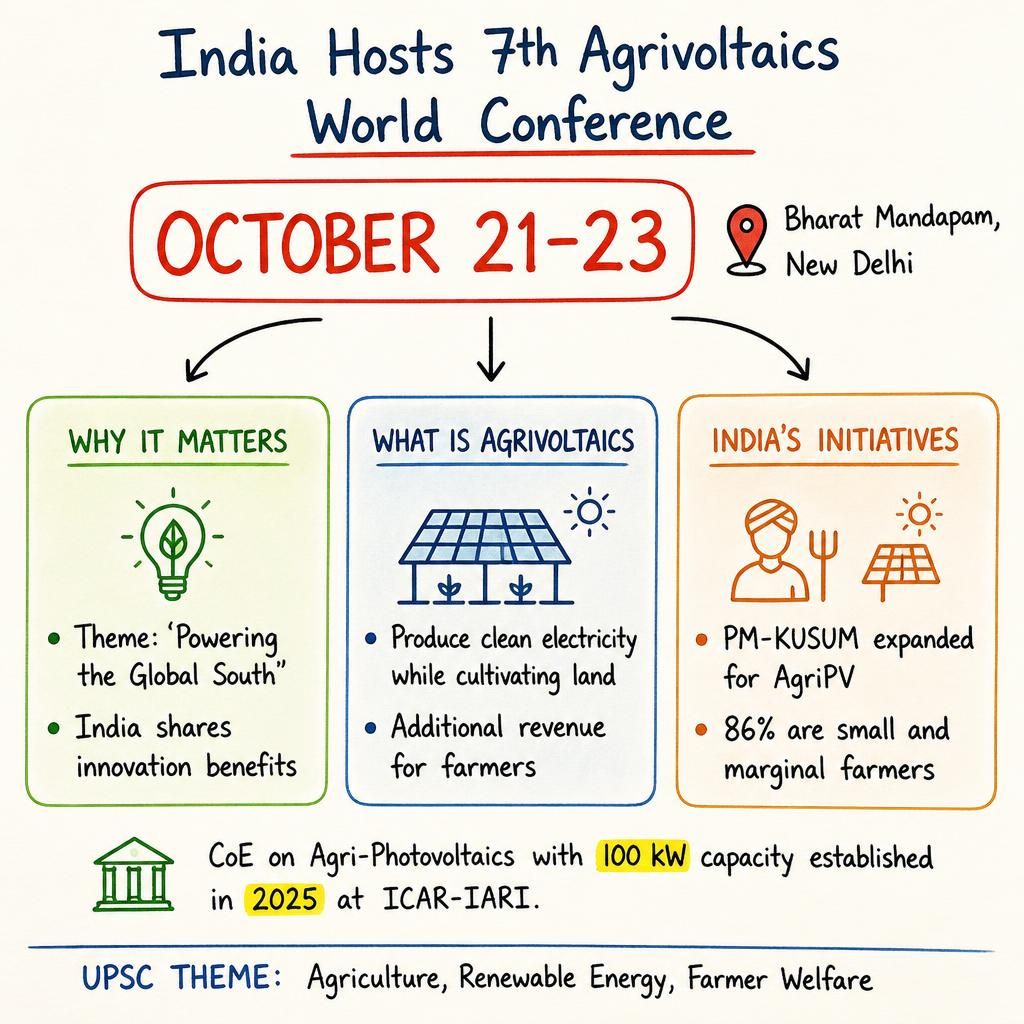
- India is hosting the 7th Agrivoltaics World Conference at Bharat Mandapam in New Delhi from October 21 to 23.
- The conference theme, 'Powering the Global South', highlights India's commitment to sharing agricultural innovation and energy transition benefits.
- Agrivoltaics (AgriPV) enables farmers to produce clean electricity while simultaneously cultivating land, offering an additional revenue stream.
- The PM-KUSUM scheme is being expanded to accelerate solar energy generation by creating separate space for AgriPV.
- The initiative aims to empower small and marginal farmers, who constitute approximately 86% of India's farming community.
- A Centre of Excellence (CoE) on Agri-Photovoltaics with 100 kW capacity was established in 2025 at ICAR-Indian Agricultural Research Institute (IARI).
Agri-Photovoltaics.jpg
Detailed Insights:
- Agrivoltaics provides farmers with an additional source of revenue from electricity generation and reduces costs by replacing diesel or purchased power.
- The system creates a favorable microclimate, offering protection against heat stress, drought, excessive solar radiation, and hail for crops.
- Optimal crop selection, emphasizing shade tolerance and stable productivity under intermittent radiation, is crucial for successful AgriPV adoption.
- AgriPV designs typically aim to maintain around 70% or more of natural incoming radiation at the crop canopy, with adjustable panels providing flexibility.
- The CoE on Agri-Photovoltaics is jointly led by ICAR and the National Institute of Solar Energy (NISE) under the guidance of the Ministry of New and Renewable Energy.
- Data generated from the CoE over two years will provide technical suggestions on specific crop suitability, boundary conditions, and optimal integration of agricultural fields and solar panels.
- India's experience in AgriPV includes research by ICAR’s Central Arid Zone Research Institute in Jodhpur and BAIF’s Rural Innovation Centre in Pune.
- The International Solar Alliance, launched by India and France, provides a foundation for cooperation on solar energy, creating further scope for joint AgriPV research and training.
- Ensuring farmer trust, protecting land ownership, and involving tenant cultivators and women farmers in project design and benefit sharing are critical for successful implementation.
Key Concepts Involved:
- Agrivoltaics (AgriPV): A system that integrates solar photovoltaic panels on agricultural land, allowing for simultaneous electricity generation and crop cultivation.
- PM-KUSUM: A scheme by the Indian government aimed at solarizing agricultural pumps and promoting decentralized solar power generation in rural areas.
- Viksit Bharat: A vision to transform India into a developed nation by 2047, focusing on economic prosperity, social progress, and good governance.
- International Solar Alliance (ISA): An intergovernmental organization of 121+ member countries, primarily "sunshine countries," working to promote solar energy.

SuperKalam is your personal mentor for UPSC preparation, guiding you at every step of the exam journey.
Download the App


STUDY RESOURCES
CONTACT US
ⓒ Snapstack Technologies Private Limited