GS 2: GovernanceGS 3: Environment & EcologyGS 3: EconomyPrelims
Share of funding spent on environmental initiatives in 2023-24, Pg10
Shocking report reveals only 8.4% of CSR funds targeted environment in FY24, with climate-vulnerable districts receiving a paltry 1%.
Practice MCQs
739 Students attempted
Key Highlights:
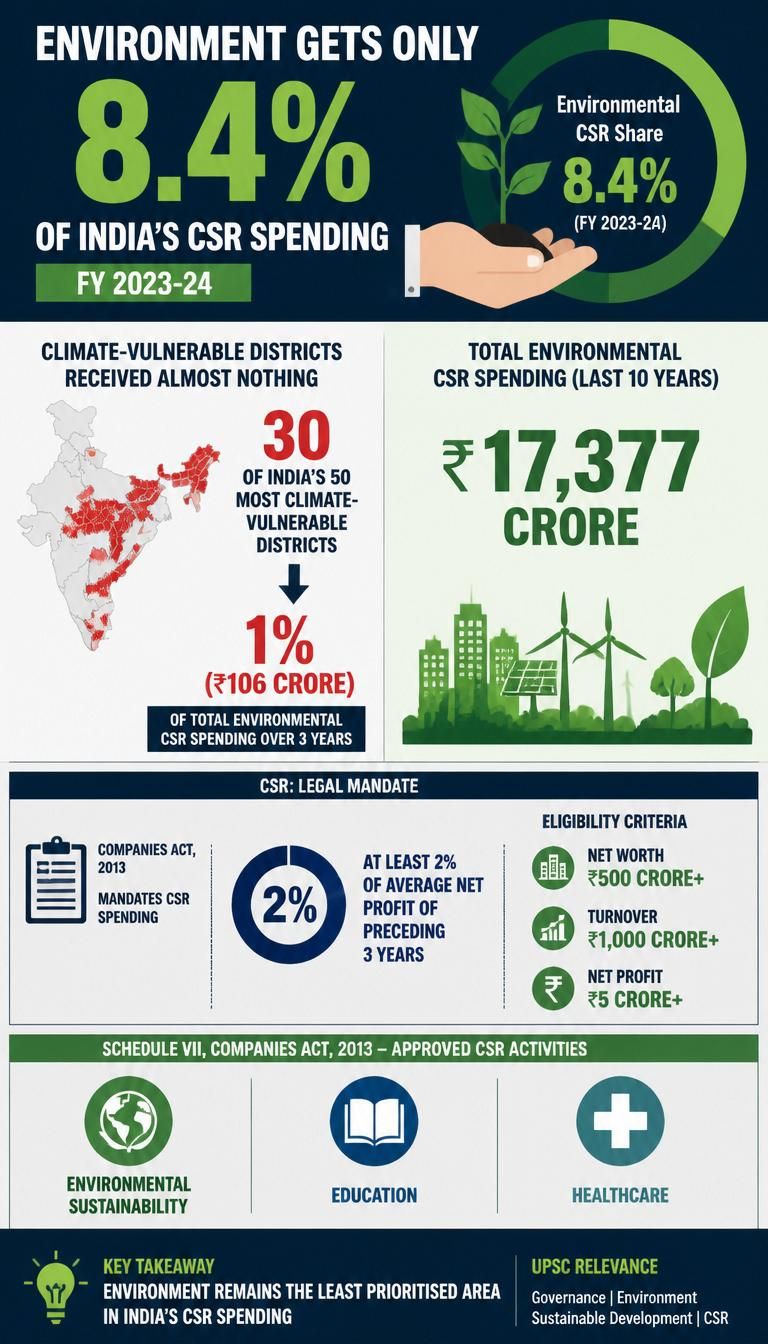
- Only 8.4% of the total Corporate Social Responsibility (CSR) spending in India was allocated to environmental initiatives in the financial year 2023-24.
- A report by Sattva Consulting revealed this figure, highlighting a low focus on environmental causes.
- Over the past three years, 30 of India’s 50 most climate-vulnerable districts received only 1% (₹106 crore) of the total environmental CSR spending.
- Total environmental CSR spending over the last decade amounted to ₹17,377 crore.
Environment CSR.jpg
Detailed Insights:
- The Companies Act, 2013, mandates that eligible companies spend at least 2% of their average net profit from the preceding three years on CSR activities.
- Companies with a net worth of ₹500 crore or more, turnover of ₹1,000 crore or more, or a net profit of ₹5 crore or more are subject to CSR provisions.
- Schedule VII of the Companies Act, 2013, outlines the approved CSR activities, which include promoting environmental sustainability, education, and healthcare.
- The Sattva Consulting report indicates a significant disparity between the areas receiving environmental CSR funds and those with the highest climate risk.
- India is recognized as one of the most climate-vulnerable countries, with a large proportion of its districts susceptible to hydro-meteorological disasters.
- The ₹17,377 crore spent on environmental CSR over a decade is a small fraction of the estimated $2.5 trillion needed to achieve India's Nationally Determined Contributions (NDCs) by 2030.
- Environmental CSR funding is primarily directed towards water management, renewable energy, and plantation activities, often through small-scale, multi-location projects.
- Achieving the goals of Viksit Bharat 2047 and India's Net Zero 2070 commitment necessitates substantial investment in climate solutions.
Key Concepts Involved:
- Corporate Social Responsibility (CSR): A mandatory obligation under the Companies Act, 2013, for eligible companies to contribute to social and environmental welfare.
- Companies Act, 2013: Indian legislation that legally mandates CSR for qualifying companies, defining spending thresholds and permissible activities.
- Climate Vulnerability: The susceptibility of a system to the adverse impacts of climate change, including climate variability and extreme weather events.
- Nationally Determined Contributions (NDCs): Climate action targets set by countries under the Paris Agreement to reduce greenhouse gas emissions and adapt to climate change.

SuperKalam is your personal mentor for UPSC preparation, guiding you at every step of the exam journey.
Download the App


STUDY RESOURCES
CONTACT US
ⓒ Snapstack Technologies Private Limited