GS 3: EconomyPrelims
Forex inflows received by India under the RBI’s swap facility, Pg10
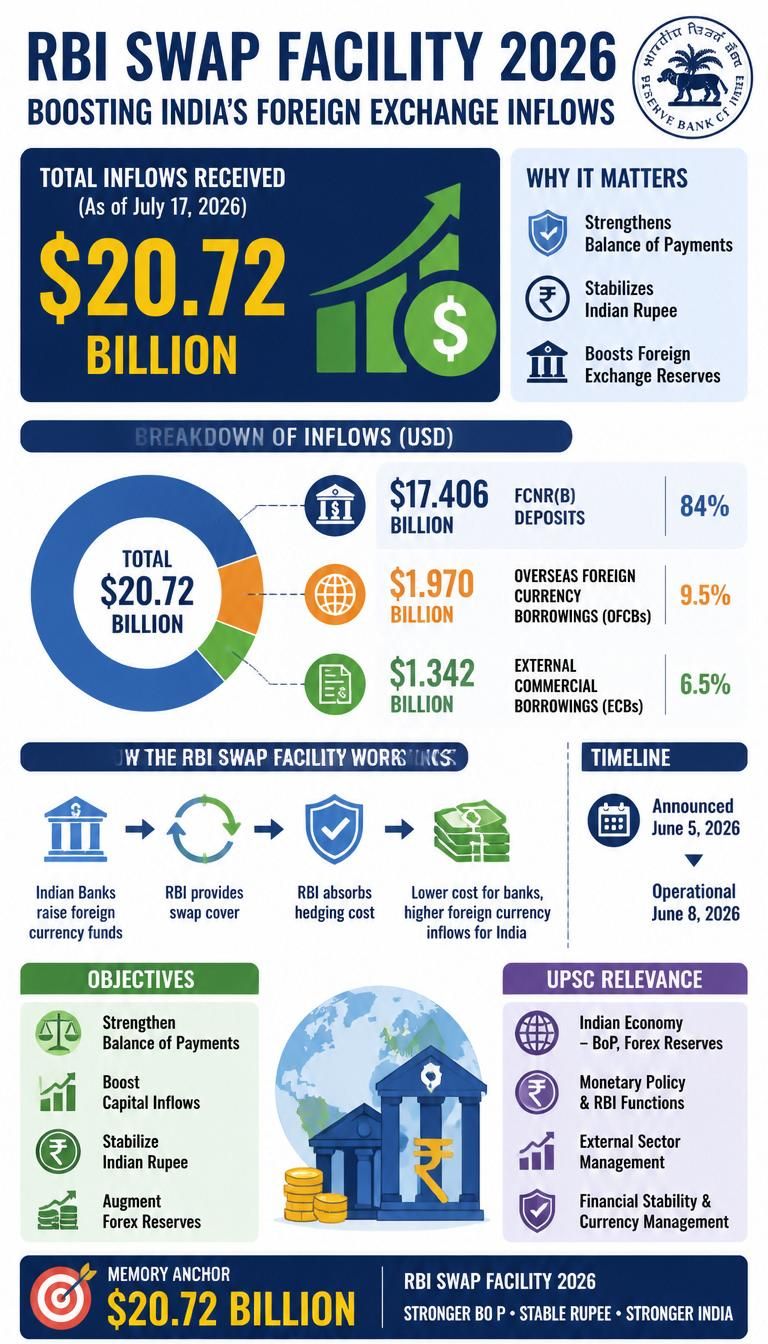
India secures $20.72 billion in forex inflows via RBI's swap facility by July 17, boosting state-owned firms' overseas fundraising.
Practice MCQs
739 Students attempted
Key Highlights:
- India received $20.72 billion in foreign exchange inflows under the Reserve Bank of India (RBI)'s swap facility as of July 17, 2026.
- The facility was introduced to encourage overseas fundraising by state-owned firms and attract Foreign Currency Non-Resident (Bank) Deposits (FCNR(B)).
- The largest portion of these inflows, $17.406 billion, came through FCNR(B) deposits.
- The remaining inflows were from Overseas Foreign Currency Borrowings (OFCBs) totaling $1.97 billion and External Commercial Borrowings (ECBs) amounting to $1.342 billion.
RBI Swap.jpg
Detailed Insights:
- The RBI announced these special measures on June 5, 2026, and made them operational on June 8, 2026.
- The primary objectives of the facility are to strengthen India's Balance of Payments (BoP), boost capital inflows, and stabilize the Indian Rupee and foreign exchange reserves.
- Under this scheme, the RBI absorbs the hedging cost for the swaps, making it more attractive for banks to mobilize foreign currency funds.
- The window for fresh FCNR(B) deposits under the concessional swap facility is open until September 30, 2026.
- The concessional swap facility for ECBs and OFCBs will continue until December 31, 2026.
- This initiative is reminiscent of similar measures undertaken by the RBI in 2013 to attract foreign currency during periods of economic pressure.
Key Concepts Involved:
- RBI's Swap Facility: A mechanism where the Reserve Bank of India offers concessional foreign exchange swaps to banks to encourage specific types of foreign currency inflows.
- Foreign Currency Non-Resident (Bank) Deposits (FCNR(B)): Fixed-term deposits held by Non-Resident Indians (NRIs) in foreign currencies with Indian banks, protecting against rupee depreciation.
- External Commercial Borrowings (ECBs): Loans raised by eligible resident entities from recognized non-resident entities, often used for capital expenditure.
- Overseas Foreign Currency Borrowings (OFCBs): Borrowings by Authorized Dealer Category-I banks in foreign currency from overseas markets.
- Balance of Payments (BoP): A statement summarizing all economic transactions between residents of a country and the rest of the world over a specific period.

SuperKalam is your personal mentor for UPSC preparation, guiding you at every step of the exam journey.
Download the App


STUDY RESOURCES
CONTACT US
ⓒ Snapstack Technologies Private Limited