GS 3: Internal SecurityGS 2: International RelationsPrelims
Indus Waters Treaty: Govt focus on Chenab projects, renegotiation, Pg1
India pushes for Chenab hydropower projects and IWT renegotiation with Pakistan, citing terror and treaty's outdated utility.
Practice MCQs
739 Students attempted
Key Highlights:
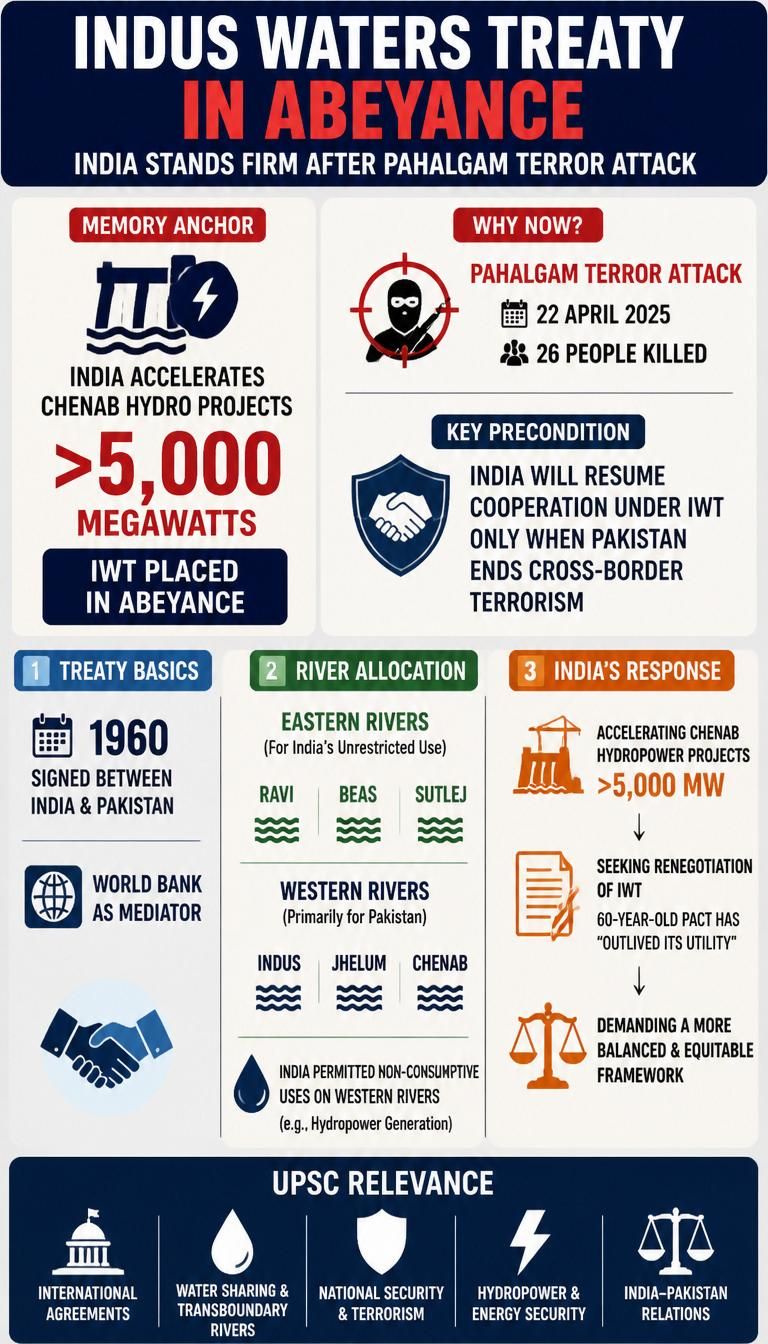
- India has placed the Indus Waters Treaty (IWT) "in abeyance" following the Pahalgam terror attack.
- The government is accelerating the development of hydropower projects on the Chenab River, with a combined capacity exceeding 5,000 megawatts.
- India seeks renegotiation of the IWT, asserting that the six-decade-old pact has "outlived its utility" and requires a more balanced format.
- A key precondition for India to resume cooperation under the IWT is Pakistan ending cross-border terrorism.
- The Pahalgam terror attack, which prompted India's stance, occurred on April 22, 2025, resulting in the deaths of 26 people.
IWT.jpg
Detailed Insights:
- The Indus Waters Treaty (IWT) was signed in 1960 between India and Pakistan, with the World Bank acting as a mediator.
- Under the treaty, the Eastern Rivers (Ravi, Beas, and Sutlej) are allocated for India's unrestricted use, while the Western Rivers (Indus, Jhelum, and Chenab) are primarily for Pakistan.
- India is permitted to undertake non-consumptive uses, such as hydropower generation, on the Western Rivers.
- The Pahalgam attack was carried out by militants, with groups like The Resistance Front (TRF), a proxy of Lashkar-e-Taiba, claiming responsibility.
- Key hydropower projects being fast-tracked on the Chenab River include Pakal Dul, Ratle, Kiru, and Kwar, with an estimated total capacity of approximately 6,000 MW upon completion.
- The Permanent Indus Commission (PIC), established by the IWT, serves as a bilateral mechanism for cooperation and dispute resolution.
- The IWT does not contain a unilateral exit clause, meaning any amendments or modifications require mutual agreement between India and Pakistan.
Key Concepts Involved:
- Indus Waters Treaty (IWT): A water-distribution treaty signed in 1960 between India and Pakistan, brokered by the World Bank, governing the use of the Indus River system.
- Permanent Indus Commission (PIC): A bilateral body formed under the IWT with commissioners from both India and Pakistan to implement the treaty and resolve issues.
- Eastern Rivers: The Ravi, Beas, and Sutlej rivers, whose waters are allocated to India for unrestricted use under the IWT.
- Western Rivers: The Indus, Jhelum, and Chenab rivers, primarily allocated to Pakistan, with India allowed limited non-consumptive uses like hydropower generation.

SuperKalam is your personal mentor for UPSC preparation, guiding you at every step of the exam journey.
Download the App


STUDY RESOURCES
CONTACT US
ⓒ Snapstack Technologies Private Limited