GS 2: GovernanceGS 2: PolityGS 3: Science & TechnologyPrelims
Allow parents to opt out of APAAR ID data sharing, SC tells CBSE, Pg3
Supreme Court mandates CBSE to allow parents to opt out of APAAR ID data sharing, upholding privacy and 'right to be forgotten' against mandatory digital academic passports.
Practice MCQs
739 Students attempted
Key Highlights:
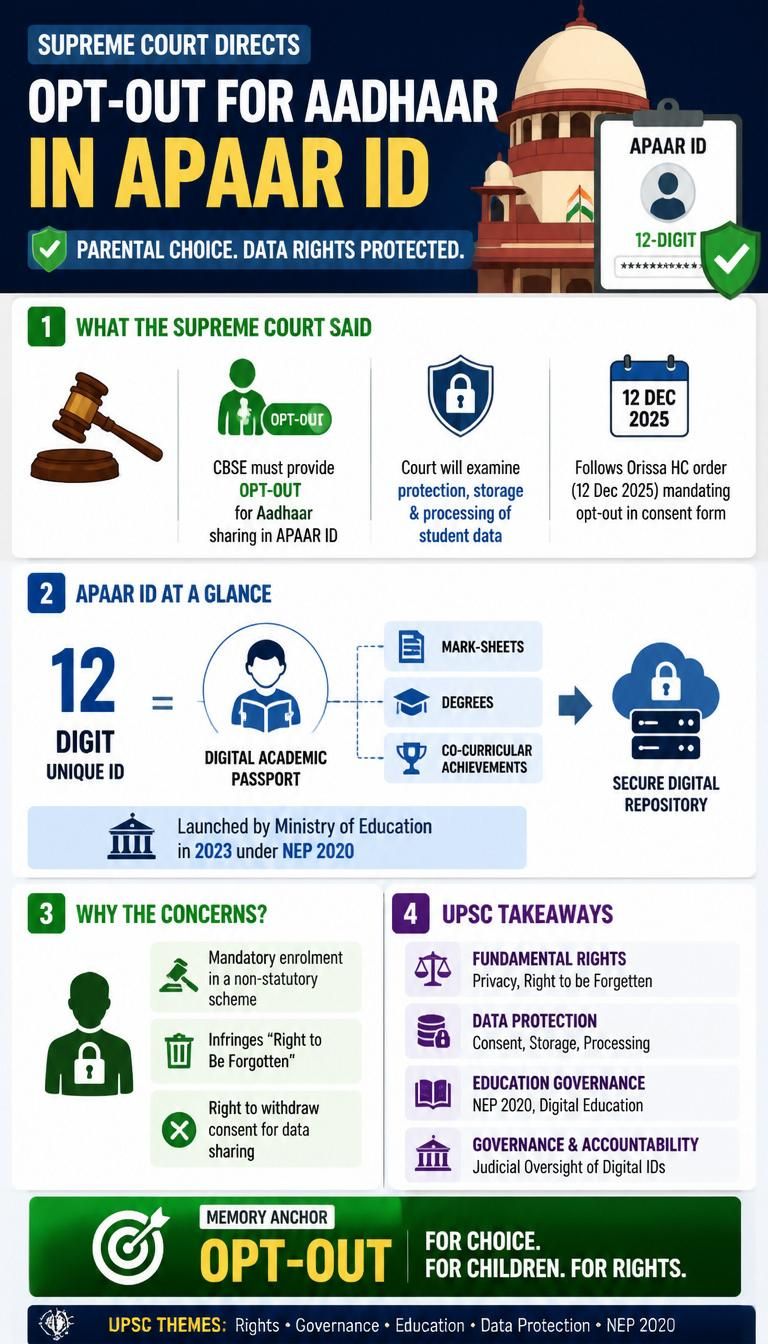
- The Supreme Court announced it will direct the Central Board of Secondary Education (CBSE) to allow parents to opt out of sharing their children’s Aadhaar details for the Automated Permanent Academic Account Registry (APAAR) ID.
- This directive follows an order from the Orissa High Court issued on December 12, 2025, which mandated an opt-out option in the consent form.
- The Supreme Court, comprising Chief Justice of India Surya Kant, and Justices Joymalya Bagchi and V Mohana, also stated it would address concerns regarding the protection, storage, and processing of students’ personal data.
- The APAAR ID, a 12-digit identification number, was launched by the Ministry of Education in 2023 under the National Education Policy (NEP).
APAAR ID.jpg
Detailed Insights:
- The APAAR ID functions as a digital academic passport, designed to securely store educational records like mark-sheets, degrees, and co-curricular achievements on a single platform.
- Petitioners argued that mandatory enrollment in this non-statutory scheme infringes upon the right to be forgotten and the ability to withdraw consent for data sharing.
- The Orissa High Court ruling in Rohit Anand Das and Another vs Union of India and Others specifically called for an amendment to the model consent form to include an opt-out/refusal of consent option.
- The National Education Policy (NEP) 2020, under which APAAR ID was conceptualized, aims to transform India's education system into a more inclusive, flexible, and multidisciplinary one.
- The Aadhaar system, established under the Aadhaar (Targeted Delivery of Financial and Other Subsidies, Benefits and Services) Act, 2016, provides a unique 12-digit identification number to residents of India.
Key Concepts Involved:
- APAAR ID: A unique 12-digit digital identity for students in India, storing academic records and achievements, launched under the National Education Policy (NEP) 2020.
- Aadhaar: A 12-digit unique identification number issued by the Unique Identification Authority of India (UIDAI) to residents, serving as proof of identity.
- National Education Policy (NEP) 2020: A comprehensive framework introduced by the Indian government to guide the development of education in the country.
- Right to be forgotten: The right of an individual to have their private information removed from public platforms, particularly the internet, under certain circumstances.

SuperKalam is your personal mentor for UPSC preparation, guiding you at every step of the exam journey.
Download the App


STUDY RESOURCES
CONTACT US
ⓒ Snapstack Technologies Private Limited