The Centre-states tussle over the Mines and Minerals Bill, Pg12
New Mines and Minerals Bill sparks Centre-state tussle over mineral taxation, threatening state revenues and raising federalism concerns after Supreme Court ruling.
Practice MCQs
724 Students attempted
Key Highlights:
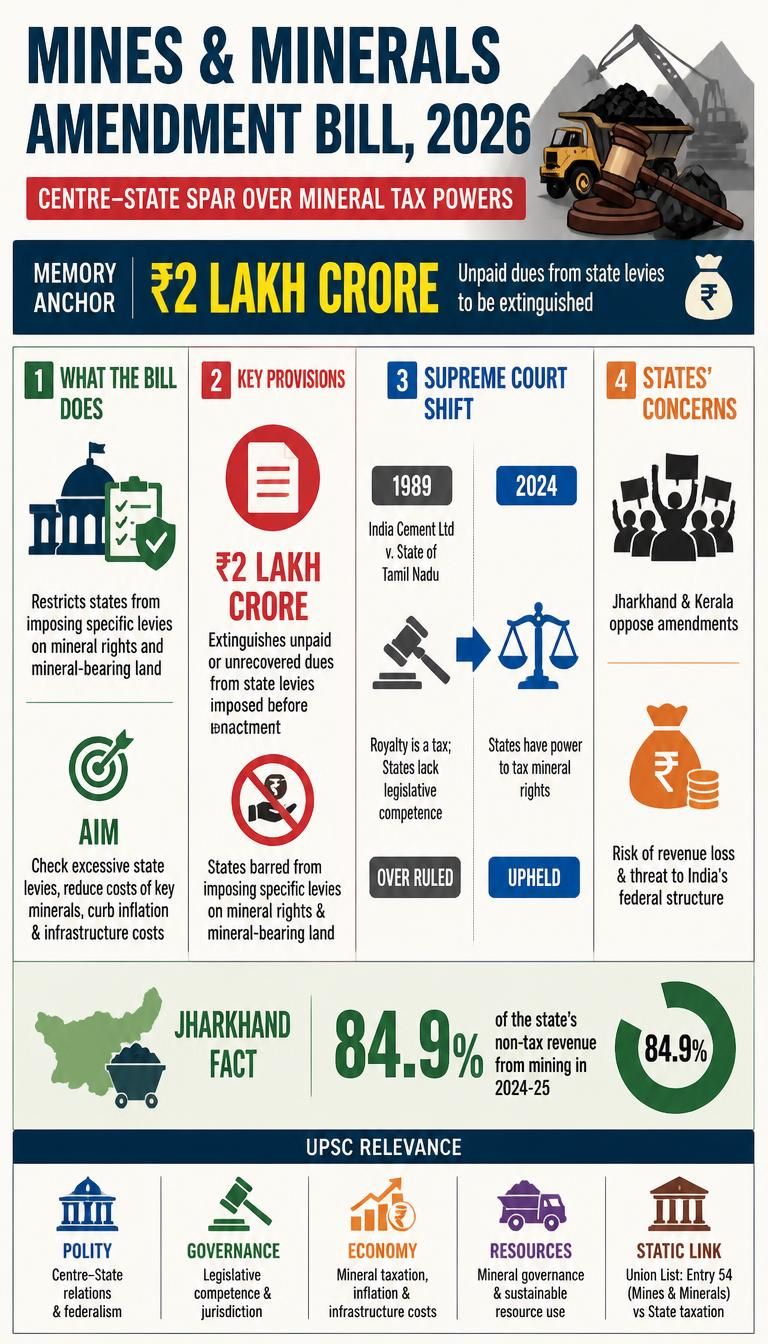
- The Mines and Minerals (Development and Regulation) Amendment Bill, 2026 was passed in Parliament, sparking a Centre-state dispute.
- The Bill restricts states from imposing specific levies on mineral rights and mineral-bearing land.
- This move aims to counter state-level taxation that followed the Supreme Court’s 2024 ruling upholding states' power to tax mineral rights.
- States like Jharkhand and Kerala have opposed the amendments, citing potential revenue loss and concerns over India's federal structure.
Mines Bill.jpg
Detailed Insights:
- The amendments seek to address what the Centre perceives as excessive cess and other levies imposed by some states.
- The Bill will extinguish unpaid or unrecovered dues from such levies imposed before its enactment, estimated at around Rs 2 lakh crore.
- The Centre argues that unchecked state levies could increase the cost of key minerals, contributing to inflation and infrastructure costs.
- The Supreme Court’s 2024 ruling had overruled the 1989 India Cement Ltd v. State of Tamil Nadu judgment.
- The 1989 ruling had held that royalty was a tax and states lacked legislative competence as the subject falls under the Union List.
- Jharkhand Chief Minister Hemant Soren stated that mining revenue accounts for approximately 84.9% of the state’s non-tax revenue in 2024-25.
- The Mineral Bearing Land Cess alone was projected to generate around Rs 11,000 crore annually for Jharkhand.
- Industry experts believe the amendments will provide fiscal certainty for mining companies by preventing multiple and excessive levies.
- Existing levies such as royalty, District Mineral Foundation contributions, and National Mineral Exploration Trust contributions will remain.
Key Concepts Involved:
- Mines and Minerals (Development and Regulation) Amendment Bill, 2026: Legislation restricting states from imposing certain levies on mineral rights and land.
- Federal Structure: A system of governance where power is constitutionally divided between a central authority and constituent political units.
- Union List: A list in the Seventh Schedule of the Indian Constitution detailing subjects on which only the Parliament can legislate.
- District Mineral Foundation: A non-profit trust established in mining-affected districts to work for the benefit of persons and areas affected by mining.
- National Mineral Exploration Trust: A non-profit body established to promote mineral exploration in India.

SuperKalam is your personal mentor for UPSC preparation, guiding you at every step of the exam journey.
Download the App


STUDY RESOURCES
CONTACT US
ⓒ Snapstack Technologies Private Limited