GS 3: EconomyPrelimsGS2: Government policies and interventions for development in various sectorsGS3: Indian Economy, Planning, Mobilization of Resources, Growth, Development and Employment
The rupee's borrowed breathing space , Pg11
RBI's FCNR(B) facility provides temporary rupee stability, attracting NRI deposits but shifting hedging costs to public balance sheet, creating future banking risks.
Practice MCQs
724 Students attempted
Key Highlights:
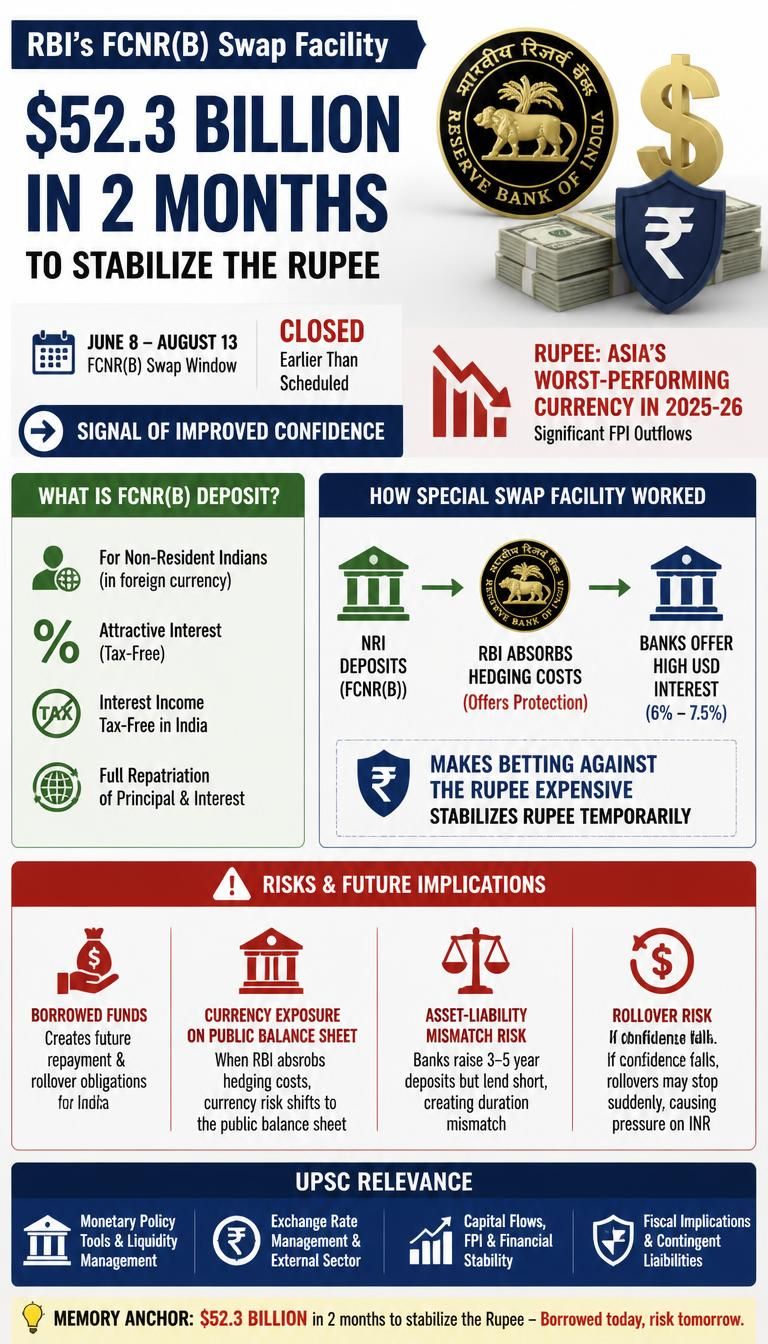
- The Reserve Bank of India (RBI) implemented a special swap facility for Foreign Currency Non-Resident (Bank) [FCNR(B)] deposits to stabilize the Indian Rupee.
- This facility mobilized $52.3 billion in foreign-currency inflows between June 8 and August 13.
- The RBI closed the FCNR(B) swap window earlier than scheduled, signaling a perceived improvement in confidence.
- The Rupee was Asia's worst-performing currency in 2025-26, leading to significant foreign portfolio investor outflows.
FCNR Swap.jpg
Detailed Insights:
- The FCNR(B) scheme allows non-resident Indians to hold foreign currency deposits in Indian banks, offering tax-free interest and full repatriation.
- Under the special swap facility, the RBI absorbed the hedging costs, enabling banks to offer attractive dollar interest rates (6-7.5%).
- This mechanism effectively made betting against the Rupee expensive, thereby stabilizing its value temporarily.
- The article highlights that this inflow represents borrowed funds, creating future repayment and rollover obligations for India.
- When the RBI absorbs hedging costs, the currency exposure shifts to the public balance sheet.
- Banks raising three-to-five-year money and lending against it can create an asset-liability mismatch.
- The long-term solution involves building export-surplus sectors, attracting Foreign Direct Investment (FDI), and reducing energy import dependence.
Key Concepts Involved:
- FCNR(B) deposits: Foreign currency deposits held by Non-Resident Indians (NRIs) in Indian banks, offering tax-free interest and full repatriation.
- Current Account Deficit (CAD): Occurs when a country's total value of imports of goods, services, and transfers is greater than its total value of exports.
- Asset-Liability Mismatch: A situation where the duration or nature of a bank's assets and liabilities do not align, creating interest rate or liquidity risks.
- Carry Trade: A strategy where an investor borrows in a currency with a low interest rate and invests in a currency with a higher interest rate.

SuperKalam is your personal mentor for UPSC preparation, guiding you at every step of the exam journey.
Download the App


STUDY RESOURCES
CONTACT US
ⓒ Snapstack Technologies Private Limited