GS 2: GovernanceGS 3: Science & TechnologyGS 3: Environment & EcologyGS 3: EconomyPrelims
Turning Battery Waste Into Strategic Mineral Wealth, Pg6
India must urgently implement battery recycling strategies to transform e-waste into strategic critical mineral wealth, ensuring resource security and industrial growth.
Practice MCQs
883 Students attempted
Key Highlights:
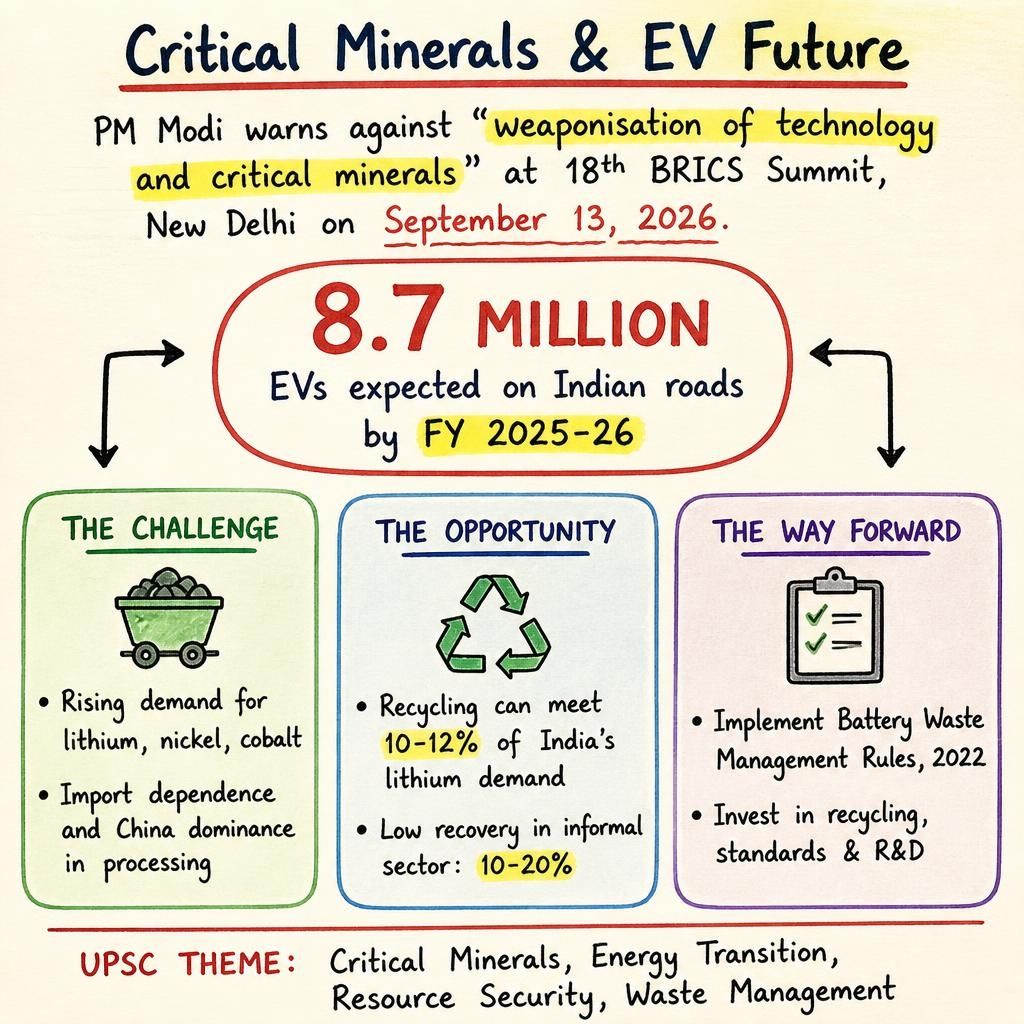
- Prime Minister Narendra Modi warned against the “weaponisation of technology and critical minerals” at the 18th BRICS Summit in New Delhi on September 13, 2026.
- India faces a rising demand for critical minerals like lithium, nickel, and cobalt, essential for electrification and lithium-ion batteries.
- The country is heavily dependent on imports for these minerals, with supply chains vulnerable to geopolitical tensions and China dominating processing.
- Recycling end-of-life (EoL) lithium-ion batteries is identified as a strategic opportunity to secure domestic mineral supplies.
- By FY 2025-26, over 8.7 million EVs are expected on Indian roads, significantly increasing the volume of spent batteries.
- Recycling could meet 10-12% of India’s lithium demand for EV battery manufacturing, providing a crucial secondary source.
- The Battery Waste Management Rules, 2022, provide a foundational framework for this recycling ecosystem.
Critical Minerals.jpg
Detailed Insights:
- The global demand for critical minerals is surging due to the increasing shift towards electrification in transport and other energy-intensive sectors.
- Geographically concentrated supply chains and resource nationalism make access to critical minerals vulnerable to disruptions.
- India's current informal recycling sector for lithium-ion batteries achieves low material recovery rates of 10-20%, compared to over 90% in formal facilities.
- Developing a robust recycling ecosystem can help India build its own critical minerals processing capability, which is currently lacking.
- Early and proactive investment in recycling facilities is crucial to avoid challenges when the volume of spent batteries significantly increases.
- A holistic strategy includes incorporating recycled critical minerals into a proposed national critical mineral stockpile to ensure predictable demand.
- Intensified research and development (R&D) in mineral recycling technologies is necessary to address diverse battery chemistries and improve recovery rates.
- Establishing clear standards for battery characterisation, recycled mineral quality, and second-life applications, supported by testing infrastructure, is vital.
- Easier collection mechanisms, such as remunerated take-back or buy-back options offered by EV manufacturers, are essential for public participation.
- Battery recyclers require patient capital to establish facilities due to long gestation periods and initial risks of under-utilization.
- Building circularity into the EV system now can transform EoL batteries from an environmental liability into a domestic resource and buffer against supply shocks.
Key Concepts Involved:
- Critical Minerals: Elements essential for modern technologies and economies, often with limited supply or concentrated processing.
- Lithium-ion Batteries: Rechargeable batteries commonly used in electric vehicles and portable electronics, containing critical minerals.
- Extended Producer Responsibility (EPR): A policy approach where producers are responsible for the entire life cycle of their products, including take-back and recycling.
- Circular Economy: An economic system focused on eliminating waste and the continual use of resources, contrasting with the traditional linear economy.

SuperKalam is your personal mentor for UPSC preparation, guiding you at every step of the exam journey.
Download the App


STUDY RESOURCES
CONTACT US
ⓒ Snapstack Technologies Private Limited