GS 3: Science & TechnologyPrelimsGS 3: Achievements of Indians in Science and TechnologyGS 3: Indigenization of Technology and New Technology DevelopmentGS 3: Space Technology
Gravitational-wave astronomy is entering its statistical era, Pg2
Gravitational-wave astronomy enters statistical era with new 390-event catalogue, enabling large-scale black hole studies and testing Einstein's relativity.
Practice MCQs
883 Students attempted
Key Highlights:
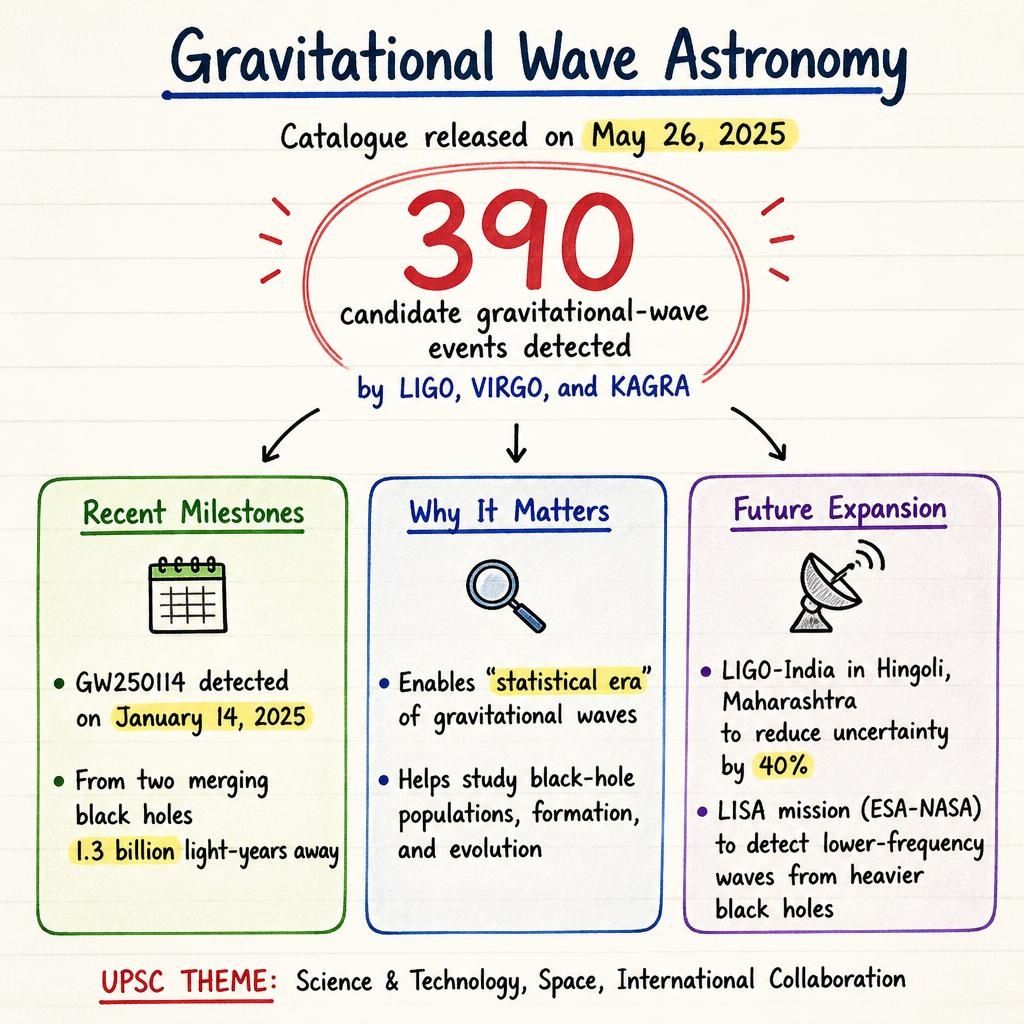
- On January 14, 2025, the LIGO observatories detected GW250114, a gravitational wave from two merging black holes 1.3 billion light-years away.
- Gravitational-wave astronomy has entered its "statistical era," enabling the study of large-scale patterns among black holes.
- A new catalogue, released on May 26, 2025, by an international collaboration, includes 390 candidate gravitational-wave events detected by LIGO, VIRGO, and KAGRA.
- LIGO-India, located in Hingoli, Maharashtra, is planned to enhance the precision of gravitational wave source triangulation.
- The LISA mission, a joint ESA and NASA project, aims to detect lower-frequency gravitational waves from heavier black holes using three satellites.
Gravitational Wave.jpg
Detailed Insights:
- Gravitational waves are ripples in spacetime caused by the rapid acceleration of massive objects like black holes and neutron stars.
- The new catalogue, 70% larger than its predecessor, facilitates the study of black-hole populations, their formation, and evolution, and helps validate theoretical predictions.
- Current detectors' northern latitude locations limit precise source triangulation, resulting in large sky area uncertainties.
- LIGO-India's strategic southerly placement is projected to reduce the average area of uncertainty by 40%.
- Scientists use gravitational wave signals, specifically "chirps" and "ringdowns," to test Einstein's General Theory of Relativity under extreme cosmic conditions.
- The clear ringdown of the GW250114 signal allowed for detailed measurements that consistently matched predictions from general relativity.
- Current gravitational wave detectors are more sensitive to nearby sources and signals from objects above a specific minimum mass.
- Analysis of the catalogue indicates a non-uniform distribution of black hole masses, with an abundance around 10 solar masses and a tendency for 35 solar mass black holes to merge with similar companions.
- These mass distribution patterns offer insights into black hole formation mechanisms, including binary star evolution, gravitational capture in star clusters, and sequential mergers.
- The spin direction of black holes provides crucial clues, with only about 15% of detected black holes exhibiting rapid spins.
- Gravitational-wave data helps reconcile stellar physics, such as identifying a predicted mass gap around 44 solar masses due to pair-instability supernovae.
- Similar to radio and optical astronomy, gravitational-wave astronomy is now capable of statistical studies, providing insights into the universe's expansion rate.
- An analysis this year, using gravitational-wave data, estimated the universe's expansion rate at 71 km/s per megaparsec, improving precision by 26% over previous gravitational-wave estimates.
- While the May catalogue focused on black hole mergers, previous detections include neutron star inspirals, which can also produce observable electromagnetic counterparts.
Scientific/Technical Concepts Involved:
- Gravitational Waves: Ripples in spacetime caused by accelerating massive objects, propagating at the speed of light.
- Spacetime: A four-dimensional continuum combining three dimensions of space and one dimension of time, central to Einstein's General Theory of Relativity.
- Black Hole Merger: The process where two black holes orbit, spiral inward, and coalesce to form a single, more massive black hole.
- General Theory of Relativity: Einstein's theory describing gravity as a curvature of spacetime caused by mass and energy.

SuperKalam is your personal mentor for UPSC preparation, guiding you at every step of the exam journey.
Download the App


STUDY RESOURCES
CONTACT US
ⓒ Snapstack Technologies Private Limited