GS 3: Science & TechnologyPrelimsGS 3: Science and Technology in Everyday Life
Meson to Muons: Ultra-Rare Decay, Pg II
CERN scientists observe ultra-rare B0 meson decay into muons, confirming Standard Model predictions but highlighting its incompleteness regarding dark matter.
Practice MCQs
876 Students attempted
Key Highlights:
- Scientists at CERN have observed evidence of an ultra-rare decay of the B0 meson into two muons (one positive, one negative).
- This decay is predicted by the Standard Model of particle physics to occur only about 1 in 10 billion times.
- The observation was made at CERN's Large Hadron Collider (LHC) with a statistical significance of 3.2 sigma.
- The measured properties of this decay align with the predictions of the Standard Model, which helps to rule out certain proposed extensions to the theory.
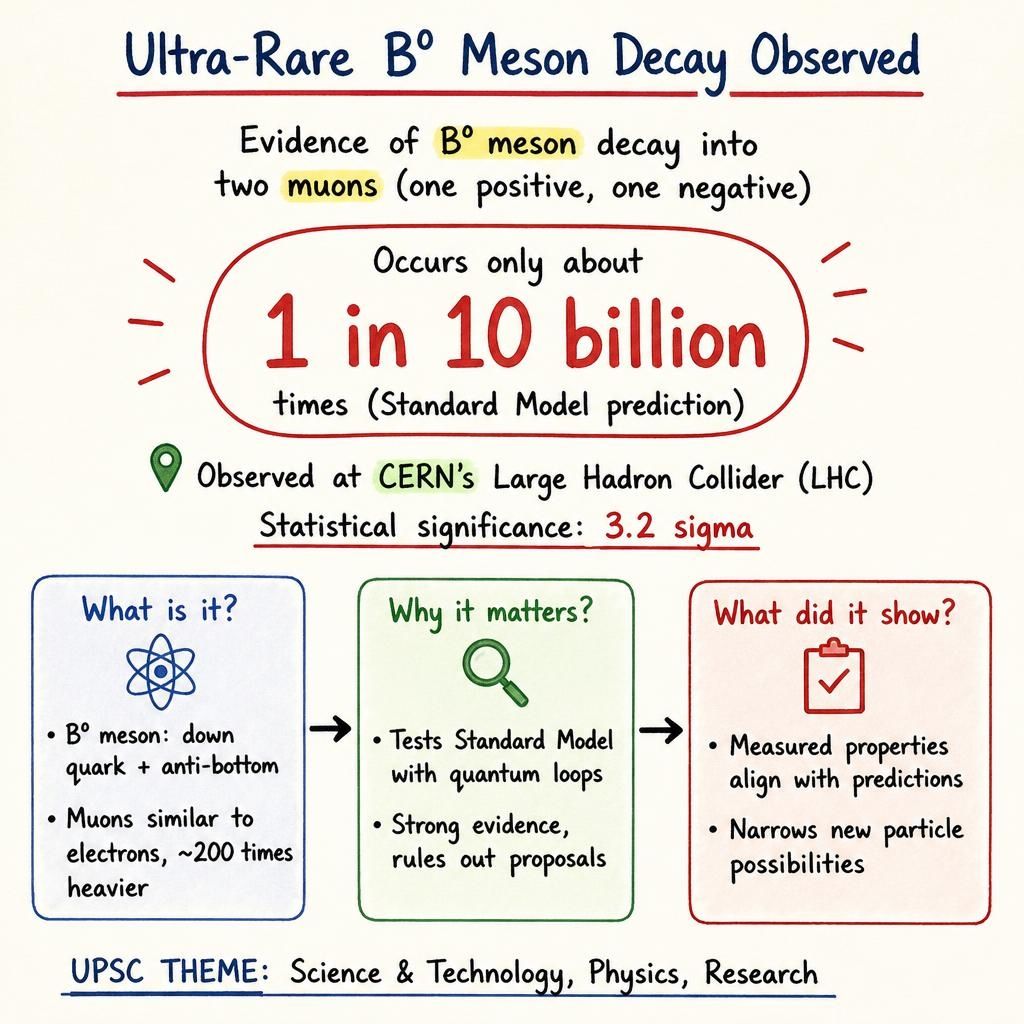
Meson Decay.jpg
Detailed Insights:
- The B0 meson is a subatomic particle composed of a down quark and an anti-bottom quark, existing for a fraction of a second before decaying.
- Muons are elementary particles similar to electrons but are approximately 200 times heavier.
- The Standard Model is the fundamental theory describing elementary particles and three of the four fundamental forces (excluding gravity).
- A statistical significance of 3.2 sigma indicates strong evidence for the phenomenon, though 5 sigma is typically required for a formal "discovery" in particle physics.
- This rare decay process involves quantum loops with heavy particles, making it a sensitive probe for physics beyond the Standard Model.
- The agreement with the Standard Model in this specific decay narrows the possibilities for where new, undiscovered particles might exist.
- This research contributes to refining our understanding of the universe's fundamental building blocks and their interactions.
Scientific/Technical Concepts Involved:
- Standard Model: A theoretical framework in physics that describes the fundamental particles and forces governing their interactions, excluding gravity.
- B0 Meson: An unstable subatomic particle made of a down quark and an anti-bottom quark, used to study rare decay processes.
- Muon: An elementary particle, classified as a lepton, which is similar to an electron but significantly more massive and unstable.
- Dark Matter: A hypothetical form of matter that does not interact with light or other electromagnetic radiation, making it invisible, but its gravitational effects are observed.

SuperKalam is your personal mentor for UPSC preparation, guiding you at every step of the exam journey.
Download the App


STUDY RESOURCES
CONTACT US
ⓒ Snapstack Technologies Private Limited