GS 2: GovernanceGS 3: Environment & EcologyGS 3: EconomyPrelimsGS 3: Indian Economy, Planning, Mobilization of Resources, Growth, Development and Employment
India’s Efforts To Clean Its Air Need Not Slow Its Economic Growth, Pg II
India's severe air pollution, causing 20 lakh deaths, challenges economic growth; integrated policies leveraging co-benefits are crucial for sustainable development and cleaner air.
Practice MCQs
876 Students attempted
Key Highlights:
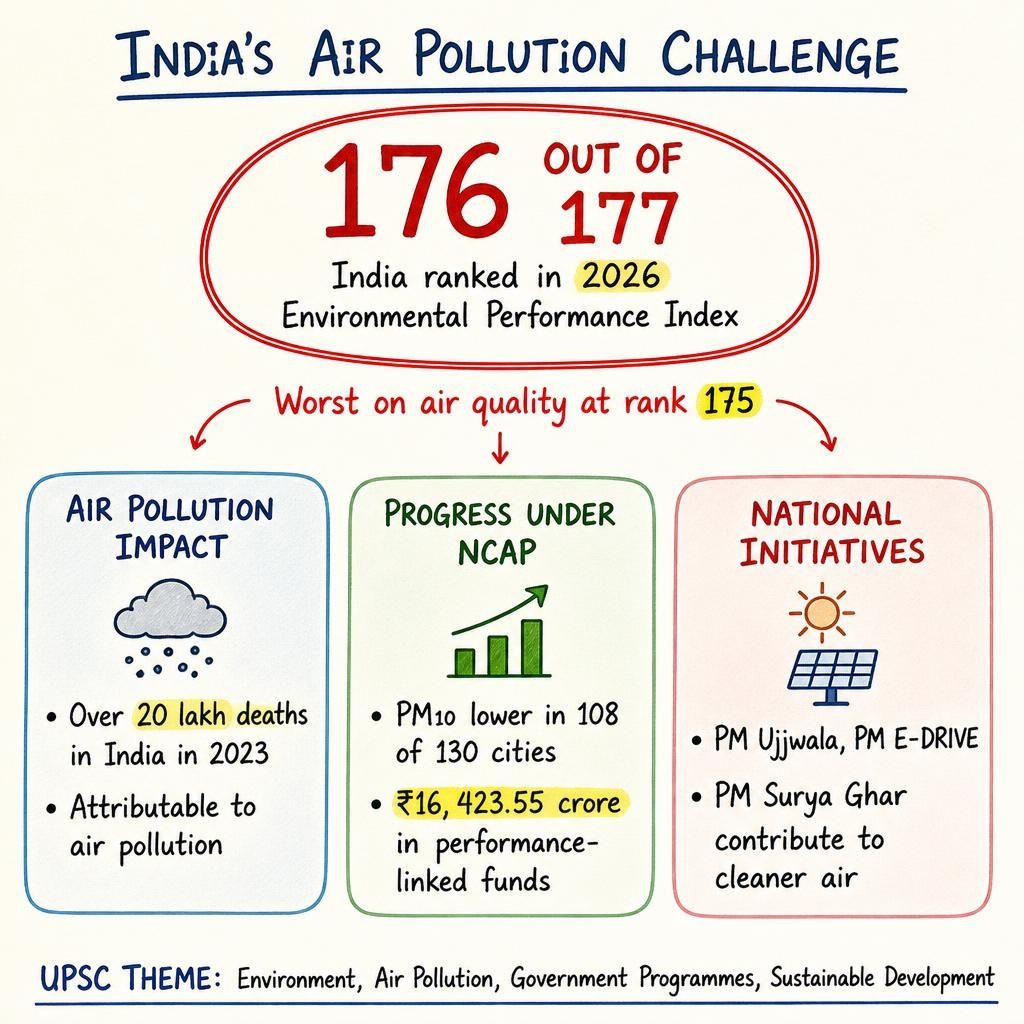
- India ranked 176 out of 177 countries in the 2026 Environmental Performance Index (EPI), performing worst on air quality at rank 175.
- The State of Global Air 2025 report estimated over 20 lakh deaths in India in 2023 were attributable to air pollution.
- The National Clean Air Programme (NCAP) reported lower annual PM10 concentrations in 108 of 130 cities between 2017-18 and 2025-26.
- The government provided ₹16,423.55 crore in performance-linked funds to 130 NCAP cities for air pollution control from 2019-20 to 2025-26.
- National initiatives like Pradhan Mantri Ujjwala Yojana, PM E-DRIVE, and PM Surya Ghar contribute to cleaner air alongside other objectives.
India's Air Pollution Challenge.jpg
Detailed Insights:
- India's low EPI ranking underscores the significant challenge of mitigating air pollution while sustaining rapid economic growth.
- Key sectors vital for development, including industry, power generation, transport, and agriculture, are major sources of air pollution.
- China's experience demonstrates that substantial pollution reduction is achievable during economic expansion through stringent emission controls.
- The International Energy Agency projects India's electricity demand to grow by 6.4% annually through 2030, with solar and coal meeting significant portions.
- Revised Sulphur Dioxide (SO2) requirements for thermal power plants in July 2025 highlight the policy dilemma between immediate control costs and distributed long-term benefits.
- Assessing progress requires evaluating whether the combined impact of cleaner technologies effectively offsets the increase in emissive activities.
- Effective interventions should generate co-benefits, addressing air pollution while simultaneously advancing other development priorities like energy efficiency or urban services.
- Policymakers need to establish clear connections between investment and outcomes, measuring expected pollution reduction, costs, and actual exposure reduction.
Key Concepts Involved:
- Environmental Performance Index (EPI): A data-driven summary of the state of sustainability and environmental health around the world.
- National Clean Air Programme (NCAP): A national-level strategy launched by India to tackle air pollution across 131 non-attainment cities.
- PM10/PM2.5: Particulate matter, referring to inhalable particles with diameters of 10 micrometers or less (PM10) and 2.5 micrometers or less (PM2.5).
- Co-benefits: Additional positive outcomes that arise from an action primarily aimed at achieving another specific goal, such as health benefits from cleaner energy.

SuperKalam is your personal mentor for UPSC preparation, guiding you at every step of the exam journey.
Download the App


STUDY RESOURCES
CONTACT US
ⓒ Snapstack Technologies Private Limited