GS 2: PolityGS 3: Science & TechnologyGS 3: Internal SecurityGS 2: International RelationsPrelims
Strategic autonomy must guide India’s Starlink policy, Pg6
India must ensure strategic autonomy in Starlink policy, demanding strict compliance and developing domestic alternatives to counter foreign control and national security risks.
Practice MCQs
876 Students attempted
Key Highlights:
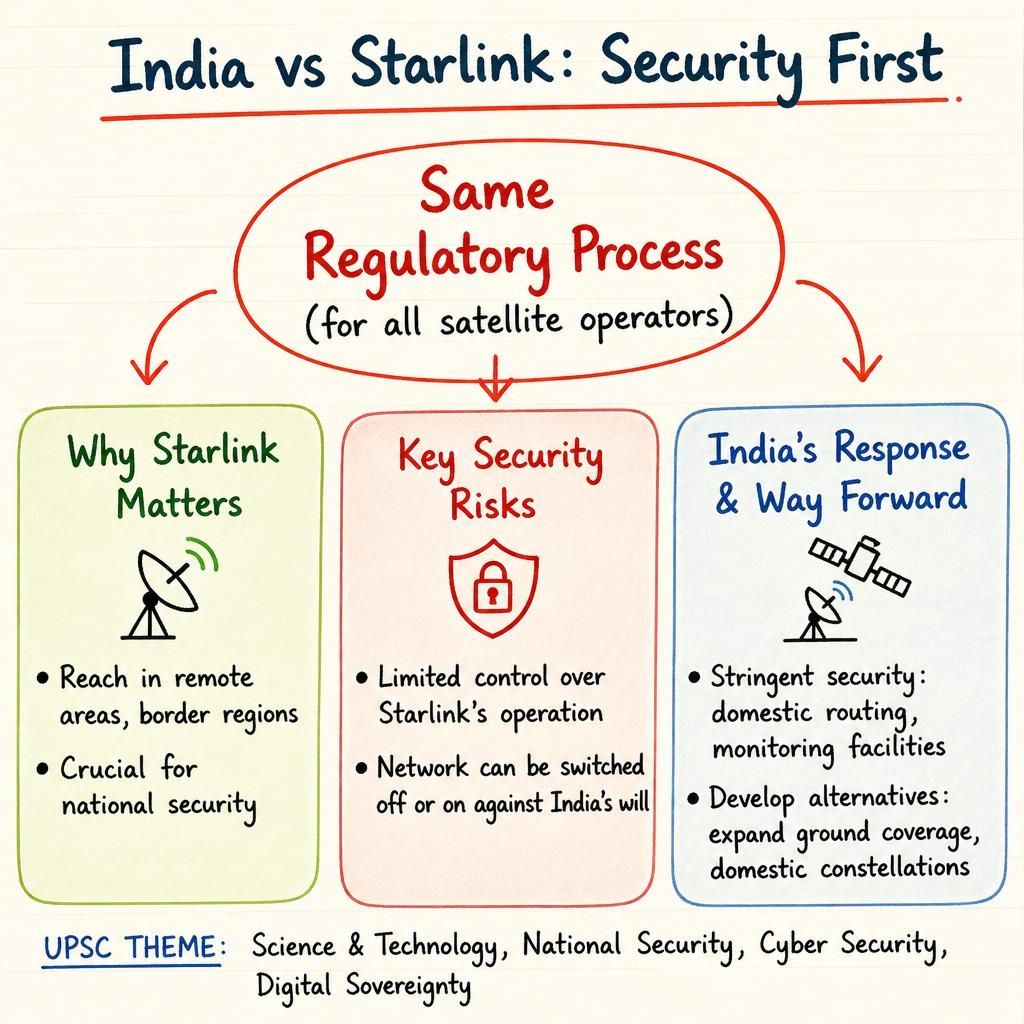
- The Indian government rejected Elon Musk's accusations of impeding Starlink's entry, clarifying that all satellite operators must follow the same regulatory process.
- Starlink, a satellite internet constellation by SpaceX, is optimized for reach in remote areas, border regions, and disaster zones, making it crucial for national security.
- India faces risks of limited control over Starlink's operation, including potential for the network to be switched off or on against India's will.
- India has imposed stringent security requirements, mandating Starlink to route Indian user traffic through domestic ground stations and provide monitoring facilities.
- Global experiences in Iran and Ukraine highlight the challenges of enforcing control over foreign satellite internet providers and potential strategic vulnerabilities.
- India aims to reduce dependency by developing alternatives, including expanding ground coverage and fostering domestic satellite constellations.
India vs Starlink.jpg
Detailed Insights:
- Starlink's operational model prioritizes reach over density, making it suitable for isolated settlements and military applications where traditional networks are unfeasible.
- The Indian government's regulations aim to ensure data sovereignty and security by preventing Starlink from bypassing Indian gateways or routing traffic abroad via inter-satellite links.
- Enforcement of these regulations is challenging, as verifying traffic routing through foreign gateways or mirrored links is difficult without full cooperation from SpaceX.
- A trade-off exists, as restricting inter-satellite links for Indian traffic reduces Starlink's inherent redundancy feature, which allows satellites to pass traffic when ground stations fail.
- The Iranian experience demonstrates the difficulty of stopping unauthorized Starlink operations, despite appeals to the International Telecommunication Union (ITU).
- The Ukrainian experience shows both cooperation with SpaceX (blocking Russian use) and potential external influence (disruption of Starshield services, possibly due to US pressure).
- India's dependence on a foreign entity like SpaceX, which is subject to American regulatory approvals and government contracts, could become a strategic vulnerability during a crisis.
- Expanding ground coverage through initiatives like BharatNet and encouraging domestic satellite internet providers are crucial steps to build strategic autonomy and reduce reliance on single foreign entities.
Scientific/Technical Concepts Involved:
- Low Earth Orbit (LEO) Satellites: Satellites orbiting relatively close to Earth, enabling low-latency internet communication.
- Ground Stations/Gateways: Terrestrial facilities that transmit and receive signals to and from satellites, connecting them to the global internet.
- Inter-satellite Links: Communication connections directly between satellites in a constellation, allowing data to be routed without immediately touching a ground station.

SuperKalam is your personal mentor for UPSC preparation, guiding you at every step of the exam journey.
Download the App


STUDY RESOURCES
CONTACT US
ⓒ Snapstack Technologies Private Limited