GS 2: PolityGS 3: EconomyPrelimsGS 3: Indian Economy, Planning, Mobilization of Resources, Growth, Development and EmploymentGS 2: Government policies and interventions for development in various sectors
House Clears Taxation Bill; No UPI Payment Charge for Consumers: FM, Pg6
Finance Minister Nirmala Sitharaman confirms no UPI payment charges for consumers as Parliament clears key Taxation and Bankers' Books Evidence Bills.
Practice MCQs
855 Students attempted
Key Highlights:
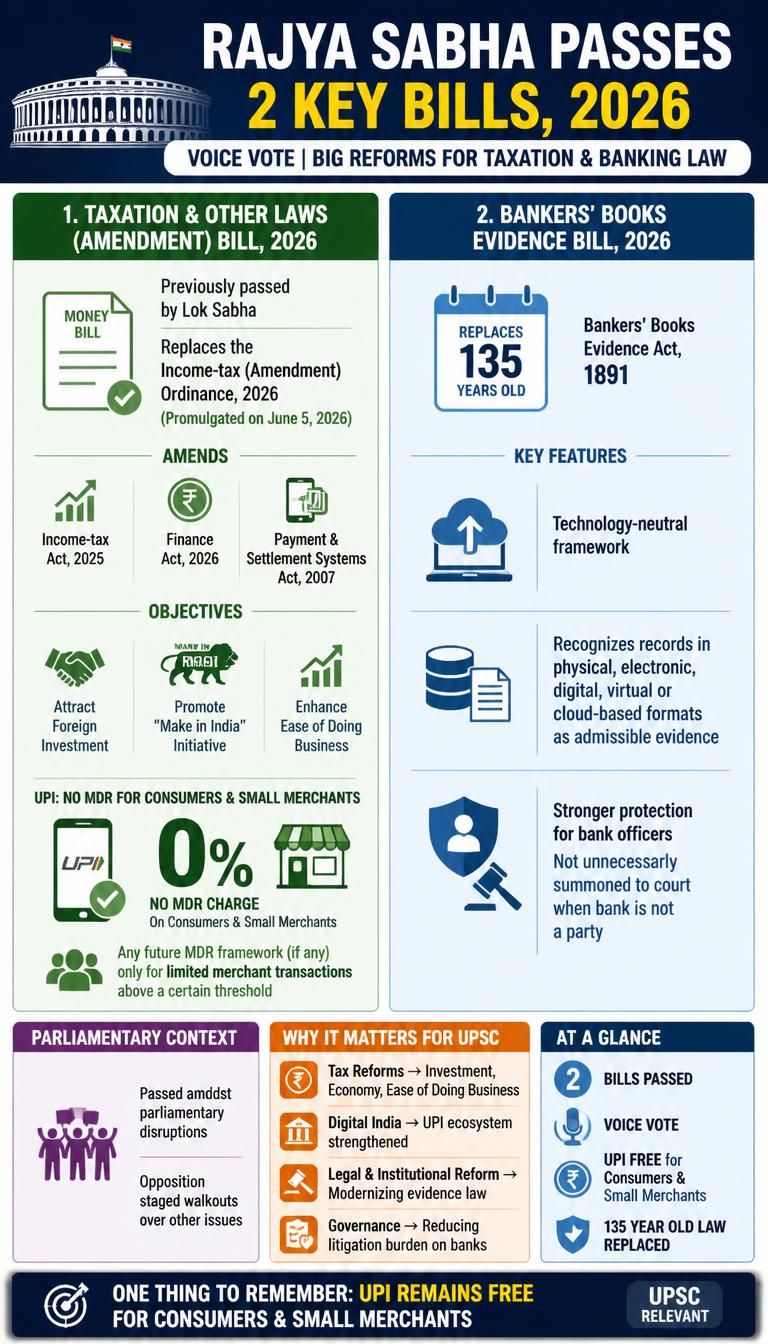
- The Rajya Sabha passed the Taxation and Other Laws (Amendment) Bill, 2026, and the Bankers' Books Evidence Bill, 2026, by voice vote.
- Finance Minister Nirmala Sitharaman confirmed that UPI transactions will remain free for consumers and small merchants, with no Merchant Discount Rate (MDR) charges imposed on them.
- The Taxation Bill, a Money Bill, had previously been cleared by the Lok Sabha.
- The Bankers' Books Evidence Bill, 2026, aims to modernize the legal framework for admitting electronic and digital banking records as evidence in legal proceedings.
- The Taxation Bill replaces the Income-tax (Amendment) Ordinance, 2026, promulgated on June 5, 2026.
RS Bill.jpg
Detailed Insights:
- The Taxation and Other Laws (Amendment) Bill, 2026, amends the Income-tax Act, 2025, Finance Act, 2026, and Payment and Settlement Systems Act, 2007.
- Its objectives include attracting foreign investment, promoting the "Make in India" initiative, and enhancing the ease of doing business.
- The Finance Minister clarified that any future MDR framework for UPI would apply only to a limited category of merchant transactions above a certain threshold, not to ordinary low-value transactions.
- The Bankers' Books Evidence Bill, 2026, repeals and replaces the 135-year-old Bankers' Books Evidence Act, 1891.
- This new legislation provides a technology-neutral framework, recognizing records in physical, electronic, digital, virtual, or cloud-based formats as admissible evidence.
- It also strengthens statutory protection for bank officers, ensuring they are not unnecessarily summoned to court in proceedings where the bank is not a party.
- The passage of these bills occurred amidst parliamentary disruptions, with the Opposition staging walkouts over other issues.
Key Concepts Involved:
- Unified Payments Interface (UPI): An instant real-time payment system developed by the National Payments Corporation of India (NPCI).
- Merchant Discount Rate (MDR): A fee paid by a merchant to their bank or payment service provider for processing digital transactions.
- Money Bill: A bill dealing exclusively with financial matters, which can only be introduced in the Lok Sabha and has limited powers for the Rajya Sabha under Article 110 of the Constitution.
- Ordinance: A temporary law promulgated by the President when Parliament is not in session, having the same force as an Act of Parliament but requiring parliamentary approval within six weeks of reassembly.

SuperKalam is your personal mentor for UPSC preparation, guiding you at every step of the exam journey.
Download the App


STUDY RESOURCES
CONTACT US
ⓒ Snapstack Technologies Private Limited