GS 2: GovernanceGS 3: Science & TechnologyGS 3: Environment & EcologyPrelimsGS 3: Conservation, Pollution and Degradation
Targeted tech approach, smart poles expected to boost fight against air pollution, Pg4
Delhi government implements target-based model and smart poles to combat air pollution, testing 22 innovative technologies for wider deployment.
Practice MCQs
855 Students attempted
Key Highlights:
- Delhi is implementing a target-based model for selecting pollution-control technologies and deploying digital smart poles to combat air pollution.
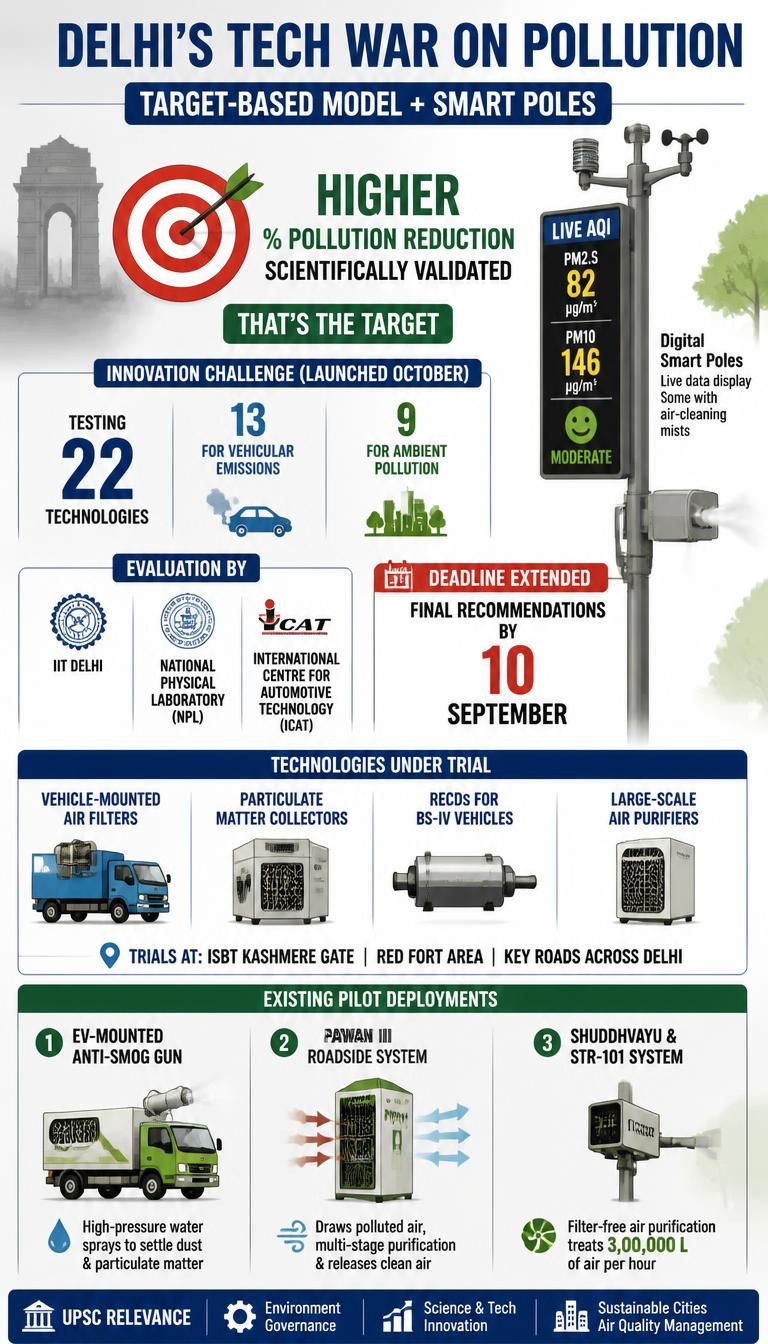
- The Delhi government's Innovation Challenge, launched in October, is currently testing 22 technologies, including 13 for vehicular emissions and nine for ambient pollution.
- IIT Delhi, National Physical Laboratory (NPL), and International Centre for Automotive Technology (ICAT) are independently evaluating these technologies.
- Smart poles display live pollution data, such as PM2.5 and PM10 levels, and some may incorporate air-cleaning tools like mists.
- The deadline for the final recommendations on technology evaluation has been extended to September 10.
Delhi Pollution.jpg
Detailed Insights:
- The target-based model will prioritize technologies that demonstrate a higher percentage of pollution reduction, provided claims are scientifically validated.
- Technologies under trial include vehicle-mounted air filters, particulate matter collectors, retrofit emission control devices (RECDs) for BS-IV vehicles, and large-scale air purifiers.
- Trials are being conducted at various locations across Delhi, including ISBT Kashmere Gate, the Red Fort area, and key roads.
- Existing pilot deployments include the EV-mounted anti-smog gun, the PAWAN III roadside pollution-control system, and the ShuddhVayu vehicle-mounted air filter.
- The STR-101 filter-free air-purification system, capable of treating three lakh liters of air per hour, has been installed on electricity poles.
- The EV-mounted anti-smog gun uses high-pressure water sprays to settle dust and particulate matter.
- PAWAN III draws polluted air and processes it through a multi-stage purification system.
Key Concepts Involved:
- PM2.5 and PM10: Fine particulate matter with diameters of 2.5 micrometers and 10 micrometers or less, respectively, which are major air pollutants.
- Retrofit Emission Control Devices (RECDs): Aftermarket devices installed on existing vehicles to reduce their exhaust emissions.
- BS-IV vehicles: Vehicles compliant with Bharat Stage IV emission standards, which specify limits for pollutants released from internal combustion engines.
- Internet of Things (IoT): A network of interconnected physical objects embedded with sensors, software, and other technologies to connect and exchange data over the internet.

SuperKalam is your personal mentor for UPSC preparation, guiding you at every step of the exam journey.
Download the App


STUDY RESOURCES
CONTACT US
ⓒ Snapstack Technologies Private Limited